

.webp "4 Critical Specs That Define a Premium Kayak Fish Cooler Bag OEM Production")
Kayak fishing has transformed from a niche pursuit into one of the fastest-growing categories in the outdoor recreation market. Anglers regularly target trophy-sized saltwater and freshwater species from small personal watercraft. However, managing and preserving their catch presents a major logistical challenge.
Traditional rotomolded hard coolers are too heavy, bulky, and square to fit into narrow kayak hulls. They crowd the cockpit and raise the vessel's center of gravity. As a result, serious anglers rely heavily on soft-sided, tapered fish cooler bags (also known as fish kill bags) that strap securely to the bow or stern well.
For outdoor brands, launching these products presents distinct technical hurdles. An everyday insulated picnic bag will fail rapidly on the water. Fish blood seeps into cheap stitching, sharp dorsal spines pierce thin linings, and direct sun exposure melts ice within hours. Partnering with an experienced kayak fish cooler bag OEM is essential to avoid costly customer warranty claims.
At Weierken, we engineer and manufacture heavy-duty marine storage and high-frequency welded bags for top global brands. This guide outlines the four critical engineering specifications your production partner must deliver to build a dependable, premium fish catch cooler.
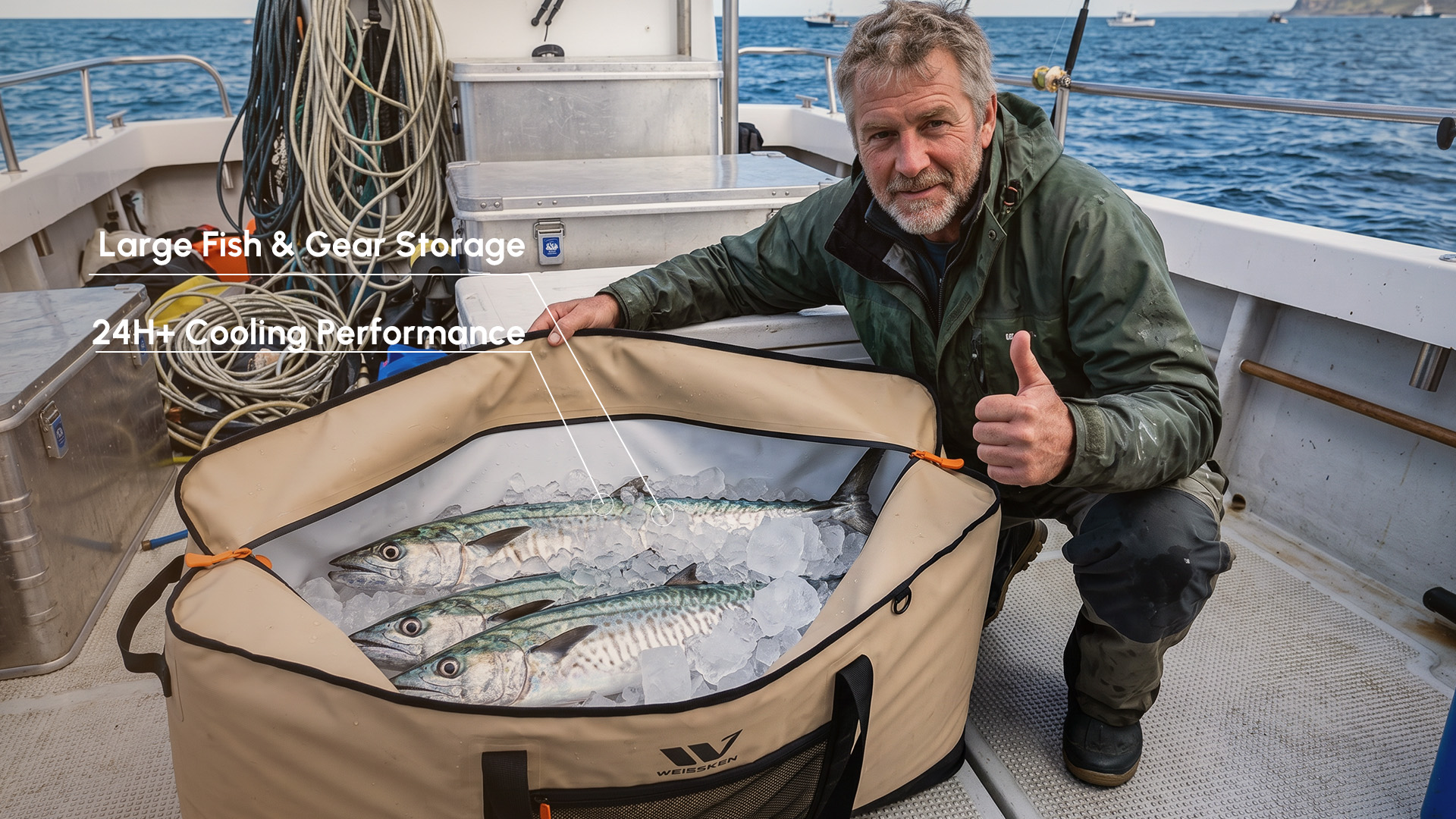
Spec 1: Thermal Retention and Advanced Insulation Architecture
A kayak deck offers zero shade. Throughout a long day on the water, deck temperatures can easily exceed 45°C (113°F). A commercial-grade kayak fish cooler bag OEM must build multi-layer thermal barriers that protect ice for 24 to 48 hours.
Meeting this standard requires three specific thermal engineering details:
- High-Density Closed-Cell Foam: Never permit the use of cheap expanded polyethylene (EPE) open-cell foam. Open-cell foam absorbs moisture, harbors bacterial odors, and compresses under pressure, which destroys its insulating value. Premium bags specify 12mm to 20mm (0.5" to 0.8") high-density closed-cell NBR (Nitrile Butadiene Rubber) or high-grade EVA foam that will not absorb water or collapse under load.
- Cold-Bridge Mitigation: Thermal energy transfers rapidly through poorly planned seam junctions. The insulation layer must butt together cleanly inside the laminate sandwich without voids, gaps, or stitched punctures along the edges.
- Reflective Thermal Barriers: Advanced designs incorporate an internal vapor-barrier film or high-radiance radiant barrier between the exterior shell and foam core. This layer deflects infrared solar radiation away from the catch chamber.
When reviewing factory specifications with your wholesale insulated fish kill bag supplier, demand verified melt-rate test logs conducted under direct heat lamp arrays or simulated solar conditions.
Spec 2: 100% Leak-Proof Welds and Sealing Systems
Nothing ruins a kayak trip faster than fish blood and oily brine dripping into the cockpit, soaking gear, and attracting predators. Standard cut-and-sew assembly methods are completely unacceptable for this category. Needle holes inevitably leak when water pools inside a flexible basin.
A capable RF welded cooler bag OEM relies on seamless high-frequency fusion to guarantee a water-tight seal:
- High-Frequency (RF) Radio Welding: The internal fish basin must be fused into a single seamless trough. Radio frequency energy melts polymer coatings together at the molecular level, forming joints that withstand heavy internal hydrostatic pressures without weeping.
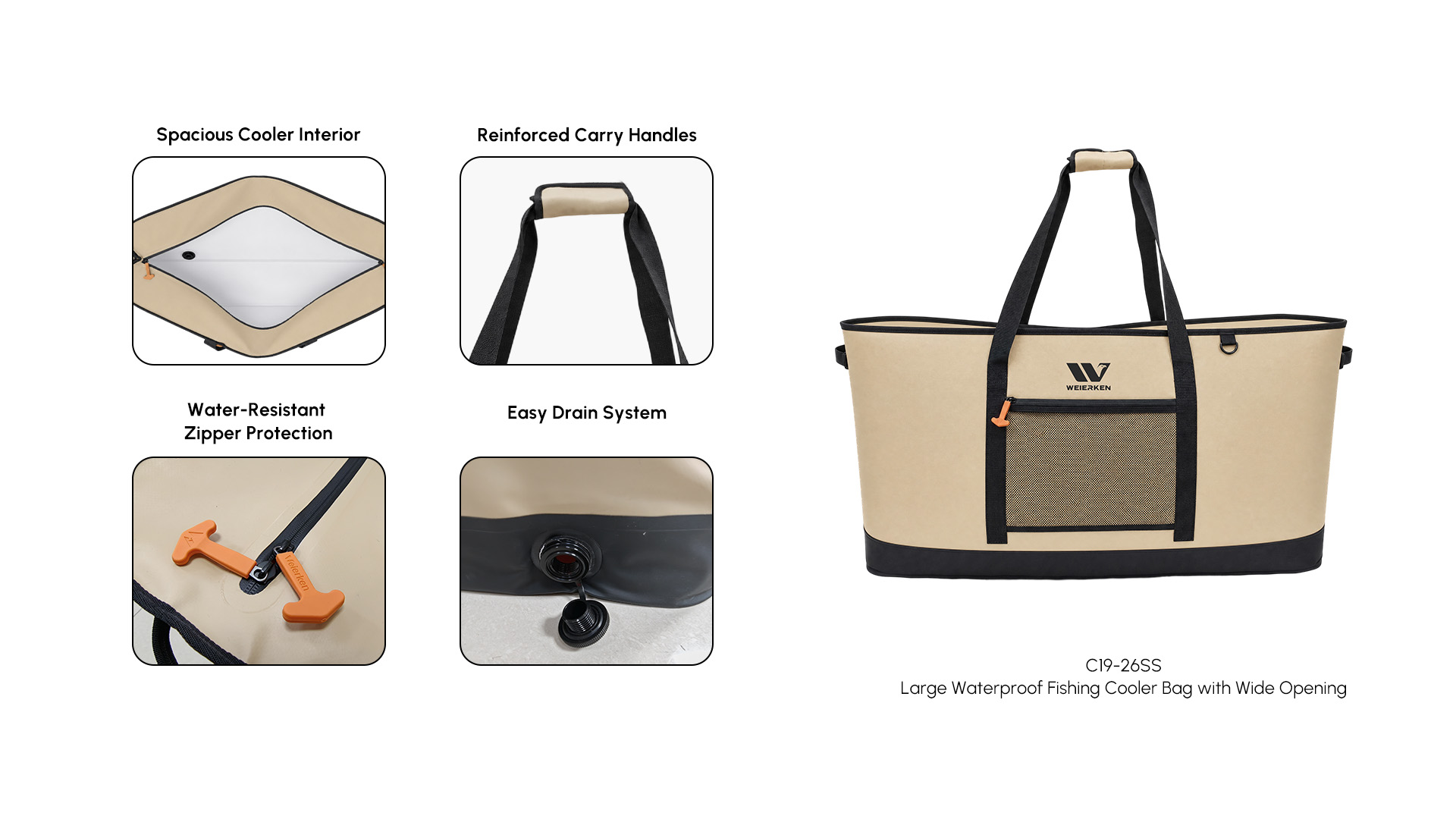
- Airtight and Watertight Zippers: For entry-level bags, an oversized water-resistant coil zipper protected by an overlapping insulated storm flap may suffice. However, pro-grade marine bags require IPX7 or IPX8 pressure-rated airtight zippers. These zippers use interlocking polyurethane or chloroprene gaskets that prevent leaks even if the bag flips upside down in heavy surf.
- Flush-Mount Drainage Valves: Anglers need an easy way to drain melted slurry and wash out fish slime without unstrapping the entire bag from the kayak deck. A marine grade cooler bag factory should integrate low-profile, threaded drain plugs welded directly to the lowest point of the sidewall or rear corner.
Spec 3: Puncture-Resistant Liners and Marine-Grade Shells
Fish anatomy is tough on equipment. The sharp dorsal spines of striped bass, walleye, and snapper, combined with razor-sharp treble hooks, easily puncture standard cooler linings. Once a liner punctures, bloody brine saturates the internal foam, creating permanent odors and mildew.
A qualified custom kayak fish bag manufacturer solves this by engineering a rugged, dual-sided material defense:
- Heavy-Duty Inner Lining: Specify thick, knife-grade thermoplastic polyurethane (TPU) composite fabric (typically 420D to 840D nylon coated with heavy TPU). The inner surface must be smooth, non-porous, and food-grade compliant to allow quick rinse-downs while resisting hook snags and dorsal punctures.
- Antimicrobial and Anti-Stain Chemistry: The internal contact laminate must incorporate non-migrating antimicrobial additives that stop bacteria from multiplying and neutralize fish odor absorption over repeated uses.
- Extreme-Duty Exterior Shell: The outer shell needs 840D to 1000D TPU or heavy-duty marine-grade PVC tarpaulin. This shell must include UV50+ stabilization to prevent sun-bleaching and embrittlement, along with proven saltwater resistance to stop material cracking.
Spec 4: Kayak Deck Ergonomics and High-Tension Rigging
Kayaks feature curved hulls, narrow bows, and tight deck bungees. A rectangular cooler bag will not sit flat, will catch side winds, and will interfere with paddling. An experienced kayak fish cooler bag OEM must build with paddlecraft ergonomics in mind.
Ensure your manufacturing specs include these kayak-specific details:
- Tapered Wedge Silhouette: The bag should feature a contoured, wedge-shaped footprint that matches the bow or stern cargo wells of market-leading fishing kayaks (such as Hobie, Old Town, Jackson, and Native Watercraft). This profile minimizes aerodynamic drag in high winds and keeps the deck balanced.
- Multiple High-Tension Anchors: Bags must incorporate 4 to 8 strategically placed tie-down points. These D-rings must be constructed from marine-grade 316 stainless steel or heavy-duty molded acetal, welded onto reinforced base patches to resist continuous wave pounding.
- Integrated Deck Measuring Ruler: Silkscreening a clear catch-measuring ruler (in inches and centimeters) directly onto the exterior top lid allows anglers to measure legal keepers without bringing slippery fish into their lap.
- Low-Profile Carry Handles: Ergonomic rubberized or
reinforced webbing handles on both ends allow anglers to hoist a 50-pound bag of
fish and ice off the kayak deck with two hands.
Factory Checklist: How to Audit a Kayak Fish Cooler Bag OEM
Before issuing tooling deposits, evaluate your prospective factory against this practical capability matrix:
| Audit Benchmark | Standard Bag Factory | Specialized Marine Cooler OEM |
|---|---|---|
| Welding Technology | Basic sewing; glued seam tapes | Automated RF welders with custom contour dies |
| Liner Material | Thin PVC film or PEVA foil (punctures easily) | Heavy-gauge puncture-resistant TPU laminate |
| Internal Foam | Cheap open-cell EPE (soaks up water) | 12mm–20mm closed-cell NBR or high-density EVA |
| Drain Port Integration | Glued plastic spigots prone to cracking | RF-welded low-profile marine screw-cap plugs |
| Prototyping Speed | 45 to 60 days with frequent errors | Fast 12 to 30 day sampling with complete 3D modeling |
At Weierken, our engineering teams build rapid prototypes in 12 to 30 days. We balance structural foam shaping with high-frequency RF welding, helping brands turn concept sketches into fully validated production runs that excel on the water.
Frequently Asked Questions (FAQ)
Q1: Can a kayak fish cooler bag maintain ice for more than 24 hours under direct sun?
A1: Yes. When built with 15mm to 20mm closed-cell NBR or high-density EVA foam and covered by a UV-reflective outer shell, a properly packed fish bag (using a 2:1 ice-to-fish ratio) can keep ice solid for 24 to 48 hours, even in hot deck environments.
Q2: Why is radio-frequency welding superior to stitched and taped seams for fish kill bags?
A2: Stitched seams rely on a needle puncturing the waterproof fabric. Even when covered with tape, the hydrostatic pressure of sloshing melted ice and fish blood can peel the tape back, causing dirty water to seep into the insulation core. High-frequency RF welding fuses the fabrics together into a single solid piece, guaranteeing a leak-proof basin.
Q3: What are the typical minimum order quantities (MOQ) for custom kayak fish cooler bags?
A3: MOQs typically start between 300 and 500 units per colorway when utilizing factory-stocked roll materials in standard colors (such as black, grey, olive, or white). Fully customized exterior Pantone colors or proprietary custom-molded EVA bases generally require an MOQ of 1,000 units.
Q4: How should anglers clean and maintain these cooler bags after trips?
A4: High-quality TPU inner liners clean easily with fresh water and mild dish soap. The welded, non-porous surface stops fish oils and blood from penetrating the fabric. Opening the bottom drain plug lets users hose out the interior completely. Anglers should store the bag with the zipper unzipped to let the inside air-dry.
Q5: Is TPU or PVC better for an OEM kayak fish cooler bag?
A5: Both materials work well, but TPU is the premium choice. TPU provides superior puncture resistance against fish spines, remains flexible in cold weather, contains zero toxic phthalate plasticizers, and resists odor absorption. Heavy-duty 500D to 1000D PVC is a rugged, cost-effective alternative for entry-level price points.
Build Your Custom Cooler Line with Weierken
Launching a standout product line in the competitive kayak fishing market requires deep material knowledge, reliable welding machinery, and an understanding of on-water realities. Cutting corners on foam density or seam integrity leads straight to negative reviews and damaged gear.
Weierken provides turnkey OEM and ODM contract manufacturing for premier outdoor and marine luggage brands. We operate high-frequency welding lines, maintain strict in-house submersion testing labs, and coordinate manufacturing across our China and Cambodia production campuses to optimize duty structures and lead times.
Work with an experienced kayak fish cooler bag OEM that understands high-performance marine manufacturing. Contact the Weierken engineering team today to review your tech pack, review material swatches, and request a detailed OEM manufacturing quote.