
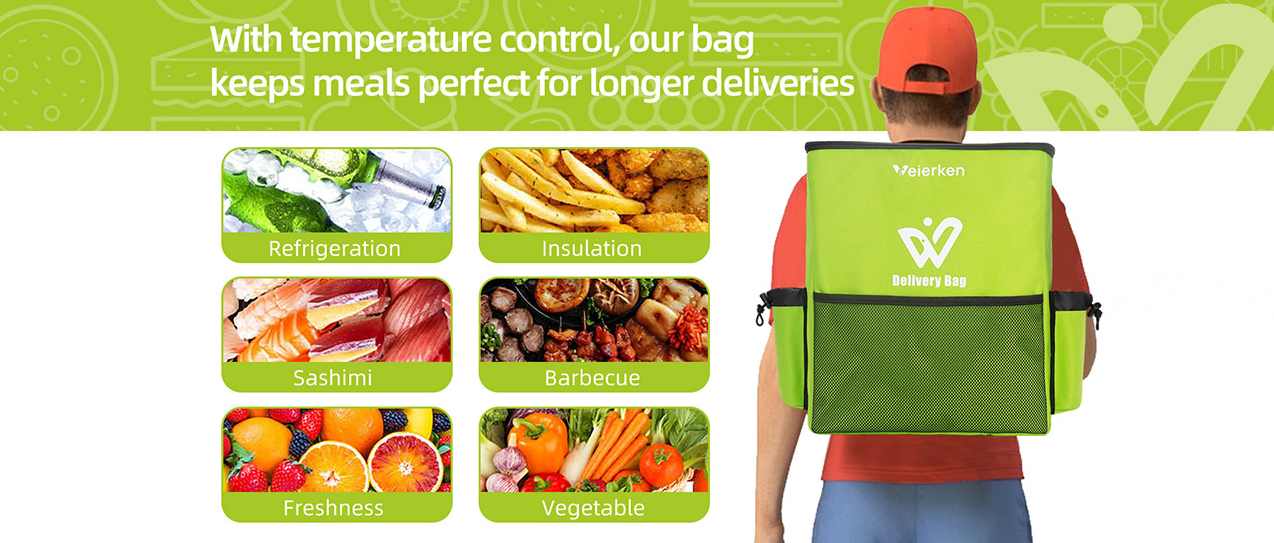
Cloud kitchens operate under punishing delivery schedules. Unlike standard restaurant takeaways, a single virtual kitchen hub dispatches orders for multiple brands simultaneously. A courier might carry piping-hot bone broth from a ramen concept alongside chilled boba milk tea from a beverage stall, all packed into a single run.
Two-wheel couriers navigate potholed streets, speed bumps, and sudden downpours on bicycles and mopeds. Under these conditions, generic thermal bags fail fast. When a bag sags, soup containers tip over. When heat bleeds between compartments, ice cream melts and french fries turn soggy. The result is instant customer churn and expensive refund claims.
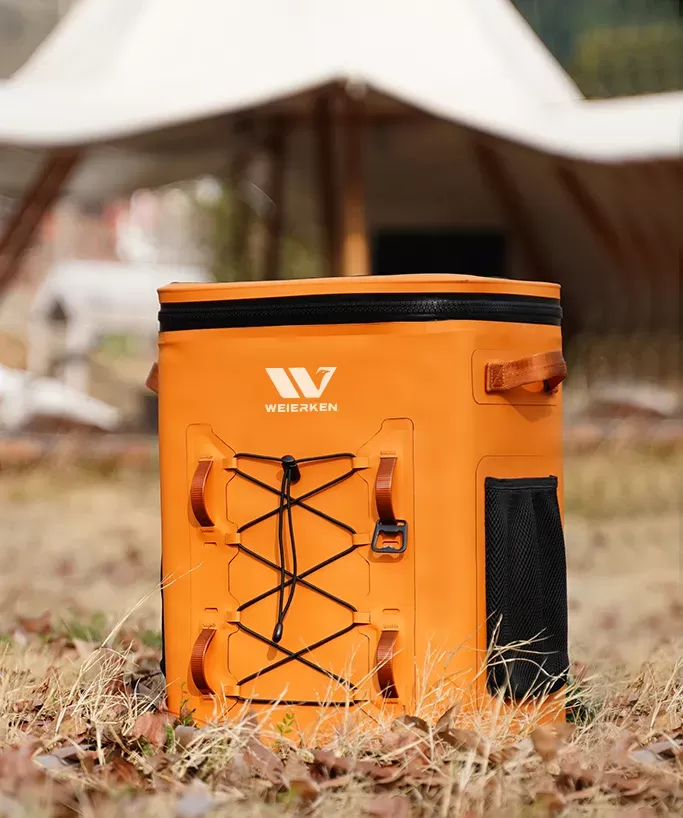
Fleet managers cannot treat thermal gear as an afterthought. Commercial equipment manufacturers like Weierken engineer specialized delivery carriers to handle these exact operational stresses. If you are sourcing insulated delivery backpacks for cloud kitchens, here are the seven non-negotiable hardware specifications your fleet requires.
1. Dual-Zone Thermal Segregation (Active Micro-Climates)
Cloud kitchen orders frequently mix contrasting temperatures within a single pickup. Placing hot entrees next to cold sides inside an undivided bag triggers rapid thermal equalization. Heat transfers from the hot food to the cold drink, ruining both items within twenty minutes.
Professional insulated delivery backpacks for cloud kitchens solve this physics problem with modular thermal separation walls. Fleet buyers must look past flimsy fabric flaps and demand rigid, high-density thermal baffles.
Core Material: The divider must feature at least 8mm of high-density closed-cell EPE (expanded polyethylene) foam or cross-linked PE foam core.
Radiant Barrier: Both faces of the baffle must be wrapped in heavy-duty food-grade aluminum foil laminate to bounce infrared energy back to its source.
Perimeter Gasket Seal: The divider must secure to the backpack walls via wide, industrial hook-and-loop tracks. A loose fit allows warm air to circulate around the edges, defeating the purpose of the divider.
When properly sealed, this system maintains hot foods above 60°C (140°F) on one side while keeping chilled beverages below 4°C (40°F) on the other for over 45 minutes of transit.
2. Rigid Anti-Crush Internal Skeletons
Couriers on bicycles and motorcycles ride with their torsos pitched forward at a 30 to 45-degree angle. In a soft-sided bag, gravity causes the entire pack to collapse in on itself. The top containers slide downward, crushing delicate compostable paper bowls and popping plastic lids off soup tubs.
A true commercial thermal delivery backpack must maintain an uncompromising box profile under severe mechanical stress. It requires a dedicated internal structural frame.
Hollow PP Honeycomb Sheets: Lightweight polypropylene (PP) twin-wall boards offer superior impact resistance and complete moisture immunity compared to cheap cardboard stiffeners.
Fiberglass Support Rods: High-tensile composite rods slotted into corner seams provide vertical compressive strength without adding excessive dead weight.
Dynamic Load Rating: The structural frame must withstand a top and side load of at least 15 kilograms without sidewall deflection when tilted at full riding angles.
This structural rigidity keeps food containers stacked flat on their bases, regardless of how aggressively the courier pedals or brakes.
3. Ergonomic Load Distribution and Back Heat Dissipation
Cloud kitchen dispatchers schedule riders for grueling 8 to 10-hour shifts. Carrying 10 to 15 kilograms of shifting cargo across a full workday leads to rapid physical fatigue, shoulder strain, and high driver turnover. Sourcing an ergonomic insulated delivery bag is a direct investment in courier retention and safety.
Look for three-point ergonomic weight-distribution systems adapted from modern mountaineering packs:
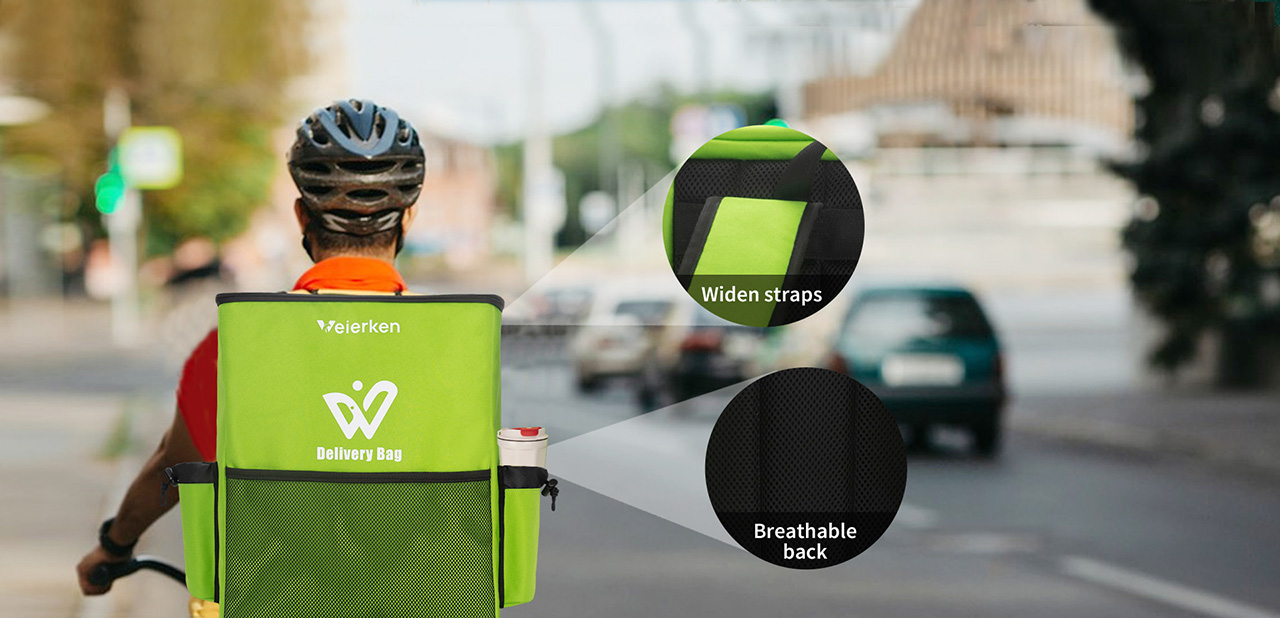
Contoured S-Straps: Wide, high-density EVA foam shoulder straps distribute load across the chest muscles rather than pinching the clavicle nerves.
Load-Bearing Hip Belts: A padded, wide waist strap transfers up to 60% of the total pack weight directly to the pelvic girdle, unloading the spine.
Sternum Stabilizers: An adjustable chest strap prevents the bag from swaying laterally during aggressive turns on two wheels.
Rider comfort also depends on temperature control. Backpacks must integrate molded 3D mesh back panels with central spinal airflow channels. This gap allows trapped heat and sweat vapor to vent away from the courier's spine during hot summer shifts.
4. 100% Seamless High-Frequency Welded Tub Liners
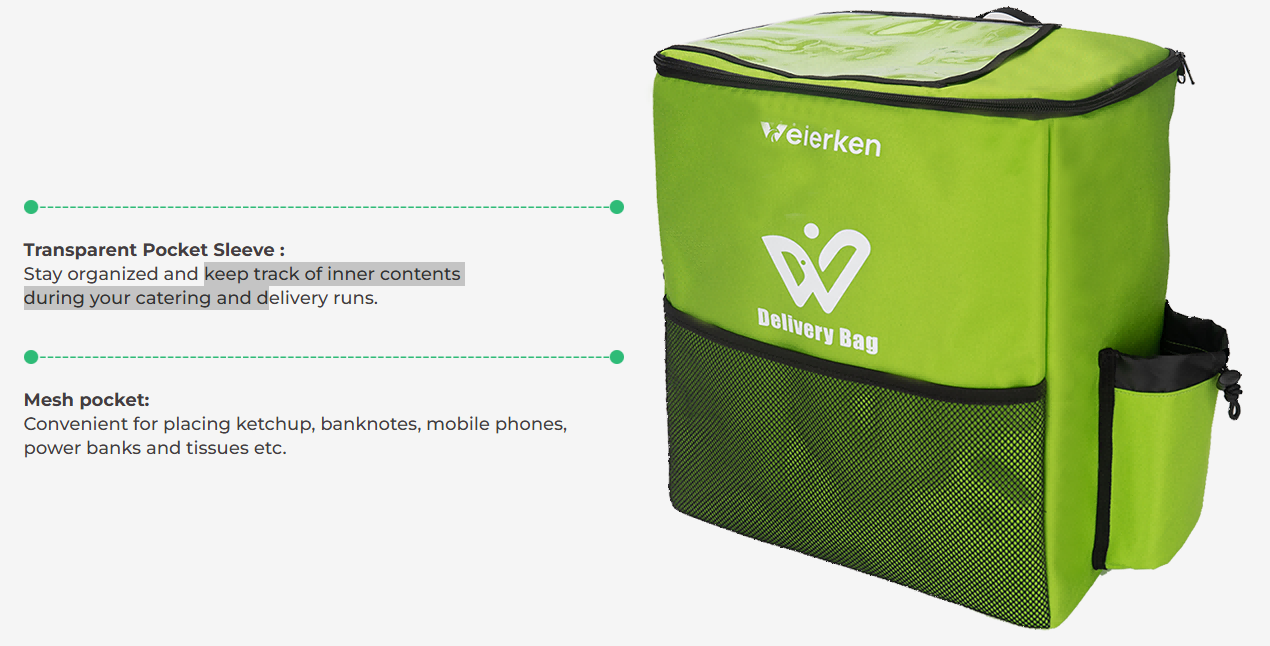
Liquid spills are inevitable when delivering hot broths, gravies, and bubble teas over rough city asphalt. In conventionally stitched bags, leaking liquid seeps straight through the needle holes along the base seams.
Once liquid enters the open spaces between the outer shell and the inner insulation, disaster follows. Stale broth turns rancid, bacteria colonizes the insulation foam, and the bag develops an unshakeable sour odor. In worst-case scenarios, greasy liquid leaks through to soak the courier's clothes.
Experienced fleet managers reject cut-and-sew internal construction. Your waterproof food delivery backpack supplier must use high-frequency (HF) radio-welded liners made from heavy-gauge food-grade PEVA or TPU.
High-frequency welding fuses the plastic sheets at a molecular level, creating a completely seamless, liquid-tight basin. The base of the bag can hold two liters of spilled soup without a drop escaping. When a spill occurs, cleaning crews wipe the interior clean with a sanitizer rag in under thirty seconds.
5. Weatherproof Shell Fabrics and Heavy-Cycle Hardware
Bad weather drives peak delivery volumes for ghost kitchens. Rainstorms, blizzards, and cold snaps bring surges in online order tickets. If your equipment cannot keep paper delivery bags bone-dry during a downpour, customer complaints spike instantly.
Your heavy-duty bike delivery bag requires tough outer materials and hardware designed for commercial abuse:
Shell Textiles: Specify 500D to 1000D PVC tarpaulin or thick polyester Oxford cloth backed by a heavy thermoplastic polyurethane (TPU) coating. The shell fabric must deliver a hydrostatic head rating of at least 10,000mm.
Reverse-Coated Waterproof Zippers: Standard coil zippers leak moisture along the teeth. Bags must feature #8 or #10 heavy-gauge waterproof zippers with polyurethane tape coatings to block driving rain.
Zipper Fatigue Limits: Cloud kitchen couriers open and close bags hundreds of times per week. Demand hardware tested for a minimum of 20,000 failure-free mechanical cycles.
Zinc Alloy Sliders: Plastic sliders snap under cold weather conditions. Insist on cast zinc-alloy pullers equipped with oversized tactile rubber pull-cords for gloved hands.
At Weierken, production protocols subject all load-bearing structural seams to automated double-box stitching and high-density bartacking to ensure handles never rip free under peak cargo loads.
6. Certified Food-Contact Safety and PFAS-Free Chemistry
Global regulatory agencies are tightening food logistics regulations. Because delivery bag interiors operate in hot, high-humidity environments, volatile chemical outgassing can contaminate unwrapped foods or migrate through porous packaging.
Procurement teams must audit their ghost kitchen courier backpack supply chains for material safety:
Food-Grade Contact Certification: The interior lining material must pass direct lab tests for FDA 21 CFR 175.300 (USA) or EU LFGB (European Union) standards for safe contact with consumables.
Zero Plasticizer Migration: Liners must test free of restricted phthalates, heavy metals, and toxic plastic softeners that degrade under heat.
PFAS-Free Waterproofing: Environmental laws in North America and the EU strictly limit per- and polyfluoroalkyl substances (PFAS). Ensure your OEM supplier utilizes certified fluorine-free durable water-repellent (DWR) surface treatments.
Ask prospective manufacturers for traceable testing documentation issued by recognized independent inspection bodies like SGS or TÜV before approving volume runs.
7. Knock-Down (K/D) Flat-Pack Architecture and Modular Maintenance
Cloud kitchen hubs rarely have spare storage room. Staging 50 rigid, three-dimensional backpacks in a pickup vestibule clutters corridors and creates safety hazards. Furthermore, shipping assembled hollow bags overseas wastes substantial capital on ocean container space.
A smart OEM design incorporates a Knock-Down (K/D) flat-pack framework:
Ultra-Compact Storage: By releasing the internal PP stiffeners and folding the side walls along pre-creased hinge lines, the backpack collapses to a profile under 8cm thick.
Drastic CBM Reduction: Collapsible engineering cuts ocean freight volume by up to 75%. You fit thousands of units into a standard shipping container instead of hundreds, dramatically lowering your landed unit cost.
Modular Field Repairs: A torn strap buckle or a damaged divider should not force you to scrap an entire bag. Premium designs use modular components—such as field-replaceable shoulder strap assemblies and interchangeable Velcro wall panels—to extend overall equipment service life.
Frequently Asked Questions
Q1: How do insulated delivery backpacks for cloud kitchens prevent hot food and cold drinks from affecting each other?
They use modular, high-density thermal baffle boards lined with radiant-barrier foil and closed-cell EPE foam. When pressed firmly into the bag's internal hook-and-loop mounting tracks, these dividers seal off two distinct physical chambers, blocking convective heat transfer for up to 45 minutes.
Q2: Why is high-frequency welding better than conventional sewing for bag liners?
Sewing punches thousands of microscopic needle holes through the fabric. Liquid from spilled soups or condensation seeps through these punctures directly into the interior insulation foam, causing mold growth and permanent odors. High-frequency welding melts the edges together without seams, creating a completely leakproof, washable basin.
Q3: What makes an ergonomic harness necessary for commercial bike delivery fleets?
Carrying 10 to 15 kilograms of shifting weight over an 8-hour shift causes severe spinal fatigue. An ergonomic system with wide S-shaped straps, a sternum strap, and a load-bearing waist belt shifts up to 60% of that weight onto the rider's hips and pelvis, reducing injuries and courier turnover.
Q4: How does flat-pack (K/D) construction reduce overall equipment costs?
Fully assembled delivery bags waste money by shipping trapped air inside containers. A flat-pack design collapses the bag down to under 8cm in thickness. This cuts ocean container volume (CBM) by up to 75%, lowering landed import costs while saving floor space in crowded cloud kitchen hubs.
Q5: What certifications should procurement directors demand from a delivery backpack supplier?
Look for third-party lab documentation (such as SGS or Intertek) verifying compliance with FDA 21 CFR 175.300 or EU LFGB standards for food-contact safety. Additionally, verify that all external water-repellent coatings are certified 100% PFAS-free to comply with incoming global environmental regulations.
Secure Your Fleet Equipment with Weierken
Specifying the right insulated delivery backpacks for cloud kitchens protects food quality, safeguards your riders, and cuts your total cost of ownership. Cheap, poorly structured bags inevitably lead to crushed orders, food safety violations, and frequent replacements. Purpose-built commercial gear keeps your delivery operations profitable and your virtual brands reputable.
Weierken engineers and manufactures industrial-grade thermal backpacks tailored to the demands of cloud kitchens, virtual commissary networks, and high-volume delivery fleets worldwide. Our team delivers custom CAD mockups, quick physical prototypes, and mass production built to pass global food safety and performance standards.
Ready to upgrade your fleet's delivery equipment?
Contact the Weierken engineering team today to submit your technical specifications, request a prototype sample, or receive a fast, competitive quote for your fleet.