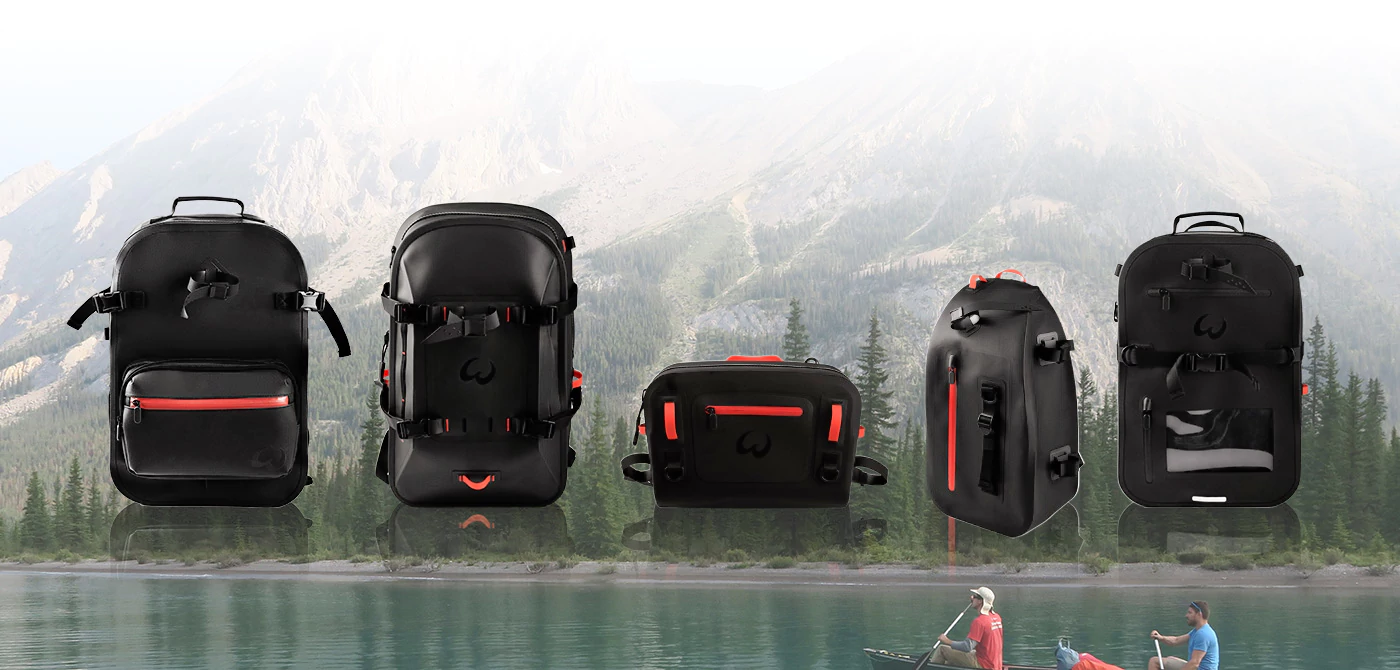
Food delivery logistics rely entirely on the condition of the meal when it arrives at the customer’s door. Cold pizzas, melted ice cream, and spilled soups ruin brand reputations instantly. As a B2B procurement manager for a restaurant chain, ghost kitchen, or delivery platform, you carry the heavy responsibility of sourcing reliable thermal gear.
You must partner with a highly competent meal delivery bag fabricator to protect your food quality and your company’s image. Trusted manufacturing brands like weierken understand these high-stakes urban logistics. We know that finding the right factory requires a strict, methodical approach rather than just browsing catalogs.
You need a structured evaluation process to filter out generic bag makers and find true thermal engineering experts. Here is a proven seven-step guide to help you evaluate, audit, and select the best factory for your custom food delivery equipment.
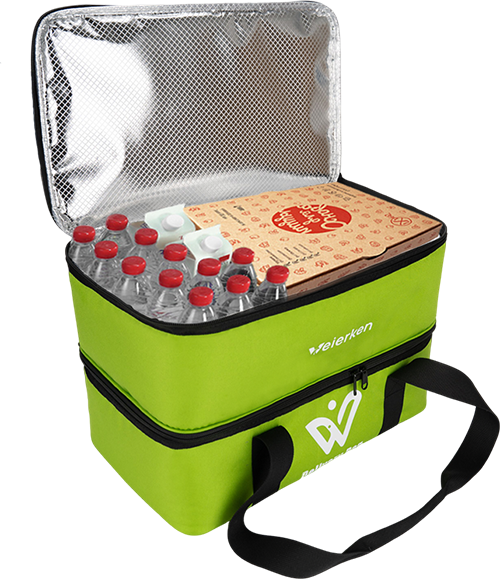
Step 1: Define Your Delivery Scenarios and Product Specifications
Before you contact any meal delivery bag fabricator, you must map out exactly what your delivery fleet needs. Vague requests lead to inaccurate quotes and poor product performance.
Establish Temperature Control Goals
Different cuisines dictate different thermal engineering requirements. You must define your core temperature parameters immediately.
- Identify if you primarily transport hot food that needs to stay above 60℃.
- Determine if you deliver cold items, like sushi or desserts, requiring an environment below 5℃.
- Decide if you need a mixed dual-zone bag with thick insulated dividers to carry hot and cold items simultaneously.
Determine Capacity and Internal Dimensions
Food packaging comes in specific shapes. Your delivery bag must accommodate these containers perfectly to prevent shifting during transit.
- Measure your standard food containers, including multi-compartment boxes, large soup bowls, and tall beverage cups.
- Calculate the exact internal volume needed based on the average number of orders a rider carries per trip.
- Specify the exact height, width, and depth to your meal delivery bag fabricator so they can engineer the correct 3D shape.
Set Weight-Bearing and Special Feature Requirements
Bulk catering orders get extremely heavy. Your bags must survive the physical stress of daily commercial use.
- Specify the maximum load capacity per bag (e.g., 5kg, 10kg, or 15kg) to ensure the factory reinforces the base and handles.
- List special functional needs, such as independent cup holder inserts, adjustable internal dividers, or hard-shell plastic liners for extra rigidity.
- Determine your branding needs. Decide if you require large-scale silk-screened logos, custom corporate colors, or high-visibility reflective strips for rider safety at night.
Step 2: Global Search and Preliminary Screening
Once you define your technical specifications, you need to cast a wide net. You must then filter the results ruthlessly to find a specialized meal delivery bag fabricator.
Utilize Professional Search Channels
Do not rely on generic retail search engines. Target B2B platforms where serious manufacturers list their industrial capabilities.
- Browse verified supplier databases on major B2B platforms like Alibaba, Global Sources, and Made-in-China.
- Attend major catering and hospitality trade shows, such as Internorga in Germany or the NRA Show in the USA.
- Ask for supplier recommendations from catering supply chain associations or network with technical sales directors on LinkedIn.
Use Targeted Keyword Combinations
Using specific search terms helps you avoid factories that only make cheap promotional tote bags.
- Search for an insulated food delivery bag manufacturer or a catering cooler bag factory.
- Use terms like custom food delivery backpack supplier to find factories experienced in rider ergonomics.
- Look for suppliers advertising commercial-grade thermal packaging solutions.
Apply Strict Preliminary Screening Criteria
Disqualify unqualified suppliers quickly during your first interaction. Ask every potential meal delivery bag fabricator these qualifying questions:
- Do you specialize specifically in food delivery thermal products?
- Can you provide verifiable case studies of partnerships with major fast-food chains or global delivery apps?
- Does your manufacturing facility hold a valid ISO 9001 quality management certification?
- Do you possess genuine OEM/ODM custom design capabilities, or do you only sell off-the-shelf inventory?
Step 3: Deep Audit – Material Safety and Food-Grade Compliance
A genuine meal delivery bag fabricator knows that materials must never contaminate the food. The inner lining of the bag sits just inches away from the customer’s meal.
Verify Food Contact Certifications
You cannot compromise on chemical safety. The interior materials must meet international health regulations.
- The inner lining material must strictly comply with FDA, LFGB, or GB 4806 food contact safety standards.
- Require the manufacturer to provide recent third-party laboratory test reports proving these compliance claims.
- Ensure the testing laboratory explicitly states that harmful heavy metals or plasticizers will not migrate into the food.
Evaluate Insulation Safety and Leak-Proof Materials
Thermal materials react differently under extreme heat. You must verify their stability.
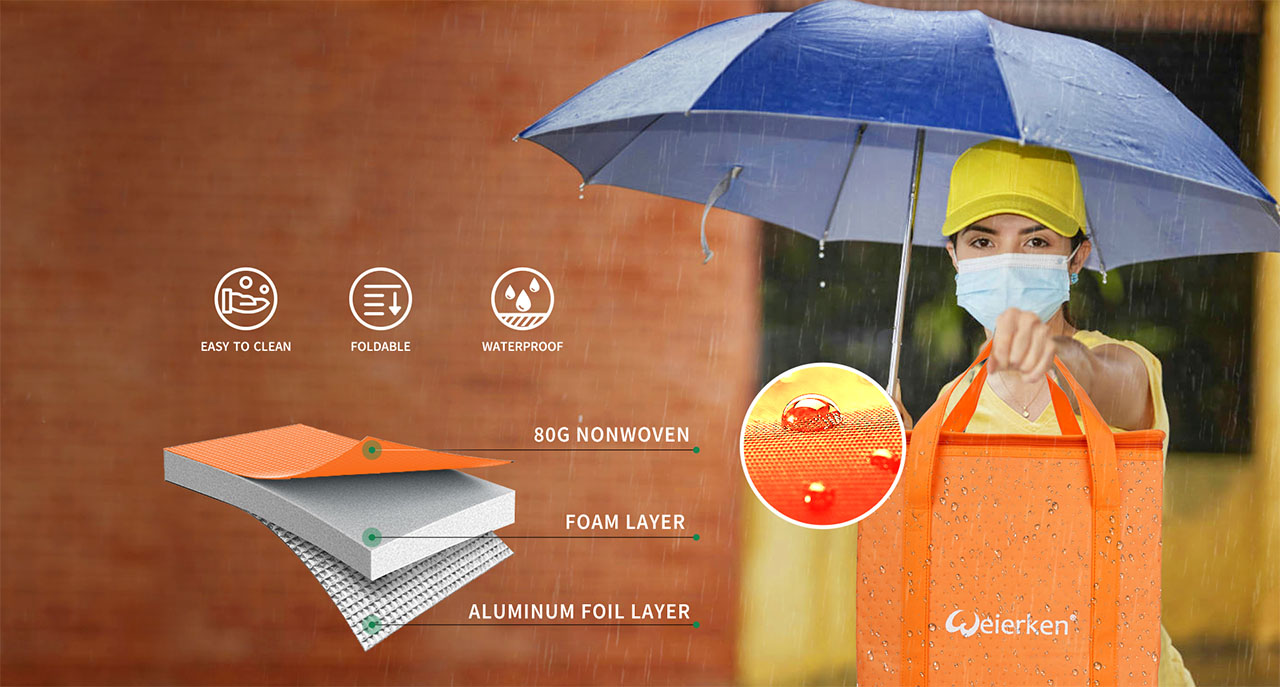
- Check the middle insulation layers, such as high-density PE cotton or EVA foam. They must remain completely non-toxic and odorless, even when constantly exposed to 80℃ radiating heat from hot food.
- Inspect the inner layer materials. Ensure the factory uses TPU coating, PEVA composite cloth, or food-grade PVC for maximum leak resistance.
- Always ask the meal delivery bag fabricator to supply Material Safety Data Sheets (MSDS) and certificates of conformity for all internal fabrics.

Step 4: Technical Capability Assessment – Insulation and Leak-Proof Craftsmanship
Paperwork proves compliance, but physical engineering proves a factory’s true skill. A professional meal delivery bag fabricator like weierken invests heavily in advanced manufacturing techniques.
Validate Thermal Performance Engineering
Request hard data to prove the bag will perform under actual delivery conditions.
- Demand thermal test reports based on recognized protocols like the ASTM D3103 standard.
- You need documented proof that the bag maintains an internal temperature of >60℃ or <5℃ for a specific number of hours.
- Check that the test simulates realistic ambient environments, such as a 30℃ summer day or a 0℃ winter night.
Inspect Leak-Proof Structures and Durability
Soup spills happen daily. The bag must contain the mess and survive the cleanup process.
- Inspect how the factory connects the interior panels. Look for high-frequency welding or seamless hot air taping rather than traditional needle stitching.
- Check if the bottom features a reinforced, leak-proof molded base to prevent liquids from dripping onto the delivery rider.
- Ensure the factory uses waterproof zippers or designs thick storm flaps over standard zippers to block rain.
- Verify the structural durability. The factory must use heavy bartack stitching at all high-stress points, especially where the handles and shoulder straps meet the main body.
Step 5: Sample Testing and Field Verification
Never place a bulk B2B order without testing a physical prototype. You must force the meal delivery bag fabricator to prove their claims in the real world.
Request and Test the Prototype
Ask the manufacturer to build a custom sample that matches your exact technical drawings and material requirements.
- Conduct a Thermal Test: Place piping hot simulated meals inside the bag. Leave the bag at room temperature for two hours and use a data logger to measure the internal heat loss minute by minute.
- Execute a Leak Test: Fill a plastic container with colored water and leave the lid slightly loose. Place it inside the bag, tilt it, shake it aggressively, and leave it upside down. Check if any liquid seeps through the bottom seams or zipper tracks.
- Perform a Load-Bearing Test: Fill the bag with heavy sandbags matching your defined maximum weight limit. Lift the bag repeatedly by the handles and drop it from a low height to check for fabric tearing or strap failure.
- Run a Cleaning Test: Smear cooking oil and sauce on the inner lining. Wait an hour, then wipe it with a damp cloth. Check if the fabric stains permanently or holds onto lingering food odors.
Provide detailed feedback to the meal delivery bag fabricator based on these results and demand necessary adjustments before approving mass production.
Step 6: Business Negotiation and Contract Terms
Once the customized sample passes your rigorous field tests, you must secure your business interests legally and financially.
Analyze the Quotation Structure
Do not accept a simple lump-sum price. Ask the meal delivery bag fabricator for an itemized quotation.
- Break down the specific costs for raw materials, manufacturing labor, custom molds, sample development, and bulk shipping.
- Compare these itemized quotes across multiple shortlisted suppliers to gauge market fairness.
- Clarify the Minimum Order Quantity (MOQ). Confirm their standard production lead times and ask about their capacity to handle urgent rush orders.
Establish a Strict Quality Agreement (QA)
Define exactly what constitutes an acceptable product in a legally binding document.
- Implement a strict Acceptable Quality Limit (AQL), such as AQL 1.5. State clearly that you have zero tolerance for critical defects like broken zippers, missing insulation, or torn inner liners.
- Document the precise thermal and leak-proof performance guarantees, outlining exactly how you will verify them during pre-shipment inspections.
- Define the warranty period and specify the financial claim terms for any defective units found after delivery.
- Secure your intellectual property. Explicitly state that your brand logos, custom design blueprints, and specific mold designs remain your exclusive property.
Step 7: Long-Term Cooperation Value Assessment
You want a meal delivery bag fabricator who can scale operations smoothly alongside your expanding restaurant chain or delivery network.
Evaluate Capacity, Stability, and Innovation
Look beyond the first order. Assess the manufacturer’s long-term business health.
- Check their total monthly production capacity. Ensure they can comfortably handle your projected volume growth over the next two years.
- Investigate the stability of their raw material supply chain. Ask if they have backup material suppliers to prevent delays during global shortages.
- Assess their continuous R&D capabilities. A forward-thinking manufacturer will proactively introduce new technologies, such as bio-based insulation materials or lighter, stronger exterior fabrics.
Assess Peak Season Support and Communication
Food delivery spikes during specific seasons. Your supplier must adapt to your rhythm.
- Verify their contingency plans. Ask how they allocate production capacity before major holidays, severe weather seasons, or major sporting events when delivery demand explodes.
- Evaluate their customer service culture. You require a dedicated, fluent account manager who responds rapidly to production updates, design tweaks, and after-sales logistics issues.
Selecting the ideal meal delivery bag fabricator requires patience, strict technical evaluation, and comprehensive testing. By carefully defining your thermal needs, auditing food-grade materials, field-testing physical prototypes, and securing airtight contracts, you eliminate costly procurement risks.
Top-tier manufacturers like weierken build commercial food transport gear that protects your product quality and enhances your brand’s professional image. We understand the precise thermal engineering required to keep hot food steaming and cold drinks frosty during frantic, high-traffic city deliveries.
Are you ready to upgrade your food delivery equipment and protect your brand reputation?
Contact our B2B sales and engineering team today. Send us an inquiry with your exact dimensions, payload weights, and temperature requirements. Let us custom-manufacture the perfect thermal delivery solution for your logistics fleet.
Frequently Asked Questions (FAQ)
1. Why do I need a specialized meal delivery bag fabricator instead of a standard backpack factory?
A standard backpack factory lacks the specialized equipment needed for thermal engineering. A dedicated meal delivery bag fabricator uses food-grade materials, high-frequency welding machines for leak-proof seams, and dense insulation layers designed specifically to block heat transfer. Standard bags simply cannot maintain safe food temperatures.
2. How does a meal delivery bag fabricator ensure the bag does not leak soup or drinks?
An expert meal delivery bag fabricator prevents leaks by using completely waterproof inner linings like TPU or PEVA. More importantly, they abandon traditional sewing needles, which create holes. Instead, they use hot air taping or high-frequency welding to fuse the inner seams together, creating a seamless, watertight internal tub.
3. What food safety certifications should a meal delivery bag fabricator provide?
Because the bag carries consumable goods, the interior materials must be chemically safe. You should ask the meal delivery bag fabricator for third-party lab reports proving compliance with FDA (US), LFGB (Europe), or GB 4806 (China) food contact standards. This ensures no toxic chemicals migrate into hot food.
4. Can a meal delivery bag fabricator customize bags for both hot and cold food simultaneously?
Yes. A professional meal delivery bag fabricator can design dual-zone delivery bags. They achieve this by engineering thick, insulated, adjustable dividers inside the main compartment. This allows a delivery rider to carry steaming hot pizzas on one side and frozen ice cream on the other without temperature interference.
5. What is AQL, and why should I discuss it with my meal delivery bag fabricator?
AQL stands for Acceptable Quality Limit. It is a statistical measurement used during quality control inspections. Discussing an AQL standard (like 1.5) with your meal delivery bag fabricator sets clear, legally binding rules on exactly how many minor or major defects you will accept in a bulk order before rejecting the entire shipment.