In the competitive world of fashion and utility gear, a backpack is more than just a sack with straps; it is a daily companion. For a retailer or brand, nothing damages reputation faster than a strap snapping on a subway commute or a zipper jamming on a hiking trip. As a professional canvas backpack distributor, your role goes beyond simple logistics. You are the gatekeeper of quality.
The difference between a premium product and a bargain-bin disaster often lies in the rigor of the inspection process. It isn’t enough to look at the finished product and hope for the best. Quality control is a lifecycle that begins the moment the raw canvas rolls off the truck and ends only when the product is packed for shipment. Established manufacturers like weierken understand that a robust inspection protocol is the only insurance against costly returns and brand dilution.
Whether you are sourcing for a private label or stocking your own warehouse, understanding these four critical inspection phases will help you hold your suppliers accountable and ensure the durability your customers expect.
1. Fabric & Component Incoming Inspection (Raw Materials)
The philosophy here is simple: “Garbage in, garbage out.” If the raw materials are flawed, no amount of skilled sewing can save the final product. This stage, often called IQC (Incoming Quality Control), is where a proactive canvas backpack distributor catches problems before they become expensive mistakes.
Canvas Fabric Verification
Canvas is valued for its rugged texture and durability, but it varies wildly in quality.
- Specs Confirmation: The first step is verifying the “GSM” (grams per square meter), thickness, and density against the technical specification sheet. If a client ordered a heavy-duty 16oz canvas but the factory received a 12oz roll, the final bag will feel flimsy and cheap.
- Color Fastness: Canvas is often dyed in rich, deep tones. Inspectors must perform rub tests (crocking), wash tests, and light exposure tests. There is nothing worse than a customer complaining that their navy blue backpack stained their white t-shirt in the rain.
- Visual Defects: The fabric must be unrolled and inspected for “weaving flaws”—knots, oil stains from the loom, or significant shading differences between the center and the edge of the roll.
Accessory and Trim Validation
A backpack is a system of moving parts.
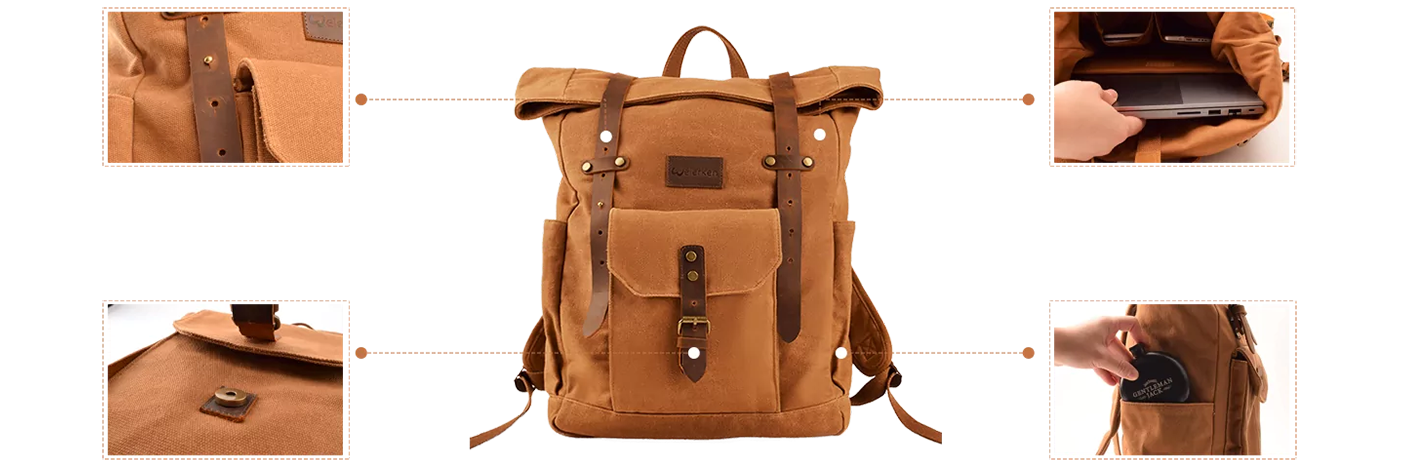
- Zippers: These are the most common failure point. Inspectors need to test the chain for missing teeth and ensure the slider glides smoothly without catching. The pull tab must be pulled with force to ensure it doesn’t snap off.
- Buckles and Webbing: Plastic hardware (buckles, adjusters) must be tested for brittleness. If you squeeze a buckle and it cracks, the entire lot is suspect. Webbing straps are checked for tight weaving; loose weaves will fray rapidly under use.
- Linings and Foams: The internal experience matters. The lining should not be paper-thin, and the foam used in the laptop sleeve or shoulder straps must provide actual cushioning, not just bulk.
Supplier Requirement: Always demand that your manufacturing partner provides a lab test report for every batch of fabric and a certificate of conformity for the hardware.
2. In-Process Production Inspection (IPQC)
Once production starts, the “In-Process” inspection acts as a course correction. If a cutting machine is misaligned by 5mm, and nobody checks until 5,000 units are made, that is 5,000 wasted bags. A vigilant canvas backpack distributor ensures that inspectors are walking the floor while the lines are running.
Precision in Cutting
The cutting stage dictates the shape of the bag.
- Pattern Matching: Inspectors check if the fabric panels match the paper patterns exactly.
- Clean Edges: Canvas can fray. The cut edges must be clean.
- Markings: In mass production, workers use chalk or pens to mark where pockets go. These markings must be within the seam allowance so they don’t show on the finished bag.
Sewing Integrity and Assembly
This is the core of the manufacturing process.
- Stitch Consistency: The “SPI” (Stitches Per Inch) must be consistent. If the stitches are too long, the seam is weak; too short, and the fabric might perforate and tear. Inspectors look for skipped stitches, broken threads, or “floating” threads where the tension wasn’t adjusted correctly.
- Reinforcement (Backtacking): This is non-negotiable for canvas backpacks. Critical stress points—specifically where the shoulder straps meet the body and where the top handle is attached—must have “backtacking” (sewing back and forth) or bar-tack stitching. Without this, the heavy canvas will pull apart under load.
- Binding and Edging: Canvas is thick. When binding tape is applied to cover raw edges inside the bag, it must be smooth. If the operator misses the edge, the raw canvas will unravel inside the bag, leading to a messy interior.
- Symmetry: When the front pocket is sewn on, is it straight? Is the left shoulder strap attached at the exact same height as the right one? These visual cues are immediate indicators of quality to a consumer.
At weierken, we emphasize this stage heavily because fixing a sewing error while the panel is flat is easy; fixing it after the bag is fully assembled is often impossible without ruining the product.
3. Final Random Inspection (FRI)
The goods are finished, packed, and ready to go. Before they are loaded onto the container, a Final Random Inspection is conducted, usually following the AQL (Acceptable Quality Limit) standard. This is the final report card for the canvas backpack distributor.
Aesthetics and Craftsmanship
This is about the “unboxing experience.”
- Cleanliness: The bag should be free of loose thread ends (which should be trimmed to less than 0.5cm), dust, or oil marks from the sewing machines.
- Logo Execution: Whether it is screen printed, embroidered, or a leather patch, the branding must be level, centered, and color-accurate. A crooked logo screams “counterfeit” or “cheap quality” even if the bag is sturdy.
- Overall Shape: Does the bag stand up as intended? Or does it slump and twist due to poor panel alignment?
Structure and Functionality (“The Road Test”)
The inspector acts as the user here.
- The Fit Test: Put the backpack on. Do the adjusters slide easily but hold firm when pulled? Is the back padding lumps-free?
- Closures: Open and close every single zipper, snap, and Velcro flap. A zipper that feels “gritty” now will fail in a month. Velcro must have strong adhesion.
- Pocket Capacity: If the spec sheet says the side pocket holds a water bottle, the inspector attempts to fit a standard bottle in it. If the laptop sleeve claims to fit a 15-inch laptop, a dummy laptop is inserted to verify the fit.
- Hardware Function: Do the magnetic snaps align perfectly? If you have to struggle to align the magnet, the design or assembly is flawed.
Dimensional and Weight Checks
Finally, random samples are measured and weighed. If a backpack is significantly lighter than the pre-production sample, it suggests the factory may have secretly switched to a thinner canvas or cheaper, less dense foam padding.
4. Safety & Reliability Specialized Tests
While visual inspections catch cosmetic issues, safety tests catch liabilities. For a canvas backpack distributor selling into strict markets like the EU or USA, these tests are not optional—they are essential for compliance.
Load-Bearing and Stability Testing
A canvas backpack is often sold on the promise of strength.
- The Jerk Test: The bag is loaded with a specified weight (e.g., 10kg or 15kg) and picked up rapidly by the top handle and by the straps. This simulates the sudden force of someone grabbing their bag to rush off a bus. The stitching must not pop, and the fabric must not tear.
- Static Load Test: The weighted bag is hung for a prolonged period (24-48 hours) to ensure the straps don’t deform or detach under sustained pressure.
- Seam Strength: A tensile machine pulls the seams apart to measure exactly how much force is required to burst the bag open. This ensures the thread strength matches the canvas strength.
Metal and Chemical Safety
- Sharp Edges: Metal zippers, buckles, or logo plates must be checked for burrs or sharp points that could scratch a user’s skin or snag their clothing.
- Chemical Compliance: This is critical. Canvas is often treated with water-repellent coatings, and dyes are used for color. You must verify via third-party lab testing (like SGS or Intertek) that the materials meet standards like REACH (Europe) or CPSIA (USA).
- Heavy Metals: Ensure zippers and buttons are lead-free and nickel-free.
- Phthalates: Ensure any PVC backing or plastic coating does not contain banned plasticizers.
- Formaldehyde: Often found in fabric stiffeners, this must be within safe limits.
Procurement Tip: Ask your supplier for their internal testing protocols. A reliable partner will have their own “torture test” room where they push their products to failure before you even ask.
Quality control is not a step in the process; it is the mindset that defines your brand’s longevity. By implementing these four layers of inspection—raw materials, in-process, final check, and safety testing—a canvas backpack distributor can confidently stand behind every product delivered.
It requires effort and investment to set up these protocols, but the return is seen in customer loyalty and reduced waste. Companies like weierken have built their reputation by strictly adhering to these standards, ensuring that when a customer swings a canvas pack over their shoulder, it carries not just their belongings, but the trust of the brand. Whether you are dealing with heavy-duty travel gear or fashion-forward daypacks, never compromise on the inspection.
Frequently Asked Questions (FAQ)
Q1: What is the most common defect found in canvas backpacks during inspection?
A: The most common issues are usually related to stitching. “Skipped stitches” or “loose threads” are frequent. In canvas specifically, “puckering” (where the fabric gathers unevenly along the seam) is also common because the fabric is thick and difficult to feed through the machine if the operator is not skilled.
Q2: How much does a third-party quality inspection cost for a canvas backpack distributor?
A: The cost varies by location and sample size, but generally, a “man-day” for a professional inspector in Asia ranges from $200 to $300 USD. For a standard order, one man-day is often enough to perform a statistically significant Final Random Inspection.
Q3: What is the “AQL” standard mentioned in the article?
A: AQL stands for “Acceptable Quality Limit.” It is an industry-standard statistical chart used to determine how many units to inspect and how many defects are allowed before the entire shipment is rejected. For backpacks, a common standard is AQL 2.5 for major defects (like a broken zipper) and AQL 4.0 for minor defects (like a loose thread).
Q4: Can I skip the raw material inspection if I trust the factory?
A: It is highly risky. Even a trustworthy factory can be duped by their fabric suppliers. If the canvas mill sends a batch of fabric that isn’t colorfast, and your factory cuts and sews it without checking, the entire production run is ruined. It is always cheaper to catch bad fabric before it is cut.
Q5: Why is the “backtacking” inspection so important for canvas bags?
A: Canvas bags are heavier than nylon bags and are often used to carry heavier loads (books, tools, laptops). Backtacking (reinforcement stitching) at stress points is the only thing preventing the strap from ripping out of the main body of the bag. Without it, the structural integrity of the bag is compromised.