

.webp "Wie man den besten Hersteller für maßgeschneiderte Segel-Trockentaschen für schwere Marineausrüstung auswählt")
The open ocean is a brutal proving ground for equipment. Salt spray corrodes cheap metal, ultraviolet rays degrade low-grade plastics, and rough non-skid yacht decks shred thin fabrics within days. When water penetrates a gear bag offshore, the consequences range from ruined satellite electronics to compromised safety survival gear.
General outdoor dry sacks work fine for weekend paddleboarders and river kayakers. Heavy-duty marine gear, however, operates under entirely different mechanical stresses. Sourcing your product line from a generic camping bag supplier often leads to high return rates, delaminated seams, and damaged brand equity.
Choosing an experienced custom sailing dry bag manufacturer protects your business reputation and the sailors who rely on your products. Engineering-driven production partners like Weierken understand that true marine gear requires industrial polymers, hermetic welding, and rugged hardware. This guide outlines the exact criteria procurement directors and product managers should evaluate before signing a manufacturing agreement.
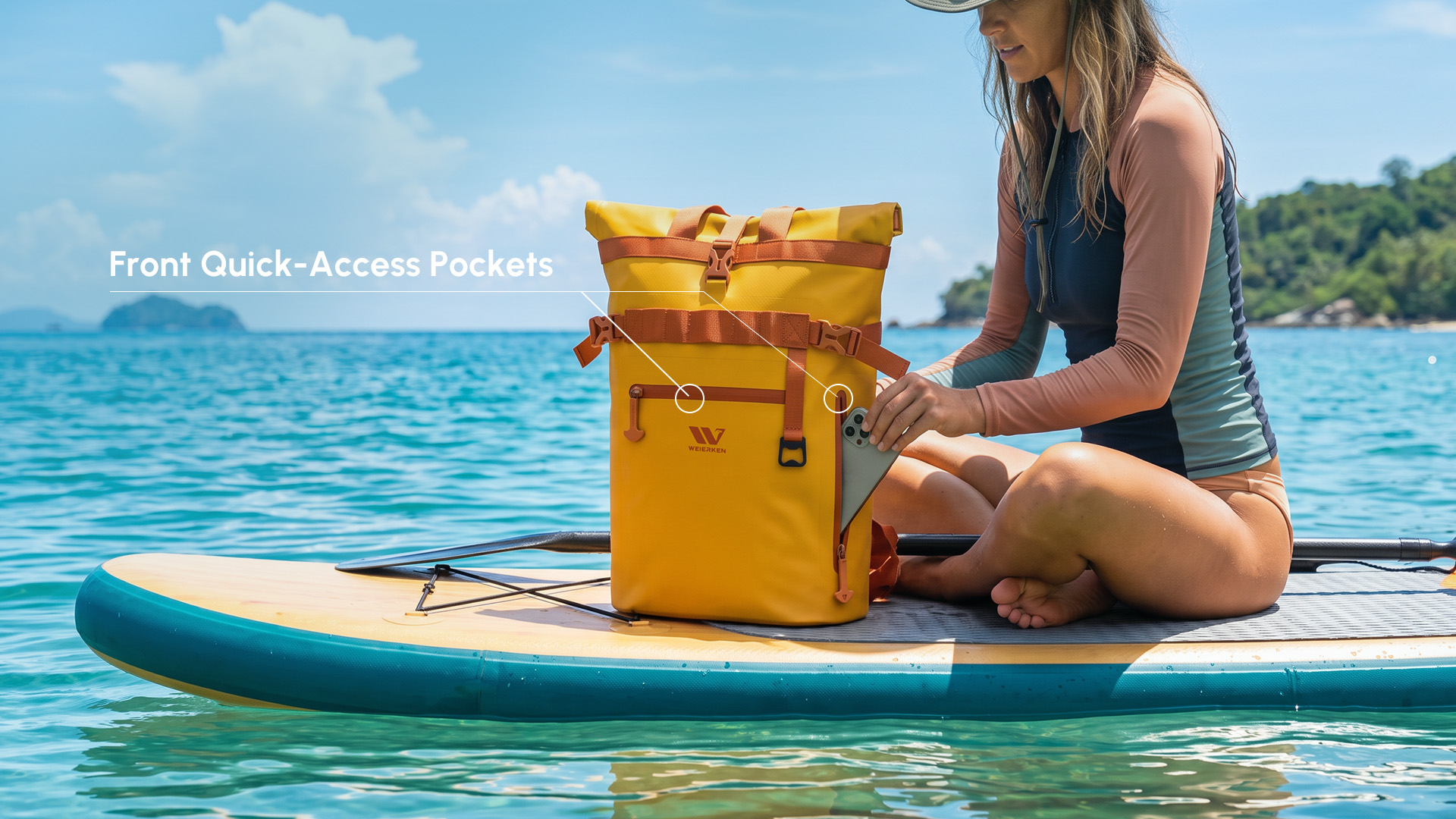
1. Marine-Grade vs. Standard Outdoor: Why Sailing Demands a Specialized Manufacturer
Offshore sailing puts extreme mechanical and chemical stress on soft goods. A factory accustomed to lightweight nylon bags often lacks the tooling and material science knowledge required for marine-grade production.
To produce a reliable heavy-duty marine dry bag, a factory must design against three relentless oceanic forces:
- Salt Spray and Chemical Corrosion: Saltwater accelerates galvanic corrosion on zippers, snaps, and D-rings. Cheap metal sliders seize within a week. Standard sewing thread rots quickly under continuous salt crystallization. Marine hardware must use 316 stainless steel or high-grade polyacetal (POM) plastics.
- Intense Ultraviolet Radiation: Marine environments double UV exposure through surface water reflection. Cheap polyvinyl chloride (PVC) fabrics leach plasticizers under this load, becoming brittle and sticky. A specialized custom offshore dry gear supplier uses UV-stabilized coatings that withstand thousands of hours of sun exposure without cracking.
- Deck Abrasion and Torsional Strain: Teak decks, aggressive fiberglass non-skid patterns, and steel rigging create constant friction. Bags shift under heavy boat motion, generating high localized wear. Fabrics must offer extreme tear strength, puncture resistance, and heavy denier counts.
2. Core Manufacturing Capabilities to Vet in a Custom Sailing Dry Bag Manufacturer
Evaluating an offshore manufacturing partner requires looking beyond sample photos. You must inspect their core technical capabilities on the factory floor.
Welding Technology: High-Frequency (HF) vs. Radio-Frequency (RF)
Never approve stitched and seam-taped construction for serious marine dry bags. Seam tape works adequately for lightweight rainwear, but it shears and delaminates under hydraulic wave pressure and persistent saltwater immersion.
An elite RF welding dry bag factory uses dielectric heating to fuse thermoplastic materials at the molecular level. High-frequency electrical energy excites the molecules inside the polymer coatings, melting them together under pneumatic pressure.
The result is a continuous, homogenous seam that is stronger than the parent fabric itself. Verify that your factory uses automated welding jigs rather than erratic manual heat guns to ensure 100% airtight and watertight joint consistency across production batches.
Stoffauswahl: Marine-Grade PVC vs. TPU
Your manufacturer should guide your material choices based on your target retail price and performance thresholds:
- Marine-Grade PVC Tarpaulin (500D to 1000D): Highly cost-effective and exceptionally abrasion-resistant. Heavy base polyester scrims coated with marine-formulated PVC handle deck abuse effortlessly. However, PVC is heavier and tends to stiffen in near-freezing ocean waters.
- Thermoplastic Polyurethane (TPU): The premium choice for high-performance ocean racing. A marine-grade TPU dry bag provides superior flexibility in cold weather, high tensile strength, and outstanding resistance to oils and fuels. Specify polyether-based TPU rather than polyester-based TPU; polyether resists microbial growth and hydrolysis caused by long-term moisture exposure.
Waterproof Sealing Systems
Water intrusion happens at access closures. Your production partner must demonstrate mastery over two primary sealing mechanisms:
- Roll-Top Engineering: Requires internal stiffening bands made from flexible POM or polypropylene. The band must maintain constant tension across the fold, allowing clean, wrinkle-free rolls that block capillary water transfer under IPX6 wave blasts.
- Watertight Zippers: For submersible IPX7 or IPX8 gear, the factory must possess the specialized tooling to bond pressure-tested, tooth-free airtight zippers (such as TIZIP MasterSeal or airtight polyurethane zippers) directly to the bag body without heat distortion.
3. Customization and OEM/ODM Versatility
A capable contract manufacturer does more than duplicate generic factory designs. They help brand managers turn ergonomic sketches into functional maritime products.
Experienced OEM manufacturers like Weierken maintain dedicated development studios to prototype functional features tailored to marine activities, commercial charter vessels, and offshore regattas.
Marine-Specific Feature Integration
Review the manufacturer's ability to incorporate functional sailing hardware:
- Deck Anchoring Systems: Reinforced lash points, MOLLE patches, and heavy-duty D-rings positioned to lash securely onto yacht lifelines, stern pulpits, or tender decks.
- Non-Absorbent Ergonomics: Backpack straps and lumbar pads built with closed-cell EVA foam. Open-cell foam acts like a sponge, absorbing salt water, adding dead weight, and causing mildew.
- Air Purge and Pressure Relief Valves: Heavy-duty roll-top bags trap massive air bubbles. Integrated manual purge valves let sailors compress their gear tight to fit into cramped cabin lockers.
Branding and Visual Durability
Standard screen printing flakes off slick marine fabrics after friction against salt-crusted ropes. A proficient custom sailing dry bag manufacturer offers durable logo application methods:
- High-frequency welded rubber badges that sit flush with the material.
- Two-pack polyurethane screen inks cured specifically for polymer adhesion.
- Abrasion-resistant reflective graphics to ensure visibility during night watches and emergency deck situations.
Prototyping and Tooling Speed
RF welding requires custom aluminum dies and molds for every distinct seam shape, handle mount, and window patch. Ask the factory about their internal tooling turnaround time. A supplier with an in-house CNC mold workshop can produce functional samples in days rather than waiting weeks for third-party tooling deliveries.
4. Factory Quality Assurance and Marine Compliance
High manufacturing standards distinguish real industrial producers from low-tier trading shops. Your supplier must enforce documented quality control at every stage of the production cycle.
Critical Marine Testing Procedures
Require your manufacturer to provide in-house verification test records before dispatching bulk shipments:
- Ingress Protection Testing (IP Ratings): Taschen must pass calibrated water spray booths for IPX6 certification (heavy sea spray and direct high-pressure hose jets) or submersion tanks for IPX7/IPX8 certification (immersion up to 1 meter or deeper for 30 minutes).
- Air Pressure Decay Testing: For fully airtight dry duffels, technicians must inflate 100% of the finished production batch and monitor pressure gauges over a 24-hour cycle to catch micro-punctures or welding pinholes.
- Salt Spray Testing (ASTM B117): Hardware, zippers, and clips must endure continuous salt fog exposure (typically 48 to 96 hours minimum) without surface oxidation, rust pitting, or mechanical failure.
- Weld Seam Peel Strength Testing: Calibrated tensile testing rigs should stretch cut seam samples to ensure the welded bond holds beyond the specified pull strength limit (typically over 200 N per 5 cm).
International Regulatory Compliance
If you distribute gear across North America, Europe, and Oceania, your supplier must meet regional environmental standards. Ensure your OEM waterproof boat bag complies with EU REACH annex XVII, RoHS, and California Proposition 65 regulations regarding phthalates, lead, and hazardous chemical plasticizers.
5. Red Flags to Avoid When Choosing a Dry Bag Factory
Vetting an overseas supplier requires watching out for common industry shortcuts. Beware of factories that show the following warning signs:
- Lightweight Bag Specialization: If a factory's catalog consists entirely of ultra-light 70D silicone-coated nylon dry sacks, they lack the high-tonnage RF presses and expertise to build a true heavy-duty marine dry bag.
- No Direct Tooling Ownership: Suppliers that outsource their high-frequency tooling run up your development costs, stretch your lead times, and struggle to correct fitment defects during mass production.
- Vague Raw Material Origins: If the factory cannot provide raw polymer mill sheets, tensile ratings, or cold-crack temperature specs for their PVC and TPU fabrics, they are likely sourcing cheap stock-lot remnants with inconsistent coatings.
- Unrealistically Low Quotations: Rock-bottom prices usually
indicate diluted polymer formulas, reground scrap plastic, thin weld lines, and
sub-standard stitching on load-bearing anchor points.
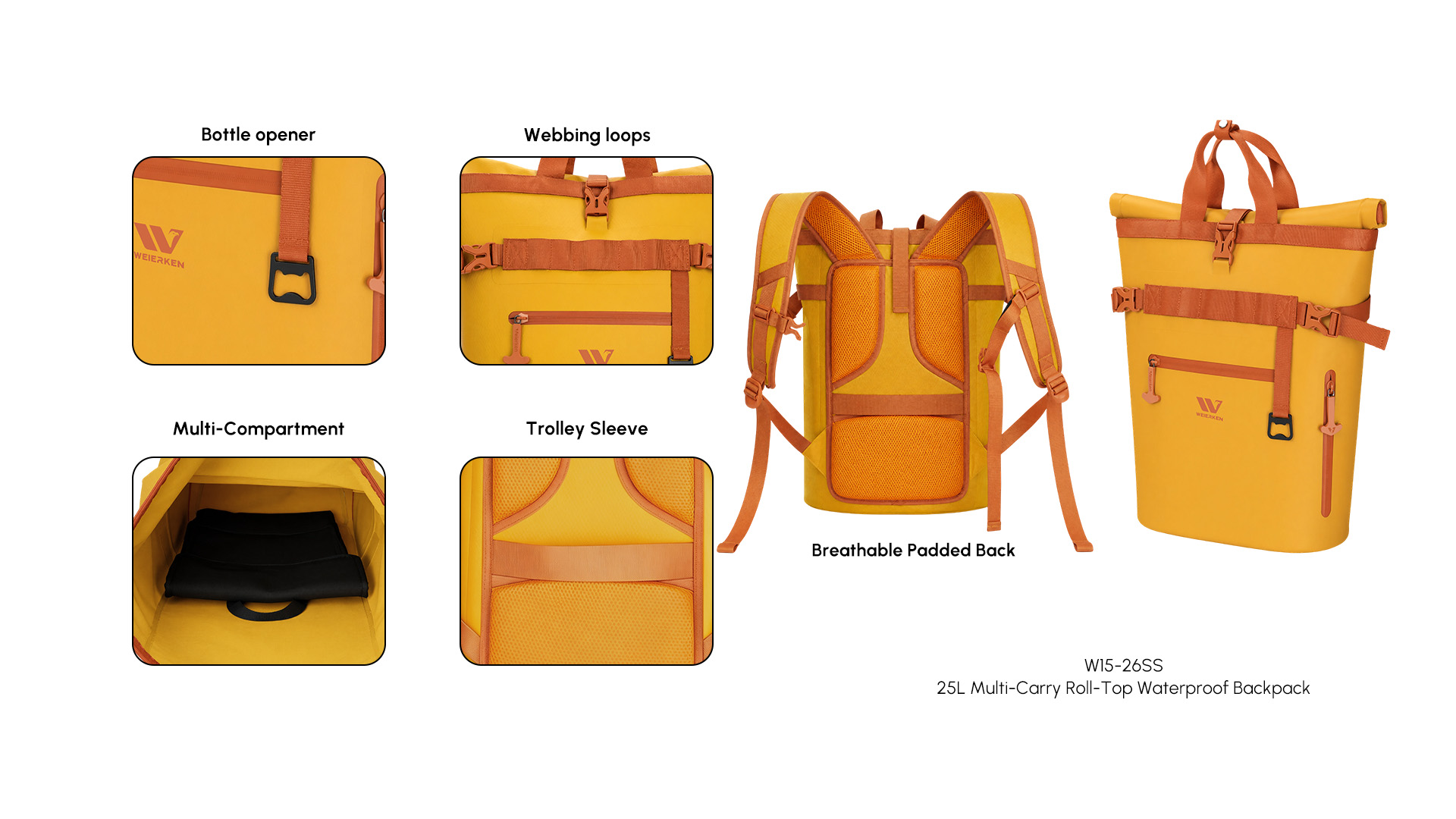
6. Sourcing Checklist: Technical Questions to Ask Before Placing an Order
Cut through sales marketing jargon by presenting your prospective manufacturer with this checklist of technical questions:
- What specific welding technology do you use for this bag profile: High-Frequency Dielectric, Hot Air, or Ultrasonic?
- Do you build the RF welding dies in your own tooling facility, or do you outsource tool production?
- What specific formulation of TPU do you stock: polyether or polyester? Can you verify its hydrolysis resistance?
- What quality assurance process do you use for airtight bags: batch testing or 100% inflation pressure decay testing?
- What salt spray resistance rating (hours under ASTM B117) do your plastic clips, metal carabiners, and zipper sliders meet?
- What is your factory's standard production lead time and Minimum Order Quantity (MOQ) for custom colorways and custom-tooled components?
Frequently Asked Questions
Q1: What is the main difference between an outdoor dry bag and a
heavy-duty marine dry bag?
A1: Outdoor dry bags often use
lightweight nylon or polyester fabrics sealed with seam tape to reduce carry
weight for hikers. Heavy-duty marine dry bags use dense 500D–1000D PVC or
ether-based TPU fabrics assembled via radio-frequency (RF) molecular welding.
Marine bags also feature non-corrosive hardware, heavy deck-abrasion defenses,
and UV stabilizers built to withstand salt-crust and offshore solar
radiation.
Q2: Which fabric is superior for offshore sailing: PVC tarpaulin or
TPU?
A2: Both fabrics have their place depending on product goals.
Heavy-gauge PVC tarpaulin offers incredible abrasion resistance at an economical
price point, making it great for charter duffels and gear sacks. Polyether-based
TPU is lighter, remains pliable in freezing sub-zero weather, resists fuel and
oils, and provides greater tensile strength for elite ocean racing gear, though
raw material costs run higher.
Q3: How do custom sailing dry bag manufacturers test for waterproof
integrity?
A3: Manufacturers use specific IP-code testing protocols.
Roll-top bags undergo IPX6 tests using high-pressure water nozzles that mimic
wave strikes on a boat deck. Airtight and submersible bags undergo pressure
decay testing—where bags are pumped with air and monitored over 12 to 24
hours—as well as IPX7 submersion tanks where gear is kept underwater for 30
minutes to check for air bubbles.
Q4: What is the typical Minimum Order Quantity (MOQ) for an OEM
waterproof boat bag project?
A4: Most specialized RF welding
factories require an MOQ between 500 and 1,000 units per colorway for custom
designs. This minimum stems from the production run sizes required by fabric
coating mills to produce custom Pantone colors, alongside the setup costs of
custom high-frequency welding tooling dies.
Q5: Can our brand integrate airtight submersible zippers on roll-top
sailing bags?
A5: Yes. An experienced manufacturing partner can weld
airtight zippers directly to side storage compartments or create hybrid bags
that feature a roll-top primary access point along with an IPX7-rated
submersible exterior pocket for electronics, safety flares, and radios.
Q6: How long does tooling and sample development take with a
specialized RF welding dry bag factory?
A6: If your factory has an
in-house tooling workshop, initial CAD modeling and custom aluminum die
production takes roughly 7 to 14 business days. You can expect a fully finished,
functional prototype bag within 2 to 3 weeks from the date the 3D design files
and material specifications are approved.
Choose an Engineering Partner, Not Just a Vendor
Sourcing offshore gear demands high technical accountability. The ideal manufacturing partner brings deep polymer expertise, precision high-frequency welding lines, and rigorous pressure testing to your supply chain.
At Weierken, our engineering teams build heavy-duty marine gear that withstands the world's harshest open-ocean conditions. From custom offshore duffels to submersible boat bags, we manage everything from custom tooling dies to comprehensive quality testing.
If you are ready to design your next marine gear collection, contact our technical sales team today. Angebot anfordern and technical evaluation for your custom project, and let our experts help you build equipment your customers can trust offshore.