
.webp "Elegir la Bolsa de Almacenamiento de Pescado Aislada OEM Correcta: Guía de Calidad y Material 2026")
Las bolsas de pescado pelágico soportan un castigo brutal. Los pescadores en alta mar las cargan con aletas de atún afiladas como cuchillas, pesadas mezclas de hielo y galones de salmuera sanguinolenta. Si una costura se rompe o un revestimiento interior se perfora, el desorden resultante arruina las cubiertas de los barcos, crea olores desagradables y destruye la confianza en la marca.
La mayoría de los fracasos comerciales ocurren dentro de los primeros noventa días de uso en el campo. Los compradores inundan las secciones de reseñas con quejas sobre agua filtrándose en los maleteros de los coches, cremalleras corroídas por la sal y olores a pescado que nunca se eliminan. Las principales marcas y fabricantes marinos como Weierken resuelven este problema al centrarse en la ciencia de materiales avanzada y la soldadura de alta frecuencia en lugar de costuras de bajo costo.
Seleccionar un fabricante de bolsas de almacenamiento de pescado aisladas OEM experimentado en 2026 requiere mirar más allá de las cotizaciones superficiales. Necesitas inspeccionar las calificaciones de polímeros crudos, las densidades del núcleo térmico y los protocolos de prueba de fugas hidrostáticas. Esta guía técnica describe los estándares de ingeniería necesarios para construir bolsas de sacrificio de alto rendimiento que sobrevivan en entornos marinos duros.
La Anatomía del Material de los Enfriadores de Pescado de Grado Comercial
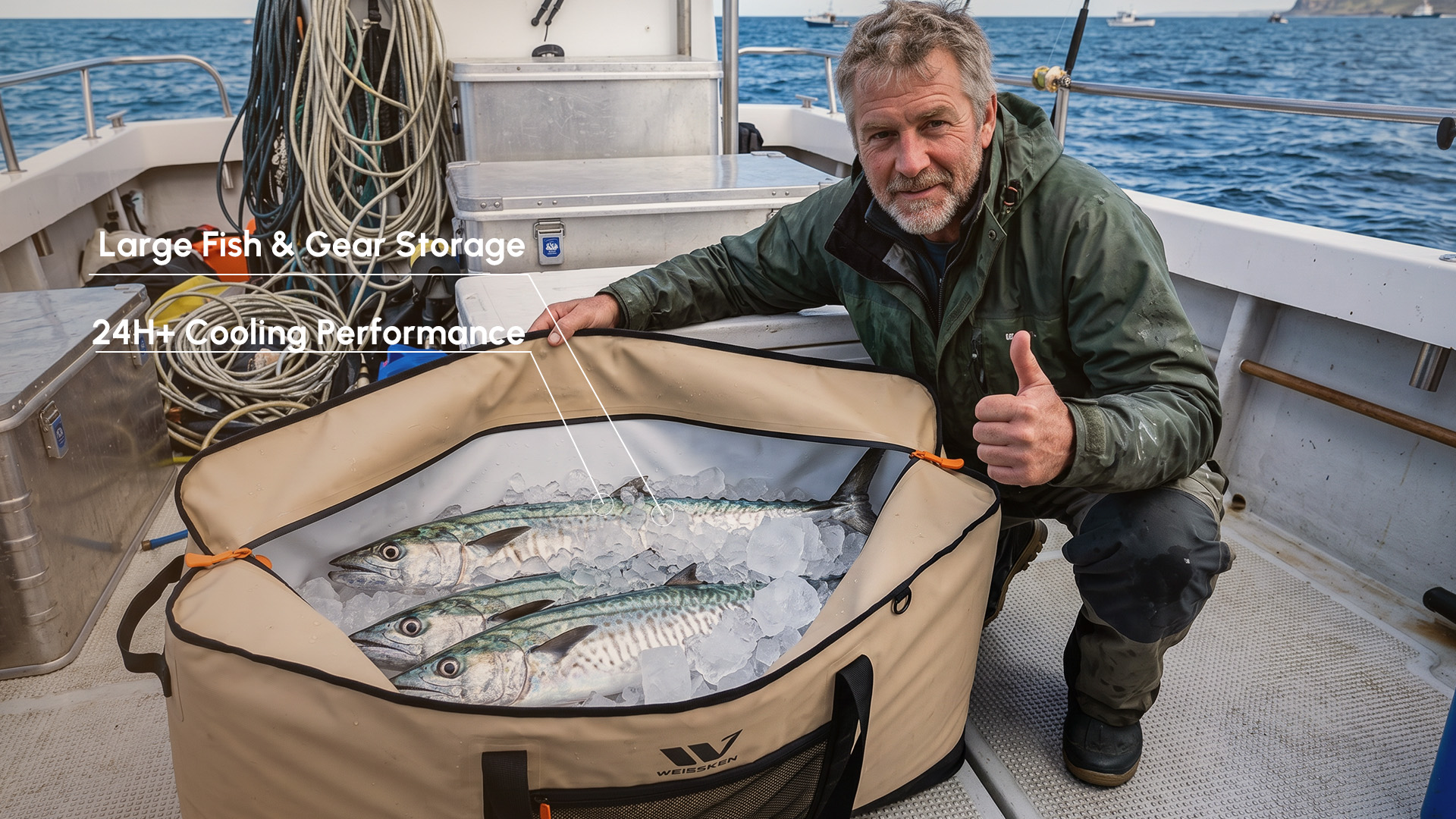
Una bolsa de enfriador de pescado de alto rendimiento se basa en una estructura laminada de tres capas. Cada capa cumple un propósito mecánico y térmico distinto.
1. Capa Exterior: Resistencia a la Abrasión y Defensa UV
El tejido exterior debe resistir las ásperas cubiertas de barcos antideslizantes, los ganchos de pesca y la radiación UV directa sin desvanecerse ni agrietarse.
Nylon/Poliéster Recubierto de TPU de 840D a 1000D: El estándar premium para el equipo marino moderno. El Poliuretano Termoplástico (TPU) ofrece una resistencia superior a las grietas por frío, cero olor químico, alta resistencia a la tracción y excelente estabilidad ambiental. Permanece flexible en condiciones cercanas a la congelación.
Lona de PVC de 500D a 1000D: El caballo de batalla comercial de alta resistencia. El PVC proporciona una resistencia excepcional a la perforación y eficiencia de costos. Sin embargo, es más pesado que el TPU y puede endurecerse en clima bajo cero a menos que esté formulado con plastificantes de baja temperatura.
2. Núcleo Térmico: Ingeniería de Retención de Hielo de 72 Horas
La espuma de celda abierta actúa como una esponja. Una vez que el agua salada penetra en una barrera de celda abierta, atrapa la humedad, cría bacterias y pierde toda capacidad aislante. Las bolsas marinas profesionales utilizan exclusivamente espuma de celda cerrada.
Espuma de NBR/PVC o EVA de Celda Cerrada: Estos bolsillos de gas cerrados y no interconectados previenen la absorción de agua. Mantienen la integridad estructural cuando están llenos con más de 100 libras de hielo y captura.
Grosor vs. Rendimiento Térmico: Una pared de espuma de 0.5 pulgadas es adecuada para bolsas de kayak y de costa donde el peso y la capacidad de plegado son importantes. Para bolsas de sacrificio pelágicas de alta mar (atún, wahoo, pez espada), se requiere aislamiento de celda cerrada de 0.75 a 1.0 pulgadas. Este grosor sostiene una mezcla de hielo durante 48 a 96 horas bajo luz solar directa.
3. Revestimiento Interior: Resistencia a la Perforación y Seguridad Alimentaria
La cámara interior trata directamente con dientes, espinas y fluidos ácidos. Un revestimiento delgado falla inmediatamente contra la aleta dorsal de un róbalo o un pargo.
Revestimiento de TPU de Grado Alimenticio de Alta Resistencia: Debe tener certificación de contacto alimentario de la FDA o la UE para prevenir la lixiviación de productos químicos tóxicos en la carne de pescado comestible. Busca revestimientos con calificaciones mínimas de resistencia a la perforación superiores a 250 Newtons.
Aditivos antimicrobianos y anti-manchas: Los poros microscópicos en plásticos de baja calidad atrapan sangre y aceites, causando un hedor permanente. Recubrimientos suaves y químicamente inertes permiten lavados rápidos con jabón suave y agua fresca.
Ingeniería de Cero Filtraciones: Soldadura vs. Costura
La costura tradicional con aguja perfora miles de agujeros microscópicos a través del tejido. Las costuras selladas con cinta se degradan rápidamente cuando se exponen a humedad continua, cargas pesadas y aceite de pescado.
Soldadura por Radiofrecuencia (RF) y Alta Frecuencia (HF)
Un rendimiento verdaderamente impermeable exige soldadura RF. La energía electromagnética de alta frecuencia excita las moléculas dentro de las capas adyacentes de TPU o PVC, fusionándolas en una sola pieza continua de material. La soldadura se vuelve tan fuerte como el tejido virgen mismo.
Al auditar un OEM de enfriadores de pescado de espuma de celda cerrada, inspeccione su herramienta de soldadura. Asegúrese de que utilicen matrices de soldadura 3D personalizadas que acomoden espuma de celda cerrada gruesa sin comprimir permanentemente el aislamiento a lo largo de los bordes de la costura.
Especificaciones de Hardware de Grado Marino
Las fallas de hardware dejan fuera de servicio una bolsa de pescado tan rápido como un tejido rasgado. Especifique componentes clasificados para uso en agua salada pesada:
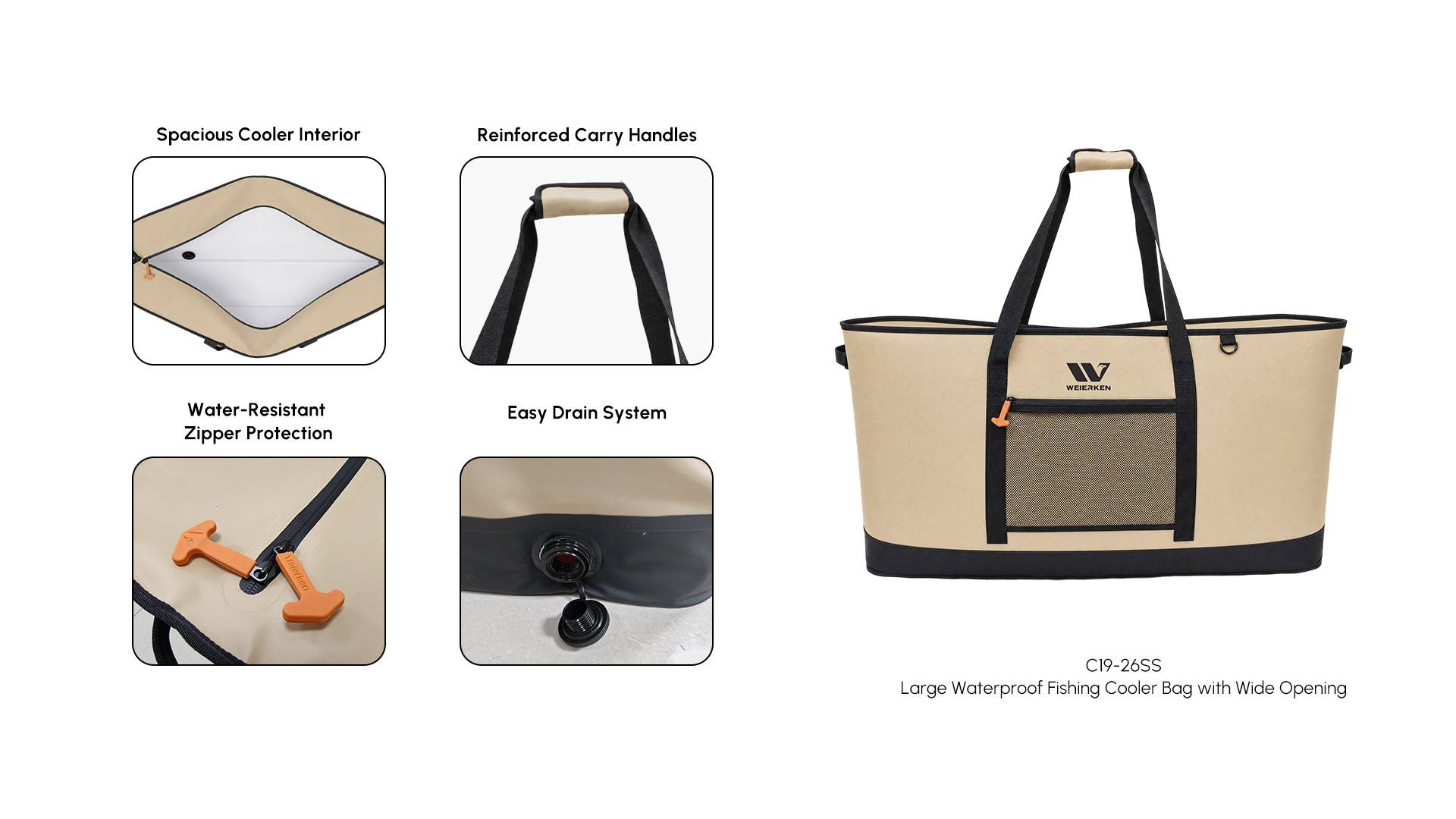
Cremalleras impermeables: Cremalleras resistentes a la presión sin dientes (similares a los cierres de trajes de buceo) evitan que el agua salpique cuando la bolsa se mueve durante el tránsito en barco. Las pistas de cremallera soldadas con TPU eliminan las vías de fuga alrededor de la apertura.
Cremalleras de agua salada sobredimensionadas: Para modelos no herméticos, use dientes de plástico moldeado pesado #10 o #12 con deslizadores de nailon de grado marino. Nunca use deslizadores de metal fundido; la sal los corroerá en cuestión de semanas.
Tapones de drenaje roscados de perfil bajo: Esenciales para bolsas de más de 36 pulgadas. Una válvula de drenaje marina roscada permite a los pescadores drenar sangre excesiva y hielo derretido sin levantar una bolsa de 150 libras. Busque diseños de tapa cautiva para que los usuarios nunca pierdan el tapón.
Cintas de carga reforzadas: La cinta debe envolver completamente debajo del vientre de la bolsa (diseño de cuna). Los puntos de anclaje cosidos en caja y soldaduras RF distribuyen el peso de manera uniforme a lo largo de todo el casco.
Control de Calidad y Pruebas de Laboratorio OEM Obligatorios
Nunca apruebe la producción a gran escala sin validar su prototipo contra estándares mecánicos y térmicos rigurosos. Una fábrica de bolsas de almacenamiento térmico de pescado personalizada debe proporcionar datos de prueba documentados internos o de terceros.
Prueba de Curva de Decaimiento Térmico: La bolsa se llena con una proporción fija de hielo a agua (típicamente 1:1) y se coloca dentro de una cámara ambiental mantenida a 38°C (100°F). Las temperaturas se registran cada hora para mapear la tasa de derretimiento del hielo durante 48, 72 y 96 horas.
Prueba de Costura Hidrostática y de Presión: La bolsa se llena a su máxima capacidad con agua y se suspende por sus asas durante 24 horas. Las costuras deben mostrar cero filtraciones, estiramientos o delaminaciones.
Pruebas de Rocío Salino ASTM B117: Todo el hardware, tiradores y cremalleras se someten a 72 a 96 horas de exposición continua a niebla salina para confirmar cero corrosión galvánica o atmosférica.
Pruebas de Punción ASTM D4833 y Desprendimiento ASTM D903: Verifica la resistencia del revestimiento interno contra objetos afilados y verifica la resistencia del vínculo entre la base del tejido y su recubrimiento impermeable.
Fabricantes como Weierken incorporan estos protocolos de prueba directamente en sus procedimientos operativos estándar, asegurando que los lotes de producción coincidan con las muestras doradas aprobadas.
2026 Cumplimiento Regulatorio y Directivas ESG
Los requisitos comerciales globales para tejidos recubiertos de polímero se están endureciendo rápidamente. Las marcas que importan equipos para actividades al aire libre en América del Norte y Europa enfrentan estrictos obstáculos legales en relación con sustancias tóxicas y sostenibilidad.
Formulaciones Libres de PFAS y No Tóxicas
Las sustancias per- y polifluoroalquil (PFAS) enfrentan severas prohibiciones en varios estados de EE. UU. y en la Unión Europea. Confirme que su fábrica de bolsas de muerte a prueba de pinchazos utiliza tratamientos de superficie DWR (Repelente de Agua Durable) libres de PFAS. Además, asegúrese de que las formulaciones de PVC y TPU cumplan con la Proposición 65 de California (libres de ftalatos restringidos y plomo) y cumplan con el Anexo XVII de REACH de la UE.
Auditorías Sociales y de Calidad de Fábrica
Los canales de venta modernos exigen cadenas de suministro limpias. Verifique que su socio de fabricación tenga:
ISO 9001: Para sistemas de gestión de calidad estandarizados.
BSCI o Sedex (SMETA): Para mano de obra ética verificada, seguridad y estándares laborales.
TPU vs. PVC: Elegir la Dirección Correcta para su Línea de Productos
Su selección de material dicta su punto de precio al por menor, público objetivo y posicionamiento de marca. Utilice esta tabla comparativa para decidir entre construcciones de TPU y PVC:
| Métrica de Rendimiento | TPU (Poliuretano Termoplástico) | Lona de PVC de Alta Resistencia |
|---|---|---|
| Peso | Ligero (30% más ligero que el PVC) | Substancialmente más pesado |
| Flexibilidad en Frío | Alta flexibilidad hasta -30°C | Se endurece por debajo de 0°C |
| Retención de Olor | Casi cero; no poroso | Bajo a moderado con el tiempo |
| Impacto Ambiental | Grados reciclables, a menudo biodegradables | Más difícil de reciclar, utiliza plastificantes |
| Resistencia a Pinchazos | Muy alta por peso unitario | Excelente debido al grosor de la tela |
| Costo del Material | Premium / Más alto | Económico / Competitivo |
Cómo Estructurar un RFQ Listo para Producción
Las consultas vagas conducen a cotizaciones inexactas y retrasos en las muestras. Al solicitar una cotización de un fabricante de bolsas de pescado de grado marino , incluya un paquete técnico completo con estos parámetros clave:
Especificaciones Exactas de Material Exterior e Interior: p. ej., "Nylon 840D Doble Cara 0.15mm TPU, Acabado Mate."
Química y Grosor de la Espuma: p. ej., "Espuma NBR de Celdas Cerradas de Alta Densidad de 20mm."
Método de Construcción de Costuras: Especifique soldadura por RF en todas las costuras estructurales que retienen agua.
Detalles de Hardware: Marca/grado de cremallera (p. ej., cremallera impermeable hermética #8), paso de rosca del tapón de drenaje y resistencia a la rotura de la cinta de nylon.
Necesidades de Empaque y Certificación: Detalle su código de barras, bolsa de polietileno, requisitos de prueba de caída de cartón maestro y certificaciones de pruebas FDA/Prop 65.
Preguntas Frecuentes
Q1: ¿Por qué es obligatorio el foam de celda cerrada para las bolsas de
muerte de peces en lugar de la espuma de esponja de celda abierta estándar?
A1: La espuma de celda abierta absorbe humedad, sangre de peces y agua salada como una esponja de cocina. Una vez húmeda, pierde su capacidad de aislamiento, añade peso muerto y cría bacterias que producen olores permanentes. La espuma de celda cerrada cuenta con cámaras de aire individuales selladas que físicamente no pueden absorber agua, manteniendo el valor R máximo de aislamiento de forma permanente.
Q2: ¿Cuál es el costo típico de herramientas y el tiempo de entrega para una
bolsa de pescado soldada por RF personalizada?
A2: Los moldes de soldadura por RF personalizados generalmente oscilan entre $800 y $3,000 dependiendo de las dimensiones de la bolsa, la complejidad del divisor interno y la integración de válvulas. El desarrollo de prototipos y herramientas suele tardar de 2 a 3 semanas, seguido de la entrega de muestras dentro de 7 a 10 días hábiles.
Q3: ¿Cómo previenen que los cierres se congelen y la corrosión por
exposición al agua salada?
A3: Recomendamos usar cierres impermeables recubiertos de TPU herméticos con dientes de polímero moldeados o rieles de Delrin/Nylon de alta resistencia. Elimine completamente los deslizadores de aleación de zinc y los topes metálicos. Usar herrajes de plástico compuesto 100% previene completamente la corrosión galvánica.
Q4: ¿Qué MOQ (Cantidad Mínima de Pedido) deben esperar las marcas de
exteriores de un OEM de bolsas de almacenamiento de pescado aisladas?
A4: Para colores estándar de lona de PVC, los MOQ generalmente comienzan alrededor de 300 a 500 unidades por tamaño. Los tejidos de TPU teñidos a medida o los grosores de extrusión propietarios pueden requerir de 500 a 1,000 unidades para cumplir con los mínimos de lote de tinte de materia prima.
Q5: ¿Cómo puede una marca verificar que los materiales de la bolsa de
pescado son 100% seguros para contacto con alimentos según la FDA?
A5: Solicite certificados de prueba de lote de materia prima para FDA 21 CFR 177.2600 (goma/elastómeros) o 21 CFR 177.1680 (poliuretano) de la fábrica. Los OEMs reputables validan sus revestimientos de TPU extruidos a través de laboratorios acreditados como SGS, TÜV o Intertek antes de entrar en producción.
Q6: ¿Se pueden personalizar las bolsas de pescado aisladas para
cubiertas de kayak y transom de barcos?
A6: Sí. Los OEM especializados pueden construir formas geométricas personalizadas, como bolsas de proa cónicas, curvas de montaje en transom y enfriadores de kayak de perfil bajo con anillas D integradas, puntos de sujeción de bungee y ubicaciones de anclaje especializadas.
Mejora tu Línea de Equipos Marinos con Weierken
Construir bolsas de pescado robustas e impermeables requiere un control de calidad estricto, equipos de soldadura especializados y fuentes de materia prima probadas. Recortar en el grosor del revestimiento o la tecnología de costura lleva directamente a devoluciones de clientes y daños a la marca.
Ya sea que necesites bolsas de atún de alta resistencia para mar abierto, enfriadores de pescado plegables para kayak, o soluciones de almacenamiento marino comerciales personalizadas, Weierken ofrece excelencia en fabricación certificada con soporte técnico completo de OEM/ODM.
¿Listo para desarrollar tu próxima generación de bolsas de almacenamiento de pescado de alta retención?
Contacta a nuestro equipo de ingeniería y adquisiciones hoy para discutir tu paquete técnico, revisar opciones de material y solicitar nuestro completo Kit de Muestra de Material y Calidad 2026.
Correo electrónico: Servicio@weierkenbag.com
Sitio web: weierkenbag.com