
Ghost kitchens operate under a completely different set of logistics than traditional brick-and-mortar restaurants. A single hub often dispatches orders for ten to thirty virtual brands simultaneously. Delivery drivers cycle through tiny pickup windows, carrying orders that range from piping hot artisan pizzas to chilled acai bowls.
Standard delivery gear fails in this environment. Off-the-shelf bags are built for single brands and single temperatures. When scaled across multiple virtual storefronts, they cause order mix-ups, crushed packaging, and cold food complaints. Experienced facility operators solve this bottleneck by sourcing custom food delivery bags for ghost kitchens directly from specialized OEM manufacturers like Weierken.
Sourcing bespoke ghost kitchen bags requires an engineering approach. You are not buying simple merchandise; you are purchasing mission-critical logistics equipment. Below is the technical procurement checklist supply chain managers must use to vet an OEM food delivery bag manufacturer.
1. Multi-Brand Adaptability and Rapid Dispatch Engineering
A ghost kitchen hub cannot issue different sets of delivery gear for every digital storefront it operates. The operational friction and inventory overhead would destroy unit economics. The thermal carrier itself must adapt to changing brands within seconds.
Interchangeable Modular Branding Panels
Top-tier OEM manufacturers design commercial delivery bag supplier solutions with high-cycle hook-and-loop (Velcro) systems or heavy-duty transparent framing windows. A courier delivering for a gourmet burger concept at noon can swap the external faceplate to a high-end sushi brand at night.
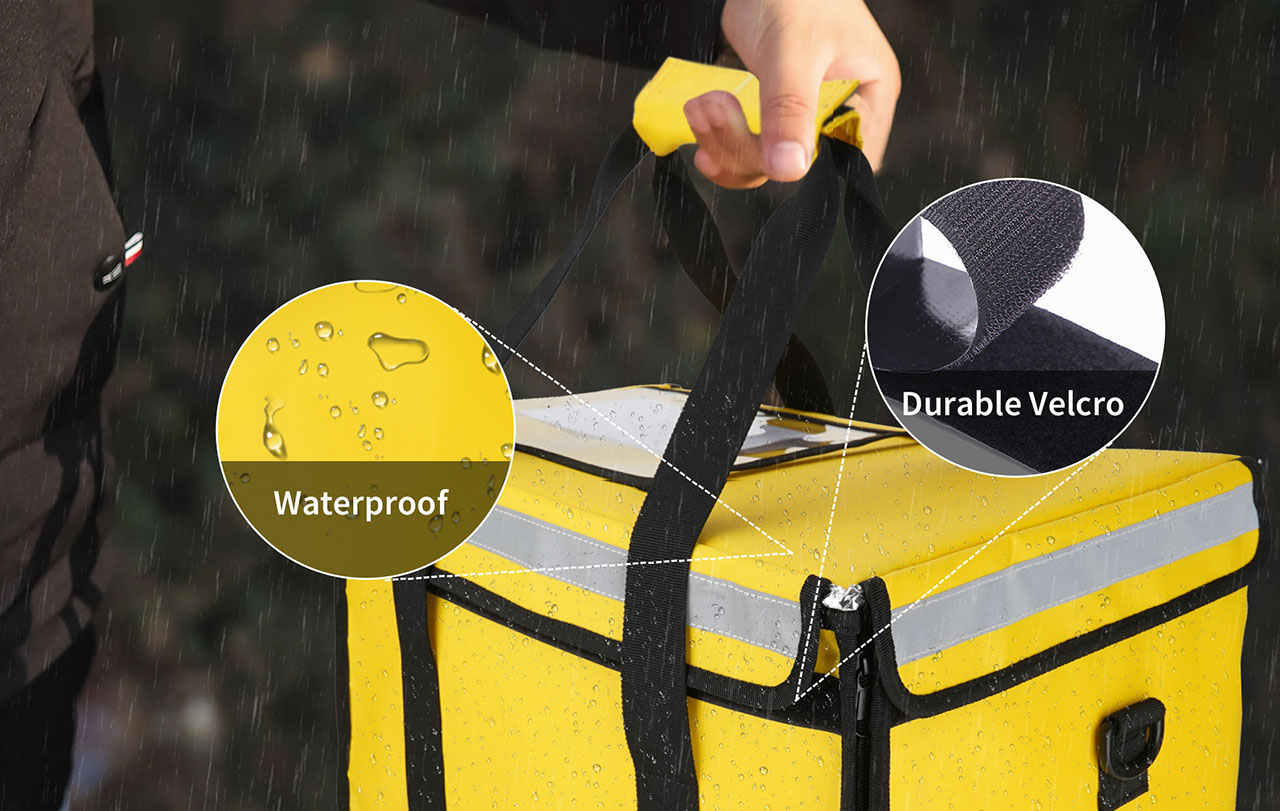
Industrial-grade Velcro: Specify nylon hook-and-loop fasteners rated for at least 5,000 peel cycles to prevent edge curling under heavy rain and greasy handling.
Weatherproof edge seals: Interchangeable panels must feature hydrophobic welted edges to stop moisture from creeping behind the branding layer.
Thermal Receipt and Digital Tracking Sleeves
Ghost kitchen staging areas run at breakneck speeds. Order routing errors cause direct revenue loss. Look for manufacturers that integrate anti-fog, UV-resistant TPU or PVC routing sleeves on the exterior top flap.
These windows hold standard thermal receipts or printed dispatch QR codes flat and visible. Pick-and-pack crews can verify order accuracy with handheld scanners without unzipping the bag or releasing retained heat.
High-Fidelity Corporate VI Reproduction
Virtual restaurant incubators demand exact color matching across multiple brand identities. Your OEM partner must offer more than basic screen printing:
Sublimation and digital heat transfer: Essential for photo-realistic graphics and complex gradients across multi-brand fleets.
High-frequency RF embossing: Produces clean, permanent, premium logos directly on heavy synthetic fabrics without puncturing the material.
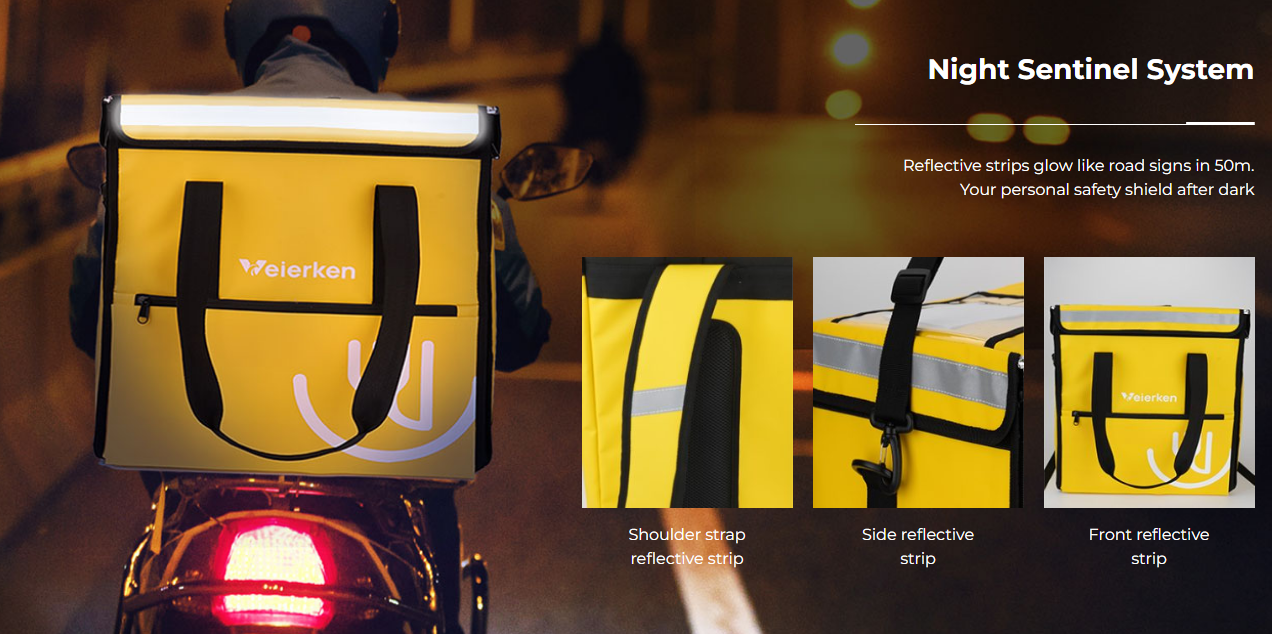
Certified reflective safety materials: Seamless integration of genuine 3M Scotchlite or EN ISO 20471-compliant reflective striping along structural seams to protect two-wheel delivery fleets.
2. Spatial Ergonomics and Storage Optimization
Floor space in a shared commissary kitchen commands a massive premium. Stacking forty fully expanded commercial Sacs de livraison along a corridor creates fire hazards and slows kitchen runners. An experienced commercial delivery bag supplier designs for spatial efficiency before the bag even enters the field.
Knock-Down (K/D) Flat-Pack Geometry
Insist on an OEM factory that holds structural patents or field-tested designs for flat-folding (Knock-Down) bags. A well-engineered bag collapses to under 15% of its fully assembled volume using internal hinge joints and perimeter fold lines.
This design metric delivers two substantial financial advantages:
Local commissary storage: Hundreds of collapsed bags can sit in a compact rack system until active shifts begin.
Ocean freight savings: Flat-packing slashes container volume (CBM). It allows you to fit 2,000 to 3,000 units into a 40-foot high-cube container instead of 600 fully erected units, cutting landing costs per bag by up to 60%.
Internal Anti-Crush Skeletons
Virtual brands struggle with crushed food packaging when drivers pile heavy family orders into unstructured bags. The bag must hold its shape under load without relying on heavy steel framing.
Look for an OEM that integrates removable fiberglass support rods or lightweight, food-grade hollow PP (polypropylene) honeycomb internal boards. These composite panels distribute vertical loads of up to 20 kilograms, stopping the lid from sagging onto soup bowls or pastry boxes below.
Dual-Access Routing Openings
Staging counters in ghost kitchens are often narrow, bench-style slots. Traditional top-loading bags require workers to lift heavy bags down to waist level to pack food safely. Modern multi-brand thermal Sacs de livraison overcome this through hybrid access:
Front-loading magnetic or zippered doors: Allow line cooks to slide pizza boxes and flat food trays straight in on a narrow shelf.
Top-loading access flaps: Provide quick top-down loading for tall beverage carriers and paper grocery sacks.
3. Thermal Engineering and Hygiene Construction
Food temperature degradation is the primary driver of customer refund requests in third-party food delivery. Custom food delivery bags for ghost kitchens must deliver verifiable thermal retention across extended delivery radii.
High-Frequency Heat-Sealed Inner Liners
Traditional cut-and-sew manufacturing creates thousands of needle punctures along the bag's interior seams. When a soup container leaks, grease and liquid seep through the stitch holes into the foam insulation core. Over time, bacteria and mold colonize the core, creating bad odors and cross-contamination hazards.
Your OEM must possess automated high-frequency (RF) welding machinery. A heat-sealed TPU or thick PEVA liner creates an entirely seamless, tub-like bottom chamber. It guarantees complete leak containment and allows cleaning crews to sanitize the bag with commercial spray disinfectants and a clean cloth in seconds.
Engineered Multi-Layer Thermal Core
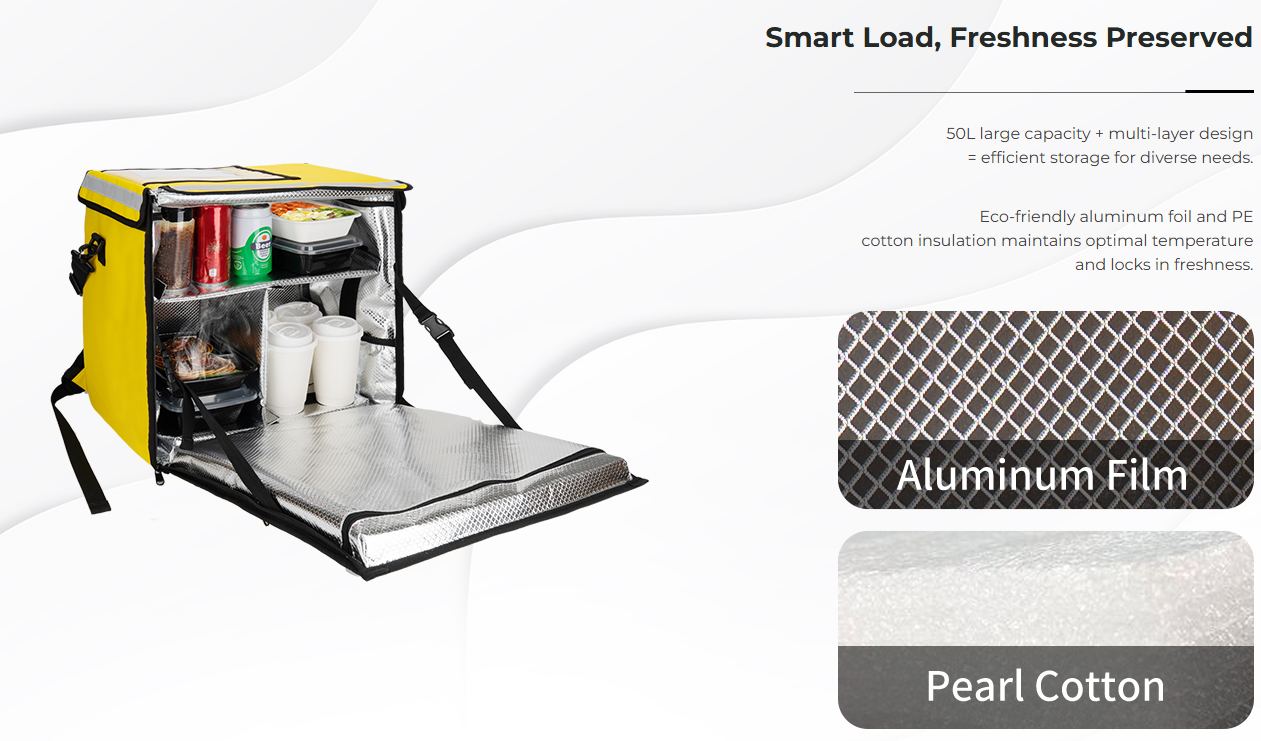
Thermal stability requires a balanced combination of conductive, convective, and radiant heat barriers. Weierken and other leading engineering-focused manufacturers use balanced composite layering to maintain food temperatures above 65°C (149°F) or below 4°C (39°F) for up to 3 to 4 hours:
Outer Shield: 900D to 1680D high-density Oxford polyester coated with waterproof, oil-resistant TPU. This layer repels road dirt, road spray, and abrasive cleaning agents.
Thermal Core: 8mm to 12mm high-density, closed-cell EPE (expanded polyethylene) or cross-linked PE foam. Closed-cell foam resists moisture absorption and maintains structural integrity under repeated compression.
Radiant Barrier: Food-grade aluminum foil laminate or thick aluminum woven composite. This inner skin bounces radiant heat energy back into the chamber instead of letting it escape through the bag walls.
Independent Hot/Cold Thermal Dividers
A ghost kitchen hub regularly pairs orders from a virtual burger brand with an ice-cream or smoothie brand on a single delivery route. Putting these items in the same main compartment spoils both orders.
Vet your OEM's ability to produce modular, thick thermal partition walls. These dividers must feature airtight, insulated perimeter gaskets with heavy-duty side Velcro tracks. When locked into place, the divider creates two isolated micro-climates inside a single bag, stopping temperature migration between hot and chilled food.
4. Industrial Durability and Stress-Point Reinforcement
Livraison fleets treat their gear roughly. Couriers slam bags onto concrete sidewalks, pack them onto motorcycle racks, and open them dozens of times a day. Standard consumer-grade bag components fail within weeks of commercial use.
Commercial Hardware and Zipper Specifications
The zipper is the most common failure point on commercial delivery bags. When a zipper teeth strip pulls apart, the entire carrier is unusable.
Zipper sizing: Require #8 or #10 heavy-gauge nylon coil or molded plastic zippers with water-resistant PU reverse tape. Never accept #5 light-duty zippers.
Cycle fatigue testing: Verify that the manufacturer can supply physical test reports certifying at least 20,000 smooth open-and-close cycles under tension.
Oversized sliders: Specify durable zinc alloy sliders fitted with extended rubber pull tabs so couriers can open the bag while wearing thick riding gloves.
Structural Load-Bearing Bartacking
The total weight of commercial food orders easily tops 15 to 25 kilograms. When couriers lift a full bag by a single shoulder strap or handle, that tension focuses entirely on narrow structural anchor points.
Verify that your OEM uses dense industrial bartack stitching at all high-stress junctions:
Strap-to-body connections must use heavy box-X cross-stitching supported by interior load-dispersal webbing plates.
Base anchor points for motorcycle bracket tie-downs must attach straight to the bag's structural skeleton, not merely through the outer fabric shell.
5. Regulatory Compliance and Factory Vetting Criteria
Building high-performance custom insulated food delivery bags requires working with a verified manufacturing facility, not a broker or trading intermediary. You must evaluate the factory's technical credentials, testing labs, and compliance standards.
Food Contact Safety and Environmental Mandates
Because the inner liner directly faces food packaging in closed, hot, humid chambers, chemical outgassing is a real risk. Your OEM must furnish current lab test reports from accredited bodies (such as SGS, TÜV, or Intertek) confirming compliance with international standards:
FDA 21 CFR 177: Guarantees that internal plastics, films, and coatings are safe for food-contact environments.
EU LFGB & REACH: Restricts hazardous substances, phthalates, plasticizers, and heavy metals.
PFAS-Free Verification: North American and European markets ban per- and polyfluoroalkyl substances (forever chemicals) on waterproof coatings. Your supplier must provide certified PFAS-free durable water-repellent (DWR) fabrics.
Manufacturing Capacity and Quality Assurance (QA) Standards
Launching a multi-city ghost kitchen rollout means managing production runs of 5,000 to 50,000 bags. If an OEM runs out of capacity or ships inconsistent lots, your launch schedule falls apart.
Demand documented factory audits before signing supply contracts:
Qualité Systems: Direct ISO 9001:2015 certification covering incoming raw material inspection (IQC), in-process quality control (IPQC), and final quality control (FQC).
Ethical Audits: Verified third-party BSCI (Business Social Compliance Initiative) or Sedex SMETA social audit reports.
AQL Standards: Production must follow strict MIL-STD-105E / ISO 2859-1 sampling standards, maintaining AQL 1.5 for major defects and AQL 2.5 for minor defects.
Engineering Turnaround Speeds
Speed-to-market matters when opening new virtual kitchens. A well-resourced OEM must offer full internal rapid-prototyping capabilities:
CAD and 3D Patterns: 3 to 5 business days for initial technical drawings, pattern cutting, and CBM freight estimates.
Working Functional Samples: 7 to 10 business days for complete physical prototypes using real production materials for thermal and stress testing.
Frequently Asked Questions
Q1: Why can't ghost kitchens use standard off-the-shelf delivery bags?
Standard delivery bags are built for single brands and single temperatures. Ghost kitchens dispatch multiple virtual menus from one hub, requiring quick-swap brand panels, dual-temperature zones, flat-folding storage frames, and heavy-duty, leak-proof liners that can be sanitized continuously.
Q2: What is the minimum order quantity (MOQ) for custom food delivery bags for ghost kitchens?
For fully custom industrial-grade bags—including custom molds, pantone-dyed fabrics, and custom dimensions—professional OEM bag manufacturers usually set an MOQ between 500 and 1,000 units. Some factories offer lower MOQs (around 200 to 300 units) if you use standard off-the-shelf fabric colors and focus customizations on branding, dividers, and hardware.
Q3: How do OEM manufacturers guarantee that inner liners will not leak?
Reliable OEMs do not stitch the interior tub of the bag. Instead, they use high-frequency radio frequency (RF) heat welding to bond TPU, PVC, or PEVA seams together. This process melts the edges into a single, non-porous layer that holds liquid without leaks.
Q4: How do flat-pack (K/D) bags save on logistics costs?
Fully assembled delivery bags waste container space by shipping air. K/D flat-pack designs use hinge panels and removable stiffeners so the bag folds flat. This design cuts the volume of each unit by 70% to 85%, significantly lowering ocean freight costs per unit and saving room in crowded kitchens.
Q5: Are the fabrics and coatings used in commercial delivery bags safe for food contact?
Yes, provided your OEM adheres to strict compliance protocols. You should require current testing documentation verifying that all interior liner fabrics, foams, and seams meet FDA 21 CFR or EU LFGB standards, and are fully certified as PFAS-free and phthalate-free.
Scale Your Delivery Infrastructure with Weierken
Sourcing commercial custom food delivery bags for ghost kitchens is an investment in operational efficiency, route productivity, and customer retention. Standard consumer-grade bags simply break down under the high-volume demands of digital commissaries. Partnering with an engineering-focused OEM manufacturer protects your food quality and keeps your operations running smoothly.
At Weierken, we engineer and manufacture custom, fleet-grade thermal solutions for virtual restaurant incubators, shared commissary hubs, and major 3PL networks around the world. Our engineering team provides end-to-end design support, rapid physical prototyping within 7 days, and audited manufacturing output that satisfies strict global safety guidelines.
Ready to elevate your delivery fleet's thermal
performance?
Contact the Weierken engineering team today to request
a quote, submit your design specs, or schedule a free engineering consultation
for your custom delivery project.