

.webp "From Tech Pack to Bulk Production: A Guide to Waterproof Beach Tote OEM Services")
The outdoor and resort markets are merging rapidly. Modern consumers want a stylish tote that looks great poolside but also protects cameras, dry clothes, and car keys from crashing ocean waves and heavy downpours. This demand has made waterproof beach bags one of the fastest-growing segments in the lifestyle bag sector.
Yet for brand founders and sourcing managers, turning an artistic sketch into a dependable, factory-ready product is difficult. Standard luggage workshops often fail when working with airtight and waterproof textiles. They treat technical waterproof fabrics like standard cotton canvas, leading to leaking seams, misaligned weld lines, and failed mass runs.
Navigating this complex process requires understanding how an experienced waterproof beach tote OEM operates. Specialized manufacturers like Weierken bridge the gap between creative design and technical production, turning detailed design packages into rugged, market-ready bags. This step-by-step roadmap walks you through each stage of the OEM journey.
Phase 1: Decoding the Tech Pack for Waterproof Beach Totes
Your Technical Package (Tech Pack) acts as the central blueprint for your product. In standard cut-and-sew manufacturing, minor dimensional variances of two or three millimeters rarely cause structural issues. In waterproof bag manufacturing, however, tiny miscalculations can compromise the bag's seal.
A complete tech pack for a waterproof beach tote OEM must contain several critical specifications:
- Precise Dimensions and Radii: Unlike stitched bags that allow sharp 90-degree corner turns, high-frequency welded bags require specific corner radiuses (usually 5mm to 15mm) to distribute welding pressure evenly.
- Detailed Bill of Materials (BOM): Specify base fabrics, internal linings, exterior coatings (TPU, PVC, or PU), webbings, and hardware down to the exact millimeter thickness and gram weight.
- Welding Callouts vs. Stitch Callouts: Clearly designate which seams require radio-frequency welding for waterproofing, and which secondary components (like interior hanging organizer sleeves) can use standard stitching.
- Logo and Branding Execution: Clarify whether logos require high-frequency debossing, screen printing with solvent-resistant inks, or heat-welded silicone patches.
The most common mistake brands make is sending a tech pack created for cotton canvas or stitched nylon. Stitched bags rely on needle seam allowances that simply do not work on welded thermoplastic components.
Phase 2: Selecting Materials and Waterproof Technologies
Material selection defines both your retail pricing and your bag's real-world performance. A qualified waterproof beach tote OEM helps you evaluate the trade-offs between cost, weight, aesthetic appeal, and environmental footprint.
| Material Type | Primary Seam Method | Environmental Footprint | Durability & Flex Life | Relative Cost Index |
|---|---|---|---|---|
| 500D PVC Tarpaulin | High-Frequency (HF) Welding | Traditional (Contains Phthalates) | High puncture resistance, stiff in cold | Economy ($) |
| TPU-Coated Recycled Polyester | HF / Hot-Air Welding | Sustainable (GRS Certified, Non-Toxic) | Exceptional flex life, abrasion-proof | Premium ($$$) |
| EVA Film Laminates | Thermal Press / Welding | Chlorine-Free / Recyclable | Lightweight, moderate scratch resistance | Moderate ($$) |
Choosing the Right Seam-Joining Technology
Waterproof totes generally rely on two primary assembly methods:
- High-Frequency (HF) Welding: This is the gold standard for waterproof bags. The machine passes electromagnetic radio waves through the overlapping thermoplastic layers, melting and fusing the molecules into a single, permanent bond. It eliminates needle holes entirely.
- Stitched and Taped Seams: The factory stitches the bag with heavy-duty thread, then applies a hot-melt waterproof tape over the needle line. While cheaper for intricate fashion shapes, seam tape can peel over multiple seasons of UV exposure and salt water immersion.
Hardware and Closure Selection
For beach totes, closures dictate the level of water protection. Splashproof molded plastic zippers handle wind-driven rain and ocean spray effectively. If your target customer intends to toss their tote onto stand-up paddleboards or into open dive boats, your waterproof beach tote OEM should integrate an airtight, pressure-tested IPX7 submersible zipper instead.
Phase 3: Prototyping and Engineering Validation
Once the engineering team reviews your tech pack, production moves into the physical sampling stage. Developing an authentic waterproof bag requires multiple testing cycles before authorizing mass tooling.
Specialized manufacturers like Weierken execute prototyping through three structured steps:
- First-Article Pattern Prototype: The pattern maker creates cardboard or digital CAD die-lines to verify bag proportion, handle drops, and general ergonomics.
- Welding Tooling Development: Engineers build custom brass or aluminum welding electrodes (tooling molds) shaped to your specific bag contours and seam paths.
- The Golden Sample (Pre-Production Sample): This sample uses your actual specified custom-dyed fabrics, printed logos, and production-grade hardware. It serves as the baseline quality standard for mass manufacturing.
Mandatory Pre-Production Performance Tests
Never approve a golden sample without verifying factory test data:
- Handle Tensile Pull Test: The bag is loaded with 15 to 25 kilograms of steel shot and suspended by its handles for 24 hours to ensure weld points do not tear.
- Hydrostatic Water Pressure Test: Seams are placed under pressurized water columns to confirm they withstand water ingress without weeping.
- UV and Salt Spray Exposure: Hardware and fabrics sit inside environmental test chambers to confirm they will not discolor, rust, or crack after long days in the sun.
Phase 4: The Bulk Production Workflow
After your team approves the pre-production sample, mass production begins. Managing a commercial run of technical bags requires tight process control at every station.
1. Incoming Quality Control (IQC)
Bulk fabric rolls undergo automated inspection to check coating thickness uniformity, color consistency across dye lots, and base fabric tensile strength. Defective rolls get rejected before hitting the cutting tables.
2. CNC Laser and Die Cutting
Waterproof welding tolerates zero edge fraying. Advanced factories use CNC automated laser cutters or heavy hydraulic presses to slice fabric panels. Smooth, sealed cut edges ensure clean weld seams and zero water leakage.
3. Dedicated Tooling Welding Stations
Technicians mount the custom welding molds into high-frequency presses. Workers align panels using guide jigs to ensure millimeter-accurate placements for base inserts, exterior pockets, and shoulder straps.
4. In-Line Quality Control (IPQC) and Packaging
Inspectors pull bags directly from the assembly line throughout the shift to run air-pressure decay tests. Once finished, bags undergo final cosmetic audits based on standard Acceptable Quality Limit (AQL 2.5/4.0) guidelines before packing into moisture-barrier cartons.
Phase 5: How to Select the Right Waterproof Beach Tote OEM
Choosing an inexperienced factory can lead to delayed seasonal deliveries and compromised waterproof quality. Sourcing teams should audit candidate suppliers against four operational benchmarks:
- In-House Tooling and Welding Capacity: Does the factory operate its own radio-frequency welding machinery, or do they outsource critical bonding steps to sub-tier workshops? Keeping tooling in-house ensures tighter quality control.
- International Regulatory Certifications: Look for factories with active ISO 9001, BSCI, SEDEX, and GRS (Global Recycled Standard) credentials to protect brand compliance.
- Transparent Prototyping Timelines: A reliable partner delivers initial samples within 7 to 14 days and provides helpful Design for Manufacturability (DFM) feedback.
- Dual-Country Footprint: Look for partners who maintain
engineering centers alongside diversified production facilities in Southeast
Asia (such as Cambodia) to help minimize import tariffs.
Frequently Asked Questions (FAQ)
Q1: What is the typical Minimum Order Quantity (MOQ) for custom waterproof beach tote OEM services?
A1: Standard production runs usually require an MOQ of 500 to 1,000 units per colorway. This minimum is primarily driven by fabric dye lots and the setup time required to calibrate high-frequency welding machines. Some factories accept smaller runs of 300 units if you choose in-stock fabric colors.
Q2: How long does the process take from tech pack sign-off to finished bulk delivery?
A2: Prototyping and tooling fabrication typically take 15 to 25 days. Once you approve the pre-production sample, bulk manufacturing takes roughly 35 to 45 days. You should also budget 20 to 35 days for ocean freight depending on your destination port.
Q3: Can an OEM factory build a proper tech pack if my brand only has an initial design sketch?
A3: Yes. Experienced manufacturers like Weierken provide comprehensive ODM/DFM support. Their technical pattern engineers can take clean hand drawings, mood boards, and target dimensional outlines, then convert them into fully specified CAD tech packs with complete BOM listings.
Q4: What is the cost difference between high-frequency welding and traditional stitched assembly?
A4: Welded bags generally cost 15% to 30% more to produce initially. This difference stems from upfront custom tooling costs (molds run $400 to $1,500 depending on complexity) and the specialized labor required to operate radio-frequency equipment. However, welding eliminates seam taping steps and significantly reduces product return rates.
Q5: Can our brand add internal slip pockets and zip compartments to an HF-welded tote?
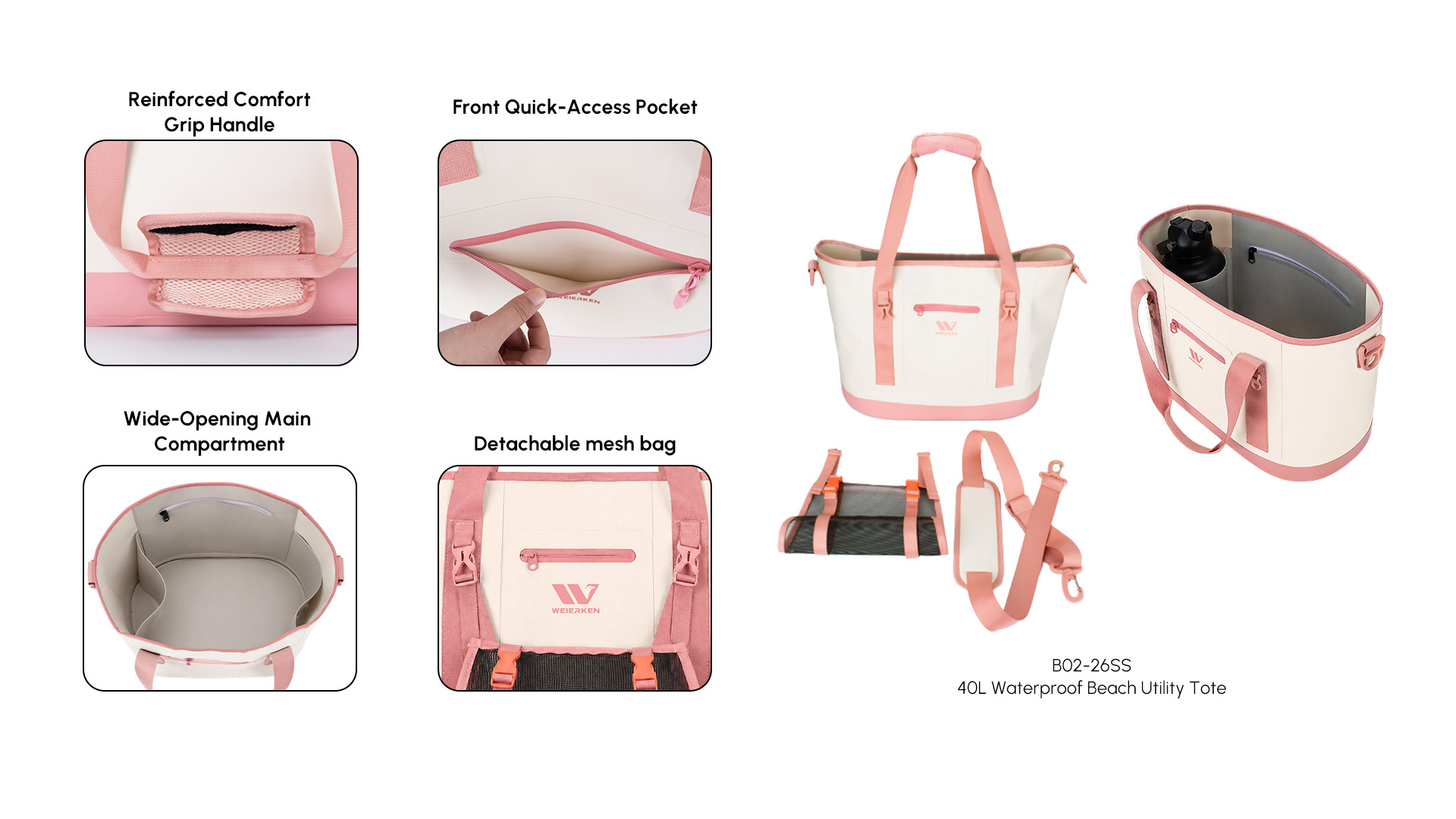
A5: Yes. An OEM factory can attach interior pockets by welding secondary mounting patches to the inside panels before assembling the main body, or by stitching organizer pockets onto a hanging welded collar. This approach keeps interior items organized without creating needle holes through the outer waterproof shell.
Build Your Next Collection with a Proven Manufacturing Partner
Transitioning from an initial tech pack to a successful mass production run requires more than just standard bag assembly. It demands material chemistry expertise, precision tooling, and rigorous testing at every stage. Finding a specialized waterproof beach tote OEM ensures your products survive sand, saltwater, and heavy use while safeguarding your profit margins.
Weierken helps consumer brands, resort chains, and outdoor labels bring technical waterproof bags to market. With 20 years of technical manufacturing experience, advanced high-frequency welding lines, and dual-hub production capabilities, we ensure your designs hit the market on schedule and perform without failure.
Have a tech pack or design sketch ready for review? Contact the Weierken engineering team today to schedule your complimentary Design for Manufacturability (DFM) review and request a detailed OEM production quote.