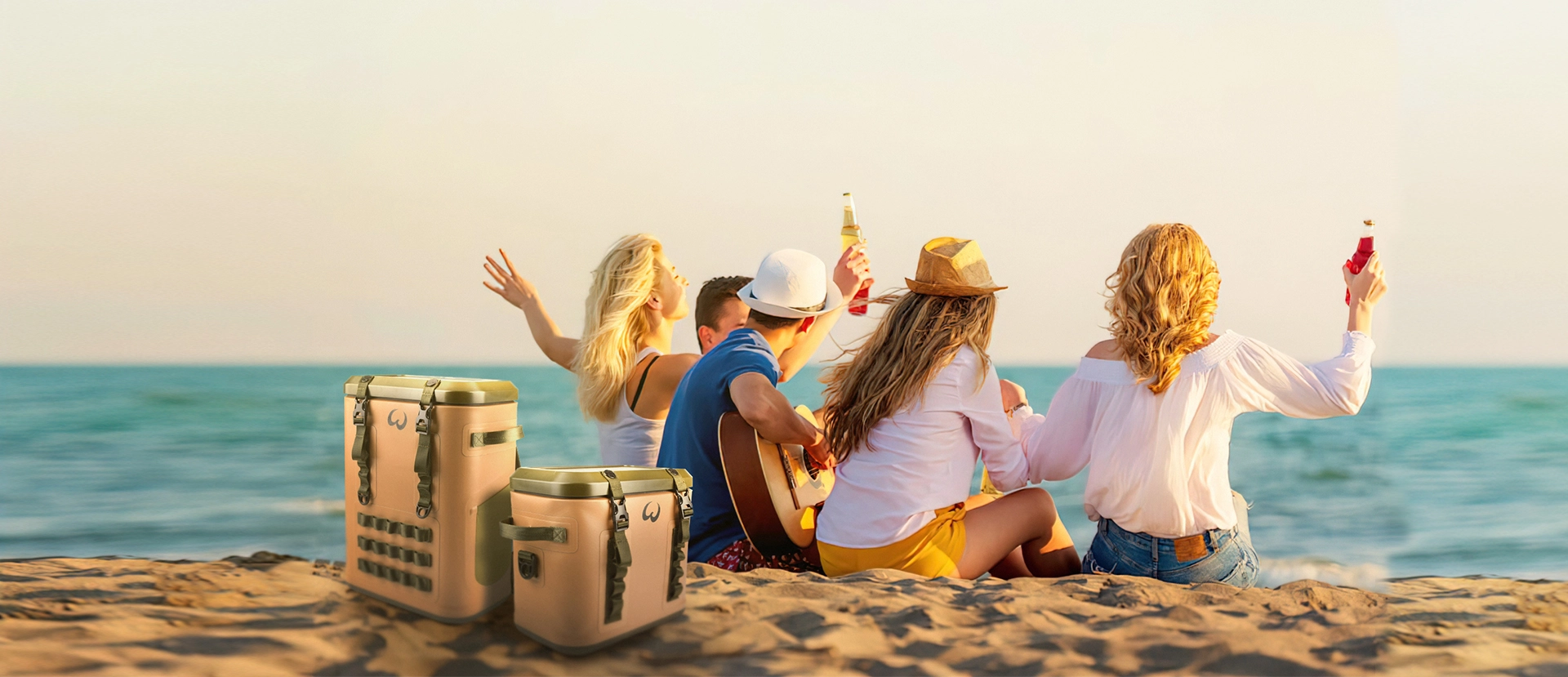
For food and beverage brands, a cooler bag is more than a simple delivery tool. It serves as a vital carrier for product quality and a physical representation of your brand identity. Whether you run a fresh food e-commerce platform, a supermarket chain, a coffee brand, or a ready-to-eat meal business, your choice of a cooler bag fabricator impacts your customer experience and operational costs.
A reliable cooler bag fabricator like Weierken understands that a failed bag means spoiled food and a damaged reputation. This guide will help you systematically screen manufacturers to find a partner that meets the rigorous demands of the food and beverage industry.

I. Define Your Core Business Requirements
Before you start contacting a cooler bag fabricator, you must define your specific logistics scenarios. Without clear parameters, you risk overspending on features you don’t need or, worse, buying bags that fail in the field.
Product Category and Temperature Zones
Identify exactly what you are transporting. Dairy products like fresh milk and yogurt require a 0-4°C refrigerated environment. Ice cream and frozen seafood need temperatures at or below -18°C. Hot meals require heat retention above 60°C. Some brands even require multi-zone bags that can carry hot and cold items simultaneously.
Delivery Duration and Frequency
How long is your typical delivery window? Is it a 30-minute short-hop, a 2-hour city-wide trip, or a 6-hour cross-city journey? The duration determines the thickness of the insulation. Additionally, consider if the bag is for single use or high-frequency reuse. Daily use demands higher durability and better-reinforced stitching.
Brand Visibility and Special Features
Cooler bags are moving billboards. You should decide if you need full-surface printing, specific Pantone color matching, or high-end embroidery for your logo. Beyond aesthetics, think about functionality. Do you need leak-proof liners for soups, ice pack compartments for easy swaps, or slots for temperature loggers to ensure traceability?
II. Evaluate Material Safety and Food-Grade Compliance
Because these bags come into close proximity to food, material safety is your baseline requirement. A professional cooler bag fabricator must prioritize non-toxic, compliant materials.
- Food-Grade Liner Certifications: Ensure the liner materials meet FDA (US), LFGB (Europe), or GB 4806 (China) standards. Ask the manufacturer for third-party test reports. These documents confirm the absence of heavy metals, plasticizers, and formaldehyde.
- Insulation Safety: The insulation layer, typically PE cotton or EVA, should be odorless. Some low-quality materials release harmful gases when exposed to heat. A reputable cooler bag fabricator will provide a material composition declaration.
- Eco-Friendly Options: Many consumers now prefer sustainable brands. Ask if the manufacturer offers rPET (recycled polyester) fabrics, bio-based insulation, or biodegradable liners to align with your CSR goals.
III. Verify Thermal Performance and Structural Design
The core function of the bag is temperature maintenance. You cannot rely on verbal promises; you need empirical proof.
Request Thermal Testing Reports
A competent cooler bag fabricator should provide reports based on ASTM D3103 standards. These reports show how long the bag maintains a target temperature (like 0-4°C) in a specific ambient temperature (like 35°C). Review the temperature curves to see the safety margin.
Selection of Insulation Materials
Understand the hierarchy of materials. Standard PE cotton is suitable for short trips. High-density EVA works well for mid-range deliveries of 2 to 4 hours. For long-distance cold chain logistics, a specialized cooler bag fabricator might suggest Vacuum Insulation Panels (VIP) or Phase Change Materials (PCM).
Multi-Layer Composite Structures
Effective bags usually feature a three-layer system:
- Outer Layer: Wear-resistant fabric like Oxford cloth or heavy-duty polyester.
- Middle Layer: High-density thermal foam for heat resistance.
- Inner Layer: Reflective aluminum foil or food-grade PEVA to minimize radiation heat transfer.
IV. Inspect Sealing and Leak-Proof Craftsmanship
Sauce leakage or condensation seepage is a major source of customer complaints. Your cooler bag fabricator must use advanced sealing techniques to prevent these issues.
- Seamless Construction: Look for high-frequency welding or heat-pressing. Traditional sewing leaves needle holes where liquids and cold air can escape. Seamless liners ensure that even if a container breaks, the mess stays inside the bag.
- Zipper Integrity: The zipper is often the weakest point for heat loss. Check if the manufacturer uses waterproof zippers like YKK AquaGuard® or if they include an insulated flap over the zipper line.
- Reinforced Bottoms: A heavy load of drinks or frozen meat can stress the bottom seams. Ask for reinforced bases with additional leak-proof layers or drainage holes to manage condensation from ice packs.
V. Assess Durability and Manufacturing Details
In a high-volume food delivery business, bags take a beating. They are tossed into bikes, dragged across counters, and overstuffed. Durability directly affects your long-term replacement costs.
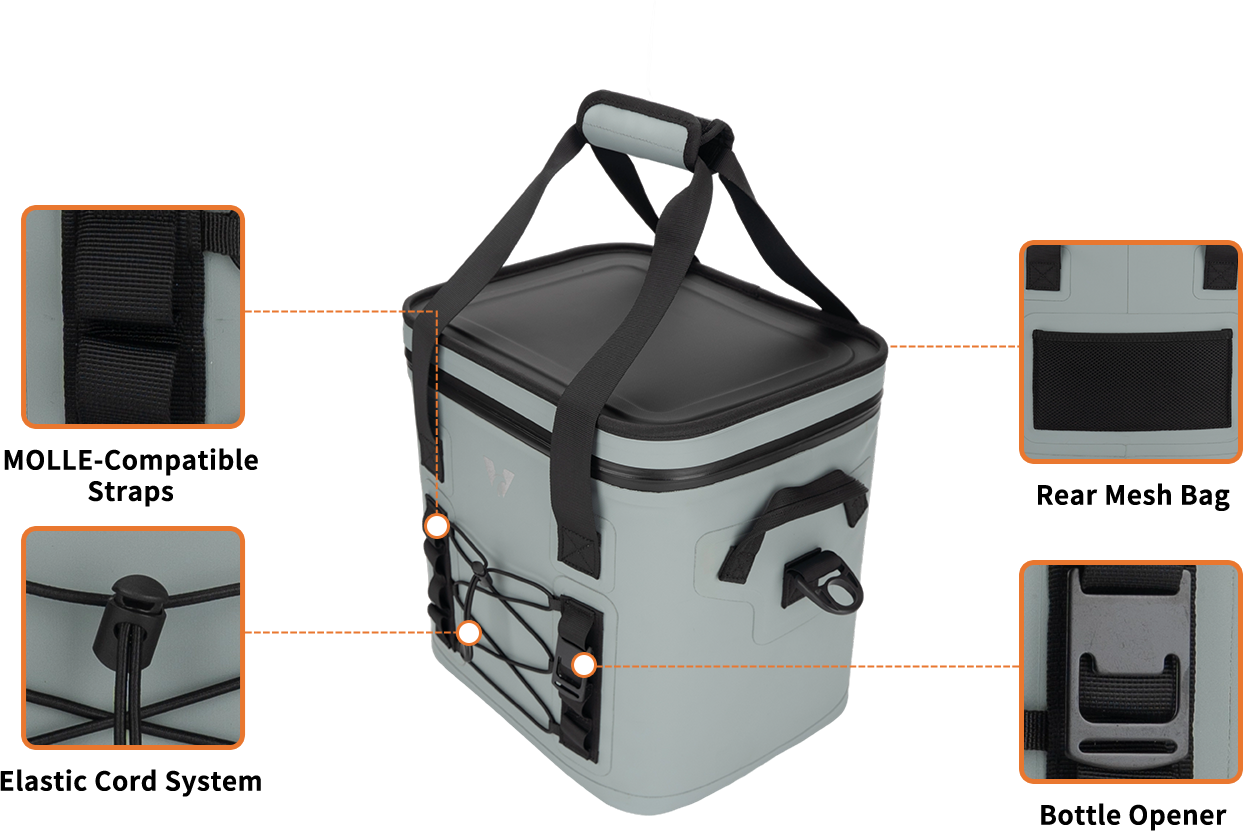
- Stress Point Reinforcement: Examine the handles and shoulder strap connections. A high-quality cooler bag fabricator uses bar-tacking, multi-layer stitching, and internal reinforcement patches at these high-tension areas.
- Fabric Denier: Higher denier counts (like 600D or 1680D Oxford) indicate thicker, more durable fabric. This resists tears and abrasions during daily use.
- Stitching Consistency: Look for neat, even stitching with no loose threads. Generally, a professional standard is 3 to 5 stitches per centimeter. Ask for load-bearing test reports where a full bag is repeatedly lifted to check for seam failure.
At Weierken, we emphasize these small details because we know that a single broken handle can disrupt an entire delivery route.
VI. Audit Customization and Service Capabilities
Every brand has a unique voice. Your cooler bag fabricator should be a partner in design, not just a factory that churns out generic products.
OEM Customization
This involves adjusting standard designs to fit your brand. Can they match your specific brand colors? Can they adjust the size to fit your specific pizza boxes or milk bottles? Confirm their Minimum Order Quantity (MOQ) for custom colors and logo printing.
ODM Development
If you need a completely new bag from scratch, you need a cooler bag fabricator with a strong R&D team. They should help you move from a concept sketch to a functional prototype. Discuss the turnaround time for sampling and how many rounds of revisions are included in the development fee.
- Visual Identity: Support for heat transfer, silk-screen printing, or 3D rubber patches.
- Functional Innovation: Capability to design foldable structures for easy storage or modular bags with detachable dividers.
VII. Verify Quality Control and Supply Chain Stability
Stable delivery is the lifeblood of the food industry. You cannot afford to have your bags delayed or to receive a batch that doesn’t match the sample.
- Quality Management Systems: Is the factory ISO 9001 certified? Do they perform Incoming Quality Control (IQC), In-Process Quality Control (IPQC), and Final Quality Control (FQC)?
- In-House Testing Equipment: Does the cooler bag fabricator own constant-temperature chambers, tensile testing machines, and hydrostatic pressure testers? If they have these on-site, they can monitor quality in real-time.
- Capacity and Lead Times: Check their monthly production capacity. Can they handle a sudden surge in orders during the holiday season? Ensure there is a clear penalty clause in the contract for significant delivery delays.
VIII. Sample Validation and Trial Orders
Never sign a major contract without a trial run. The sample is the ultimate proof of the fabricator’s skill.
- Request a Custom Sample: It should include your specific logo, color, and functional requirements.
- Conduct Real-World Thermal Tests: Use your own products. Place a temperature logger inside and leave it in your typical delivery environment.
- Perform the “Mess Test”: Pour liquid inside the bag and shake it to check for leaks. Smear sauce on the liner and see how easily it wipes off without leaving a smell.
- Batch Consistency Check: Once you are happy with the sample, start with a small trial order. Compare the mass-produced units to the original sample to ensure no “quality fade” occurred.
Frequently Asked Questions
1. Can a cooler bag fabricator help with the initial design?
Yes, many professional fabricators have in-house design teams. They can suggest materials and structures based on your target temperature and budget. They often provide 3D renderings before creating a physical sample.
2. What is the typical MOQ for a custom-printed cooler bag?
MOQs vary by manufacturer. Usually, for basic logo printing on a standard bag, it might be 100-300 pieces. For custom colors and unique shapes, a cooler bag fabricator might require 500 to 1,000 pieces.
3. Are there bags that can keep food hot and cold at the same time?
Yes. Designers can create multi-compartment bags using different types of insulation or thermal barriers. This allows a delivery driver to carry a hot pizza in one section and a cold soda in another without temperature transfer.
4. How do I clean and sanitize delivery bags?
Most bags feature PEVA or PVC liners that are easy to wipe down with disinfectant. Some high-end manufacturers use antimicrobial coatings on the liner to inhibit the growth of bacteria and mold between cleanings.
5. What is the difference between PE cotton and EPE foam?
PE (Polyethylene) cotton is softer and more flexible, making it good for lightweight bags. EPE (Expanded Polyethylene) foam is more rigid and offers better structural support and slightly higher thermal resistance. Your cooler bag fabricator can recommend the best option based on your bag’s shape.
6. Can a cooler bag be made waterproof from the outside?
Yes. Using materials like PVC tarpaulin or adding a TPU coating to Oxford fabric makes the exterior waterproof. This is essential for delivery drivers using bikes or scooters in rainy weather.
Choosing the right cooler bag fabricator is a strategic investment in your brand’s future. By focusing on material safety, thermal precision, and manufacturing durability, you ensure that every meal reaches your customer exactly as intended.
Weierken combines years of industry experience with a commitment to high-quality craftsmanship. We work closely with food and beverage brands to develop solutions that are as beautiful as they are functional.
Ready to find the perfect cooler bag solution for your brand?
Inquire today to speak with our technical experts. We can provide custom quotes, material consultations, and help you design a bag that strengthens your brand’s logistics.
[Click Here to Send Your Inquiry]