
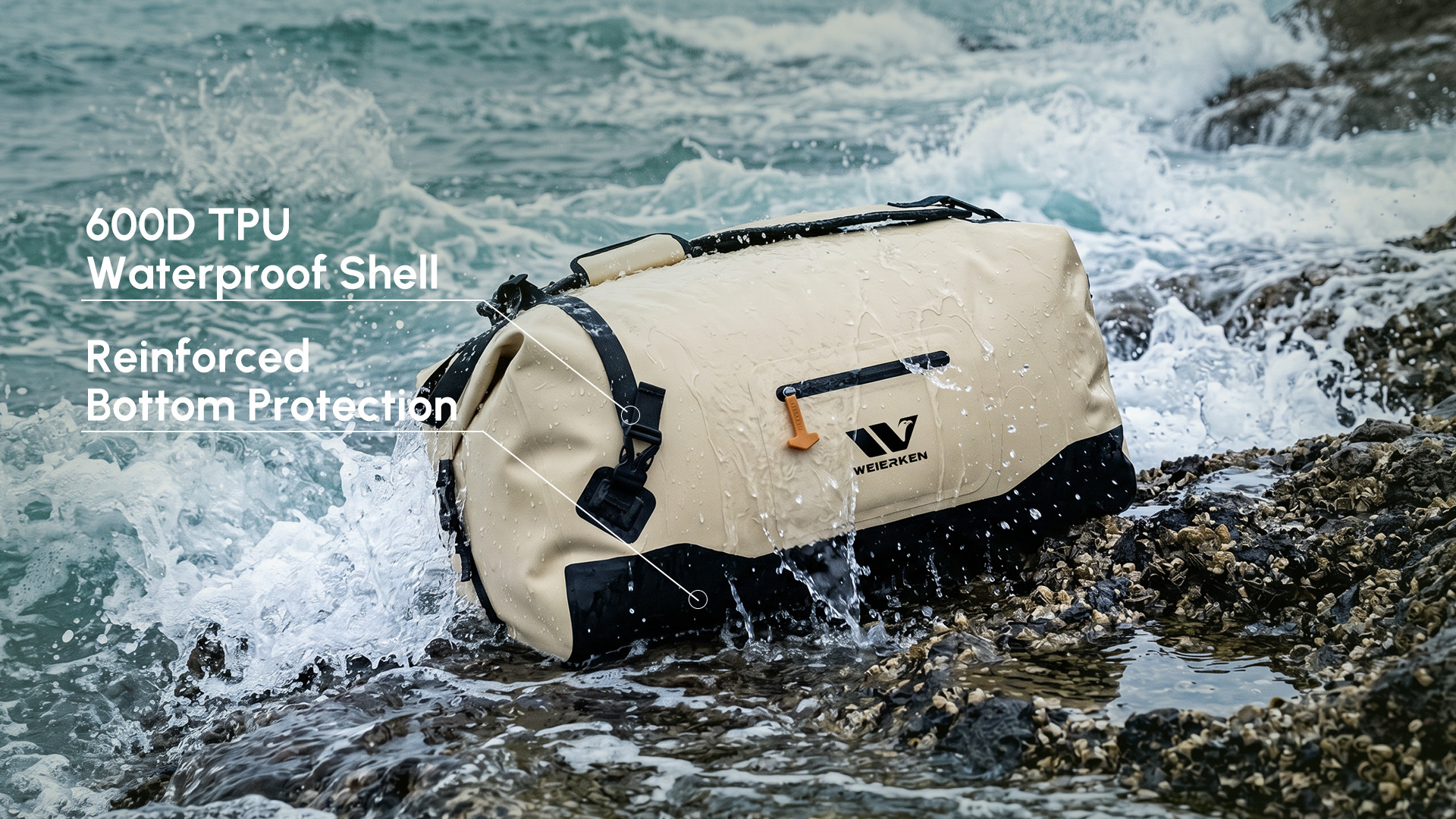
The open ocean shows no mercy to inferior gear. Salt spray corrodes hardware, relentless UV rays degrade cheap plastics, and intense wave pressure forces water through the smallest stitching holes.
For outdoor brands, marine equipment distributors, and private label owners, selecting the wrong production partner leads to catastrophic product failures. Glue peeling, seam delamination, delayed deliveries, and unpredictable tariffs can destroy your profit margins and brand reputation.
Navigating these manufacturing hurdles requires an experienced partner. With over 20 years of technical expertise in outdoor and waterproof bag manufacturing, Weierken builds extreme-grade marine gear designed to withstand the toughest ocean conditions while keeping your supply chain stable.
The Brutal Reality of Marine Environments & Industry Sourcing Pain
Points
Marine bags operate in extreme environments. Unlike standard hiking dry sacks, marine-grade bags face constant hydrostatic pressure, salt crusting, rough deck abrasion, and prolonged sun exposure.
B2B buyers routinely run into major operational friction when sourcing these technical products overseas:
Delamination and Seam Failure: Poorly regulated heat-sealing causes seams to peel after exposure to saltwater and sunlight.
Water Seepage at Pressure Points: Standard zippers and cheap stitched construction leak when submerged or splashed under high pressure.
Late Delivery & Supply Chain Disruptions: Unreliable factories miss seasonal sales windows, leaving brands without inventory during peak boating months.
Heavy Import Tariffs: Shifting international trade policies add unexpected duty costs, crippling gross margins for importers in Western markets.
Overcoming these challenges requires an established marine waterproof bag manufacturer that masters advanced material science and maintains strict supply chain control. That is where Weierken steps in.
Material & Technical Mastery: Achieving True IPX8 Waterproofing
Building a genuine IPX8 waterproof bag requires moving beyond traditional cut-and-sew methods. It demands precise material selection and high-frequency bonding techniques.
TPU vs. PVC: Choosing the Right Marine Material
Material selection forms the first line of defense. While traditional Polyvinyl Chloride (PVC) offers a low-cost entry point, Thermoplastic Polyurethane (TPU) serves as the premium industry standard for marine applications.
TPU (Thermoplastic Polyurethane): Offers superior abrasion resistance, high flexibility in cold temperatures, excellent UV stability, and eco-friendly recyclability. It resists cracking even after long-term exposure to salt spray.
PVC (Polyvinyl Chloride): Cost-effective and durable, making it suitable for heavy-duty commercial dry bags. However, it is heavier and less pliable in cold conditions.
Weierken helps brand owners select the ideal fabric weight—ranging from 210D TPU to 840D heavy-duty TPU laminated nylon—tailored directly to your target price point and performance requirements.
High-Frequency RF Welding and Airtight Zipper Craftsmanship
To achieve an IPX8 rating (guaranteeing protection against continuous submersion beyond 1 meter), needle holes must be eliminated entirely. We use advanced High-Frequency (Radio Frequency) Welding and Hot-Air Seam Sealing technologies.
RF welding melts the chemical molecules of TPU or PVC coatings under high pressure, fusing fabric panels into a single, continuous bond. This seam becomes stronger than the surrounding material itself.
For main compartment openings, we integrate airtight/watertight zippers featuring precise TPU hot-pressing. This construction locks out atmospheric pressure and prevents liquid entry even during deep immersion.
Solving Complex Technical Challenges with 99.5% First-Pass Yield
Watertight construction leaves no room for error. A micro-gap of 0.1mm causes air leakage, ruining the bag's performance.
Weierken solves complex structural and sealing challenges through custom tooling mold designs and automated welding setups. Our internal quality control team tests every batch using automated air-inflation pressure tests and deep-water immersion chambers.
By enforcing rigid quality control across every production line, Weierken maintains a 99.5% first-pass yield rate. This high standard minimizes warranty returns and protects your brand image on retail shelves.
Fast-Track R&D and Precision Sampling for Rapid Market Entry
Speed to market determines success in today's competitive outdoor industry. Launching a marine product line requires rapid prototyping and market-aligned design iterations.
As an agile marine waterproof bag manufacturer, Weierken acts as a proactive product design partner rather than a passive assembly plant.
In-House R&D Driven by Market Insight
Our dedicated R&D team continuously tracks marine design trends, ergonomic harness advancements, and functional hardware innovations. When you bring us a concept or a rough sketch, our engineers evaluate structural feasibility, stress points, and waterproofing efficiency.
We offer actionable engineering advice that trims unnecessary production costs while enhancing product durability and aesthetic appeal.
High-Precision Sampling Room
Testing product performance quickly allows you to secure pre-orders and validate sales channels early. Our high-precision sampling workshop runs dedicated production machinery separate from our main assembly lines.
Standard Outdoor Backpacks: Prototype delivery within 3 to 7 days.
Complex Marine Waterproof Bags: Fully sealed, airtight dry bag prototypes ready in 12 to 30 days.
This rapid turnaround enables brand managers to hold physical samples, perform real-world field tests, and make revisions weeks ahead of schedule.
Strategic Dual-Base Supply Chain: China + Cambodia Advantage
Modern B2B buyers must mitigate geopolitical risks, rising labor costs, and unpredictable tariff spikes. Relying on a single manufacturing origin introduces significant business vulnerabilities.
Weierken operates a strategic dual-factory production model across China and Cambodia, giving our partners total flexibility and risk diversification.
China + Cambodia Dual-Base Production Model
Our long-established China manufacturing facility serves as our technical innovation hub, raw material sourcing engine, and high-complexity bag production base.
Our Cambodia manufacturing facility provides massive scalable capacity for high-volume orders. It offers long-term delivery stability and insulates your business from localized production bottlenecks.
Substantial Duty and Tariff Savings
Shipping custom marine bags out of our Cambodia facility enables qualified buyers in North America and Europe to leverage preferential trade programs (such as GSP and EBA status). This setup reduces or completely eliminates punitive tariff surcharges.
This tariff savings directly improves your bottom line, giving you a distinct pricing advantage over competitors reliant solely on single-country sourcing.
Seamless Door-to-Door DDP Logistics
Managing international ocean freight, custom brokerage, and import documentation can drain your internal resources. Weierken eliminates logistics complexity by offering comprehensive Door-to-Door Delivered Duty Paid (DDP) shipping services.
We handle export customs, ocean transport, import clearance, duty payments, and final door delivery. Buying custom bags from our overseas facilities feels as straightforward as ordering from a local supplier.
Global Compliance and Seamless B2B Collaboration
Top outdoor retailers and enterprise brands enforce strict social compliance, chemical safety, and ethical factory standards. Partnering with a fully certified factory prevents costly compliance roadblocks later on.
International Factory Certifications and Environmental Standards
Weierken maintains rigorous global production benchmarks to simplify your vendor onboarding process:
BSCI & SEDEX: Guarantees fair working conditions, ethical labor standards, and safe factory environments.
ISO 9001: Validates standardized quality management across all operational departments.
REACH Compliance: Ensures raw materials contain zero toxic chemicals or banned substances.
GRS & rPET Options: Supports eco-friendly production using certified Global Recycled Standard fabrics made from post-consumer recycled plastics.
An Extension of Your Internal Engineering Team
Clear communication stops manufacturing mistakes before they happen. With two decades of global account management experience, Weierken operates as a seamless extension of your product design team.
Our bilingual project managers communicate fluently in English, providing transparent milestone reporting, production timeline updates, and direct video walkthroughs. We eliminate time-zone friction and give you complete control over your order progress.
Ready to Scale Your Marine Waterproof Bag Line?
Choosing the right marine waterproof bag manufacturer transforms your supply chain into a competitive advantage. Whether you need custom OEM production, duty-free manufacturing out of Cambodia, or rapid prototype turnaround, Weierken brings the equipment and experience you need.
Take the next step toward upgrading your outdoor product line:
Request a Precision Sample: Send us your design files or product specs. Receive your fully custom marine bag prototype in 12 to 30 days.
Request a Duty & Tariff Assessment: Speak with our logistics experts to calculate how much our Cambodia production base can save you on import duties.
Request Audit & Compliance Reports: Review our latest BSCI, GRS, REACH, and ISO documentation to verify our facility standards.
Contact the Weierken engineering team today to request a quotation and discuss your custom manufacturing project.
Frequently Asked Questions
1. What makes a bag marine-grade waterproof compared to standard dry bags?
Marine-grade waterproof bags utilize heavy-duty TPU or PVC fabrics combined with High-Frequency (RF) welded seams and specialized airtight zippers. Unlike basic light-splash dry sacks, marine bags withstand prolonged submersion, high hydrostatic water pressure, continuous salt exposure, and harsh deck abrasion without leaking.
2. Why should we choose TPU instead of PVC for custom marine bags?
TPU provides superior abrasion resistance, higher tensile strength, and better UV stability than PVC. It stays flexible in freezing conditions and does not crack over time. Additionally, TPU is environmentally friendlier and easier to recycle, making it the preferred material for premium outdoor and marine brands.
3. How does Weierken's China + Cambodia dual-factory model lower tariff costs?
By producing high-volume orders in our Cambodia facility, buyers in regions like the US and EU can utilize preferential trade agreements (such as GSP/EBA eligibility). This configuration allows importers to bypass high single-country tariffs, lowering landed costs and improving profit margins.
4. How long does it take to get a custom marine waterproof bag sample?
For standard outdoor backpacks, our high-precision sampling room finishes prototypes in 3 to 7 days. For complex IPX8 marine bags requiring custom tooling, airtight zipper fitting, and RF welding, sample delivery takes between 12 and 30 days.
5. How does Weierken verify IPX8 waterproofing during production?
We execute strict quality control tests on raw material coatings and finished seams. Every batch undergoes automated air-inflation pressure retention tests and deep-water chamber immersion testing. This rigorous QC process enables us to achieve a 99.5% first-pass yield rate.
6. What is the minimum order quantity (MOQ) for custom OEM orders?
MOQs depend on material specifications, fabric custom colors, and bag complexity. Generally, custom production runs start at 500 to 1,000 units per style. Contact our sales team with your tech pack to receive specific MOQ guidance tailored to your design.