

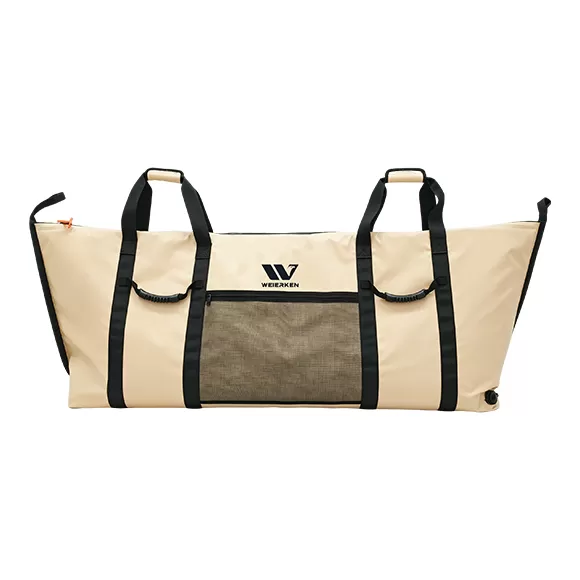
Anglers no longer settle for bulky, rigid plastic ice chests that clutter boat decks and slide around during transit. Modern fishermen want portable, durable, and space-saving gear that preserves their catch at peak freshness. This shift has driven massive demand for soft-sided, marine-grade fish kill bags across coastal and freshwater markets alike.
For fishing tackle brands, outdoor gear startups, and marine retailers, capitalising on this shift requires more than just buying generic gear off the shelf. Weak materials, substandard stitching, and leaky seals can quickly destroy a brand's reputation. Sourcing products from a proven insulated catch bag supplier like Weierken gives you access to industrial engineering and consistent production standards.
Selecting the right factory partner allows you to bring competitive, performance-tested products to market without building your own production plant. This guide covers how professional OEM and ODM frameworks operate, the core technical details required for marine coolers, and how to evaluate contract manufacturers effectively.
Understanding OEM vs. ODM for Insulated Catch Bags
Before launching a new product line, you must decide which manufacturing model matches your company's technical abilities, timeline, and budget. Professional factories usually operate under two distinct frameworks: OEM and ODM.
OEM Model: Contract Manufacturing for Established Designs
Original Equipment Manufacturing (OEM) works best for brands that have dedicated product designers and complete technical specifications. You supply the blueprints, 2D/3D CAD models, material requirements, and bill of materials (BOM).
The factory works as your pure production arm. They handle raw material sourcing, mold fabrication, radio-frequency (RF) welding, assembly, and quality verification. Choosing this path gives you complete control over dimensional tolerances, ergonomic handles, zipper paths, and insulation thickness.
ODM Model: Private Label and Turnkey Design
Original Design Manufacturing (ODM) suits brands that want to enter the market fast without investing heavy capital into early R&D. An experienced custom fish kill bag manufacturer maintains an archive of battle-tested, pre-engineered patterns.
Under an ODM agreement, you select an existing base bag and apply your visual brand identity. You can modify exterior shell colours, specify custom logos, alter pocket configurations, and select zipper grades. This process slashes lead times and eliminates initial mold development costs.
Which Model Fits Your Brand Strategy?
- Choose OEM if: You hold proprietary patents, target unique watercraft (such as specialized kayak decks), or want distinct dimensions that differentiate your product line from competitors.
- Choose ODM if: You want to expand your current catalog within weeks, reduce upfront engineering expenses, or test seasonal market demand with manageable investment.
Key Customization Features Demanded by Modern Anglers
Anglers subject their gear to brutal conditions. Saltwater spray, blazing sun, sharp fish teeth, dorsal fins, and heavy ice loads will rapidly ruin cheap coolers. Your production partner must provide commercial-grade components capable of withstanding open-water abuse.
Puncture-Resistant, Marine-Grade Fabrics
Durable catch bags depend on rugged base textiles. Standard polyester with cheap PU coating will peel and tear under typical fishing conditions. High-performing bags use heavy-duty coated composites instead.
- 840D to 1000D TPU-Coated Nylon: High-end bags rely on thermoplastic polyurethane (TPU). It provides unmatched abrasion resistance, stays flexible in freezing temperatures, and resists punctures from sharp spines.
- Heavy-Duty Tarpaulin (500D - 1000D PVC): A dependable, cost-effective industrial standard. Commercial PVC tarpaulin offers complete waterproof protection, UV stability, and quick-cleaning surfaces.
- Food-Contact Safe Interior Liners: Catch bags hold fish intended for dinner tables. Liners must use non-toxic, BPA-free, FDA-compliant, or REACH-certified materials that resist bacterial build-up and will not hold fishy odours.
Thermal Insulation and High-Frequency Welding
Stitching needle holes directly into cooler bags creates leak points and lets cold air escape. A premier marine-grade catch bag supplier uses radio-frequency (RF) or hot-air welding rather than traditional sewing for structural seams.
Welded seams fuse fabric coatings at the molecular level, creating a permanent, 100% leakproof bond. Manufacturers pair these welded seams with 0.5-inch to 0.8-inch closed-cell NBR or PE foam. Unlike open-cell sponges, closed-cell foam refuses to absorb water even if an interior puncture occurs, preserving its thermal performance for days.
Airtight Zippers and Drainage Systems
Melted ice, ocean brine, and fish blood must stay locked inside the bag to prevent deck contamination. Leaky gear will quickly ruin your customer's vehicle cargo areas or boat decks.
- Pressure-Resistant Waterproof Zippers: Top-tier bags use airtight toothless or heavy-duty rubber-sealed track zippers. These zippers lock in cold air and prevent liquid leaks even when the bag lays flat.
- Marine Screw-In Drain Plugs: Anglers need an easy way to wash out blood and drain melted slush. Built-in threaded drain ports let users empty fluids without dumping out ice or tipping the entire bag over.
Branding, Ergonomics, and Size Adaptations
Every fishing discipline has distinct spatial limits. A reliable factory can adapt core platforms to match specific fishing niches.
- Kayak Fishing Bags: Tapered profiles designed to clip directly onto open bow wells and stern cargo decks.
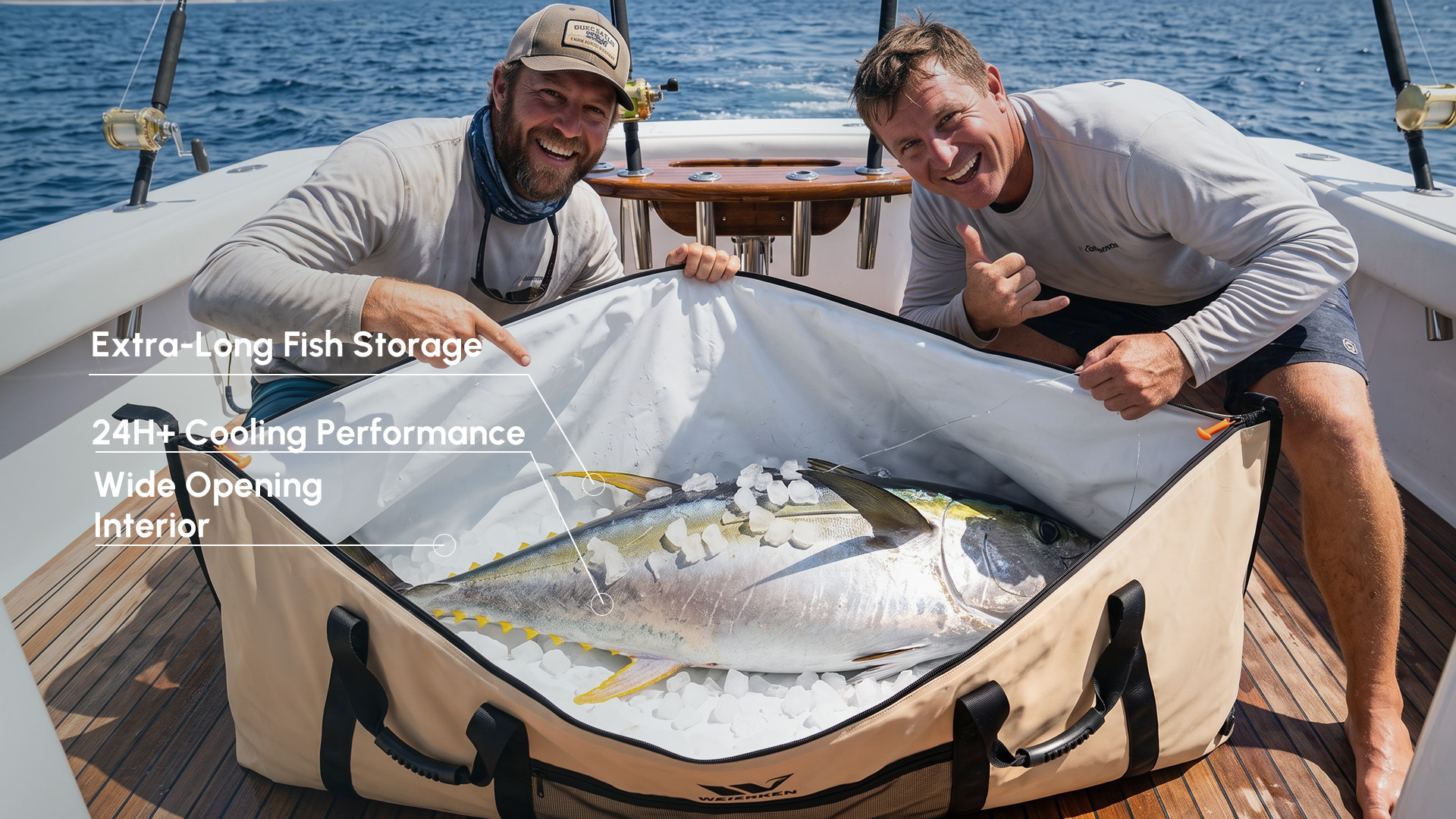
- Offshore & Tournament Kill Bags: Massive, flat-bottom rectangular builds ranging from 40 to over 70 inches long, tailored to hold pelagic species like tuna, wahoo, and kingfish.
- Branding Applications: High-density silk screening, high-frequency embossed patches, UV-resistant logos, and reflective safety bands.
How to Vet and Select an Insulated Catch Bag Supplier
Finding a factory online takes minutes, but verifying their manufacturing consistency requires careful screening. Poor production runs can lead to high return rates, chargebacks, and bad reviews that cripple an emerging business. Use these core benchmarks to evaluate any potential manufacturing partner.
Raw Material Traceability and Safety Compliance
Ask the supplier for independent lab test reports before signing production agreements. High-end retail markets demand documented compliance for safety and material performance.
Demand documented verification for REACH, RoHS, or FDA food-contact safety for interior liners. Ask for cold-crack resistance data confirming the fabric will not split when folded in freezing temperatures, along with UV-weathering ratings (minimum 500-hour UV exposure tests).
Factory Machinery and Floor Capacity
Not every outdoor gear facility owns the specialized machinery required to produce heavy-duty waterproof gear. Avoid simple cut-and-sew apparel operations that outsource their technical welding to external workshops.
Your production partner should run automated CNC pattern-cutting tables, programmable high-frequency welding machines, hot-air taping stations, and dedicated inflation-testing racks. Professional suppliers like Weierken run these operations in-house to protect structural build quality.
Strict Quality Control and Leak Testing
A reputable factory should never rely on quick visual checks alone. Inquire about their specific quality control (QC) procedures across each phase of manufacturing:
- Incoming Material Inspection: Testing raw fabric rolls for coating adhesion, tensile strength, and color matching against Pantone swatches.
- In-Line Airtight Testing: Inflating partially finished catch bags with compressed air and submerging them in testing tanks to catch seam flaws.
- Pre-Shipment Load Audits: Filling finished production units with water and hanging them by their haul handles to confirm handle strap integrity under heavy loads.
Flexible Order Minimums and Sampling Cycles
Rapidly growing brands need an agile partner. Inquire about Minimum Order Quantities (MOQs). While large industrial runs yield lower unit prices, responsive suppliers provide sensible initial MOQs (100 to 300 units per size) to help clients validate regional demand.
Take note of their prototype turnaround times. A capable engineering team should turn your CAD drawing or technical pack into a physical, test-ready sample within 10 to 18 business days.
The Step-by-Step OEM/ODM Manufacturing Process
Working alongside an overseas contract manufacturer goes smoothly when both sides follow a standardized development workflow. Here is how your project moves from an initial concept to finished inventory ready for store shelves.
Step 1: Tech Pack Review and Material Sourcing
You provide your design brief, dimensions, target price point, and performance goals. The factory's engineering team analyzes the designs for manufacturing feasibility (DFM), suggesting minor adjustments to seam paths or material weights to lower costs and strengthen weak spots.
Step 2: Prototyping and Field Testing
The sample workshop fabricates physical working prototypes. Once the sample arrives at your office, put it to work immediately:
- Pack the bag with saltwater slush and ice to measure internal temperatures over 24, 48, and 72-hour intervals.
- Drop the fully loaded cooler from a pickup bed to verify structural seam strength.
- Check handle ergonomics, shoulder strap padding, and zipper smoothness under heavy loads.
Step 3: Tooling, Mold Setup, and Pilot Run
After you approve the sample, the factory builds any required high-frequency welding horns, cutting dies, and custom zipper pulls. Most brands order a small pilot production run to clear up assembly bottlenecks before committing to full production volume.
Step 4: Full Production and Quality Audits
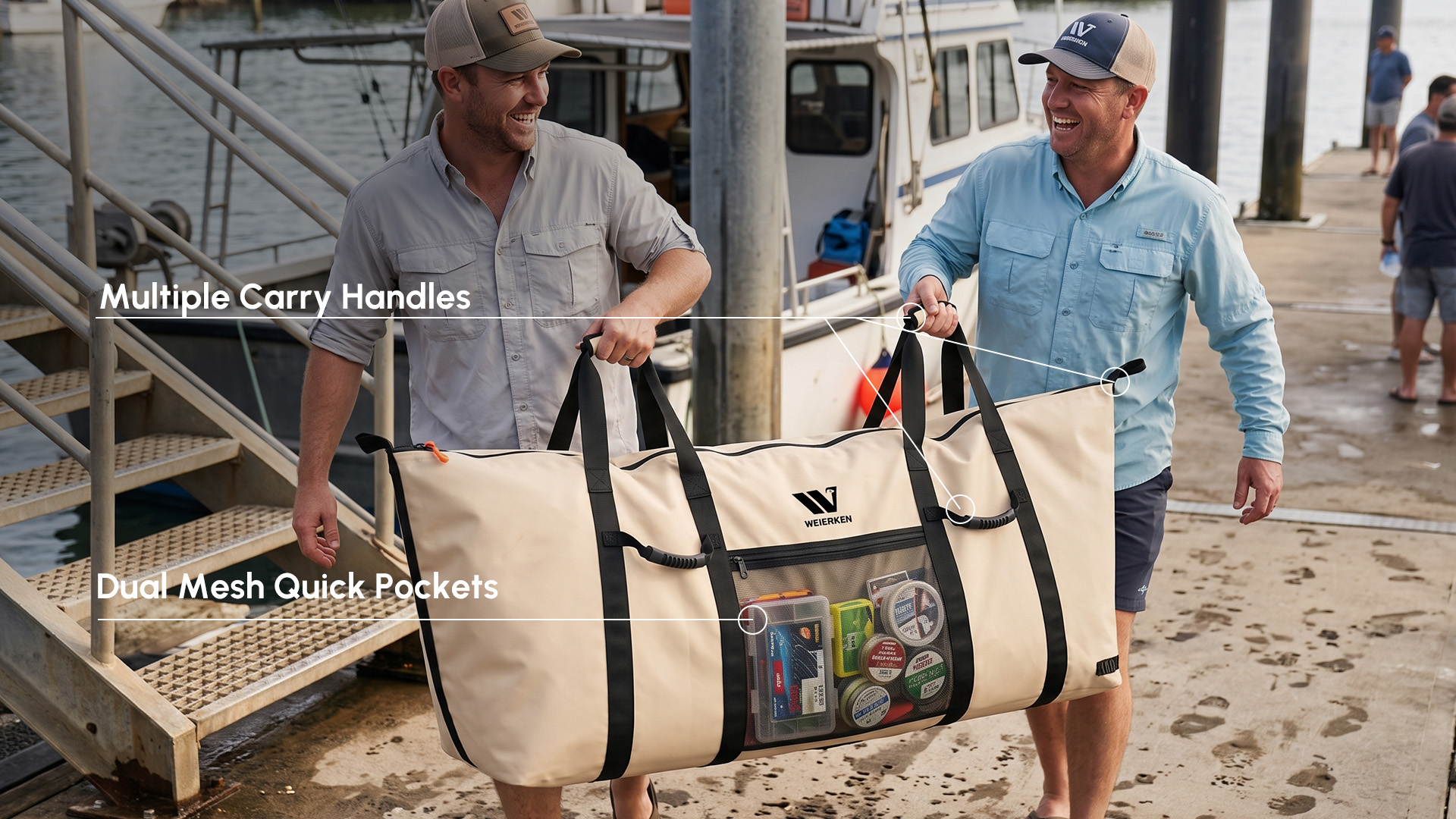
The factory begins mass production. Skilled technicians weld the panels, fit the closed-cell foam cores, install drain plugs, and attach reinforced carry handles. Internal QC staff inspect each unit against pre-agreed defect limits (AQL 2.5/4.0 standard).
Step 5: Packaging, Exporting, and Logistics
Each bag is collapsed, wrapped in protective polybags, and packed into master cartons built to resist ocean freight humidity. The factory works alongside your freight forwarder or arranges complete DDP (Delivered Duty Paid) delivery straight to your regional distribution warehouse.
Frequently Asked Questions (FAQ)
Q1: What is the typical Minimum Order Quantity (MOQ) for
custom-manufactured catch bags?
A1: Standard MOQs for custom designs
usually sit between 200 and 500 units per colorway, depending on material
availability. For private-label ODM designs using stock materials, order
minimums often start lower, near 100 units.
Q2: How long can a high-grade insulated fish kill bag retain
ice?
A2: Ice retention depends on ambient temperatures, sun
exposure, and how often anglers open the bag. Well-built bags made with 0.5-inch
or thicker closed-cell foam and welded seams hold ice for 48 to 72 hours under
regular use.
Q3: Which exterior fabric is better: TPU or PVC
tarpaulin?
A3: TPU offers superior flexibility in freezing
conditions, better puncture resistance, lighter weight, and eco-friendly
properties, making it the top pick for premium products. PVC tarpaulin costs
less, provides reliable waterproof performance, and works well for
cost-conscious, heavy-duty commercial lines.
Q4: How do you prevent fish blood and smells from lingering in the
bag?
A4: Quality bags use smooth, non-porous interior liners with
high-frequency welded seams that eliminate stitching crevices. This stops
liquids from soaking into the insulation foam, allowing users to sanitize the
bag using basic soap and water.
Q5: Can you manufacture custom shapes designed for fishing
kayaks?
A5: Yes. An experienced heavy-duty fish cooler bag
wholesale manufacturer can build tapered, triangular, or low-profile
designs tailored to specific kayak brands and deck cargo wells.
Q6: How long does the entire production process take from design to
delivery?
A6: Initial prototyping generally takes 2 to 3 weeks. Once
samples are approved, mass production runs between 35 and 50 days, depending on
order size and custom color requirements. Ocean transit adds another 20 to 35
days depending on the destination port.
Partner with Weierken: Scale Your Fishing Brand Today
Entering the marine cooler market requires an experienced manufacturing partner who understands real-world fishing demands. Poor stitching, inferior insulation, and leaking seams can alienate customers and hurt your brand's growth.
At Weierken, we engineer high-performance waterproof solutions that protect your brand equity. Operating as a dedicated OEM/ODM insulated fishing cooler bags specialist, we supply outdoor and fishing tackle companies with durable, leakproof products designed to meet demanding retail expectations.
Our team provides end-to-end manufacturing support, including:
- In-house RF welding and specialized automated bonding technology.
- Extensive material selections, including heavy-duty 840D TPU, rugged commercial PVC, and certified food-safe liners.
- Strict quality control systems covering air-retention, cold-holding performance, and load testing.
- Dedicated industrial design engineers ready to translate your technical specs into durable, market-ready products.
Stop turning away sales due to out-of-stock supply chains or fragile products. Contact the Weierken engineering team today to discuss your project, evaluate sample options, and get an accurate custom manufacturing quote.