


The outdoor retail landscape has shifted. Ten years ago, stocking shelves was largely a game of aesthetics and price points. Today, the conversation has evolved into a complex dialogue about engineering, sustainability, and biomechanics. For retailers, gear brands, and large-scale procurement platforms, the challenge isn’t just finding a supplier; it is finding a partner capable of navigating this technical revolution.
Your customers are more educated than ever. They know what Dyneema is. They understand the difference between water-resistant and waterproof. Consequently, they expect their gear to perform at professional standards, even on amateur weekend trips. This places a heavy burden on the B2B buyer to source products that are not just sewn together, but engineered.
Selecting a hiking bag distributor in 2025 requires looking under the hood. It demands a deep dive into the R&D capabilities of your supply chain. You aren’t just buying backpacks; you are buying the technology that makes those backpacks sellable at a premium margin.
In this competitive arena, industry leaders like Weierken have stepped up, moving beyond the role of simple manufacturers to become innovators. They understand that for a brand to succeed, the product must solve problems the end-user hasn’t even realized they have yet.
Here is a detailed look at the four critical dimensions of innovation that distinguish top-tier distributors from the rest of the pack.
1. Material Science: The Trinity of Lightness, Ecology, and Function
The first question a sophisticated hiking bag distributor asks is not “What color?” but “What performance?” Material science is the bedrock of modern outdoor gear. The days of heavy canvas and basic nylon are long gone, replaced by fabrics that seem to defy physics.
Lightweight High-Strength Fabrics
The “Ultralight” movement is no longer a niche; it is the industry standard. However, reducing weight often comes at the cost of durability. The innovation lies in breaking this trade-off.
Advanced distributors are now sourcing and utilizing composite fabrics like ultra-high-molecular-weight polyethylene (often branded as Dyneema®) or custom-blended high-tenacity nylon mixed with recycled polyester.
These materials offer a strength-to-weight ratio that is significantly higher than steel. For a B2B buyer, this means you can offer a 40-liter pack that weighs less than a kilogram but can survive being dragged over granite rocks. This “impossible” combination of lightness and tear resistance is a massive selling point for technical consumers.
Environmental Sustainability Applications
Greenwashing doesn’t cut it anymore. Consumers check labels for certification. A competent distributor must offer a robust menu of sustainable options.
This goes beyond just using recycled PET bottles. We are seeing the rise of bio-based PU coatings that replace petroleum-based water repellents. Top-tier suppliers are moving toward completely PFC-free DWR (Durable Water Repellent) treatments.
Furthermore, solution-dyeing processes, which color the fiber before it is spun to save massive amounts of water, are becoming a hallmark of responsible manufacturing. Brands that can claim their packs are “Earth-First” without sacrificing performance have a distinct competitive edge.
Smart Temperature Control and Protection
Fabrics are becoming active rather than passive. Innovation in this sector includes the integration of Phase Change Materials (PCM) into the back panel lining. These materials absorb heat when the hiker is hot and release it when they cool down, maintaining a stable microclimate.
Additionally, the application of metal oxide coatings on the exterior fabric can reflect UV rays, protecting the gear from degradation and keeping the internal contents cooler. This is particularly vital for distributors supplying markets in high-altitude or desert regions.
2. Structural Engineering: Redefining How We Carry
A backpack is effectively a house that you carry on your back. Just like architecture, structural engineering determines stability and usability. When evaluating a hiking bag distributor, look for evidence of advanced structural design that moves away from the “sack with straps” mentality.
Molded Back Panels and Dynamic Suspension
The era of flat foam sheets is ending. Leading manufacturers are utilizing thermoplastic molding to create 3D back panels.
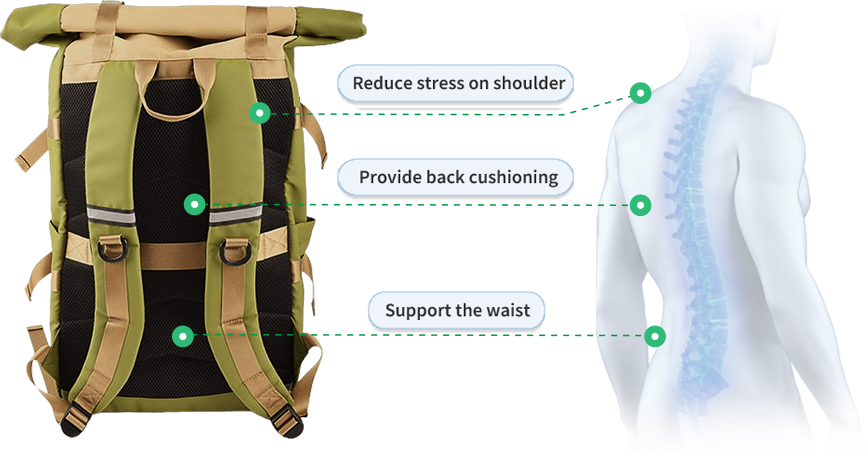
These panels are designed to mimic the curvature of the human spine. But innovation goes further with dynamic suspension systems. Instead of a static frame, these systems allow the hip belt and shoulder straps to pivot independently.
This means when a hiker climbs over a fallen log, the pack stays centered while their hips move. For the retailer, this translates to a “try-on experience” that immediately sells the product. The moment a customer puts it on, they feel the difference in load distribution.
Modular Design Architecture
One size rarely fits all, and one use-case rarely defines a trip. Modularity is a massive trend in structural engineering.
Innovators are offering systems where components are removable. We are talking about top lids that convert into lumbar packs (fanny packs) for day trips from base camp.
Internal compartments that can be removed to reduce weight. Hip belts that can be swapped out for different sizes or padding levels. This modularity allows retailers to stock fewer SKUs while satisfying a broader range of customer needs, as the product adapts to the user, not the other way around.
Quick Access Systems
The “black hole” effect—where gear gets lost at the bottom of the bag—is a major pain point. Structural innovation solves this with intelligent access points.
Look for distributors offering J-zip or U-zip front panels that allow full suitcase-style opening of a top-loading pack.
Other engineering feats include external hydration routing that doesn’t pinch the tube, and “stealth” pockets integrated into the seams for passports or wallets. These features enhance the user experience significantly, turning a frustrating search for a snack into a seamless action.
3. Ergonomics and Health Tech: Prioritizing the Human Body
As a B2B practitioner, you must realize that you are selling health as much as you are selling storage. A poorly designed pack causes injury. Therefore, a premium hiking bag distributor must double as an ergonomics expert.
Airflow Back Systems
Sweat management is critical for comfort and health (preventing chafing and hypothermia). The innovation here is the “trampoline” style suspended mesh back panel, but evolved.
Newer designs create a wind tunnel effect between the user’s back and the pack body without pushing the load center of gravity too far back. This requires precise tension engineering.
Some distributors, including forward-thinking brands like Weierken, utilize 3D-printed lattice structures in the lumbar pad. This provides support that is breathable by nature, rather than just foam with holes punched in it.
Adjustable Load Transfer Technology
The magic of a heavy pack is making it feel light. This is achieved through load transfer to the hips.
Innovative distributors are implementing “on-the-fly” adjustment systems. These allow hikers to tighten or loosen the load lifters and hip belt tensioners with a single motion while walking.
Furthermore, multi-point dispersion structures in the harness ensure that the strap doesn’t dig into the clavicle but spreads the weight across the upper chest and shoulders evenly. This technology is vital for long-distance trekking packs (50L+).
Gender-Specific Design
“Shrink it and pink it” is an insult to female hikers. True ergonomic innovation involves completely different architectural blueprints for men and women.
Top distributors offer female-specific designs featuring shoulder straps with an S-curve that navigates around the bust, rather than crushing it.
Torso lengths are shorter, and hip belts are canted at a different angle to accommodate the shape of female hips. Offering these anatomically correct options is a non-negotiable for any serious outdoor retailer today.
4. Smart Integration and UX: The Future-Ready Hiking Bag Distributor
We live in a digital age, even when we are off the grid. The modern hiker carries cameras, GPS units, drones, and solar panels. The backpack must evolve to host this ecosystem.
Embedded Smart Device Compatibility
A standard bag becomes a “smart pack” through thoughtful integration. This includes dedicated, padded compartments for hydration bladders that double as laptop sleeves for the “digital nomad” hiker.
Innovations include shoulder strap pockets specifically sized for large smartphones or GPS trackers. Cable routing ports that allow a power bank in the lid to charge a phone in the hip belt pocket are becoming standard in high-end models.
Some cutting-edge distributors are even experimenting with integrating RECCO® reflectors directly into the chassis of the bag for avalanche safety, adding a layer of tech-based security.
Waterproofing and Sealing Upgrades
There is a distinct move away from “rain covers” (which can blow away) toward inherently waterproof construction.
This involves technical innovation in manufacturing processes, such as High-Frequency (HF) welding or laser cutting. These methods eliminate needle holes entirely.
Roll-top closures, borrowed from dry bag technology, are being aesthetically integrated into hiking packs. This ensures that even in a torrential downpour, the gear remains dry without the user needing to stop and put on a cover.
Customizable Appearance and Function (OEM/ODM)
For the B2B buyer, the ultimate innovation is flexibility. The ability to take a high-tech “chassis” and skin it with your brand’s identity is crucial.
Top distributors offer modular manufacturing. You want the Dyneema body but with the 3D-printed lumbar pad? You want a specific colorway to match your seasonal apparel line?
Providers like Weierken excel here, offering a menu of technical modules. They allow retailers to build a product that looks unique on the shelf but shares the proven engineering DNA of a high-performance carrier. This reduces the risk for the buyer, as the R&D has already been validated.
The hiking backpack is no longer a commodity; it is a piece of precision equipment. For retailers and brands, the sourcing strategy must shift from finding the lowest bidder to finding the highest innovator.
Material science creates the foundation of durability and lightness. Structural engineering ensures the pack functions as an extension of the body. Ergonomics protects the hiker’s health. Smart integration future-proofs the product for the modern user.
When you choose a hiking bag distributor, you are effectively hiring their engineering team. You are leveraging their investment in laser cutters, impact testing machines, and textile sourcing networks.
Companies that prioritize these four dimensions of innovation, such as Weierken, provide their B2B partners with more than just inventory. They provide market relevance. They provide the stories you tell your customers about why this pack is worth the investment.
As the outdoor market continues to grow and fragment, the brands that succeed will be those that partner with manufacturers capable of pushing the boundaries of what a backpack can be.
Ready to elevate your product line with cutting-edge hiking gear?
Don’t settle for yesterday’s technology. Secure your position in the market with high-performance, engineered solutions.
[Contact Us Today for a Quote and Sample Inquiry]
FAQ: Common Questions for B2B Buyers
Q1: How can I verify the technical claims (e.g., waterproof rating, load capacity) of a hiking bag distributor?
A1: A reputable hiking bag distributor should be able to provide third-party laboratory test reports (such as SGS or Intertek) for their materials and finished products. For waterproofing, ask for the Hydrostatic Head test results (measured in mm). For load capacity, ask for tensile strength data on the stitching and strap anchor points. Always request a physical sample to perform your own field testing before committing to a bulk order.
Q2: What is the typical Minimum Order Quantity (MOQ) for backpacks featuring custom advanced materials like Dyneema?
A2: Advanced materials often come with higher MOQs because the fabric mills require larger minimum runs. While a standard polyester pack might have an MOQ of 300-500 units, packs utilizing specialized technical fabrics might require 500-1,000 units per color. However, distributors with strong supply chain relationships can sometimes aggregate orders or have stock fabric available, allowing for lower trial run quantities.
Q3: Can a distributor help modify an existing design to be more “female-friendly” or ergonomic?
A3: Yes, capable distributors offering ODM (Original Design Manufacturer) services have in-house design teams and pattern makers. They can adjust the torso length, shoulder strap curvature, and hip belt angulation of an existing “white label” model to create a women’s specific SKU for your brand. This is a cost-effective way to expand your catalog without starting R&D from scratch.
Q4: How long is the lead time for developing a new hiking bag with custom features?
A4: The timeline varies based on complexity. For a completely new design involving custom molding and specialized materials, the R&D and prototyping phase can take 2 to 4 months. Once the “Golden Sample” is approved, mass production typically takes another 60 to 90 days. It is best to start the conversation at least 6 months before your target launch date.
Q5: Why should I choose a distributor that offers “smart integration” if my customers are traditional hikers?
A5: Even traditional hikers use smartphones for photography and safety (GPS) today. Features like hydration ports and accessible hip-belt pockets are now considered basic expectations, not futuristic add-ons. Ignoring these integrations can make a product feel dated. Furthermore, offering “tech-ready” gear future-proofs your inventory as the demographic of hikers continues to skew younger and more digital-native.


