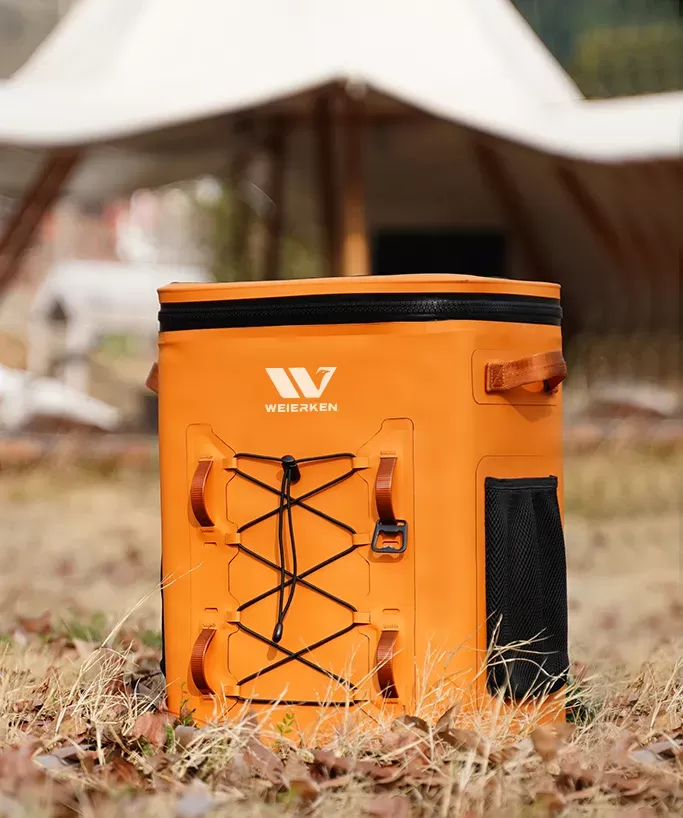

The camping market keeps growing. Brands pour money into marketing and eye-catching designs. Yet when it comes to selecting a custom camping cooler bag manufacturer, most purchasing teams focus on unit price and lead time. They ignore the manufacturing specs that determine product lifespan and user reviews.
I have spent over a decade on the front lines of outdoor gear supply chains. I have watched brands struggle under the weight of bad reviews and returned shipments. All because they compromised on a few seemingly minor parameters early on.
At Weierken, we have verified our quality baseline through more than 2,000 global brand partnerships. The following seven specifications are not just numbers on a datasheet. They are the difference between a cooler bag that survives a season and one that becomes a liability. Use this list as your checklist when you interview any factory.
1. Insulation Core Density and Thickness – The Hard Metric of Cold
Retention
Many buyers start with "How long does it stay cold?" Few ask "What is inside?" The material, density, and thickness of the insulation core directly determine cold retention. This is the most significant cost driver in your cooler bag.
Key parameters to verify:
Core type: High-density PU integral foam is superior to low-density EPE.
Thickness: At least 20mm. Do not accept less.
Density: Should be ≥40kg/m³. Lower density means shorter cold life.
Here is the industry reality: Low-cost products often use low-density EPE. They pass initial lab tests but turn warm in 4 to 6 hours of actual use. High-density PU foam can maintain safe temperatures for 8 to 12 hours or more. Some factories use spliced scrap foam. That filler degrades quickly and rarely passes food contact safety tests.
Weierken's approach: We insist on food-grade high-density PU foam core. Every batch goes through an 8-hour continuous temperature test in a 35°C chamber at our in-house lab. If the cooling curve fails, the entire batch is rejected. This is not a cost. This is a commitment to your brand's reputation.
2. Fabric Tear Strength and Abrasion Resistance – Survival in the Wild
Camping cooler bags are not display items on a store shelf. They face thorny bushes, rocky ground, and being dragged across campsites. Choose the wrong fabric, and you will receive photos of ripped bags before the first shipment sells out.
What to demand:
Tear strength: ≥250N (ASTM D2261).
Abrasion resistance: ≥1000 cycles on Taber H-18 wheel.
Denier count: 1000D or higher for nylon.
420D nylon fuzzes up after a few rough encounters. Industrial-grade PVC mesh or high-tenacity nylon is necessary for multi-season use.
One aspect often overlooked is UV aging. Many fabrics look fine in the warehouse but become brittle and discolored after two weeks of direct sunlight. Weierken uses 1000D+ high-tenacity fabrics. Our tear strength tests consistently exceed 250N. We also run 500-hour QUV accelerated weathering tests. Our three owned factories (China and Cambodia) control every step, from yarn twist to coating thickness, ensuring consistent physical properties across every batch.
3. Waterproof Construction: Seamless Welding vs. Traditional Stitching
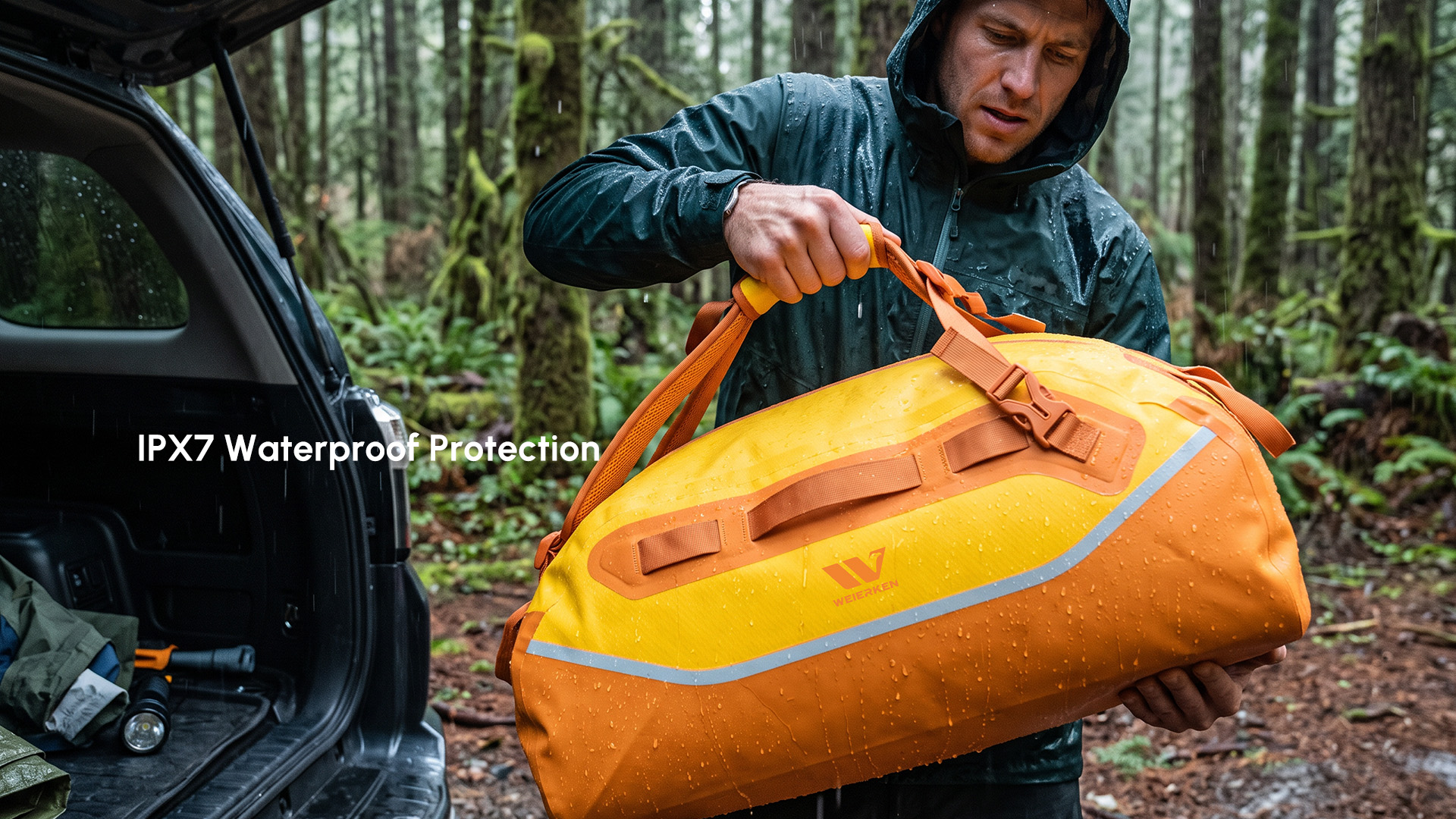
A stitched cooler bag will leak. It is just a matter of time. Needle holes absorb water under pressure, which wets your contents and degrades the insulation layer. Durable camping cooler bags must use welding technology.
Critical processes: High-frequency heat sealing or radio-frequency welding. These methods fuse the material at the seams, creating a single, impermeable piece.
Testing: Air pressure hold testing. Inflate the bag and maintain pressure for 30 seconds. No drop indicates a good weld.
The upfront investment in welding equipment is significant. But the reduction in warranty claims and customer complaints far outweighs the additional manufacturing cost. Weierken uses imported high-frequency welding machines at our Cambodia factory. Our senior technicians ensure weld strength and consistency that surpasses industry standards. Every finished product undergoes a 100% air-tightness test before packaging.
4. Zipper and Hardware Corrosion Resistance
Many brands allocate their budget to fabric and insulation. Then they save a few cents on zippers and buckles. One night by the sea, and the zipper jams. The customer films a video, posts it online, and your product is done.
Minimum requirements for hardware:
Zippers: Water-resistant, meeting YKK-equivalent standards.
Buckles: Cold-resistant POM plastic, no cracking at -20°C.
Salt spray test: ≥72 hours (ASTM B117).
Opening cycles: At least 5,000 operations without failure.
Standard plated zippers rust in humid conditions. A rusted zipper effectively kills the bag's functionality. At Weierken, we use YKK-equivalent water-resistant zippers and POM buckles as standard. Each batch of hardware undergoes 72-hour salt spray and 5,000-cycle fatigue tests in our CNAS-accredited lab. This is why our DDP door-to-door deliveries pass customs smoothly and our products never fail on the hardware.
5. Liner Food Safety and Anti-Microbial Protection
The inner liner directly contacts food and beverages. Any chemical migration can cause a brand crisis. Additionally, the damp interior is a breeding ground for mold and bacteria, especially in southern or coastal markets.
Safety and compliance standards:
FDA or EU food-contact grade certification.
No BPA, no phthalates.
Silver-ion or organic antimicrobial additives to inhibit E. coli and Staphylococcus aureus.
Full REACH and ROHS compliance is a non-negotiable entry ticket for European and US retailers.
Weierken uses only food-grade PEVA or TPU liners. All materials pass the full REACH test suite. For high-humidity markets, we offer an antimicrobial upgrade coating. We hold BSCI, GRS, and SEDEX certifications, ensuring your brand is compliant at every level.
6. Lid Seal and Thermal Barrier – The Invisible Cold Lock
You will not find this spec on many quotation sheets. But professional sourcing managers will open the lid and check the sealing strip. The lid gap is the largest channel for cold air leakage. A bag without a proper seal loses up to 20% of its cooling efficiency.
What to look for:
A continuous, surrounding sealing gasket.
An additional thickened thermal insulation pad inside the lid.
This combination acts as a "cold lock."
Smaller factories often use a single layer of lid fabric. They skip the seal entirely and still label the product as "high-performance." Weierken developed a proprietary one-piece molded sealing structure. Combined with our thickened lid insulation, we have measured up to 20% better cold retention compared to standard designs. A major European client pushed us to solve this pain point. Our R&D team went through seven iterations before finalizing the design. It is now a key selling point for many co-branded products.
7. Recycled Materials and Carbon Footprint Traceability
European and US retail channels are moving past "recommendations" for sustainable materials. They are now requirements. Without GRS certification for rPET, your product may not even make it onto the shelf.
Key certifications and added value:
GRS (Global Recycled Standard) and traceable rPET content.
Carbon footprint estimates for your product as ESG communication assets.
Many retailers apply "green penalties" for products without sustainable materials starting in 2025.
Weierken holds GRS, BSCI, and other full certifications. We can provide complete material traceability reports and carbon footprint estimates. If you need a full rPET eco-friendly version or a jute/cotton blend series, our sample room can produce a prototype in as little as 3 days. We help you tell a credible sustainability story before peak season arrives.
Specs Are Your Promise. Quality Drives Reorders.
These seven specs are the essence of nearly 20 years of manufacturing experience at Weierken. They are also the reason over 2,000 global brands choose to work with us long-term. We do not win orders with low prices. We win with verifiable data, end-to-end quality control across our owned factories, and production capacity coordinated between China and Cambodia. Every cooler bag we produce is built to survive the real-world demands of camping.
If you are selecting a supplier for your next-season cooler bag, take this list with you. Go through each point with the factory. We are ready to go through them with you as well.
Frequently Asked Questions (FAQ)
Q1: How do I verify if a custom camping cooler bag manufacturer actually uses high-density PU foam and not cheap EPE?
A: Ask for a cross-section sample. High-density PU foam has a fine, uniform cell structure and is noticeably heavier and firmer than EPE. Also, request the density test report (ASTM D3574). At Weierken, we provide independent test reports and can arrange a lab visit for you to witness the testing process.
Q2: Why is the welding process so critical for a cooler bag, and can standard stitching be enough for budget products?
A: Stitching creates thousands of needle holes. Under pressure, water seeps through these holes, ruining the insulation. For any product claiming "waterproof," welding is mandatory. While stitching is cheaper upfront, the return rate and warranty costs will destroy your margins. Weierken's welded construction offers IPX5-level protection, which our clients use as a competitive advantage.
Q3: What is the minimum order quantity (MOQ) for a custom camping cooler bag manufacturer with full customization, and how does Weierken compare?
A: Many factories require 3,000-5,000 units for full customization. Weierken offers more flexible terms for new brand partnerships. We can start with a trial order of 1,000 units, depending on the complexity of the design. Our integrated supply chain reduces tooling costs and speeds up the sample approval process.
Q4: How does Weierken ensure consistent quality across its China and Cambodia factories?
A: We use a unified quality management system across both locations. All key technicians undergo the same training. We also have a centralized lab that tests materials from both factories. Regular cross-audits and random batch sample testing ensure that a bag from Cambodia meets the same spec as a bag from China.
Q5: What are the most common hidden costs when working with a cooler bag supplier?
A: Mold costs, testing fees, and shipping surcharges for bulky items are often overlooked. Also, many suppliers charge extra for certifications like GRS or for using rPET materials. Weierken provides a clear, all-inclusive quote from the start. We help you plan for these costs during the design phase, so there are no surprises later.
Q6: Can Weierken help with sustainable packaging and logistics for EU/US markets?
A: Yes. We have extensive experience with DDP shipping. We source sustainable packaging materials (recycled cardboard, biodegradable poly bags) and handle all customs clearance. We also provide full documentation for your EU/ US retailers, including product compliance and traceability reports.
Ready to build a cooler bag that truly represents your brand?
Contact Weierken today. We will walk you through our specs, our test reports, and our production facilities. Request a quote or schedule a virtual factory tour to see how we turn quality specs into finished products.
Send your inquiry now for a detailed technical dossier and sample support.