
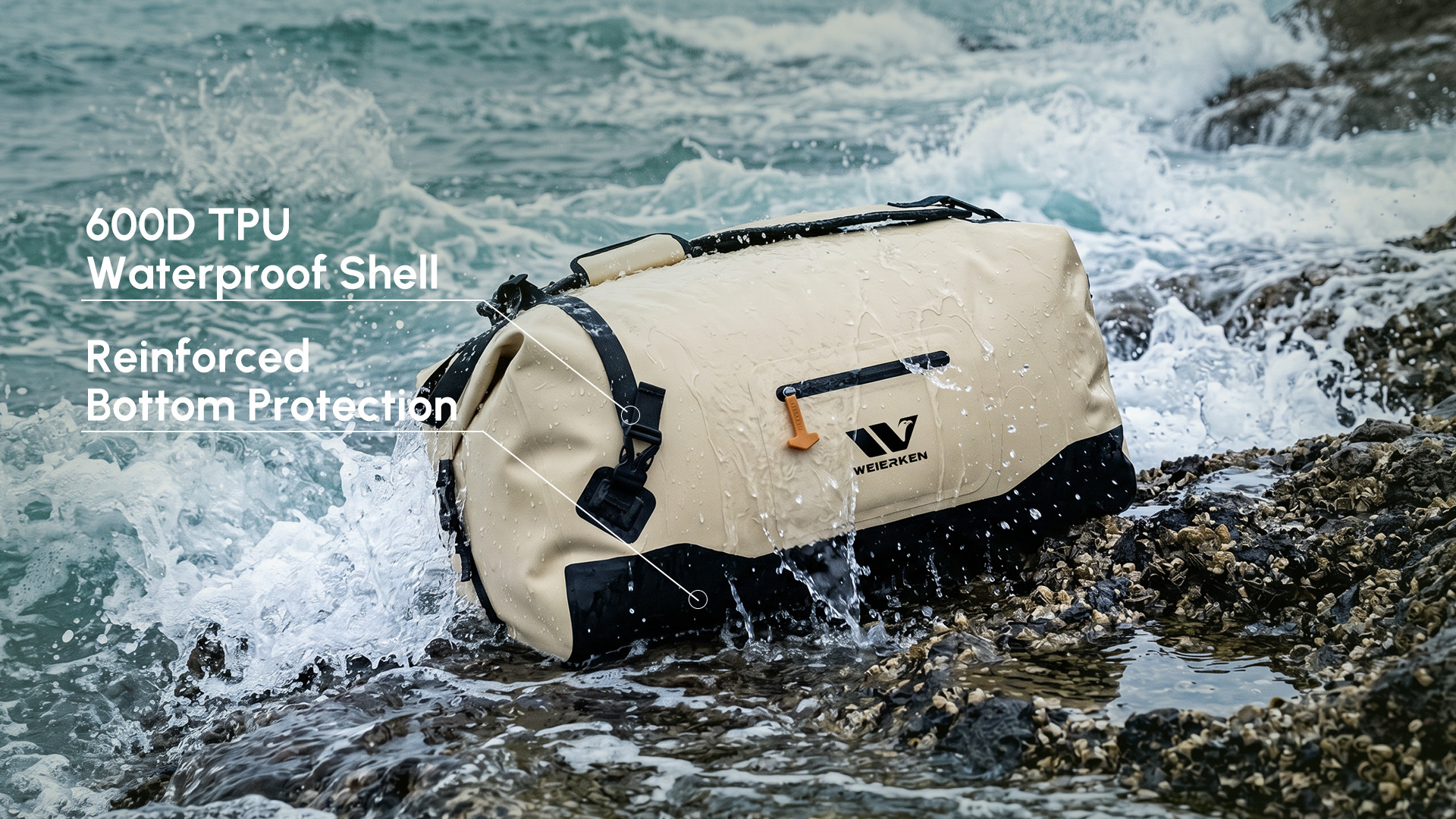
Boating brands face brutal field conditions that standard outdoor gear cannot survive. Ocean spray, high-pressure waves, harsh sunlight, and heavy equipment loads put extreme stress on gear bags. When a dry duffel leaks at sea, clothes soak, sensitive electronics short-circuit, and customer trust breaks down immediately.
Sourcing from a specialized custom marine waterproof duffel bag factory is essential for premium marine brands. A dependable OEM partner does not simply stitch fabric panels together. They implement strict laboratory testing to verify every seal, zipper, and seam before full-scale manufacturing begins.
At Weierken, we bring over 20 years of experience as a high-frequency welded duffel supplier. We work closely with international boating brands to build ocean-ready gear. Below are the four rigorous laboratory quality tests every waterproof duffel manufacturer for boating brands must perform to guarantee marine-grade performance.
4 Critical Quality Tests for Marine-Grade Waterproof Duffels
Building a fully waterproof duffel requires advanced engineering and specialized materials. High-frequency welding must create seamless joins, while airtight zippers must withstand internal pressure. To verify these features, top-tier factories rely on four non-negotiable laboratory testing protocols.
Test 1: Hydrostatic Head & Complete Submersion Testing
Water penetration is the ultimate failure for any ocean gear bag. A quality high-frequency welded duffel supplier must test both the raw fabric and the welded seams under severe water pressure. Standard rain testing is simply not enough for marine environments.
Factories conduct two distinct water barrier evaluations:
Hydrostatic Head Test (AATCC 127 / ISO 811): Applies continuous water pressure against the TPU-coated fabric and welded joints until liquid forces its way through. Marine-grade duffels must exceed a 10,000mm to 20,000mm H2O rating.
IPX7/IPX8 Submersion Chamber Test: The complete bag is inflated, loaded with ballast weights, and submerged in a pressure tank under 1 meter of water for 30 to 60 minutes. Technicians inspect the chamber for escaping air bubbles and verify zero moisture ingress inside.
This test ensures your customers can drop their dry duffel off a dock or store it on an open kayak deck without worrying about water seepage.
Test 2: Salt Spray & Hardware Corrosion Resistance Testing
Saltwater accelerates oxidation on metallic components and degrades low-grade plastics. A common frustration among boaters is a zipper that seizes up after a single season on salt water. Metal sliders, D-rings, strap adjusters, and zipper teeth must withstand salt air exposure.
Top factories follow the ASTM B117 neutral salt spray testing standard:
Components like airtight zippers, UTX/YKK buckles, and 316 stainless steel hardware are placed in a closed salt fog chamber.
A 5% sodium chloride solution mist sprays continuously over the hardware for 48 to 96 hours at elevated temperatures.
Technicians inspect parts for rust, pitting, surface degradation, or mechanical sticking on zipper sliders.
Passing this test ensures that zipper tracks slide smoothly and hardware operates safely even after month-long sea voyages.
Test 3: Seam Tensile Strength & Dynamic Load Drop Testing
Boating duffels carry heavy gear, including anchor ropes, diving weights, wet suits, and tools. Heavy loads place immense stress on hand straps, shoulder harness attachment points, and welded panel seams. Purely stitched seams will pull apart or tear open under these heavy strain points.
A reliable OEM TPU dry duffel bag factory validates structural integrity using two load stress tests:
Seam Tensile Testing (ISO 13934): Machines pull welded fabric joints in opposite directions to measure maximum breaking force. The welded seam must demonstrate equal or greater tensile strength than the base fabric itself.
Dynamic Drop Impact Testing: The duffel is filled with 25kg to 30kg of dense weight. A specialized rig lifts the loaded bag 1.2 meters into the air and drops it repeatedly over hundreds of cycles.
This testing checks for cracking along high-frequency weld boundaries and guarantees that handle box-stitches and reinforcement patches will not rip out when lifted onboard.
Test 4: UV Acceleration & Cold Flex-Cracking Testing
Boating gear sits exposed on hot boat decks under scorching sun, only to face freezing spray or cold storage during winter months. Ultraviolet rays break down inferior PVC or TPU coatings, causing material surfaces to turn yellow, sticky, or brittle. Cold temperatures cause cheap coatings to crack when folded.
Factories run accelerated environmental simulations to prevent long-term material failure:
Accelerated UV Testing (ISO 4892-3 / ASTM G154): Fabric swatches undergo intense UV lamp exposure for 72+ continuous hours. Testers evaluate color fading, surface oxidation, and coating adhesion strength.
Low-Temperature Flex Testing (ISO 5423): Coated materials are chilled to -20°C inside a climate chamber and rapidly flexed or folded thousands of times to check for surface micro-cracking or peeling.
These trials ensure that your branded dry bags retain their vibrant colors, clean finish, and waterproof properties across diverse ocean climates worldwide.
How Weierken Empowers Boating Brands with Advanced Supply Chain Solutions
Executing rigid waterproof bag QC testing standards is only half the equation. Boating brands also require flexible, cost-effective manufacturing options and predictable international logistics. Weierken supports private label brands through comprehensive OEM/ODM production capability.
99.5% QC First-Pass Yield Rate
Weierken integrates incoming raw material inspection, inline high-frequency pressure checks, and final pre-shipment sampling across every production run. All materials comply strictly with REACH, GRS, and rPET environmental guidelines. Our rigorous quality control protocols produce a 99.5% first-pass yield, helping your brand avoid customer warranty returns and negative online reviews.
Cambodia + China Dual-Base Production for Tariff Reduction
Large dry duffel bags require significant manual assembly time and technical welding labor. To help marine brands manage rising trade costs, Weierken operates twin manufacturing centers in China and Cambodia. Our Cambodia facility provides lower import duties into North America and European markets, reducing your landed purchasing costs by 10% to 25% while maintaining strict quality controls.
Rapid Prototyping in 12–30 Days
Speed to market is a crucial competitive edge for modern gear outfitters. Our high-precision sample room and dedicated engineering team transform technical drawings into fully functional, IPX7-tested prototypes in just 12 to 30 days. This rapid turnaround allows you to conduct real-world field trials and lock in seasonal product catalogs quickly.
Seamless End-to-End DDP Logistics
Managing cross-border freight, customs declarations, and harbor tariffs takes focus away from sales and marketing. Weierken offers complete DDP (Delivered Duty Paid) shipping service. We handle all export paperwork, sea freight, customs clearance, and local trucking, delivering completed inventory directly to your distribution center without hassle.
Frequently Asked Questions (FAQ)
1. What is the recommended material for high-end marine waterproof duffels?
Thermoplastic Polyurethane (TPU) laminated onto 840D or 1000D high-density nylon or polyester face fabric is the industry standard for premium marine duffels. TPU offers excellent abrasion resistance, stays flexible in cold weather, resists oil and saltwater degradation, and can be bonded through high-frequency welding. Recycled TPU (rPET) face fabrics are also popular for eco-focused brands.
2. How does high-frequency welding differ from traditional sewn and taped seams?
Traditional sewing pierces thousands of tiny needle holes through the fabric, which relies on iron-on seam tape to prevent leaks over time. Seam tape can degrade or peel after heavy use and UV exposure. High-frequency welding uses radio energy and pressure to melt TPU coatings together, creating a permanent, continuous, molecular bond that never unravels or leaks.
3. Why should a marine brand consider manufacturing in Cambodia?
Producing waterproof gear in Cambodia offers key trade advantages, including favorable duty treatments under trade agreements for US and EU imports. Sourcing heavy volume gear like marine duffels from our Cambodia manufacturing hub reduces your overall import tariff burden and helps maintain healthy gross margins.
4. What minimum order quantity (MOQ) is required for custom OEM TPU dry duffel bag orders?
Our standard production MOQ generally starts at 500 to 1,000 units per style or color, depending on fabric specifications and custom hardware requirements. We work flexibly with growing marine brands to support seasonal catalog rollouts.
5. Can Weierken customize airtight zippers and marine-grade hardware?
Yes. We partner with top marine hardware suppliers like YKK, UTX-Flex, Duraflex, and TIZIP to offer customized airtight zip closures, heavy-duty shoulder clips, molded haul handles, and corrosion-resistant metal D-rings customized with your brand logo.
6. What testing documentation is provided before mass order shipment?
We provide comprehensive lab testing reports before shipping mass production runs. This includes fabric hydrostatic head pressure reports, tensile strength data, salt spray corrosion test results, and final inline AQL inspection certificates signed by our quality assurance team.
Partner with Weierken for Your Next Marine Duffel Collection
Working with an experienced waterproof duffel manufacturer for boating brands is the best way to safeguard your product reputation. From high-frequency TPU welding to tariff-optimized Cambodia manufacturing, Weierken brings 20 years of technical expertise to your supply chain.