
Procuring commercial fleet equipment is fundamentally an exercise in risk management. When regional delivery startups and multinational food aggregators search for a food delivery backpack OEM, procurement teams frequently stumble into the lowest-bid trap. Bidding wars look attractive on a quarterly budget sheet. On the streets, however, low-cost gear fails quickly.
Data across the last-mile sector reveals a grim reality: sub-par commercial delivery packs suffer zipper blowouts, torn seams, and structural collapse within three months of deployment. In high-density cities, zipper failure rates on discount packs can exceed 30%. When bags fail, insulation collapses, food turns cold, and customer refunds surge. In worst-case scenarios, failing shoulder harnesses cause courier injuries and expose platforms to legal liability.
Selecting the right food delivery backpack OEM requires looking past the unit price. Experienced manufacturers like Weierken understand that your backpack is an engineering tool that directly controls your Total Cost of Ownership (TCO). Avoiding the following five missteps will protect your operating margins and brand reputation.
Mistake 1: Prioritizing Upfront Unit Price Over Total Cost of Ownership (TCO) and Material Integrity
Every commercial delivery backpack factory operates under the laws of material economics. To quote an impossibly low per-unit price, disreputable factories cut corners deep inside the bag where buyers cannot see them.
Substandard factories use these cost-cutting tricks:
Chalk-Filled Plastics: Liners mixed with calcium carbonate (chalk) to save resin costs. The material feels thick initially but cracks after weeks of folding and sun exposure.
Low-Density Filler Foam: Using open-cell 2mm to 4mm furniture foam instead of 8mm to 12mm high-density Expanded Polyethylene (EPE). It crushes flat under normal loads and permanently loses thermal resistance.
Cheap Garment Thread: Using cotton-blend or cheap polyester thread that rots under UV rays and rain, rather than bonded anti-aging nylon thread designed for industrial gear.
Saving $3.00 on unit costs is a poor financial trade-off when the pack disintegrates in 90 days. A professional courier pack built by an experienced custom food delivery bag manufacturer should run continuously on the road for 18 to 24 months.
Smart procurement teams calculate Cost-Per-Day (CPD):
Cheap Factory Pack: $22.00 purchase price ÷ 90 days of road life = $0.24 per day (plus refund spikes and replacement shipping fees).
Industrial OEM Pack: $36.00 purchase price ÷ 540 days of road life = $0.06 per day.
Demand that your contracts lock down exact raw material specifications. Require minimum fabric yarn counts, specific coatings (such as 0.55mm TPU tarpaulin), and UV-stabilized industrial threads.
Mistake 2: Overlooking In-House Thermal Testing and Food-Contact Validation
Many suppliers claim to be a specialized insulated delivery backpack supplier, yet they do not own a single piece of thermal testing equipment. They assemble reflective foil and generic sponge, assume it will trap heat, and ship the product. This creates massive thermal bridges where cold air leaks straight through unsealed stitching and thin zipper walls.
When food travels for more than 25 minutes, hot meals chill and iced beverages melt. Platforms absorb the financial hit through customer service credits, cancelled orders, and restaurant partner disputes.
When evaluating a food delivery backpack OEM, require hard laboratory proof:
Thermal Degradation Curves: Request real test data from environmental test chambers. Professional suppliers map internal temperature loss over 30, 60, and 90 minutes at ambient temperatures of -10°C and +40°C.
Cold-Bridge Mitigation: Ensure the factory uses insulated interior storm baffles behind zipper lines and heat-sealed partition junctions.
Food-Contact Certifications: Internal foil and PEVA liners touch food packaging constantly. Verify current, passing test certificates for FDA 21 CFR, LFGB, and EU REACH to confirm the materials do not off-gas toxic chemical plasticizers under high steam and heat.
Mistake 3: Ignoring Structural Load Mechanics and Ergonomic Stress Testing
A delivery backpack is not an oversized school bookbag. Full-time gig workers carry loads between 15 and 25 kilograms for up to 10 hours daily. Low-tier factories lack mechanical design capabilities; they simply enlarge consumer backpack patterns without rethinking weight distribution.
When a manufacturer fails to reinforce structural load paths, the bag pulls backward away from the rider's spine. This causes chronic lower back pain, rider dissatisfaction, and driver turnover. Worse, shoulder straps can tear cleanly off the main body mid-ride, destroying customer orders and creating road hazards.
A capable courier backpack manufacturing process integrates industrial-grade physical testing:
Dynamic Jerk Testing: The factory must test shoulder straps and top carry handles on cyclic drop-test rigs. The industry baseline is at least 30,000 continuous shock cycles under a 20kg load without seam displacement.
Bartack Stitching Matrices: Look for multi-pass boxed bartack reinforcement on every webbing-to-body interface, especially upper harness yokes.
Cold-Crack Buckle Testing: Fasteners made from brittle recycled plastics snap during freezing winters. High-grade builders specify pure POM (Polyacetal) or branded hardware that survives heavy impacts at -20°C.
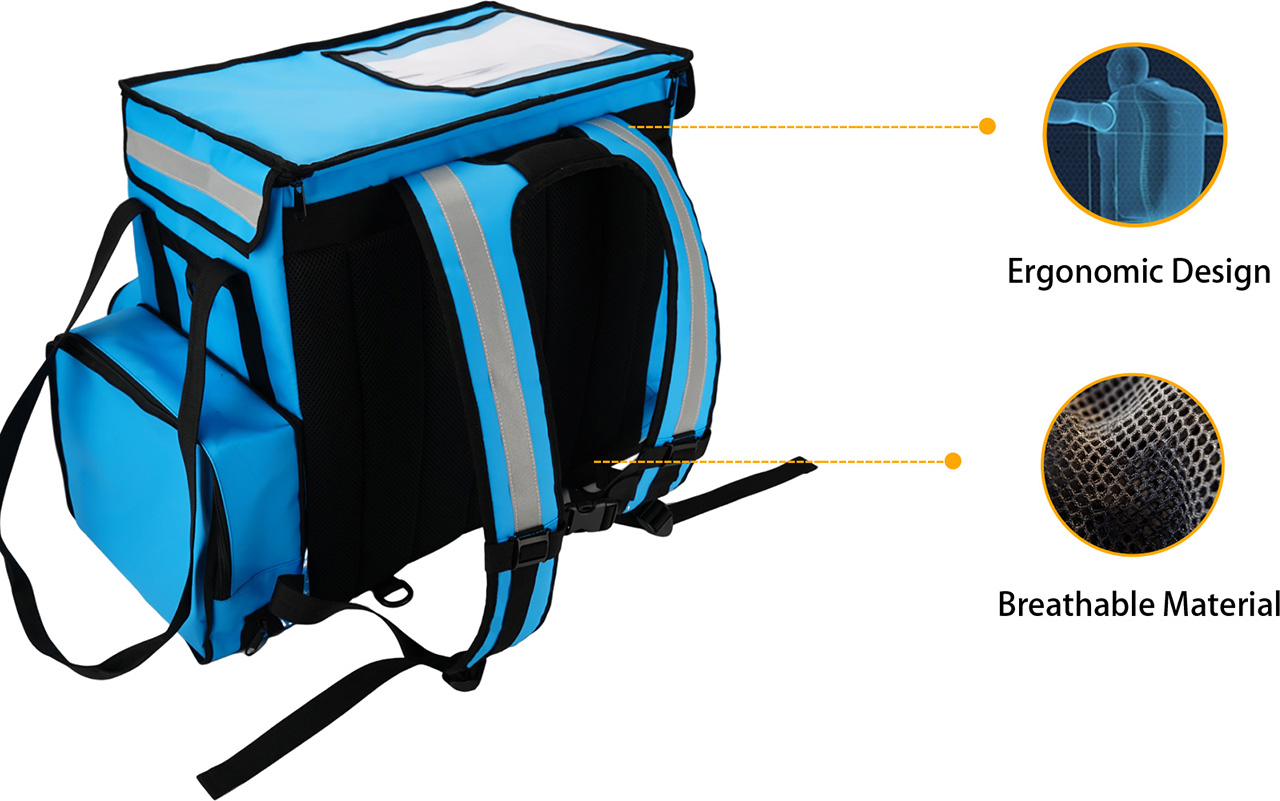
Spinal Ventilation Architecture: Quality factories integrate 3D air-mesh channels and multi-density foam panels to disperse weight across the pelvis and circulate air along the spine.
Mistake 4: Partnering with Trading Intermediaries Disguised as True OEM Factories
Online sourcing portals are crowded with middleman trading firms masquerading as deep-tier manufacturers. These brokers present slick marketing pages but subcontract purchase orders to small, unregulated sewing workshops scattered across rural industrial zones.
Brokers add a 15% to 30% price markup while insulating buyers from the true assembly floor. This leads to critical operational issues:
Zero Engineering Agility: If you need custom motorcycle rack locking brackets, internal battery-routing channels, or customized drink caddies, brokers cannot help. They lack direct CAD drafters and structural pattern engineers.
Blame Shifting During Defect Surges: If an entire shipment arrives with delaminating tarpaulin or backward-facing reflective strips, the trading company points fingers at the workshop, leaving your platform with useless stock.
Uncontrolled Lead Times: Middlemen shuffle your production run behind larger domestic clients, triggering severe shipment delays during peak seasonal launches.
To confirm a true food delivery backpack OEM, run a direct delivery bag OEM audit. Request an unannounced live video walkthrough of the factory floor. Confirm they operate automated CNC fabric cutting machines, computer-guided programmable sewing stations, and dedicated high-frequency welding lines. Require direct engineering calls with their structural bag designers rather than communicating through sales reps.
Tier-one manufacturers, including Weierken, maintain dedicated technical development workshops where structural design, 3D prototyping, and sample stress testing happen entirely under one roof.
Mistake 5: Neglecting ESG, Compliance Certifications, and Material Traceability
Global food platforms and logistics giants operate under heavy investor scrutiny. Platform boards track Scope 3 emissions, human rights policies, and sustainable supply-chain commitments. Selecting an unvetted cut-and-sew shop with poor labor and environmental practices poses severe corporate risk.
If an NGO or investigative outlet discovers child labor, forced overtime, or illegal toxic waste dumping within your gear supplier's network, the resulting press coverage damages enterprise valuation overnight. Furthermore, customs authorities in North America and Europe routinely seize cargo imports lacking verifiable material traceability chains.
Audit your supply chain against international compliance standards:
Social Responsibility Audits: The facility must hold active, verifiable audit reports from Sedex (SMETA) or amfori BSCI. This confirms fair compensation, safe machine conditions, and zero forced labor.
Quality Systems: Demand an up-to-date ISO 9001 certification to ensure standardized tracking of raw materials and inline defect rejection.
Certified Recycled Materials (GRS): If your platform promotes green delivery initiatives, verify that rPET fabrics carry authentic Global Recycled Standard (GRS) transaction certificates to avoid greenwashing liabilities.
Frequently Asked Questions
Q1: What is the minimum order quantity (MOQ) for an industrial food delivery backpack OEM?
A1: Fully customized projects—incorporating bespoke molded backplates, proprietary hardware, and pantone-dyed fabrics—typically require an MOQ of 500 to 1,000 units. Some OEM factories accept lower trial volumes for standard shell patterns using custom-branded screen printing and heat transfers.
Q2: What is the main difference between TPU and PVC fabrics for delivery backpacks?
A2: TPU (Thermoplastic Polyurethane) is environmentally cleaner, stays flexible in freezing weather, and delivers superior tensile and abrasion resistance. PVC (Polyvinyl Chloride) is cheaper upfront but cracks under sub-zero temperatures, emits volatile plasticizers, and wears out much faster on the road.
Q3: How do true OEM factories test the water resistance of delivery packs?
A3: True factories conduct rain-chamber shower tests, spraying loaded packs with multi-directional high-pressure water jets for 30 to 60 minutes. The internal compartment must remain dry, with zero moisture tracking through seams, zip tapes, or fold joints.
Q4: Why are waterproof zippers prone to early failure on cheap delivery bags?
A4: Low-grade bags run standard nylon coil zippers coated with cheap polyurethane film. Constant dust and road grime wear away the film, while heavy pulling derails the sliders. Industrial backpacks use heavy-gauge #10 resin track zippers or genuine YKK AquaGuard closures with reinforced end-stops.
Q5: How long does the custom prototype process take with an experienced OEM factory?
A5: When working from complete Tech Packs or physical benchmark samples, an experienced supplier completes structural prototypes in 7 to 12 business days. Complex builds requiring custom injection-molded components or specialized frames may take 3 to 4 weeks.
Q6: Can an OEM factory integrate smart electronics into fleet delivery backpacks?
A6: Yes. Professional manufacturers routinely engineer internal channels for courier power banks, pass-through ports for phone charging, integrated heated thermal pads, and exterior LED hazard light panels wired directly into the backpack structure.
Choose an Engineering Partner, Not Just a Vendor
Sourcing your platform's delivery gear should never be treated as a quick transactional purchase. The wrong supplier drains operational cash through early bag replacements, damaged meals, high driver turnover, and compliance headaches. A qualified food delivery backpack OEM operates as an engineering consultant, protecting your capital investments and street reputation.
Weierken engineers durable delivery solutions for platforms, postal networks, and fleet operators worldwide. By combining in-house thermal engineering labs, automated fabrication lines, and verified international ESG compliance, our manufacturing facilities turn gear specifications into reliable, long-lasting assets.
Do not let poor equipment slow down your fleet. Contact our engineering team at Weierken today to request a comprehensive design review, schedule an audit, or receive a free quotation on your upcoming production runs.