
For top-tier food delivery enterprises, last-mile equipment is never just a commodity. Every hour, thousands of couriers navigate congested streets, bad weather, and tight dispatch windows. In this environment, branded delivery bags for food delivery platforms serve as vital operational assets rather than simple carrying packs.
Procuring low-grade delivery gear creates immediate downstream expenses. Flimsy zippers snap mid-shift. Poor insulation yields lukewarm food, spiking customer refund requests. Cheap fabrics soak through during sudden downpours, while poorly balanced packs lead to driver fatigue and churn.
Experienced OEM manufacturers like Weierken approach bag manufacturing through an engineering mindset. Solving these issues requires rigorous material selection, ergonomic validation, and strict temperature control standards designed specifically for high-velocity fleets.
Thermal Control and Food Safety Architecture
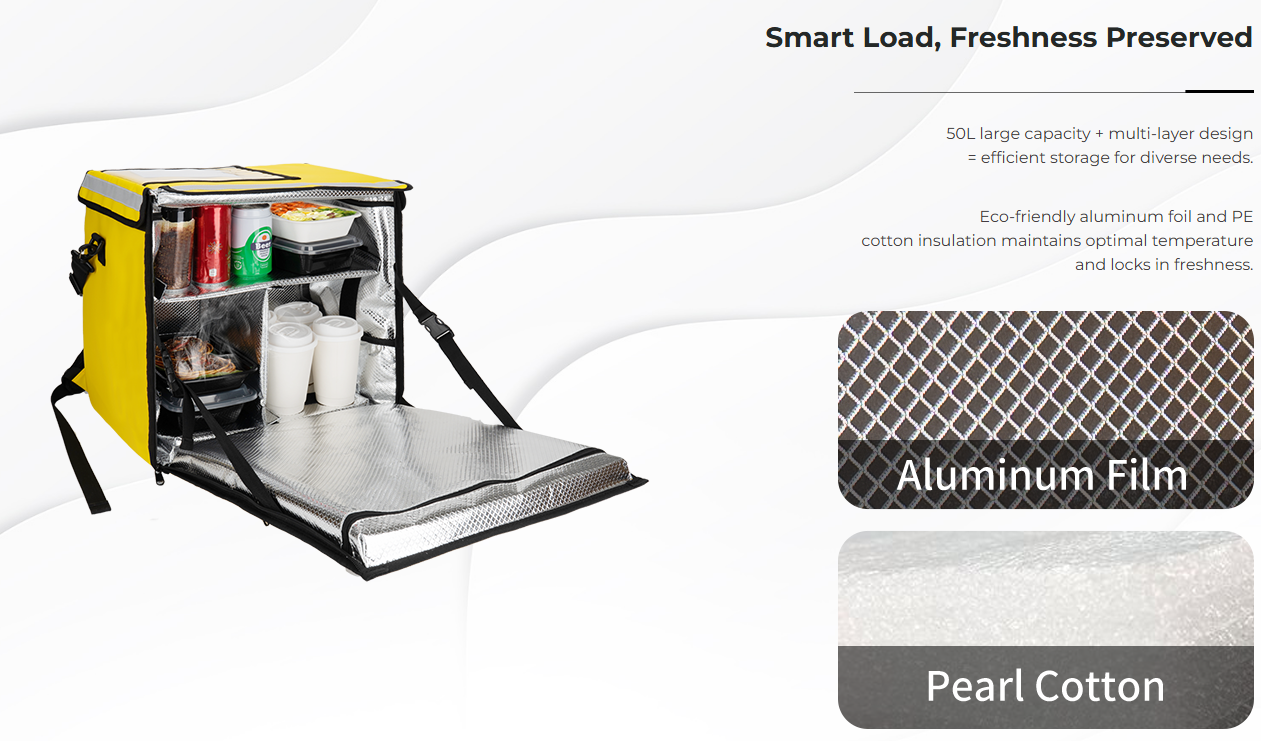
Temperature retention directly protects platform margins. If hot orders arrive under 60°C or chilled desserts arrive melted, the platform absorbs the financial loss. High-grade branded delivery bags for food delivery platforms rely on a multi-layer insulation matrix to control conduction, convection, and radiation.
Top-tier bags use a distinct triple-layer thermal barrier:
Inner Radiance Shield: Food-grade aluminum foil or heat-sealed PEVA composite film that bounces radiant heat back into the cargo zone.
Core Insulation Foam: 8mm to 12mm high-density Expanded Polyethylene (EPE) or closed-cell EVA foam that halts thermal conduction across outer walls.
Thermal Break Outer Shell: Heavyweight industrial textiles bonded to prevent external cold air or blistering surface heat from penetrating the core.
Hot and Cold Compartmentalization
Urban delivery logistics frequently combine opposing orders. A single rider might transport wood-fired pizza alongside iced specialty drinks. Mixing these items in an open cavity ruins both items within twenty minutes.
Industrial OEM designs utilize adjustable, hook-and-loop modular thermal dividers. These insulated partition walls feature dense foam cores and magnetic or heavy-duty velcro perimeter seals. Couriers can reconfigure the internal layout in seconds, creating two isolated micro-climates that prevent steam transfer and thermal bridging.
Hygiene Compliance and Cleanability
Spills are unavoidable. Unchecked grease and sauce residues inside bag seams breed bacteria and unpleasant odors. Inner linings must meet international food-contact safety benchmarks such as FDA, LFGB, and EU REACH regulations.
Manufacturers integrate antimicrobial coatings into the inner film to stop fungal growth. Seamless heat-sealed bases prevent fluids from sinking into internal foam layers. Drivers can wipe the interior clean with sanitizing sprays between trips, maintaining pristine operating conditions.
Material Durability and Industrial Wear Resistance
Consumer backpacks never face the abuse sustained by food delivery bags. A platform bag undergoes thousands of abrasive contact cycles every month against motorcycle racks, concrete curbs, and building elevators. Material selection dictates the bag's operational lifespan.
OEM factories balance tear resistance, total weight, and water impermeability through specialized industrial textiles:
500D to 1000D TPU Tarpaulin: The premier choice for all-weather fleets. Thermoplastic Polyurethane (TPU) tarpaulin provides smooth, wipe-clean surfaces, extreme tensile strength, and superior UV resistance without cracking over time.
1680D Ballistic Oxford Polyester: A dense weave with polyurethane (PU) backing that delivers extreme scratch resistance against metal cargo racks while offering a softer, technical aesthetic.
Seamless Waterproofing Technology
Heavy precipitation represents peak order volume for food delivery platforms. If a bag leaks during a storm, deliveries fail and brand trust evaporates. True weatherproofing requires more than surface-treated water-repellent sprays.
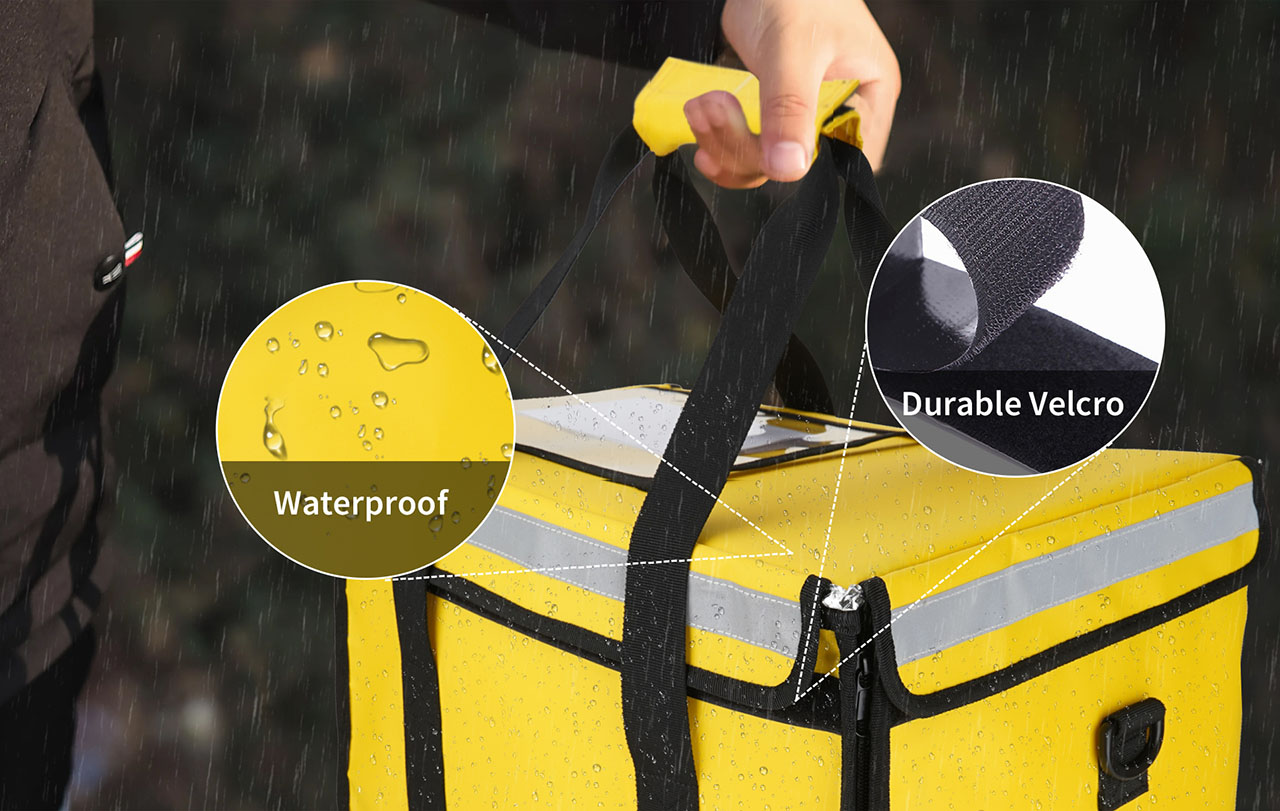
High-performance bags use High-Frequency (RF) seamless welding on tarpaulin fabrics. This process fuses textile edges at the molecular level, eliminating needle holes entirely. Combined with roll-top configurations or waterproof storm flaps, these designs achieve IPX4 to IPX6 water ingress ratings, keeping contents dry through torrential rain.
Hardware Fortification and Stress-Point Reinforcement
A bag is only as dependable as its primary failure points: hardware and seams. Standard nylon zippers quickly strip under constant pulling and dirt exposure. Custom commercial builds require heavy-gauge waterproof zippers, such as genuine YKK AquaGuard or custom oversized #10 resin tracks.
Stress points require targeted structural reinforcement:
Reinforced box-X stitching and industrial bartack points across shoulder strap anchors and top handles.
Military-grade polyacetal (POM) buckles that retain impact resistance below freezing temperatures.
Extra-wide 50mm industrial hook-and-loop fasteners rated for tens of thousands of open-close cycles without losing grip strength.
Rider Ergonomics and Road Safety Compliance
Rider comfort directly influences courier retention and road safety. Full-time gig workers spend ten to twelve hours a day carrying 10 to 20 kilograms of food and beverages. Poor ergonomics cause back fatigue, slower transit times, and preventable safety risks.
Advanced OEM bag platforms incorporate human-factors engineering to evenly distribute mass across the rider's skeletal framework rather than concentrating tension on the shoulders:
3D Molded Honeycomb Back Panels: Contoured air channels promote lumbar airflow, minimizing heat accumulation and moisture buildup against the courier's spine.
Multi-Density Shoulder Straps: Dual-layer EVA foam distributes shoulder pressure without packing out or thinning over months of daily use.
Load Stabilization Straps: Integrated chest sternum clips and wide hip belts draw cargo closer to the rider's center of gravity, preventing dangerous shifts during sudden motorcycle turns.
Multi-Platform Transition Systems
Modern couriers switch between walking, riding e-bikes, and driving mopeds. Fleet gear must adapt instantly. Industrial delivery bags use quick-release webbing systems with commercial carabiners or cam buckles.
Riders can secure the bag to a bike rack in seconds, unclip it to mount it as a backpack, or tuck the shoulder straps away entirely into hidden rear sleeves when the bag stays on a scooter frame.
Night Visibility and Global Safety Norms
Courier visibility on crowded, dark roadways is non-negotiable. Delivery platforms carry strict corporate responsibilities to ensure their staff remain visible to traffic in low-light and wet conditions.
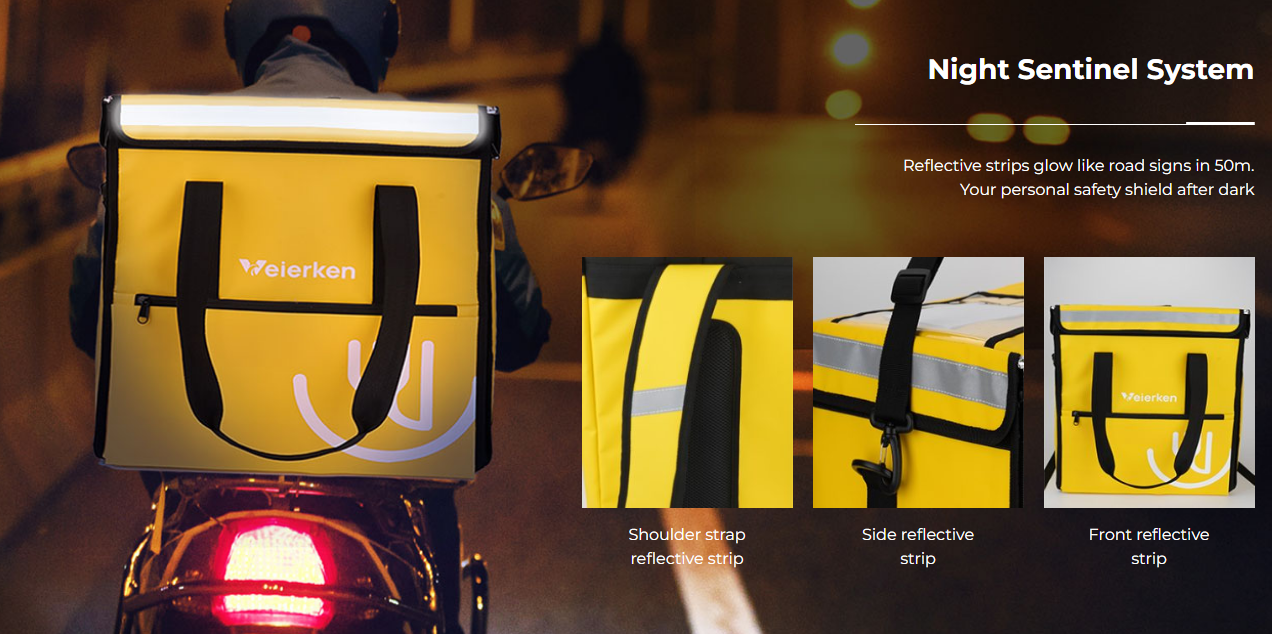
High-performance bags integrate certified retroreflective films meeting EN ISO 20471 or ANSI/ISEA 107 Class 2 standards. Broad 3M micro-prismatic reflective strips positioned on the front, bottom, and side panels reflect headlights from up to 300 meters away, offering comprehensive 360-degree night visibility.
Visual Identity and OEM Customization Engineering
Every courier cycling through an urban center acts as a mobile brand ambassador. Tens of thousands of couriers moving through high-density commercial corridors create millions of visual impressions daily. Flawless branding turns functional equipment into high-return advertising.
Precision color matching is fundamental. OEM partners like Weierken run computerized spectrophotometer audits to align base fabrics with exact corporate Pantone or RAL values. Specialized anti-UV surface chemistry prevents signature brand tones from fading into dull, chalky hues under intense sun exposure.
Industrial Printing Solutions
Outdoor delivery demands far more resilience than simple apparel printing. Logos must endure grease, pressure washing, friction, and extreme temperatures without peeling or cracking.
OEM factories deploy specialized printing techniques depending on branding goals:
Heavy-Duty Screen Printing: Uses elastomeric inks that flex with the bag material, perfect for large, solid-color vector logos on high-volume runs.
Sublimation and Thermal Transfer: Applied for complex gradients, photographic brand imagery, or limited-run promotional campaigns.
Reflective Logo Formulations: Screen-printed glass-bead inks that reflect white under vehicle headlights, transforming the company logo into an active night-safety feature.
Interchangeable Marketing Panels
Platforms frequently update marketing campaigns, announce seasonal discounts, or sell external sponsorship space to restaurant partners. Premium custom bags feature transparent, cold-crack-resistant PVC display pockets across the rear face.
These windows allow couriers to switch printed promotional cards in moments. The feature lets fleet managers update visual campaigns without incurring the cost of manufacturing entirely new bags.
Supply Chain Control and Scaled OEM Production
Ordering equipment for an international fleet requires rigorous supply chain management. Procurement directors need consistent, repeatable quality across manufacturing batches running into tens of thousands of units.
Professional manufacturing facilities conduct destructive stress testing inside certified testing laboratories before signing off on full-scale shipments:
Tensile Handle Testing: Pneumatic pull arms yank top handles and straps through 50,000 continuous cycles at dynamic loads over 25 kilograms.
Drop Impact Tests: Loaded bags fall from 1.5 meters onto hard concrete to confirm hardware stays intact and seams do not blow out.
Thermal Decay Logging: Multi-channel temperature sensors monitor cooling curves over a 4-hour window inside dedicated thermal test chambers.
Sustainable Materials and ESG Delivery
Corporate sustainability targets shape modern procurement tenders. Major delivery platforms must demonstrate concrete reductions in virgin plastic usage across their entire supply networks.
OEM suppliers support these ESG targets by sourcing Global Recycled Standard (GRS) certified rPET textiles. Made from reclaimed post-consumer plastic bottles, these fabrics provide identical tensile strength and weatherproofing to standard polyesters while cutting carbon impact.
Production Scalability and Tiered Delivery
Managing city launches or seasonal gear refreshments demands dependable manufacturing capacity. Automated laser fabric-cutting tables maximize textile efficiency and eliminate human measurement error. Tiered wholesale pricing structures allow fast-growing platforms to forecast capital expenditures accurately as their active driver counts expand.
Frequently Asked Questions
Q1: What is the ideal foam thickness for food delivery bag thermal insulation?
A1: An 8mm to 12mm layer of high-density EPE or closed-cell EVA foam delivers an optimal balance between insulation and total weight. For multi-drop logistics over 45 minutes, a 10mm core combined with radiant barrier foil keeps food well within safe serving parameters.
Q2: How do OEM manufacturers prevent rain from leaking through the stitching?
A2: Water ingress is prevented through two industrial methods: high-frequency (RF) welding that melts TPU seams into a solid joint, or heat-applied waterproof polyurethane seam-tape along every internal stitched seam of Oxford fabrics.
Q3: Can branded delivery bags for food delivery platforms safely transport hot and cold meals simultaneously?
A3: Yes. This is accomplished using dense, removable, insulated divider panels secured with perimeter hook-and-loop fasteners. The barrier isolates steam and heat on one side while maintaining cold storage on the other.
Q4: What certifications should platform procurement teams require for food-contact inner liners?
A4: Inner linings should comply with FDA 21 CFR standards in the United States or LFGB regulations across the European Union. Materials should also be certified free of SVHCs (Substances of Very High Concern) under EU REACH guidelines.
Q5: What is the typical service life of an industrial-grade food delivery bag?
A5: High-grade bags built with 1000D TPU or reinforced Oxford fabrics, industrial YKK zippers, and bartack stitching generally last 12 to 24 months in continuous full-time fleet service. Cheap generic alternatives typically fail within 60 to 90 days.
Q6: What are the standard Minimum Order Quantities (MOQs) for fully custom OEM bags?
A6: Full custom manufacturing—including custom pantone-dyed fabrics, proprietary hardware molds, and bespoke structural shapes—usually starts at 500 to 1,000 units. Standard frame customizations with corporate screen printing can be run at lower thresholds.
Upgrade Your Fleet's Last-Mile Performance
High-performance branded delivery bags for food delivery platforms do more than carry meals. They protect profit margins, enhance courier health, and project professional brand authority across busy city centers. Investing in purpose-built engineering pays for itself by reducing order cancellations, customer refunds, and constant equipment reorders.
Weierken engineers and manufactures industrial-grade delivery equipment for platforms, food aggregators, and national logistics networks worldwide. Whether your team requires GRS-certified sustainable textiles, custom thermal chambers, or rugged all-weather fleet packs, our design engineers deliver turnkey solutions tailored to your operational KPIs.
Contact the OEM specialist team at Weierken today to review your project specifications, request an engineering prototype, and secure tiered contract pricing for your fleet.