


SUP Yoga (Stand-Up Paddleboard Yoga) has evolved from a niche fitness trend into a significant growth driver for the water sports industry. This growth creates a unique challenge for gear designers. A standard bag no longer suffices. Practitioners need a solution that balances two conflicting requirements: carrying heavy, wet paddleboard accessories while keeping clean yoga gear dry and pristine. At weierken, we have watched this market shift firsthand. As a specialized sup yoga bag factory, we know that 2026 will demand more than just “water-resistant” fabric.
Professional B2B buyers must look deeper into the construction of these bags. If you are sourcing for the upcoming season, your inquiries need to be technical and forward-looking. Here are seven professional questions you must ask your supplier, along with the technical logic behind them.
1. How is Wet/Dry Separation Actually Achieved?
For a SUP yoga enthusiast, mixing a wet wetsuit or a sandy anchor with a clean yoga mat is a disaster. Many factories claim to offer “wet/dry separation,” but the reality is often just a thin nylon divider.
The Technical Reality of Isolation
A true wet/dry compartment must feature an independent, airtight structure. We utilize high-frequency (HF) welding to create a TPU or PVC inner liner. This creates a physical barrier that prevents moisture from seeping into the dry section of the bag. When you talk to a sup yoga bag factory, ask if the wet zone can withstand a 3-minute static pressure test. If water leaks through the seams under pressure, the design fails its primary purpose.
2026 Market Trends
By 2026, the market will favor detachable wet bags. This allows the user to remove the “wet zone” entirely for separate washing or drying. This modularity is a key selling point for high-end fitness brands looking for Dry bag wholesale for water sports solutions.
2. Is the Drainage Design Functional or a Point of Failure?
Wet gear needs to drain, but paddleboard environments involve a lot of fine sand. A simple hole in the bottom of the bag is not enough.
Professional Drainage Solutions
A professional sup yoga bag factory should implement one-way drainage valves or eyelets equipped with fine mesh. We recommend using 8mm to 12mm thickened brass eyelets lined with a 200-mesh sand screen. This setup allows water to exit quickly while preventing sand from flowing back into the bag when it sits on the beach.
- Check the Location: The drainage point should sit at the lowest physical point of the bag.
- Reinforcement: Ensure the edges of the drainage hole are reinforced with HF welding to prevent tearing under the weight of wet gear.
3. Can the Zippers Survive Saltwater and Sand?
Zippers are the most common point of failure for outdoor bags. In the SUP yoga world, they face a constant barrage of salt spray and abrasive sand.
The Standard for 2026
You should insist on sand-proof zippers. The industry standard currently focuses on two solutions. First, the YKK AquaGuard or AquaSeal series, which uses resin teeth and a PU waterproof film to prevent sand from getting trapped. Second, reversed coil zippers, which minimize the gaps between teeth.
- Salt Spray Testing: Ask your sup yoga bag factory if the zipper sliders have passed a 96-hour neutral salt spray test.
- Ease of Use: By 2026, most brands will require anti-tangle silicone pull tabs to ensure users can operate the bag with wet or cold hands.
At weierken, we treat hardware selection as a priority, ensuring that every component matches the durability of the main fabric.
4. What Are the Bag’s Breathability and Anti-Mold Capabilities?
SUP yoga bags spend a lot of time in hot, humid, and salty environments. This is the perfect breeding ground for bacteria and mold.
Advanced Material Systems
Breathability is not just about making holes; it is about the entire material system. We often use a combination of materials to facilitate airflow.
- Outer Shell: We incorporate Breathable mesh bag for yoga gear panels or perforated neoprene on the exterior to create a convection layer.
- Inner Lining: For the wet zone, we recommend silver-ion antimicrobial linings. These linings effectively inhibit the growth of mold and E. coli.
A bag that smells like mildew after two uses will destroy your brand’s reputation. Ask your factory for their plan to encourage drying, such as integrated hanging loops for open-air storage.
5. Is the Load-Bearing System Rated for Real-World Weights?
A wet, inflatable paddleboard can weigh between 15kg and 20kg. When you add a yoga mat, an anchor, and a full water bottle, the total load often exceeds 25kg. A standard backpack strap will snap under this tension.
Engineering for Heavy Loads
As an Inflatable paddle board bag manufacturer, we treat the strap system as a structural engineering project.
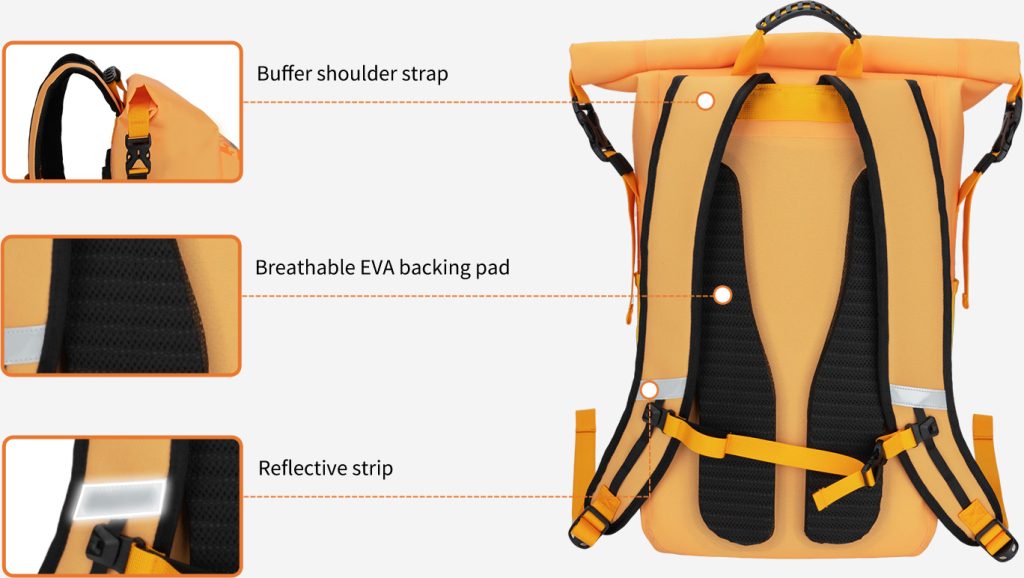
- Webbing Standards: We use high-density Nylon 66 webbing with a width of at least 38mm.
- Stitching Techniques: Critical stress points must feature Bartack reinforcement (at least 42 stitches) or Box-X stitching patterns.
- Dual Mode Carrying: A good design offers both backpack straps and a reinforced side handle to distribute the weight depending on how the user is traveling.
6. Are Eco-Friendly Material Claims Verified or Just Marketing?
Environmental Social Governance (ESG) compliance will be a hard requirement for the US and EU markets by 2026. You cannot take a factory’s word for it; you need documentation.
The 2026 Compliance Checklist
When sourcing from a sup yoga bag factory, ask for the following “hard” certifications:
- RPET (Recycled Polyester): Request the Global Recycled Standard (GRS) certificate and the Transaction Certificate (TC).
- Bio-based TPU: If the factory claims a bag is biodegradable, they must provide BPI industrial compostable or DIN CERTCO home compostable certificates.
- PFAS-Free Coatings: Confirm that the DWR (Durable Water Repellent) is “C0” and contains no PFOA or PFOS, meeting OEKO-TEX 100 Annex 6 standards.
7. Does the Factory Use Modular Design Thinking?
Product lifecycles are getting shorter. Stocking a bag that only does one thing increases your inventory risk. Modularity is the future of B2B efficiency.
Platform-Based Development
Ask if the factory can develop a “platform” for your brand. This means using a common outer frame that can accept different liners.
- MOLLE Systems: This allows users to attach extra phone pouches or water bottle holders.
- Collapsible Structures: The bag should fold flat when empty but expand into a high-capacity hauler when full.
- Universal Liners: Can the same outer shell work for a SUP yoga setup, a standard gym bag, or a photography gear bag? This approach reduces your SKU development costs significantly.
Finding a Technical Partner in a Crowded Market
The SUP yoga bag market might seem small, but it requires a sophisticated blend of marine-grade durability and fitness ergonomics. At weierken, we believe that the best suppliers are those who can explain the “why” behind every stitch and seal.
As we move toward 2026, the gap between “standard” factories and “technical” factories will widen. Choosing a partner who understands the seven questions above will ensure your brand stays ahead of the curve.
Frequently Asked Questions (FAQ)
1. What is the average lead time for a custom SUP yoga bag?
Typically, a sup yoga bag factory will take 35 to 45 days for mass production after the final sample is approved. Development and sampling usually take an additional 15 to 21 days due to the complexity of the waterproof testing required.
2. Can these bags fit both a hard board and an inflatable board?
Most bags from an Inflatable paddle board bag manufacturer are designed for the larger volume of a rolled-up inflatable board. While they can carry accessories for a hard board, the dimensions are optimized for the bulky nature of inflatable gear and its pump.
3. Is there a minimum order quantity (MOQ) for recycled materials?
Yes, because recycled yarn often needs to be custom-dyed. Most factories require an MOQ of 500 to 1,000 units to use certified GRS materials. If you need smaller quantities, you may be limited to the factory’s stock colors.
4. How do you test the waterproofness of the dry compartment?
We use a combination of “air inflation” tests and “water immersion” tests. We inflate the compartment and submerge it in a tank; if any bubbles appear, the seal is broken. For B2B orders, we can provide a 100% inspection report for high-end orders.
5. Why is Nylon 66 better than standard Polyester for straps?
Nylon 66 has a much higher tensile strength and better abrasion resistance. While it costs more, it ensures the bag won’t fail when the user is hiking to a remote lake with 25kg of gear on their back.
6. Do you offer “Dry bag wholesale for water sports” in bulk?
Yes, we provide bulk wholesale options for both standard designs and fully customized OEM projects. We also offer private labeling for established fitness and water sports brands.
Ready to Upgrade Your Inventory?
Navigating the technical requirements of the SUP yoga market requires a partner with deep manufacturing experience. Whether you need a high-capacity Inflatable paddle board bag manufacturer or a specialized sup yoga bag factory that prioritizes eco-friendly materials, weierken is here to help.
[Request a Quote Today] Reach out to our technical team to discuss your 2026 product line. Let’s build a bag that protects your customers’ gear and your brand’s reputation. Discover the difference that expert engineering makes.


