
Fly fishing sling packs demand more engineering precision than almost any other category in the technical bag market. Anglers wade chest-deep into fast currents, push through abrasive brush, and whip the pack across their torso with one hand to swap flies mid-stream. If a welded seam fails or a zipper splits, expensive fly boxes and electronics end up soaked.
Most general cut-and-sew bag factories cannot deliver true submersible gear. They often lack high-frequency welding machinery and understand little about angler ergonomics. When vetting a custom fly fishing sling pack manufacturer, asking surface-level questions about unit price and lead time leaves your brand exposed to massive quality risks. Specialized technical suppliers like Weierken design their assembly lines specifically around high-pressure welding and ergonomic tackle storage. Use the following seven critical questions to evaluate potential production partners before cutting tooling or signing a purchase order.
1. Do You Have In-House High-Frequency (RF) Welding, and How Do You Handle Corner Radii?
Many suppliers advertise waterproof packs while using standard nylon fabric with taped needle stitches. Traditional needle stitching punches thousands of micro-holes into the shell. While internal taping works for lightweight rain jackets, it fails under prolonged immersion during deep wading. A true submersible fly fishing sling bag factory must use High-Frequency (RF) or Hot-Air Radio Welding to fuse thermoplastic polyurethane (TPU) panels at the molecular level.
In-house welding capabilities separate specialized manufacturers from trading companies that broker jobs out to third parties. Ask the factory team how they handle 3D compound curves and tight corner junctions. Welding flat sheets is simple, but sling packs require ergonomic curves to wrap comfortably around an angler's back. When a welded seam outdoor pack manufacturer lacks proper aluminum tooling molds, corner transitions develop micro-wrinkles that leak under hydrostatic pressure.
Request tool design verification: Confirm that the supplier designs and machines custom CNC welding horns in-house to match your pack contour.
Check welding overlap width: Ensure the factory maintains a minimum weld bead width of 8 mm to 12 mm across all structural load-bearing seams.
Verify leak testing on curves: Inquire about their scrap rate at three-panel junction points, which represent the most common failure zone during initial trial runs.
2. Which Airtight Zipper Systems Do You Support, and How Are the Terminals Reinforced?
The main closure zipper represents both the most expensive component and the highest warranty risk on any waterproof sling pack. If a factory misaligns an airtight zipper by a fraction of a millimeter during the thermal press cycle, the tooth engagement warps, destroying the airtight seal.
A reliable OEM/ODM fly fishing gear supplier should have proven experience installing premier airtight zipper systems, including TIZIP MasterSeal, TruZip toothless sliders, and heavy-duty YKK Aquaseal chains. Inquire directly about how the factory secures the zipper garage and terminal stops. If the zipper end-stop is merely sewn into a TPU border, high-tension pulling will eventually cause delamination.
Look for factories that apply high-pressure RF welding patches over zipper terminals, supported by molded TPU reinforcement tabs. This construction distributes the pulling stress across the main fabric wall instead of concentrating force on the zipper track.
3. Have You Built Dedicated Fly Fishing Hardware Ports and Tool Workstations?
General dry bag manufacturers often treat fly packs like simple dry sacks with a single strap. However, dedicated fly anglers require immediate, blind access to specialized tools without opening the main compartment. Your custom fly fishing pack prototyping team must understand specific fly-fishing workflows.
Review the manufacturer's ability to integrate these specific functional components:
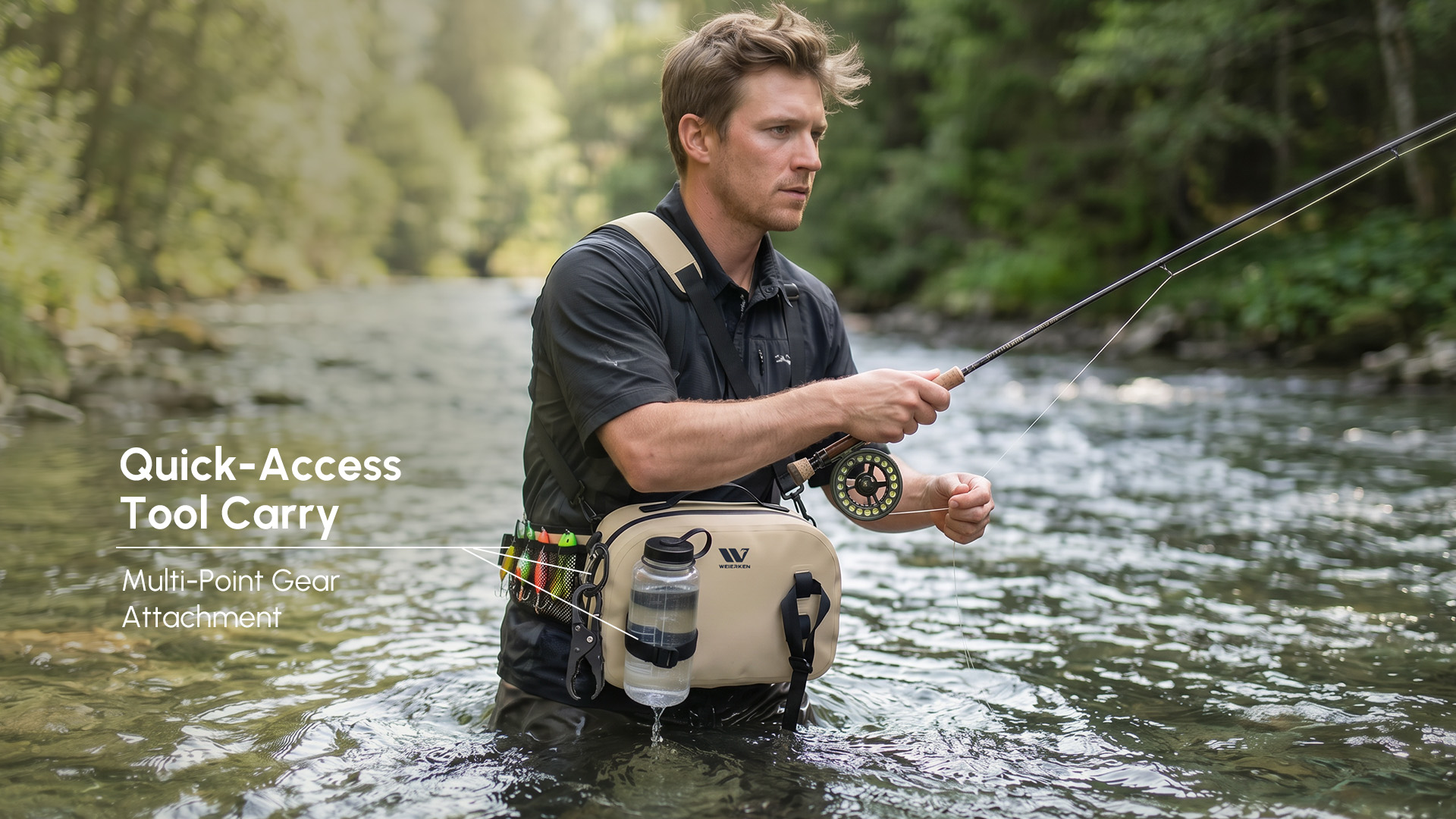
Magnetic Forceps Docks: Embedded internal neodymium magnets paired with hypalon retention sheaths to hold hemostats securely against the sling strap.
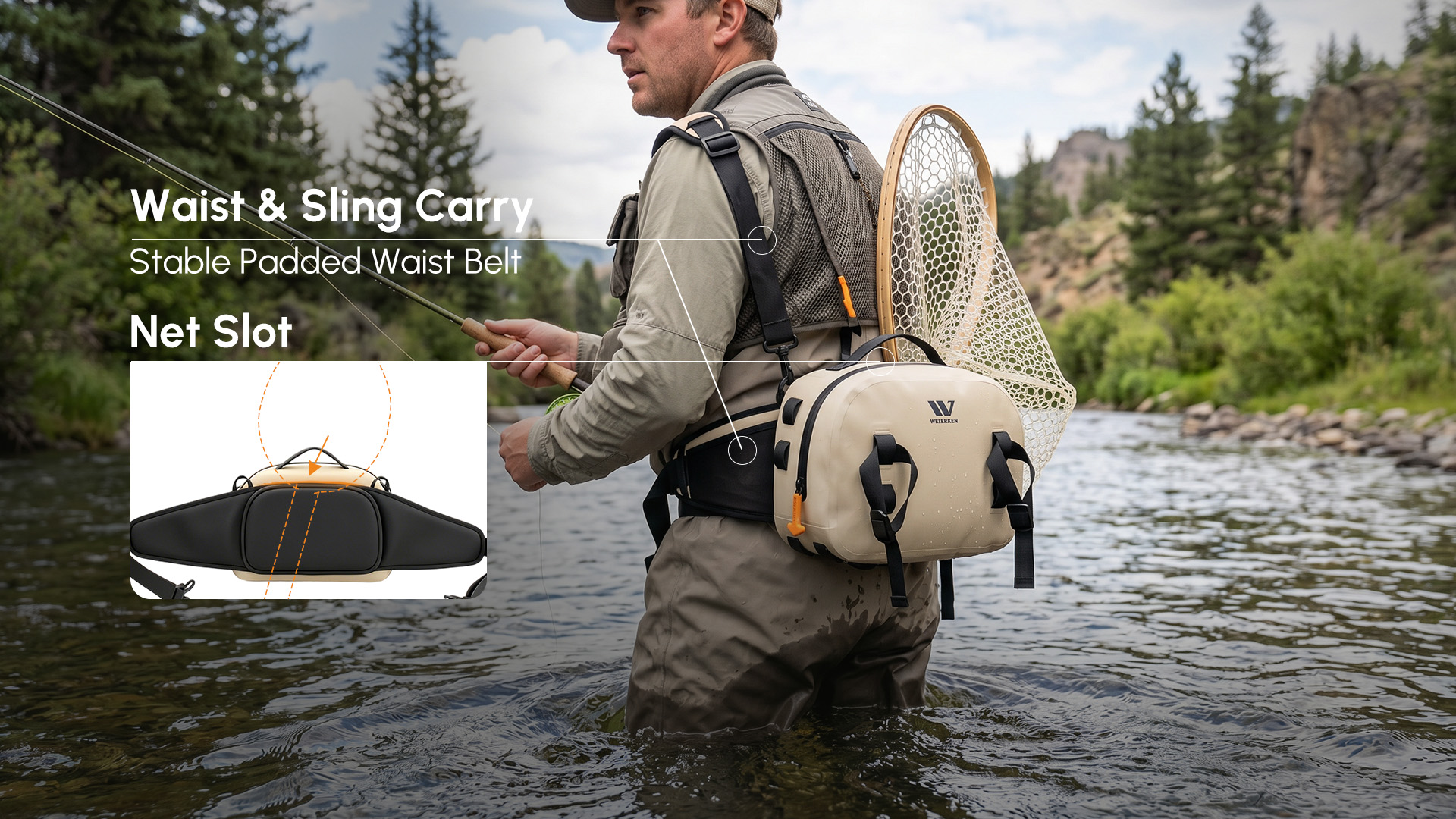
Integrated Net Slots: Internal pass-through sleeves built into the back panel or welded D-ring anchor points rated for heavy net pull forces.
Tippet Spool Stations: External cord or aluminum post systems with quick-release retention for rapid tippet management.
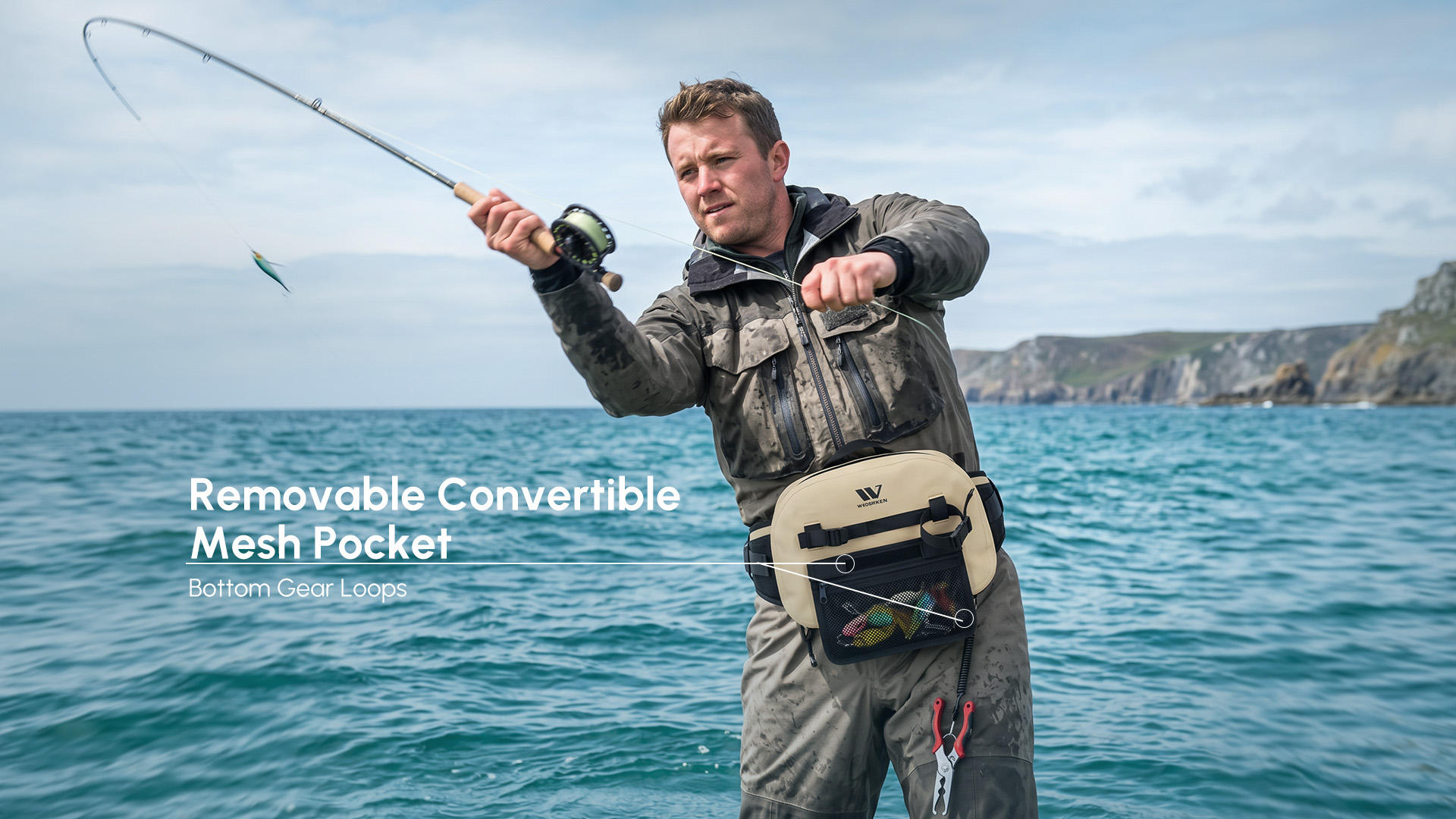
Fly Patch Workstations: Die-cut high-density EVA foam or molded silicone ribbed patches that hold dry flies and streamers without holding water.
Floatant and Desiccant Pockets: Stretch mesh or molded compartments positioned so bottles sit nozzle-down for quick access.
If the supplier does not recognize these terms, your product team will spend months educating them on basic fishing ergonomics during sampling.
4. What TPU Substrates, Recycled Deniers, and PFAS-Free Coatings Do You Supply?
Material selection dictates pack longevity, weight, and environmental compliance. Premium fly fishing packs use 420D to 840D high-tenacity nylon with double-sided or single-sided TPU coatings. Double-sided TPU allows factories to create airtight welds on both the interior and exterior of the seam, maximizing structural integrity for technical waterproof TPU tackle sling pack production.
With tightening environmental regulations across North America and Europe, you must ensure your supplier can provide verified documentation for sustainable materials:
GRS Certification: Global Recycled Standard (GRS) documentation verifying post-consumer or post-industrial recycled nylon bases.
PFAS-Free / C0 DWR: Proof that water-repellent surface finishes contain zero fluorinated compounds, satisfying strict state and regional trade laws.
UV and Hydrolysis Resistance: Anti-yellowing and hydrolysis-resistant TPU formulations tested to withstand UV radiation and constant wet-dry cycles without sticky resin breakdown.
Cold-Crack Performance: TPU composite ratings that remain pliable down to -20°C for winter tailwater and steelhead fishing.
Manufacturers like Weierken work directly with certified raw material mills to secure traceable batch test reports, helping brands avoid costly cross-border customs seizures or environmental fines.
5. What Is Your Standard Quality Assurance Protocol for Hydrostatic Pressure and Load Fatigue?
A simple visual inspection cannot verify if a welded sling pack will stay dry when submerged under three feet of water. Ask your prospective supplier for their written standard operating procedure (SOP) regarding airtight quality assurance.
Commercial-grade fly fishing gear factories use a strict multi-tier testing procedure:
100% Inflation Immersion Testing: Every completed waterproof bag is inflated to 1.5 to 2.0 PSI and submerged in an illuminated water tank to verify zero air bubbles emerge from seams, zippers, or valve ports.
Shoulder Strap Tensile Fatigue: Cyclic pull testing placing 20 kg to 25 kg of dead weight on the primary sling strap anchor points across 5,000 continuous cycles to prevent field rip-outs.
Salt Spray Chamber Testing: 72-hour to 96-hour ASTM B117 salt spray exposure on all anodized aluminum D-rings, plastic acetal buckles, and zipper sliders to verify saltwater corrosion resistance.
Require the factory to specify what percentage of production units undergo air retention testing and whether individual serial numbers or QC stamps match those inspection records.
6. How Are Custom Welding Tooling Costs Amortized Across Trial Orders and Scale Production?
High-frequency welded construction carries higher upfront capital requirements than traditional stitched soft goods. Every unique panel shape, logo patch, zipper window, and EVA back panel requires an aluminum or copper tooling die. Understanding the tooling breakdown prevents unexpected budget overruns during early development.
Ask the factory to separate tooling costs into transparent categories:
High-frequency seam welding dies (main chamber and sub-pockets).
Molded EVA back panel compression molds.
Thermoplastic logo and magnetic dock injection molds.
Inquire about their policy on Minimum Order Quantities (MOQs). Launching a technical pack often requires a low initial volume to test retail response. Top-tier manufacturers offer tiered pricing, allowing brands to place pilot runs of 300 to 500 units per colorway while keeping tooling assets on file for rapid scaling when reorders trigger.
7. What Are Your Timelines for Technical Prototyping, Design for Manufacturability (DFM), and Production?
Welded packs require precise 2D nesting and 3D mockups before cutting expensive metal welding tooling. If a supplier commits to a standard stitched sample turnaround of 5 days, they likely do not understand the steps involved in welded pack development. An experienced custom fly fishing pack prototyping cycle typically requires 2 to 4 weeks.
Ask how their engineering team handles Design for Manufacturability (DFM) feedback. An experienced factory will review your tech pack and point out areas where seam intersections are too tight for standard welding horns, suggesting minor radiuses that protect waterproof integrity without compromising your design silhouette.
Confirm the complete production schedule from physical sample sign-off and raw material procurement to final assembly, leak testing, and ocean freight dispatch. Standard production turnaround for technical waterproof packs generally ranges from 45 to 60 days once raw TPU substrates arrive at the facility.
Supplier Sourcing Evaluation Matrix
Use the matrix below to score and compare potential manufacturers during your vetting process:
| Evaluation Category | Standard Bag Factory (High Risk) | Specialized Welded OEM Partner (Weierken Standard) |
|---|---|---|
| Seam Technology | Stitched seams with iron-on PU tape (leaks under pressure). | In-house High-Frequency (RF) welding with custom CNC dies. |
| Zipper Integration | Splash-proof coil zippers sewn directly into shell seams. | Airtight zippers with RF-welded reinforcement garages. |
| Fly Gear Knowledge | Generic pockets; no net slots or tippet integration. | Custom fly workstations, magnetic ports, and net docks. |
| Airtight QA Testing | Random visual check on 2% to 5% of finished goods. | 100% inflation bubble tank pressure testing on all units. |
| Material Compliance | Standard PVC or unverified PU fabrics without certs. | GRS-certified recycled nylon, double TPU, PFAS-free DWR. |
| Tooling & Prototyping | Manual cut samples; outsourced welding molds. | Full in-house DFM review, precision tooling, 2-4 week samples. |
Frequently Asked Questions (FAQ)
Q1: What is the difference between IPX7 and IPX8 ratings for fly
fishing sling packs?
A1: An IPX7 rating ensures the sling pack
remains completely dry when submerged in water up to 1 meter deep for 30
minutes. An IPX8 rating exceeds IPX7 parameters under custom
manufacturer-specified depths and durations (often 1.5 to 3 meters continuous
submersion). For fly fishing deep-wading conditions, IPX7 serves as the baseline
technical standard.
Q2: Why is double-sided TPU preferred over single-sided TPU for
submersible tackle packs?
A2: Double-sided TPU features a
thermoplastic polyurethane coating on both the exterior face and interior
backing of the nylon base fabric. This construction allows the manufacturer to
create high-frequency welds on both sides of the material, significantly
improving seam shear strength and preventing water from wicking along bare
internal fabric threads.
Q3: How much should a brand expect to budget for custom welding
tooling?
A3: Tooling costs for a fully custom welded sling pack
typically range from $1,500 to $4,500, depending on the complexity of the
geometry, the number of welded accessory pockets, and whether compression-molded
EVA back panels or custom injection-molded rubber fly patches are included.
Q4: Can an OEM factory help optimize our CAD designs for
high-frequency welding?
A4: Yes. Specialized manufacturers provide
Design for Manufacturability (DFM) reviews. They adjust internal corner angles,
seam clearance allowances, and zipper garage placements on your 2D/3D patterns
to ensure every seam can be reached by a solid welding horn during
production.
Q5: How do we prevent zipper delamination on waterproof sling packs
over extended field use?
A5: Prevent delamination by ensuring your
manufacturer avoids raw-edge stitching around zipper openings. The factory must
use high-frequency perimeter welds backed with TPU reinforcement patches and
molded stress-relief tabs at both terminal ends of the zipper chain to
distribute opening pull force evenly.
Q6: What is the standard sample turnaround time for a technical fly
fishing pack prototype?
A6: Developing a functional, high-frequency
welded prototype generally takes 2 to 4 weeks. This timeframe accounts for
pattern digitizing, temporary CNC tooling setup, raw material cutting, RF seam
welding, and pressure leak verification.
Build Your Technical Fly Fishing Line with Confidence
Developing a high-performance, submersible sling pack requires a manufacturing partner with dedicated welding infrastructure, stringent leak-testing protocols, and deep insight into fly fishing ergonomics. Asking the right technical questions early protects your brand reputation, prevents warranty claims, and ensures your packs perform flawlessly in the river.
Ready to evaluate your new pack design? Contact the engineering team at Weierken today to submit your tech pack for a 48-hour DFM feasibility assessment, tooling breakdown, and direct factory quotation.
Request a Quote & Technical Feasibility Review