

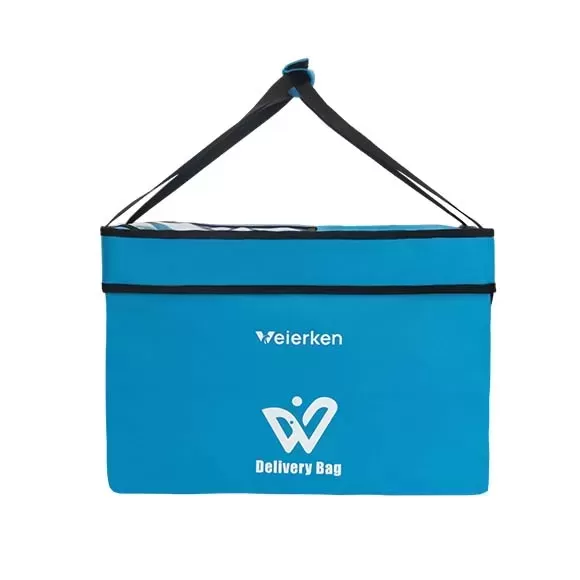
A supplier claims their insulated delivery bag holds sub-zero temperatures for 48 hours. What they rarely mention is that this claim relies on a static 20°C laboratory bench. Real-world commercial transit tells a brutally different story.
Your delivery vans sit on 40°C asphalt in mid-July. Couriers open and close bags repeatedly at multi-drop stops. Boxes jostle over potholes, crushing weak insulation foam and warping seams. At Weierken, we run rigorous qualification tests on every prototype to guarantee our thermal packaging holds up against extreme route conditions.
One single temperature excursion can trigger a cascade of commercial liabilities. A ruined batch of fresh meat or temperature-sensitive pharmaceuticals spoils your bottom line. It destroys brand reputation and brings regulatory fines from food safety agencies. Setting up an in-house thermal retention testing standard protects your logistics operation from cheap, untested gear.

Thermal Engineering Fundamentals: Measuring What Matters
Before launching a test protocol, your quality team must evaluate thermal properties through recognized transport standards. Relying on gut feeling or single-probe thermometers leads to false passes.
International Regulatory Frameworks
Enterprise logistics validation relies on two established testing methodologies:
ISTA Standard 7D / 7E: These testing sequences simulate thermal stresses across commercial transport routes. They subject packaging to alternating summer and winter thermal profiles to mimic dock delays and van storage.
ASTM D3103: The standard test method for thermal insulation performance of packaged products. It outlines direct procedures for evaluating how external ambient heat moves into an insulated cavity.
Key Thermodynamics Metrics to Track
Evaluating commercial cold chain delivery bags requires tracking specific thermodynamic indicators across transit simulations:
Thermal Resistance (R-value): Measures the material barrier's resistance to heat flow. Higher numbers mean better insulation performance under compression.
Overall Heat Transfer Coefficient (U-value): Quantifies the rate of heat transfer through the entire bag assembly, including walls, zippers, and seams. Lower numbers indicate superior efficiency.
Latent Heat: The thermal energy absorbed by your coolants (gel packs, phase change materials, or dry ice) during phase transition while maintaining a constant temperature.
Mean Kinetic Temperature (MKT): A calculated single temperature value that expresses the cumulative thermal stress an item experiences during fluctuations over time.
Required Testing Equipment and Instruments
Do not run tests using consumer kitchen tools. You need industrial-grade gear that yields audit-ready data.
Calibrated Data Loggers: Multi-channel thermocouple devices or Bluetooth loggers with an accuracy of at least ±0.5°C. Every logger must carry a traceable NIST calibration certificate.
Programmable Environmental Chamber: A walk-in or reach-in cabinet capable of sustaining steady ambient heat (e.g., constant 35°C to 43°C) and ramping through dynamic temperature steps. A temperature-controlled dark room with a ceramic space heater acts as a low-cost testing fallback.
Standardized Thermal Payloads: Never test empty cavities. Air pockets cause erratic convection currents. Pack the cavity with water-glycol solutions, synthetic hydrogel blocks, or real chilled food analogs that match your actual shipping payload mass.
Certified Refrigerants: Measured weights of fully frozen gel packs (-20°C conditioning), Phase Change Material (PCM) bricks, or dry ice pellets.
Step-by-Step SOP: Thermal Retention Verification
Follow this five-step standard operating procedure to evaluate sample durability, seam integrity, and real-world temperature performance under controlled heat stress.
Step 1: Sensor Placement Strategy (Thermal Mapping)
Placing a lone probe in the direct center of your payload gives a misleading reading. Heat penetrates from the outside in. You must map thermal weak points where heat bridges form.
Deploy a minimum of 4 to 6 sensor probes across these critical zones:
Probe 1: The geometric core of the payload (the most insulated zone).
Probe 2: The top airspace layer directly beneath the primary zipper (where hot air pools).
Probe 3: The upper corner nearest the outer seam.
Probe 4: The inner base panel touching the bag floor.
Probe 5: Pressed directly against the inner zipper track or closure flap (the primary thermal bridge).
Step 2: Pre-Conditioning Protocol
A warm bag will suck cooling energy straight out of your ice packs before the truck even leaves the yard. Condition your components carefully:
Pre-chill the bag interior at 2°C to 4°C for two hours before loading, or store it in a dry staging anteroom.
Freeze refrigerants in a certified -20°C freezer for a minimum of 24 to 48 hours to ensure complete solid phase transition.
Stabilize your payload test mass to its baseline temperature (+2°C for fresh items, -20°C for deep frozen items).
Step 3: Rapid Packing and Sealing Simulation
Real warehouse packing occurs fast. Do not leave the insulated bag standing open on an ambient packing bench. Complete your pack-out, position all sensors, insert phase change materials, and seal the bag entirely within 90 seconds. Pull airtight zippers completely flush against their terminal garages.
Step 4: Dynamic Environmental Exposure
Place the sealed delivery bag inside the environmental chamber. Run one of two standard testing sequences:
Static High-Heat Stress: Maintain a continuous 35°C to 40°C chamber ambient profile. This benchmark tests the bag's raw endurance limit across prolonged regional routes.
Dynamic Multi-Stop Profile: Run 4 hours at 25°C (warehouse staging), ramp to 38°C for 6 hours (uninsulated van cargo hold), drop to 30°C for 2 hours (late afternoon drops), and briefly open the main zipper for 15 seconds every 45 minutes to simulate active driver deliveries.
Step 5: Data Extraction and Thermal Decay Profiling
Extract your data loggers once the testing cycle finishes. Map the temperature curves across each individual sensor location. Mark the precise minute when any probe breached critical thresholds:
Chilled Payloads: The moment any sensor climbs past 8°C.
Frozen Payloads: The moment any sensor rises past -18°C (or hits 0°C for standard frozen goods).
Analyzing Structural Failure Points in Thermal Testing
When commercial cold chain delivery bags fail thermal retention tests early, the root cause is rarely the face fabric. Failure points usually stem from structural flaws and poor construction methods.
Inspect the thermal curves carefully. If Probe 5 (zipper track) spikes sharply within the first two hours while internal probes remain stable, the zipper is leaking cold air. Standard coil zippers without insulated inner draft baffles bleed chilled air continuously through convective airflow.
Inspect your perimeter seams. Bags built with traditional needle stitching puncture the insulation envelope thousands of times. Hot ambient moisture penetrates through these tiny needle holes, accumulating in the insulation core. At Weierken, we use high-frequency RF welding and heavy-gauge continuous interior liners to eliminate stitch holes entirely, creating an airtight, leak-proof internal barrier.
Another common culprit is foam collapse under payload weight. Cheap open-cell foams compress down under heavy loads. A 20mm foam wall that squashes down to 5mm under weight loses 75% of its thermal resistance. Always verify your manufacturer uses high-density closed-cell NBR or cross-linked polyethylene foam that maintains its thickness under load.

Calculating Total Cost of Ownership (TCO) from Test Data
Procurement teams often fall into the trap of buying low-cost thermal bags to save initial budget money. Test data exposes why this purchasing strategy usually fails.
| Cost Factor | Low-Cost Stitched Delivery Bag | Engineered High-Performance OEM Bag |
|---|---|---|
| Average Thermal Decay Rate | 1.8°C to 2.4°C per hour | 0.6°C to 0.9°C per hour |
| Required Refrigerant Weight | 4.5 kg of Gel Packs / Dry Ice | 2.8 kg of Gel Packs / Dry Ice |
| Payload Weight Penalty | High (increases courier fuel costs) | Low (saves ~30% in coolant weight) |
| Lifespan Under Route Stress | 40 to 60 Days (seams leak, foam mats) | 180 to 365+ Days (heavy industrial design) |
| Spanned Operational Cost per Drop | High ($1.85 – $2.40 per run) | Low ($0.45 – $0.65 per run) |
High-efficiency insulation cuts refrigerant demands by nearly a third. Less refrigerant weight frees up payload capacity and saves vehicle fuel over thousands of delivery runs. Durable bags that survive rough commercial handling deliver a substantially lower cost per delivery run over their operational lifespan.
Frequently Asked Questions (FAQ)
Q1: How often should we re-test our commercial cold chain delivery bags?
A1: Carry out a baseline thermal audit on all new supplier samples before placing production orders. For ongoing fleet management, pull working bags from your operations line every six months to test for foam degradation, liner tears, and zipper seal wear.
Q2: Can we run thermal tests without an expensive environmental chamber?
A2: Yes. Build an insulated testing closet using foil-faced polyisocyanurate insulation boards. Heat the enclosed space with a ceramic space heater wired to a digital PID temperature controller. This low-cost setup maintains a steady 35°C ambient environment for reproducible internal benchmark tests.
Q3: What is the optimal ratio of coolant to payload when running testing?
A3: Most commercial transport applications use a 1:2 or 1:3 ratio of refrigerant to payload by weight. The exact ratio depends on target holding times, ambient temperatures, and the insulation quality of your bag walls.
Q4: Why does our internal temperature spike immediately after loading?
A4: This initial jump is caused by warm internal air trapped inside an unconditioned bag during packing. Pre-chill the bag interior before loading, or pack your cooling elements on top of the cargo so falling cold air counteracts rising heat.
Q5: Are welded seams mandatory for chilled grocery distribution?
A5: Welded seams are not strictly mandatory, but stitched seams run a much higher failure rate over time. Melted ice and sanitizing fluids seep through needle holes, saturating the foam core and degrading thermal resistance while causing mold issues.
Equip Your Logistics Fleet with Verified Cold Chain Packaging
Do not leave your thermal performance to chance or unverified catalog claims. Weierken manufactures engineered commercial cold chain delivery bags backed by strict ASTM and ISTA testing parameters. Our production floor uses high-frequency welded seams, airtight zipper designs, and verified closed-cell insulation materials tailored to commercial transit environments.
Ready to upgrade your delivery performance?
Contact our engineering desk today to request sample bags for internal thermal validation, access our third-party testing documentation, or request a custom OEM quote for your commercial delivery fleet.