
Cold chain logistics operations face mounting margin pressures. Dry ice costs fluctuate wildly, while traditional rotomolded plastic coolers drive dimensional weight (DIM weight) through the roof. Empty rigid containers waste valuable square footage in regional fulfillment hubs.
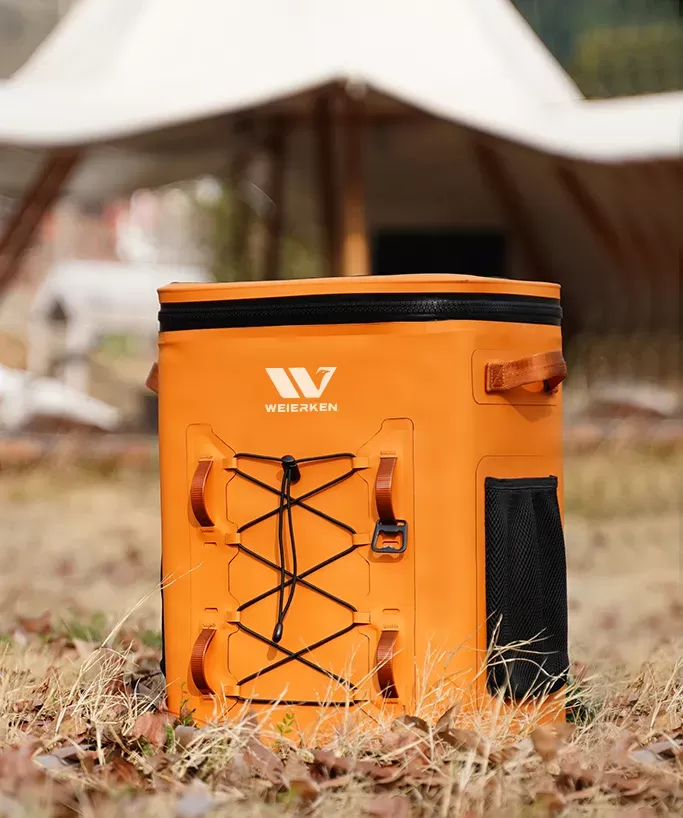
Switching to heavy-duty, reusable custom frozen food transport bags solves this core operational bottleneck. Designed for commercial food distributors, central kitchens, and pharmaceutical couriers, these flexible carriers protect payload thermal integrity while dramatically lowering reverse logistics expenses. At Weierken, we manufacture commercial-grade cold chain packaging engineered to survive the most demanding delivery routes.

The 2026 Cold Chain Shift: Compliance, Efficiency, and Thermal Control
The regulatory environment for commercial food transport is shifting quickly. Brand owners can no longer rely on single-use EPS foam coolers or materials containing PFAS chemicals. Global legislation demands non-toxic, circular-economy solutions.
Modern fleet managers require transport carriers that support closed-loop distribution networks. The goal is straightforward: achieve minimum 24- to 72-hour thermal stability at or below -18°C, survive hundreds of delivery cycles, and fold flat when empty to reclaim warehouse space.
Regulatory Bans: Strict enforcement of EU No 10/2011 and US FDA guidelines mandates food-contact safe, PFAS-free interior linings.
Return Logistics Economics: Collapsible transport bags reduce return shipping volume by up to 75% compared to hard coolers.
Precision Cold Retention: High-value frozen seafood, premium prepared meals, and biologics require zero temperature excursion tolerance during last-mile fulfillment.
Anatomy of Commercial-Grade Custom Frozen Food Transport Bags
A reliable thermal transport bag relies on advanced material bonding rather than sheer bulk. Every layer serves a distinct mechanical and thermodynamic purpose. When engineering custom units, we build each component to withstand daily industrial abuse.
1. Exterior Shell: Puncture-Resistant Armor
The outer shell takes the brunt of conveyor belts, metal shelving, and truck floors. Standard nylon degrades too fast under continuous commercial usage.
Industrial PVC Tarpaulin: 500D to 1000D options provide complete waterproofing, chemical washdown resistance, and high tear strength.
TPU-Coated 840D/1680D Oxford Nylon: Premium, abrasion-resistant, and flexible down to -30°C without cracking or flaking.
Reinforced Base Panels: Molded rubber feet or double-layered base fabrics prevent wear from rough concrete loading docks.
2. The Insulation Core: Density Over Thickness
Thermal bridging ruins payload integrity. OEM buyers must choose the correct insulation system tailored directly to route run-times and regional climates.
Standard Delivery (6–18 Hours): 10mm to 20mm closed-cell NBR or high-density EPE foam. These closed-cell structures resist water absorption completely.
Extended Transit (24–72 Hours): Vacuum Insulation Panels (VIP) encapsulated alongside aerogel blankets. VIP inserts achieve an R-value up to R-40 per inch, maintaining deep freeze conditions with minimal wall thickness.
3. Seamless Interior Liners: Zero Cold-Leakage
Traditional needle stitching punches thousands of microscopic holes into an insulation envelope. Cold air slips out, ambient moisture penetrates, and melted condensate seeps into the insulation core, breeding bacteria.
We solve this failure point at Weierken by utilizing high-frequency heat sealing (RF welding) and ultrasonic bonding. Food-grade PEVA or heavy-gauge TPU inner liners are welded into a single, seamless, watertight containment tub. If dry ice condensates or ice packs sweat, liquids remain fully trapped for fast sanitation at the depot.
4. Airtight Hardware and Zipper Engineering
A thermal bag is only as effective as its closure system. Standard nylon coil zippers bleed thermal energy within minutes.
Specifying waterproof, airtight airtight zippers creates an internal pressure seal. These tooth-configured, rubber-laminated zippers prevent convective airflow, keeping cold air inside the cavity where it belongs.
Structural Customization for B2B Operations
Off-the-shelf catalog coolers rarely match commercial distribution workflows. Custom-tailored configurations boost packing speed, maximize truck space, and lower damages in transit.
Pallet and Rack Modular Dimensions
We engineer exterior dimensions to align with standard GMA pallets (48x40 inches) and Euro pallets (1200x800 mm). Custom sizing prevents overhang, eliminates wasted pallet voids, and allows secure, uniform stacking inside reefer trucks or dry vans.
Gastronorm (GN) Pan and Tote Compatibility
Central kitchens and institutional catering teams transfer hot and cold food in standard hotel pans. We craft interior cavities around GN 1/1, GN 1/2, or proprietary distribution crates, ensuring zero interior shifting during transit.
Multi-Temperature Zone Dividers
Transporting ice cream at -18°C alongside fresh produce at +4°C in a single vehicle usually requires expensive dual-temp refrigeration systems. Removable, high-density insulated divider panels with industrial Velcro seals allow one bag to maintain two distinct temperature profiles simultaneously.
Phase Change Material (PCM) & Dry Ice Retention
Loose coolants shift around, crushing delicate food packages. We integrate internal mesh pockets for sublimating dry ice blocks or dedicated elastic sleeves that secure Phase Change Material (PCM) plates directly above or beside payloads for optimized convective cooling downfalls.
OEM Manufacturing Specifications Comparison
| Specification Feature | Standard Courier Grade | Heavy-Duty Commercial OEM | Extreme Cold VIP Industrial |
|---|---|---|---|
| Outer Shell | 420D Polyester / PVC Backing | 840D/1680D TPU Oxford | 1000D Industrial Tarpaulin |
| Insulation Core | 8mm EPE Foam | 15mm–20mm Closed-Cell NBR | VIP Panels + 15mm Aerogel |
| Target Temperature | 0°C to 4°C (Chilled) | -18°C (Frozen) | -20°C to -30°C (Deep Freeze) |
| Hold Time | 4 to 8 Hours | 12 to 24 Hours | 36 to 72 Hours |
| Assembly Method | Stitched / Taped Seams | High-Frequency RF Welded | Hermetic RF Welded + Gas-tight |
| Hardware Specs | #8 Water-Resistant Zipper | #10 Airtight PU Zipper | Industrial Airtight Pressure Zip |
Quality Assurance, Testing, and Food Safety Compliance
Deploying a custom-branded carrier fleet demands rigorous product validation before serial production begins. A supply chain failure in the field results in ruined inventory, client refunds, and brand damage.
Thermal Performance Profiling (ASTM D3103)
Every commercial design must undergo thermal chamber validation. Environmental chambers simulate real-world transport conditions, alternating through extreme ambient cycles (such as 38°C summer heat profiles) to verify interior temperatures hold steady below -18°C across the scheduled delivery window.
Mechanical Durability Testing
Human hands handle these bags aggressively. We put pre-production units through grueling physical abuse cycles:
Drop Impact Tests: Loaded to 30 kg capacity and dropped from 1.2 meters onto solid concrete at varying angles.
Handle Tensile Pull Tests: Reinforced cross-stitched webbings must withstand continuous pull forces exceeding 500 N without structural failure.
Abrasion Resistance: Shell fabrics undergo Martindale abrasion cycles to guarantee longevity against metal shelf friction.
Global Chemical & Safety Standards
Direct or indirect food-contact packaging requires clear documentation. Commercial lines must carry verified testing certificates, including FDA 21 CFR 177, EU No 10/2011 compliance, REACH SVHC reviews, and RoHS documentation. In addition, verifying that suppliers operate ISO9001 and BSCI-audited production floors keeps your supplier audit trail completely clean.
Commercial Ordering: MOQs, Tooling, and Prototyping
Transitioning from concept to serial production requires clear planning around manufacturing minimums, mold investments, and sampling timelines.
Tiered pricing controls project viability. Entry-level production runs of custom frozen food transport bags typically start around 500 units for standard stocked fabrics. Stepping up order volumes to 2,000 or 5,000 units unlocks custom pantone dyeing, bespoke hardware molds, and lower per-unit material costs.
Our OEM workflow follows a structured engineering track to limit operational delays:
Step 1: Specification & 3D CAD (Day 1–3): We analyze payload dimensions, refrigerant volumes, and drop routes to produce detailed blueprints.
Step 2: Prototyping & Heat-Welding (Day 4–7): Rapid tooling models generate physical golden samples for fit-checks and material assessment.
Step 3: In-House Thermal Testing (Day 8–10): Prototypes undergo calibrated temperature data logger profiling inside climate test cabinets.
Step 4: Tooling & Batch Manufacturing (Day 25–35): Final production runs take place under strict ISO-compliant inline quality inspections.

Frequently Asked Questions (FAQ)
Q1: Can custom frozen food transport bags hold -18°C without mechanical refrigeration?
A1: Yes. When built with high-density closed-cell foam or Vacuum Insulation Panels (VIP) and packed with sufficient eutectic plates or dry ice, these bags comfortably maintain -18°C or lower for 24 to 72 hours, even during hot summer transits.
Q2: Why is high-frequency heat sealing better than stitching for frozen delivery?
A2: Stitching pierces the insulation wall, creating thousands of points for air infiltration and water leaks. High-frequency welding fuses the lining fabrics together at a molecular level, producing a seamless, 100% leak-proof barrier that locks in sub-zero temperatures.
Q3: How do collapsible soft-sided transport bags lower our freight costs?
A3: Traditional rigid plastic coolers travel back empty at their full volume, running up immense freight expenses. Collapsible soft-sided bags fold down to roughly 25% of their expanded volume, letting you pack four times as many empty units onto a single return transport pallet.
Q4: What interior materials are certified safe for food transport?
A4: High-grade PEVA, TPU, and pure food-contact aluminum laminates are the industry standard. These materials comply with FDA 21 CFR and EU No 10/2011 regulations. They are BPA-free, odorless, easy to wash, and free from dangerous PFAS chemicals.
Q5: What is the typical life expectancy of a heavy-duty commercial thermal bag?
A5: A bag manufactured with 840D or 1000D TPU/PVC fabric, reinforced handle box-stitching, and an airtight industrial zipper will survive 250 to 500 delivery cycles, depending on route handling procedures and cleaning practices.
Q6: Can Weierken customize bags to integrate our existing Phase Change Material (PCM) panels?
A6: Absolutely. We frequently engineer custom inner dimensions, targeted elastic straps, and dedicated internal mesh bays explicitly built to lock your existing PCM ice packs or dry ice blocks in place for balanced cooling.
Scale Your Cold Chain Fleet with Weierken
Don't let leaking seams, cracked plastics, and poor insulation undermine your cold chain distribution. Weierken manufactures rugged, custom thermal management products designed to keep commercial operations running smoothly.
Whether you require a production run of 500 specialized central kitchen carriers or 10,000 modular grocery delivery bags, our engineering team handles the process from initial CAD modeling through to drop testing and serial delivery.
Take the next step in your cold chain upgrade:
Submit your route specifications, target holding times, and sizing requirements to our team. We will deliver complete engineering drawings, material data sheets, and a tiered OEM price quotation within 24 hours.