

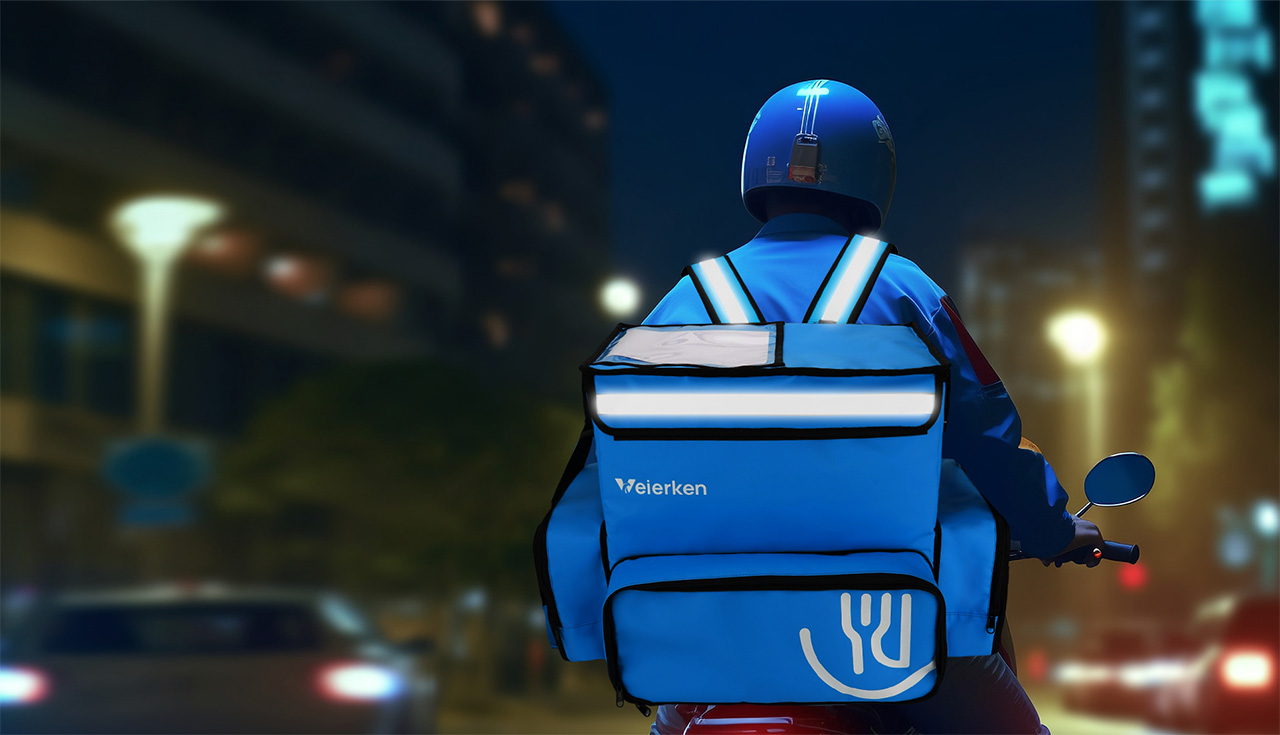
Top on-demand delivery platforms and fleet managers no longer buy generic, off-the-shelf bags from consumer trade catalogs. When riders spend eight to twelve hours a day maneuvering through heavy city traffic, basic bags fail quickly. Straps snap, rain seeps through stitch holes, and zippers jam after two weeks of constant use.
Every failed bag disrupts order fulfillment, damages brand image, and leads to costly compensation claims for soaked food. Leading logistics companies and courier networks now bypass retail traders to collaborate directly with an established motorcycle food delivery backpack manufacturer like Weierken. Direct collaboration allows fleet operators to build custom commercial gear engineered for daily road hazards, specific payload dimensions, and strict thermal safety standards.
1. Why Your Fleet Needs a Specialized Motorcycle Food Delivery Backpack Manufacturer, Not a Generic Bag Factory
Bicycle couriers and walking delivery personnel operate under mild physical conditions. A generic bag factory designs products for low wind resistance, moderate payloads, and short walking distances. These designs do not survive on a motorcycle.
Motorcycle food delivery involves harsh operational environments:
Sustained Aerodynamic Drag: Speeds between 60 and 100 km/h create immense wind pressure that pulls at outer seams and stress points.
High-Frequency Engine Vibrations: Motor vibration and bumpy roads fatigue low-grade fabrics, weakening conventional thread stitching over time.
Severe Weather Exposure: Riders travel through sudden rainstorms, high humidity, and direct sunlight without stopping.
Generic bags result in continuous replacements. When a procurement team buys cheap bags, they face broken zippers, ripped shoulder mounts, and peeling waterproof coatings within three to six months. This rapid turnover drastically inflates the Total Cost of Ownership (TCO).
A specialized motorcycle food delivery backpack manufacturer understands vehicle dynamics, payload distribution, and rugged materials. By redesigning stress points and optimizing load balance, an experienced factory builds bags that endure years of demanding daily delivery routes.
2. Core OEM Engineering Capabilities of a Leading Motorcycle Food Delivery Backpack Manufacturer
Producing reliable fleet equipment requires targeted industrial engineering. A dedicated manufacturer relies on heavy-duty materials, precise welding methods, and rider-focused ergonomics.
Extreme Weather Material Science
Standard nylon with thin polyurethane backing degrades under intense sun and heavy rain. Specialized manufacturers rely on rugged industrial fabrics:
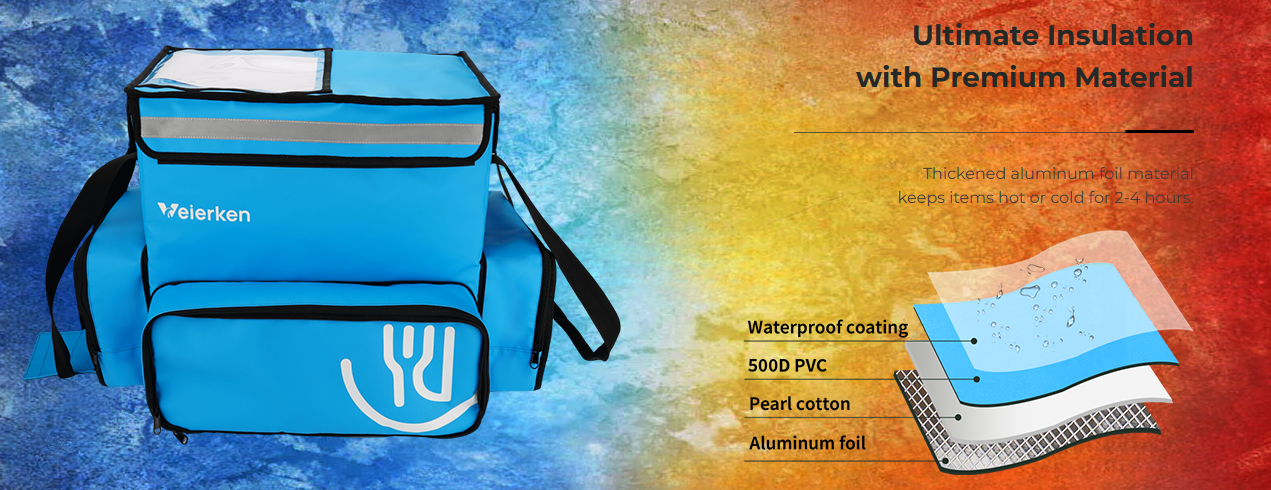
Heavy-Duty Outer Shells: 500D to 1000D PVC-coated tarpaulin or thick TPU composite fabrics resist abrasions, tears, and punctures if a bike skids.
High-Frequency (HF) Seamless Welding: Traditional needle stitching creates microscopic holes that leak water under high-speed wind. High-frequency welding melts thermoplastic layers together, forming a fused, waterproof joint with zero pinholes.
Multi-Layer Thermal Matrix: A protective shell must maintain safe food temperatures. Manufacturers combine food-grade reflective aluminum foil, high-density expanded polyethylene (EPE) or EVA foam, and internal hollow polycarbonate boards. This thermal barrier preserves hot or cold temperatures for four to six hours.
High-Speed Rider Ergonomics and Structural Safety
A 20-kilogram payload shifts during rapid braking and sharp turns, throwing riders off balance. Engineering teams solve this through ergonomic load-transfer structures:
Load-Transfer Harness Systems: Contoured, S-shaped shoulder straps line up with wide chest buckles and padded lumbar supports. This structure transfers heavy cargo weight away from the cervical spine directly down to the rider's pelvic center.
Dual-Mounting Versatility: Riders often switch between carrying payloads on their backs and mounting them on their bikes. Advanced designs feature integrated bottom anchor loops and industrial cam buckles. Couriers can wear the pack or lock it onto a motorcycle rear luggage rack within seconds.
Passive Visibility Standards: Motorcyclists face major collision risks in low-light and rainy conditions. OEM manufacturing integrates micro-prismatic reflective strips that meet EN ISO 20471 visibility standards, providing 360-degree visibility in oncoming traffic headlights.
3. Commercial OEM Customization: How We Scale Solutions for Global Delivery Brands
Delivery fleets serve as mobile billboards. Every rider carrying a bag promotes your brand across city streets. A professional manufacturer helps convert functional transport gear into an asset for commercial marketing and operational efficiency.
Brand Visibility on City Streets
Precision manufacturing aligns every delivery bag with strict corporate design guidelines:
Exact Color Matching: Matching exterior fabric dyes to Pantone or RAL standards protects your visual identity across thousands of production units.
Weatherproof Surface Printing: Screen printing and thermal transfer methods use UV-cured inks. Logos stay vibrant and resist cracking, peeling, and fading despite prolonged sun and rain exposure.
High-Visibility Accents: Photoluminescent badges and reflective logo prints keep corporate branding clearly visible during night runs.
Modular Interior Architecture
Different delivery orders demand flexible cargo configurations. Specialized OEM engineering provides adaptable storage compartments:
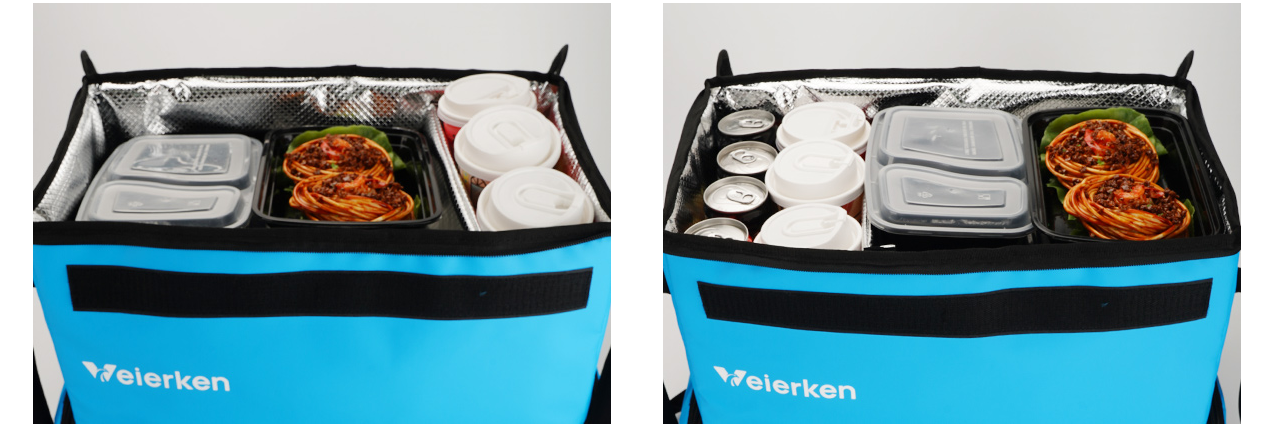
Adjustable Divider Shelves: Heavy-duty hook-and-loop wall tracks allow riders to reposition horizontal shelves quickly, supporting flat pizza boxes or stacked meal containers.
Anti-Spill Beverage Modules: Removable, high-density molded foam or rigid fabric inserts hold milk tea, coffee, and soup containers firmly upright over rough roads.
Dual-Zone Thermal Isolation: Insulated interior bulkheads isolate hot entrees from chilled beverages, preventing temperature transfer inside a single backpack.
Smart Hardware Integration
As food delivery fleets embrace technology, Weierken helps delivery platforms add smart hardware into OEM product runs:
Vehicle-Powered Heating Modules: Built-in 12V PTC heating elements plug directly into a motorcycle's auxiliary power outlet or battery, keeping food hot during freezing winter shifts.
Internal Thermal Sensors: Integrated digital thermometers show interior temperatures on external displays, assuring customers of safe transport conditions.
4. Inside the Factory: Quality Assurance and Scale of a Trusted Manufacturer
Commercial reliability requires strict quality management and high-volume output. A proven motorcycle food delivery backpack manufacturer relies on data-driven testing rather than guesswork.
Extreme Laboratory Stress Testing
Before mass production begins, prototypes go through rigorous mechanical evaluations:
Drop Impact Testing: Bags packed with 25 to 30 kilograms drop repeatedly from a height of 1.5 meters to verify that shoulder straps, top handles, and anchor seams stay intact.
Hydrostatic Rain Chamber Exposure: Technicians place bags in specialized spray chambers simulating 50 mm/h torrential rain to check seamless welds, waterproof zippers, and roll-top closures for leaks.
Zipper Fatigue Testing: Automated test arms pull heavy-duty waterproof zippers back and forth over 10,000 cycles under cross-directional tension to make sure teeth never jam or split.
International Compliance and Factory Certifications
Professional manufacturing requires compliance with strict safety and labor standards:
Management & Social Accountability: Facilities operate under ISO9001 quality management systems and maintain BSCI social compliance certifications.
Material Safety: Fabrics, foams, and interior liners comply with REACH and RoHS chemical restrictions. Food contact linings use FDA-compliant, non-toxic, easy-to-clean materials.
Production Scalability: Modern factories run automated laser cutting tables and robotic welding stations, producing more than 50,000 units monthly to fulfill large enterprise rollout schedules on time.
5. The OEM Partnership Roadmap: How to Work with Our Manufacturing Team
Developing a custom motorcycle delivery backpack moves through clear, systematic stages from the initial concept to global delivery.
Requirements & Engineering Brief: You share target payload dimensions, vehicle rack specs, climate needs, and brand guidelines. Our engineering team creates detailed technical drawings and 3D CAD models.
Rapid Prototyping: The sample shop builds functional prototypes within 7 to 10 working days, using real production materials, high-frequency welding, and custom branding.
Fleet Pilot Testing: Your couriers test sample units on active delivery routes. Drivers evaluate comfort, wind resistance, and internal dividers, providing real-world feedback for design adjustments.
Mass Production & In-Line Inspection: Once designs are approved, full-scale production begins. Quality control teams inspect fabric lots, seam strength, welding lines, and thermal assemblies at every production phase.
DDP Global Logistics Support: We organize global shipping through Delivered Duty Paid (DDP) arrangements, handling international freight, import customs clearance, and road haulage straight to your regional hubs.
6. Why Sourcing Directly from a Specialized Manufacturer Lowers Your Fleet’s TCO
Procurement teams sometimes work with local distributors or trading agents to avoid overseas manufacturing logistics. However, sourcing directly from a specialized motorcycle food delivery backpack manufacturer delivers clear financial advantages.
Eliminating middleman markups gives fleets access to competitive, tiered factory pricing. The real savings, however, come from field durability. While standard bags break down within four months, industrial-grade motorcycle backpacks endure 18 to 24 months of heavy daily use. This longer lifespan cuts recurring replacement spending by up to 40% annually.
Durable, stable bags also prevent tipped drinks, crushed boxes, and spoiled food. Fewer dropped or damaged meals protect operational profits and maintain your brand's reputation with customers.
Frequently Asked Questions (FAQ)
Q1: What makes a motorcycle food delivery backpack different from
standard bicycle delivery bags?
A1: Motorcycle backpacks face higher
mechanical stress, including speeds up to 100 km/h, intense wind buffeting, and
engine vibration. They need heavier fabrics like 500D to 1000D PVC tarpaulin,
seamless high-frequency welding instead of needle stitching, reinforced back
support panels, and secure bike rack mounting straps.
Q2: Can your manufacturing facility produce bags with custom interior
partitions for fragile beverage cups?
A2: Yes. We engineer modular
interiors with adjustable dividers, molded EVA cup holders, and fold-down
shelves. These setups keep drink cups, coffee trays, and soup containers upright
during sudden stops and sharp turns.
Q3: What are the minimum order quantities (MOQ) for fully customized
OEM delivery backpacks?
A3: Our typical minimum order quantity for
full OEM customization starts at 500 units. This allows for custom fabric
dyeing, specific corporate Pantone matching, branded hardware, and customized
sizing. Smaller prototype batches are available during product development.
Q4: How does a professional motorcycle food delivery backpack
manufacturer verify food contact safety?
A4: We construct interior
linings using food-grade aluminum foil or TPU materials that meet FDA and EU
food safety standards. These materials are non-toxic, odor-free, resist oil and
grease, and clean easily with commercial sanitizing sprays.
Q5: Can our fleet order prototypes for street testing before
committing to mass production?
A5: Yes. We encourage real-world
fleet testing. We deliver fully functional prototypes within 7 to 10 business
days so your operations team and drivers can evaluate performance on the road
before starting mass manufacturing.
Q6: How do you handle custom Pantone matching and high-visibility
printing for large corporate fleets?
A6: We mix custom pigments to
match corporate Pantone references for fabrics and edge trims. For logos, we use
UV-resistant screen printing and high-visibility micro-prismatic films that stay
bright and reflective through seasons of sun and rain.
Partner with an Industrial Fleet Equipment Manufacturer
Equipping your delivery fleet with low-grade bags leads to damaged goods, exhausted riders, and inflated recurring costs. Partnering directly with Weierken gives you access to custom engineering, dependable thermal protection, and long-term durability designed for modern city streets.
Contact our engineering sales team today to request a quote, schedule a technical consultation, or order a functional test prototype for your delivery fleet.