


Ordering ten sample bags for a trial run is simple. Sourcing five thousand units across regional distribution centers is an entirely different operational challenge. When enterprise buyers evaluate bulk catering delivery bags, minor design flaws multiply into major capital losses.
A zipper that snags on day thirty leads to late drop-offs. An unsealed interior seam leaks soup into the insulation layer, creating foul odors and health code violations. If two percent of your fleet bags fail every month, customer churn and driver dissatisfaction quickly eat away your operating margins. Established industrial manufacturers like Weierken design delivery equipment to withstand these exact high-volume commercial strains.
This guide breaks down the financial, structural, and operational criteria required to select commercial delivery gear at scale.
The Hidden Trap of Volume Sourcing: Why Standard Procurement Fails
Most commercial purchasing managers begin their search by comparing Free On Board (FOB) price tags. This single-metric mindset frequently backfires. The cheapest unit price often produces the highest cost per delivery run.
Consider the total picture behind cheap factory bids:
Punitive Import Tariffs: Relying solely on single-source production can expose Western buyers to steep tariffs (such as US Section 301 duties reaching up to 25%).
Port Demurrage and Clearance Delays: Inexperienced factories fail to provide accurate customs paperwork, leaving shipping containers stranded at destination ports.
High Defect Rates (AQL Failures): A 5% unboxing failure rate on an order of 10,000 units leaves 500 drivers without operational equipment on launch day.
Selecting commercial food transport bags in bulk is an engineering and supply chain decision, not an off-the-shelf purchase. You are investing in commercial tools that must survive relentless daily wear across thousands of logistics cycles.
Dimension 1: Calculating the True Total Landed Cost (TCO)
Professional procurement teams look past baseline unit quotes. You must calculate the Total Cost of Ownership (TCO) from the factory floor directly to your regional fulfillment hubs.
Tariff Mitigation and Dual-Factory Footprints
Geopolitics dictates import math. Sourcing large-volume soft goods directly from mainland China often triggers heavy punitive tariffs in North America and parts of Europe. Savvy buyers partner with a bulk insulated food delivery bags supplier that operates a dual-manufacturing model.
By keeping product prototyping, tooling, and fabric sourcing in China while routing high-volume cut-and-sew assembly through Southeast Asian hubs like Cambodia, buyers legally secure valid Certificates of Origin (COO). This setup eliminates 10% to 25% in landed duty costs without sacrificing product build quality.
Turnkey DDP Delivery Capabilities
Does your vendor hand over shipping containers at a distant port, or do they manage end-to-end logistics? True commercial suppliers offer complete Delivered Duty Paid (DDP) terms.
They manage ocean freight, handle customs clearance, settle domestic harbor fees, and book multi-drop ground freight. This brings the finished goods directly to your corporate cross-docking points without unexpected demurrage invoices.
Unit Price vs. Useful Service Life
Do the basic operational math:
Option A: A $14 bargain bag lasts four months before handles rip and the inner foil delaminates. Over two years, you buy six replacement bags per driver ($84 total equipment cost).
Option B: A $24 commercial-grade bag lasts twenty-four months of continuous use ($24 total equipment cost).
Industrial construction reduces hardware replacement costs by more than 70% while protecting brand reputation during daily fulfillment.
Dimension 2: Industrial Technical Specs and Material Standards
Never issue a formal Purchase Order (PO) based on generic marketing terms like "heavy-duty." Insist on verifiable engineering specifications written directly into your procurement contracts.
Closed-Cell Foam and Thermal Retention
Low-grade bags use cheap open-cell foam or loose polyurethane fluff. These materials trap moisture, compress permanently under heavy food pans, and lose all insulating capacity within weeks.
Demand 15mm to 20mm high-density, closed-cell Expanded Polyethylene (EPE) or cross-linked PE foam panels. Closed-cell structures do not absorb liquid or collapse under heavy loads. Pair this core with heat-reflective woven aluminum inner linings to keep hot food strictly above 60°C (140°F) for four hours or more.
Ultrasonic Welded Leak-Proof Liners
Traditional needle stitching punches thousands of microscopic holes through interior liners. The first spilled container of soup or sauce seeps through these punctures, soaking the internal foam. Bacteria builds up, and the bag must be thrown away.
Commercial-grade bulk catering delivery bags require seamless ultrasonic or high-frequency heat-welded liners (typically made from 0.3mm–0.5mm heavy-duty TPU or commercial PVC). Even if ten liters of liquid spill inside the bag, the seamless basin prevents any liquid from escaping into the foam. Drivers can hose down and sanitize the interior at the end of every shift.
Stress Point Reinforcement
Commercial catering orders are heavy. A delivery bag packed with full-size food pans can easily weigh 25 to 40 kilograms. Standard single-line perimeter stitching tears open under this stress.
Your technical spec sheet must require:
High-density box-X bar-tacking on every handle, shoulder strap junction, and motorcycle frame strap.
Industrial 900D to 1680D waterproof Oxford polyester exterior shells treated with water-repellent (DWR) and UV-resistant coatings.
Self-healing #10 or #12 heavy-gauge nylon coil zippers, or genuine YKK weather-sealed zippers. Zippers remain the number one mechanical failure point across commercial delivery fleets.
Dimension 3: Fleet Integration and OEM/ODM Customization
Every commercial delivery fleet runs on its own dispatch logistics. Off-the-shelf catalog designs rarely match the real-world dimensions of catering equipment and fleet vehicles.
Modular Interior Divider Systems
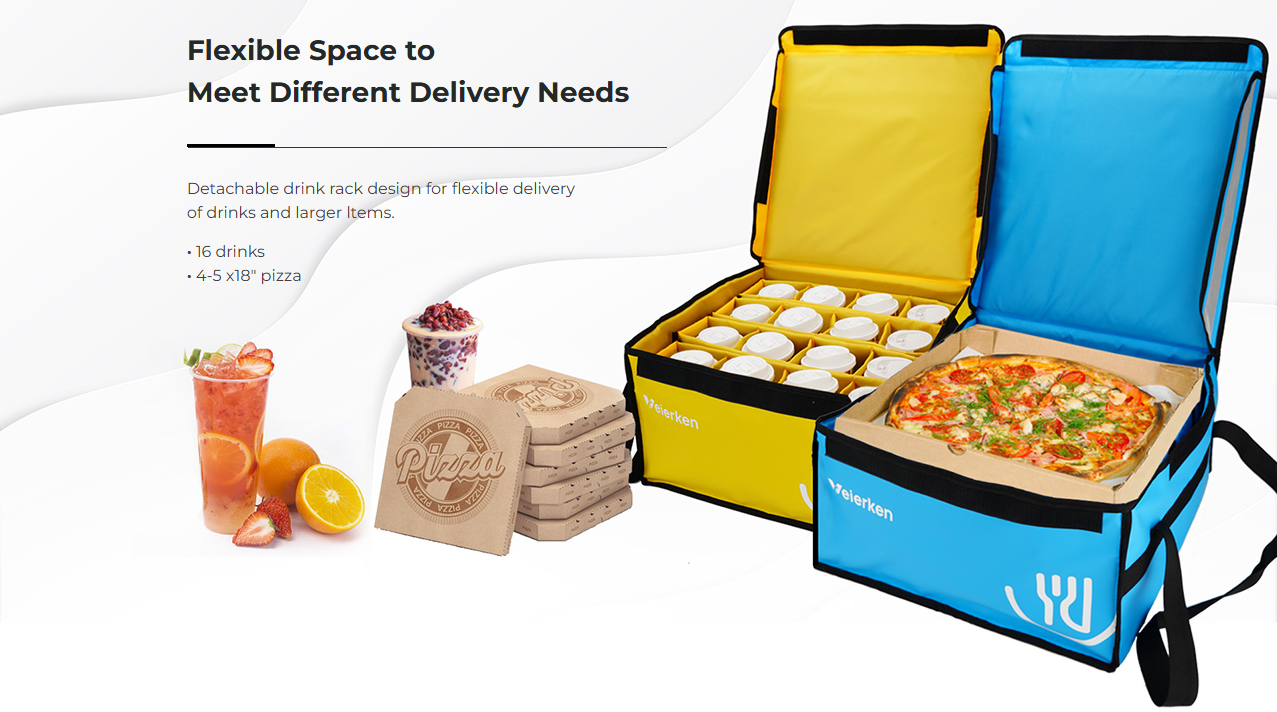
Catering operations shift rapidly between full-size Gastronorm (GN 1/1) steam table pans, tall beverage containers, and stacked takeaway meal boxes. Look for internal heavy-duty hook-and-loop wall tracks that allow drivers to reposition insulated dividers on the fly.
These dividers keep cold salads isolated from piping-hot entrees while preventing cargo from sliding around during sudden stops.
Vehicle Mounting and Driver Ergonomics
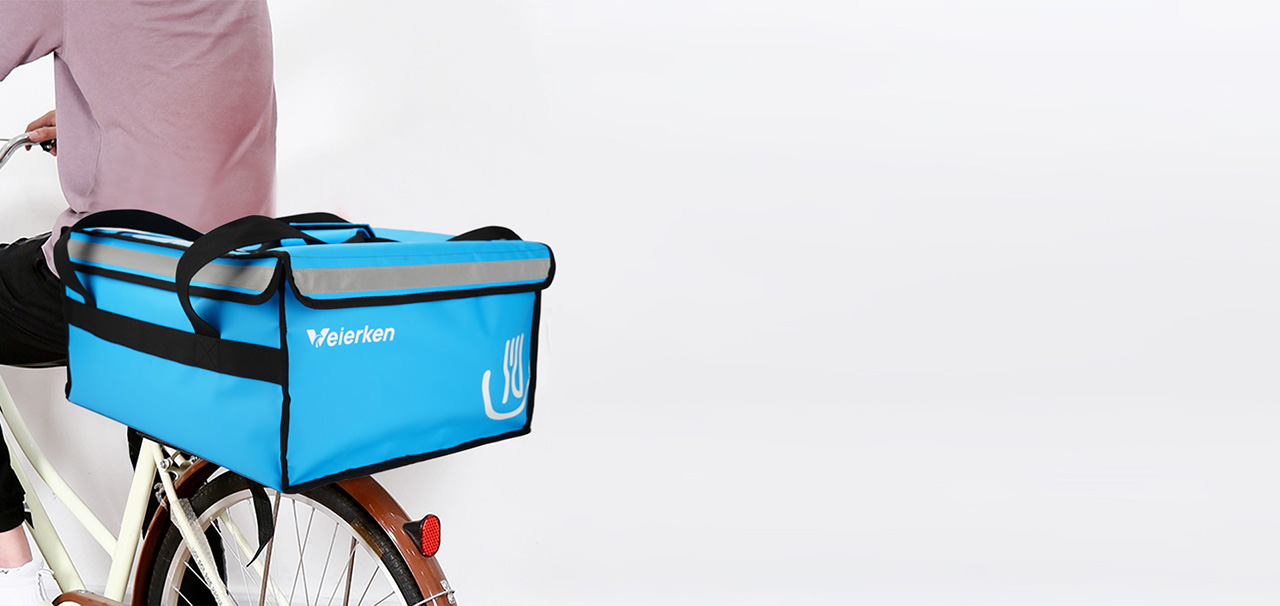
How do your couriers transport the cargo? Urban scooter fleets need bottom-mounted quick-release buckle systems that secure directly to motorcycle rear luggage racks. Foot couriers handling dense downtown drop-offs require breathable, padded backpack straps with sternum and waist support to prevent driver fatigue.
A capable custom bulk catering delivery bags manufacturer designs flexible mounting points, reinforced baseboards, and hideaway strap compartments directly into your OEM production run.
Fleet Branding Uniformity
Your delivery drivers serve as moving billboards in every city center they serve. Large production runs should maintain strict brand consistency.
Experienced manufacturers like Weierken deliver lab-matched Pantone fabric dyeing, fade-resistant silkscreen printing, and high-visibility retroreflective strips (meeting EN ISO 20471 compliance). Your fleet stays visible to traffic while projecting a clean, professional corporate image.
Dimension 4: Supplier Factory Audits and Quality Assurance Red Lines
A showroom sample rarely matches the product that rolls off a busy factory line during a 10,000-unit run. Commercial procurement leads must vet the manufacturing infrastructure behind the sales pitch.
Rapid Functional Prototyping
Can the supplier build working prototypes from your CAD drawings or reference samples quickly? An established factory maintains a dedicated sample workshop that outputs structural prototypes within three to seven business days. Fast prototyping lets you run real-world field trials with your drivers before approving mass production molds and fabric runs.
Strict Quality Control Gates (99.5% First-Pass Yield)
Do not rely on end-of-line spot checks. Your manufacturing contract should specify three discrete inspection phases:
Incoming Quality Control (IQC): Raw fabric tensile testing, zipper cycle stress-testing, and foam density verification before cutting begins.
In-Process Quality Control (IPQC): Inline stitching tension checks, seam weld burst tests, and dimensional audits at every assembly workstation.
Outgoing Quality Control (OQC): Final AQL 1.5/4.0 structural, cleanliness, and barcode packaging inspections before carton sealing.
Demand a contractual commitment to a 99.5% first-pass yield to protect against fleet launch delays.
Social Compliance and ESG Alignment
Modern restaurant enterprises and global aggregators operate under strict ESG mandates. Your tier-one suppliers must hold verifiable corporate social responsibility audits, such as SMETA (SEDEX) or BSCI certifications.
Furthermore, if your brand targets reduced carbon emissions, ensure your supplier sources genuine Global Recycled Standard (GRS) certified rPET fabrics. These fabrics turn recycled plastic bottles into durable, commercial-grade exterior textiles.
How Weierken Solves Commercial Fleet Sourcing Challenges
Procuring heavy-duty bulk catering delivery bags for commercial fleets requires an experienced manufacturing partner. Weierken operates as an industrial-tier OEM/ODM partner built specifically to handle complex, enterprise-scale soft-goods programs.
Here is how Weierken manages the operational risks that trip up standard brokers:
Strategic Dual-Facility Manufacturing: With engineering, tooling, and rapid prototyping based in China alongside high-volume production plants in Cambodia, clients bypass punitive trade tariffs while maintaining tight quality control.
Turnkey Engineering Support: Over two decades of specialized fabrication experience means every stress point, thermal boundary, and vehicle mounting interface is built to survive industrial wear.
Complete DDP Logistics: Weierken handles ocean freight, domestic clearance, and multi-location pallet drops straight to your regional logistics depots.
Action Plan for Commercial Procurement Teams
Sourcing commercial delivery gear is not a simple transactional purchase. It is an investment in delivery reliability, food safety compliance, and brand equity. A low initial price tag means nothing if your equipment fails during peak delivery hours.
Audit your suppliers on their total landed costs, stress-test their thermal and structural engineering, and verify their factory floor compliance before committing your budget.
Ready to upgrade your delivery equipment? Contact the engineering team at Weierken today. Request a quote, schedule a technical consultation, and secure high-precision functional samples for your fleet testing program within three to seven days.
Frequently Asked Questions
Q1: What is the typical production lead time for wholesale bulk catering delivery bags?
Standard lead times for fully customized, large-scale production orders (1,000 to 10,000+ units) generally range between 35 and 50 days following final sample approval. Pre-production functional counter-samples are typically engineered and delivered for fleet testing within 3 to 7 business days.
Q2: How does a dual-manufacturing setup (China + Cambodia) reduce import costs?
A dual footprint leverages China's advanced raw material supply chains for fabrics, hardware, and rapid prototyping, while routing labor-intensive cutting, sewing, and final assembly through facilities in Cambodia. This approach allows enterprise buyers to legally secure non-Chinese Certificates of Origin (COO), sidestepping Section 301 tariffs and saving 10% to 25% on landed duties in the US market.
Q3: What core insulation material maintains food temperatures above 60°C for over four hours?
Commercial transport requires 15mm to 20mm high-density, closed-cell Expanded Polyethylene (EPE) foam, frequently laminated with thick thermal aluminum foil or food-grade PEVA/TPU film. Unlike cheap open-cell polyurethane foam, closed-cell EPE retains its structural thickness under load, blocks thermal conduction, and prevents moisture absorption.
Q4: Why are ultrasonic-welded interior liners critical for commercial catering fleets?
Traditional sewn seams leave thousands of needle perforations in the waterproof lining. Spilled liquids, steam condensation, and grease seep through these holes, soaking the internal foam core. This creates bacterial growth and stubborn odors that cannot be washed out. Ultrasonic heat-welded seams melt the thermoplastic edges together into a single, continuous, 100% leak-proof pan that handles commercial spray sanitization.
Q5: How can enterprise buyers verify a factory's 99.5% quality yield claim?
Do not rely on verbal assurances. Require the factory to provide documented IQC, IPQC, and OQC inspection logs along with ISO 9001 quality system certifications. Incorporate clear Acceptable Quality Limit (AQL) standards—such as AQL 1.5 for major defects and 4.0 for minor defects—directly into your binding manufacturing agreement, tied to financial penalties for excessive defects upon arrival.
Q6: Can we source custom bulk catering delivery bags made from certified eco-friendly fabrics?
Yes. Commercial suppliers can manufacture your exterior shells and internal linings using certified post-consumer recycled fabrics (such as rPET woven from recycled plastic bottles). Legitimate suppliers will provide genuine Global Recycled Standard (GRS) transaction certificates verifying the recycled content trail for your corporate sustainability audits.