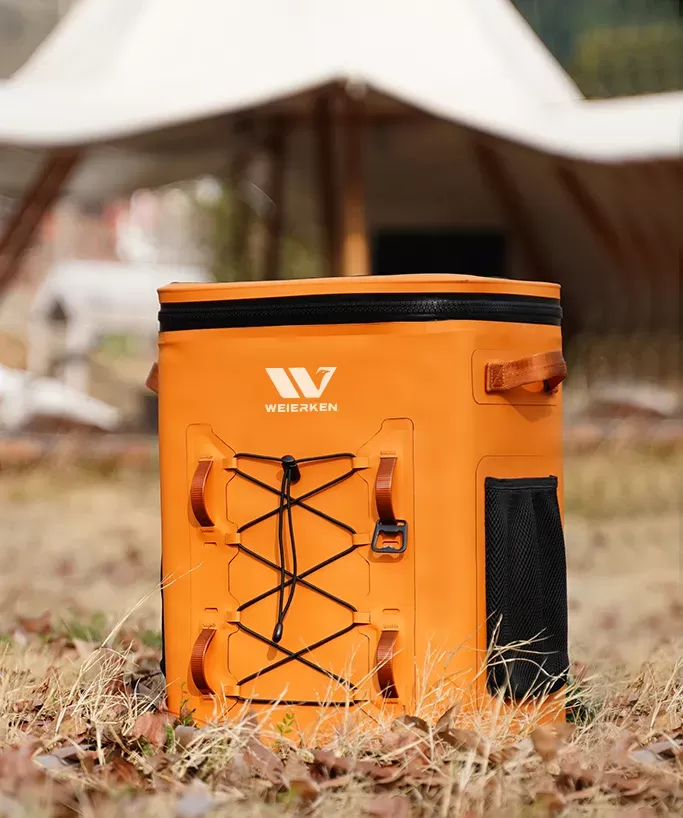

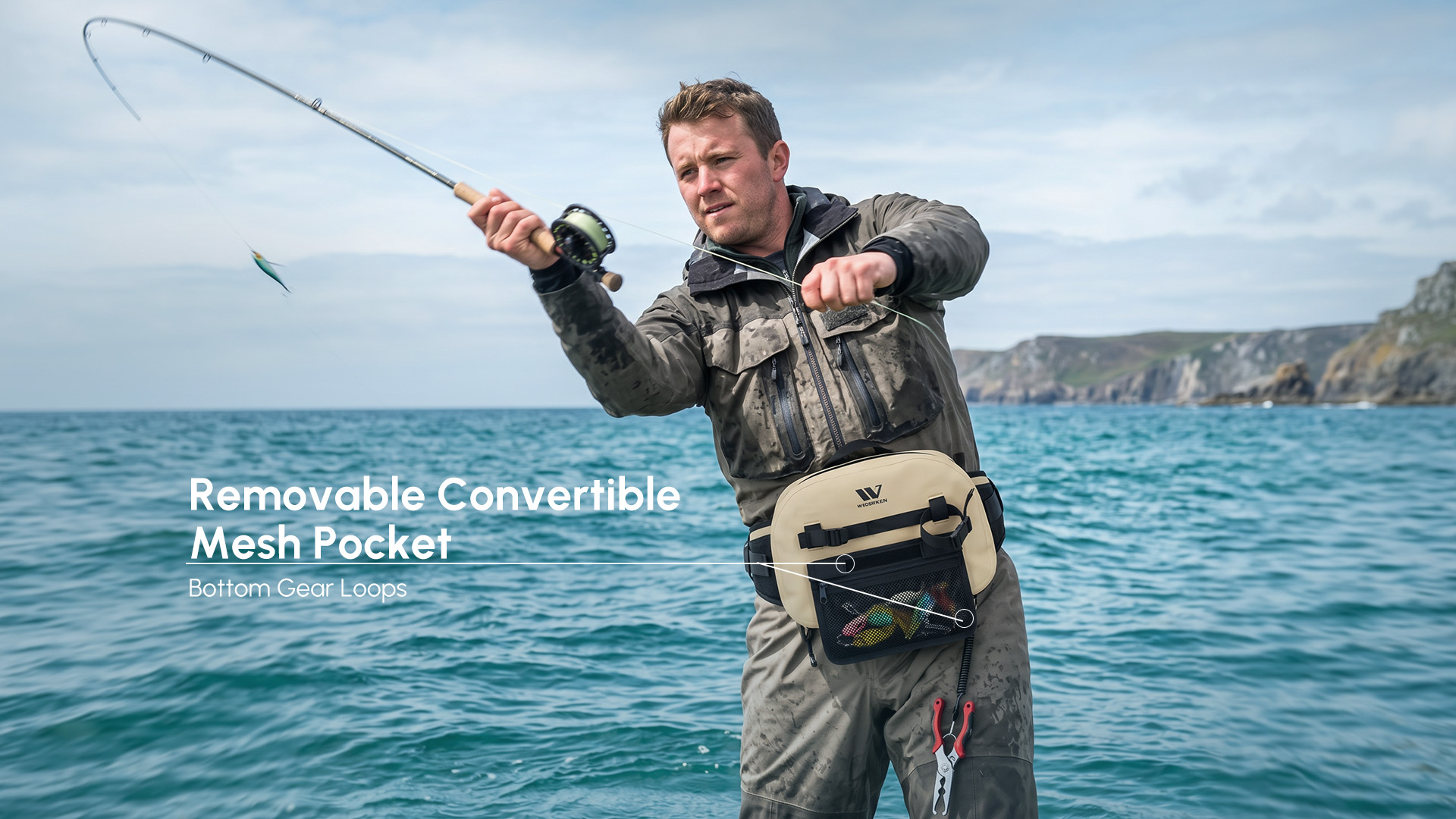
Anglers are leaving bulky traditional vests behind. Modern fly fishing, deep wading, and kayak angling demand compact, modular gear that keeps critical tackle accessible without restricting movement. For outdoor brands and tackle retailers, this transition creates a high-margin commercial opportunity.
Launching a standout line requires more than standard bag assembly. It requires a dedicated fly fishing gear bag supplier capable of high-frequency welding, tight tolerances, and technical fabric sourcing. Specialized manufacturers like Weierken help outdoor brands bridge the gap between initial design sketches and retail-ready, submersible gear.
This guide breaks down material engineering, factory selection criteria,
regulatory compliance, and step-by-step production stages to help you build
high-performing private label fishing chest packs. 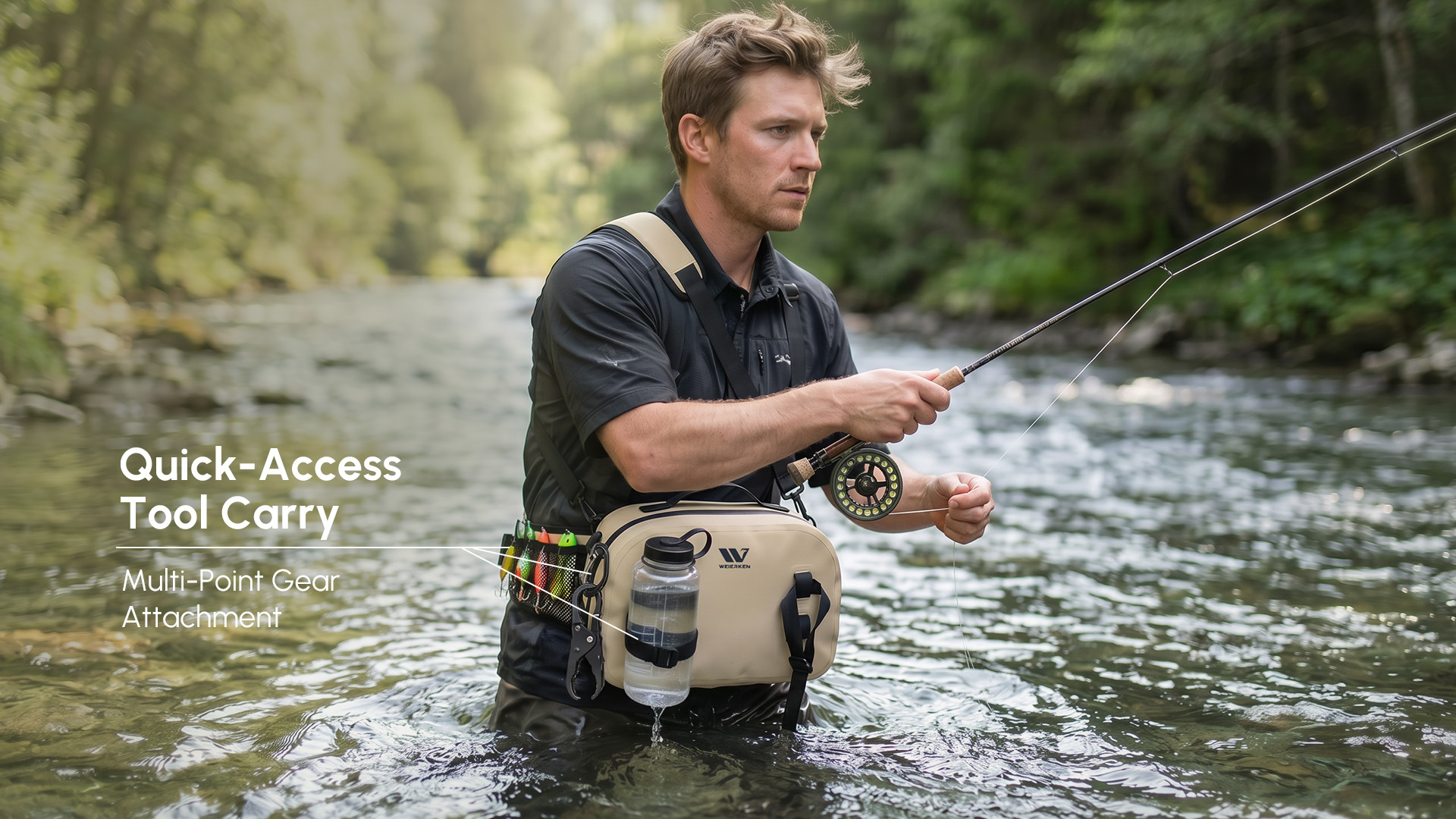
The Commercial Shift: Why Private Label Fishing Chest Packs Lead the
Market
Fishing chest packs occupy a sweet spot in the outdoor pack segment. Unlike generic tackle bags, a technical chest pack functions as an active workstation in wet environments.
Ergonomics and Mobility: Positioning tackle on the chest balances weight, frees the hips for wading belts, and keeps gear above the waterline when crossing deep currents.
Multi-Discipline Appeal: While rooted in fly fishing, these packs are now standard gear for urban lure anglers, kayak fishers, and coastal surf casters.
Healthy Profit Margins: Technical, waterproof packs command premium price points ($80 to $220+ MSRP). By establishing direct relationships with a custom fly fishing chest pack OEM, brands regularly achieve gross margins between 60% and 75%.
Product Engineering: Material Specs and Waterproof Construction
When sourcing from an outdoor tackle bag OEM/ODM factory, you must first define the waterproof threshold of your product line. Anglers operate in punishing conditions, and choosing the wrong construction method will lead to product returns.
1. Water-Resistant vs. 100% Submersible Construction
Different fishing styles require distinct construction methods:
Lightweight Water-Resistant (Splash-Proof): Built using 420D to 840D high-tenacity nylon or original CORDURA® fabric. The exterior features a C0 fluorocarbon-free water-repellent (DWR) coating, backed by an interior PU film. Seams are sewn and taped, paired with water-repellent zippers like YKK AquaGuard®. This build suits bank fishing and light spray.
100% Submersible (IPX7 / IPX8 Rated): Built from heavy-duty 500D to 840D nylon or polyester laminated on both sides with Thermoplastic Polyurethane (TPU). Instead of needle stitching, a capable submersible waterproof fishing pack supplier uses Radio Frequency (RF) or High-Frequency (HF) welding. Combined with airtight, pressure-tested zippers, these packs can be fully submerged without taking on water.
2. Purpose-Built Angling Features
A winning chest pack relies on specialized functional details. During the tech pack phase, your manufacturer must integrate these key components:
Drop-Down Molded Workstation: A compression-molded EVA front pocket that drops to a 90-degree angle, serving as a fold-down tying bench with swappable ribbed foam or silicone fly patches.
Hypalon Tool Docks & Magnetic Retainers: Laser-cut Hypalon docking tabs provide puncture-resistant anchor points for zinger retractors, while integrated internal magnets secure hemostats and nippers against the pack exterior.
Tippet Spool Tender: External or semi-integrated cord-and-grommet systems that allow anglers to pull and cut leader material without opening the main compartment.
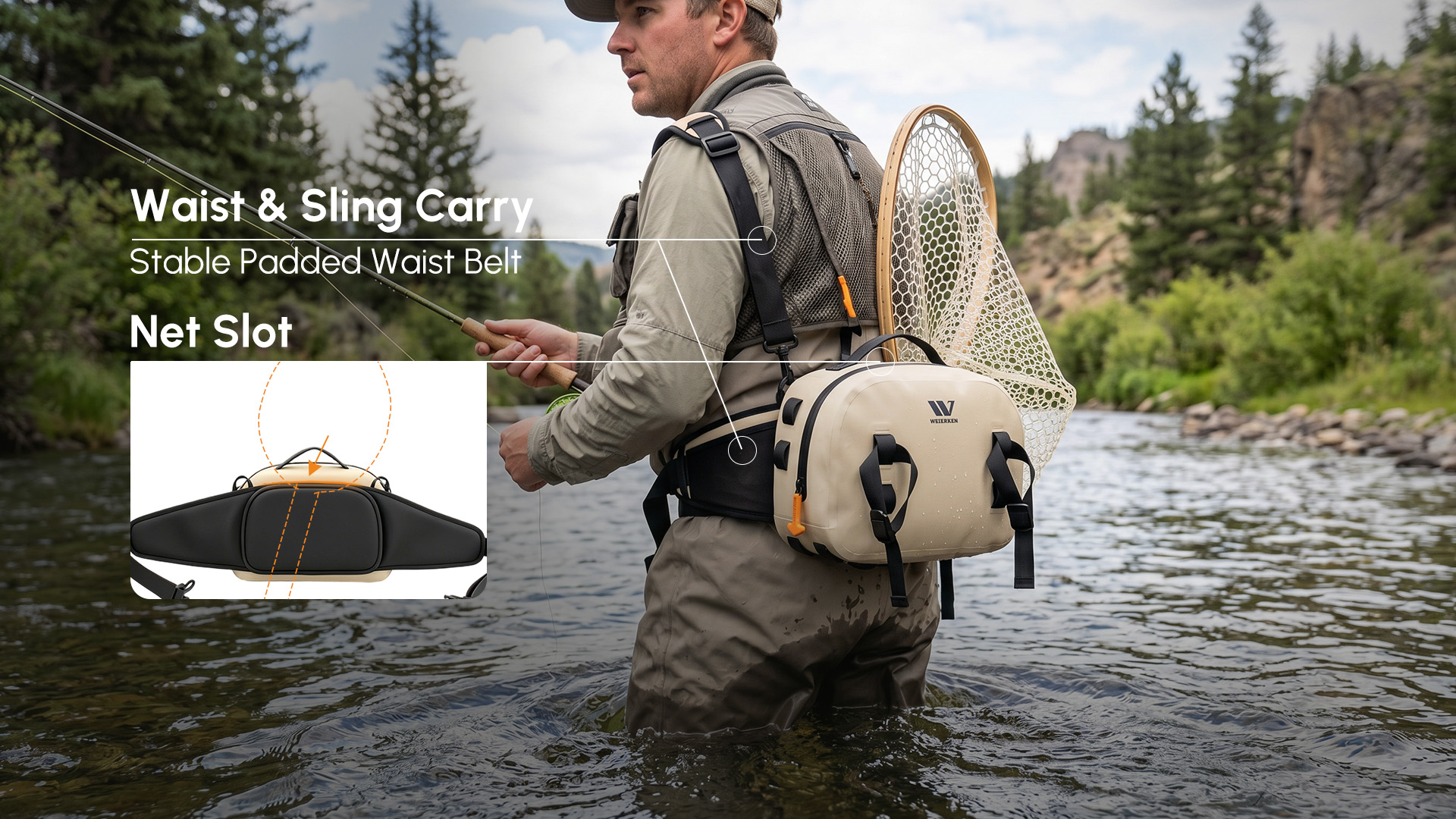
3D Molded Breathable Harness: Ergonomic, quick-drying shoulder harnesses that disperse weight, resist hook snagging, and feature modular clips that mount directly to matching fishing backpacks.
ESG and Regulatory Compliance for Global Export
Importing outdoor gear into North America, Europe, and Australasia requires strict adherence to environmental laws and chemical regulations. Selecting an experienced custom fishing gear private label partner ensures your shipments pass customs inspections without delay.
PFAS-Free Water Repellency (C0 DWR)
Environmental agencies in the United States and the European Union have enacted strict bans on per- and polyfluoroalkyl substances (PFAS). Your supplier must use verified C0 short-chain water-repellent finishes that deliver high water-bead performance without banned fluorinated chemicals. Always demand third-party test reports (such as SGS or Intertek) before approving fabric lots.
Sustainable and Recycled Textiles (GRS Certification)
Modern consumers demand sustainable production. Top factories source Global Recycled Standard (GRS) certified rPET (recycled polyethylene terephthalate) and recycled nylon derived from discarded fishing nets and post-consumer plastics. GRS certification guarantees traceability across the entire supply chain.
Social Compliance and Quality Audits
If you plan to sell through major outdoor retail chains such as Bass Pro Shops, REI, or tackle buying groups, your manufacturing partner must hold validated social and quality management credentials. Key certifications include:
ISO 9001: Standardized quality control protocols across all manufacturing lines.
BSCI / SEDEX (SMETA): Verifications for fair labor practices, safe working conditions, and responsible factory operations.
Supplier Selection: Traditional Cut-and-Sew vs. Technical RF Welding
One of the costliest sourcing mistakes is hiring a traditional backpack factory to produce an airtight fishing pack. Precision matters when evaluating a potential fishing chest pack manufacturer.
Traditional sewing factories use needle stitching. Every stitch creates a hole in the fabric. While seam tape works for light jackets, it often fails on tight, multi-angled chest pack corners under prolonged water pressure. Specialized technical manufacturers, including Weierken, build dedicated tooling and aluminum welding dies for high-frequency molecular bonding. RF welding fuses TPU-coated layers together at the molecular level, creating a continuous, permanent waterproof barrier.
Dual-Sourcing and Regional Production Strategies
To balance product development speed with import duties, experienced brands deploy regional sourcing strategies:
China Facilities: Ideal for complex R&D, rapid tooling creation, precision sampling, and advanced waterproof welding where mature supply chains provide instant access to high-end hardware and raw materials.
Southeast Asia Facilities (Vietnam / Cambodia): Well-suited for high-volume cut-and-sew orders to minimize tariff impacts for North American importers.
From Tech Pack to Bulk Export: The 5-Stage Production Workflow
Navigating private label manufacturing requires a structured process. Below is the standard production cycle when working with an established gear factory.
Stage 1: Design Consultation and Tech Pack Blueprint
You provide a complete tech pack detailing 2D/3D dimensions, material densities, Pantone color codes, and a detailed Bill of Materials (BOM). Your BOM should specify tier-one hardware brands like Duraflex® or ITW Nexus® buckles and certified waterproof zippers.
Stage 2: Prototyping and Pattern Refinement
The factory creates paper patterns, produces custom welding molds, and builds the initial working prototype. Expect this phase to take 14 to 30 days. You will review structural ergonomics, pocket depth, and harness balance before signing off on the Pre-Production (PP) sample.
Stage 3: Cost Modeling and MOQ Tiering
Technical waterproof packs generally carry a Minimum Order Quantity (MOQ) of 300 to 500 units per colorway. This minimum is dictated by fabric dye lots and custom TPU lamination runs. Volume tiering directly reduces unit costs by amortizing custom tooling and setup expenses.
Stage 4: Quality Control and Hydrostatic Testing
A dependable factory runs rigorous testing throughout bulk assembly:
100% Inflation/Submersion Testing: Fully submerged bubble-leak tests for airtight compartments to verify seam integrity.
Hydrostatic Head Testing: Confirming fabric water-column resistance (e.g., >10,000mm to 20,000mm H2O).
Salt-Spray Chamber Testing: Exposing metal components, zipper sliders, and magnetic docks to 48-hour to 72-hour salt-fog environments to prevent corrosion in marine settings.
Stage 5: Custom Branding and Door-to-Door Delivery (DDP)
Apply custom brand details via laser-engraved Hypalon patches, high-frequency TPU debossing, or heat-transfer silicone graphics. Once final QC is complete, your supplier coordinates export crating, ocean or air freight, customs clearance, and DDP (Delivered Duty Paid) logistics directly to your fulfillment warehouse.
Frequently Asked Questions (FAQ)
Q1: What is the typical MOQ for custom private label fishing chest
packs?
A1: Standard MOQs for custom cut-and-sew chest packs range
from 300 to 500 pieces per style/color. For fully submersible packs requiring
custom RF welding dies and technical TPU fabrics, MOQs usually start at 500
units to meet raw material mill minimums.
Q2: How do you verify that a chest pack is truly 100%
submersible?
A2: Submersible packs are tested under IPX7 standards
(withstands immersion in water up to 1 meter for 30 minutes without leaking).
The factory inflates the pack with air, seals the airtight zipper, submerges it
in a water testing tank, and checks for air bubble release along seams and
zipper tracks.
Q3: Can our brand provide custom colors and proprietary
camouflages?
A3: Yes. Factories can dye fabrics to match specific
Pantone codes or print custom camouflage patterns. Custom patterns require
minimum yardage commitments, typically starting around 1,000 meters of technical
fabric.
Q4: What is the normal lead time from design approval to mass
delivery?
A4: Prototype development takes 2 to 4 weeks. Once you
approve the pre-production sample, bulk manufacturing takes 45 to 60 days. Ocean
freight and customs clearance generally add another 20 to 35 days depending on
your destination port.
Q5: Why are airtight zippers more expensive than standard
water-repellent zippers?
A5: Airtight zippers feature
precision-engineered interlocking polyurethane teeth and vulcanized rubber
sealing elements that hold air and water pressure under complete submersion.
Standard water-resistant zippers (like reverse-coil PU coated styles) only
resist light rain and spray.
Build Your Custom Technical Fishing Line with Weierken
Bringing a technical angling pack to market requires an experienced manufacturing partner who understands performance demands, waterproof engineering, and international shipping standards. Weierken specializes in manufacturing high-performance waterproof bags, outdoor tackle packs, and private label angling systems for brands worldwide.
Whether you need a custom-molded fly fishing workstation, an IPX7-rated submersible chest pack, or a complete modular wading system, our engineering team is ready to assist from initial blueprint to final delivery.
Ready to start your next gear project? Contact our technical development team today at service@weierkenbag.com or request a direct manufacturing quote to review samples, material swatches, and production schedules.