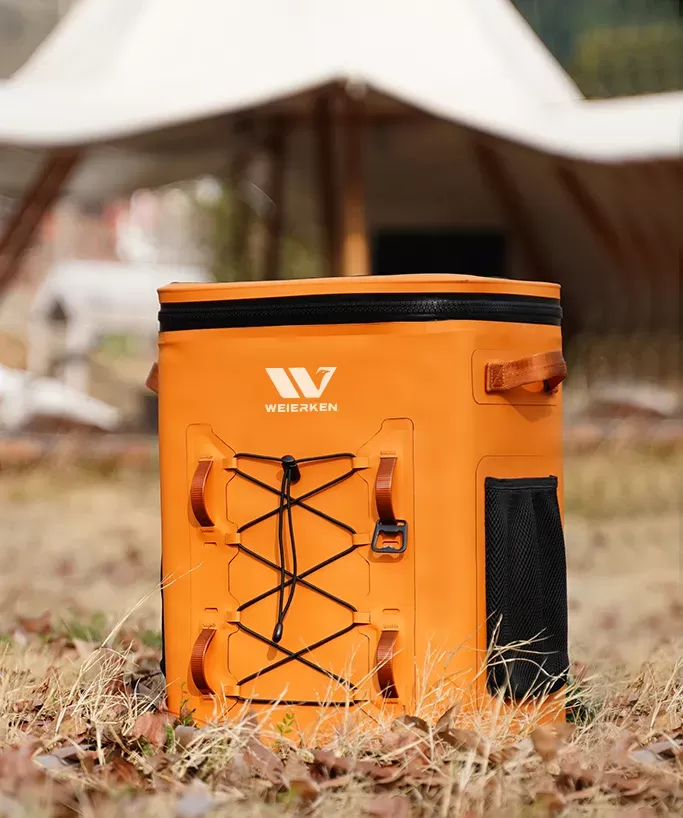

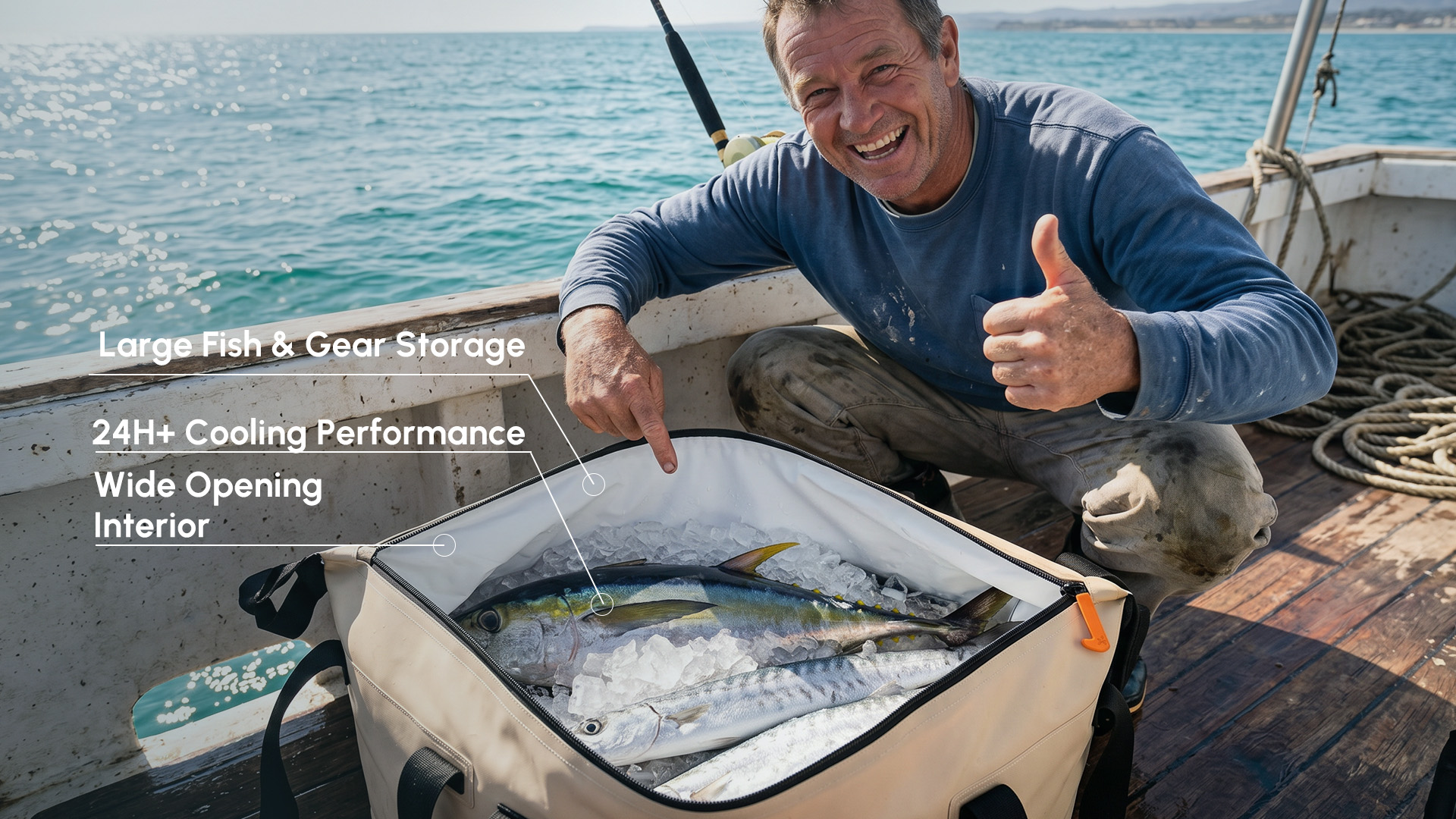
Commercial fishing charters, tournament anglers, and outdoor brands demand rugged gear. Standard consumer cooler bags cannot withstand sharp dorsal fins, heavy ice loads, corrosive saltwater, and days under direct sun. When a soft cooler leaks fish blood into a boat bilge or fails to hold ice during a long offshore haul, the brand takes the blame.
Sourcing from an experienced custom fish cooler bag manufacturer prevents these catastrophic product failures. As the market heads into 2026, the shift toward seamless radio-frequency (RF) welding, recycled TPU fabrics, and integrated drain systems is accelerating. Professional buyers need manufacturing partners capable of meeting technical marine specifications.
Specialized production facilities like Weierken focus on heavy-duty construction and rigorous cold-chain performance. This guide covers the technical benchmarks, material selections, and quality control protocols required to build commercial-grade kill bags for your brand catalog.
1. Critical Engineering and Manufacturing Capabilities
Building a high-performance marine cooler bag requires heavy industrial machinery and specific assembly techniques. Standard cut-and-sew garment factories cannot produce leakproof kill bags. Here are the core engineering standards your supplier must master.
Radio-Frequency (RF) Welding vs. Traditional Stitching
Traditional needle stitching punches thousands of microscopic holes through fabrics. Even with taped seams, stitching under pressure will stretch, leak melted ice water, and trap foul-smelling fish bacteria.
RF (High-Frequency) Welding: Fuses thermoplastic polyurethane (TPU) or PVC materials at the molecular level using electromagnetic energy and pressure.
100% Hermetic Seal: Produces completely waterproof, airtight seams that never leak blood or fluid, even when fully loaded with ice and heavy tuna.
Burst Resistance: Welded joints offer equal or greater tensile strength than the raw fabric itself, handling rough handling on pitching boat decks.
Outer Shell and Liner Material Selection
A reliable custom fish cooler bag manufacturer should offer multiple marine-grade textile options tailored to your target price and performance tier.
Heavy-Duty Outer Shell: 840D to 1000D double-sided TPU-coated nylon delivers unmatched puncture resistance and flex-crack resistance in cold weather. For budget-conscious commercial lines, 500D to 1000D high-density PVC tarpaulin provides high abrasion resistance and UV stability.
Antimicrobial Inner Liner: Food-grade TPU or smooth, heavy-gauge PVC films resist punctures from serrated fish fins. Non-porous surfaces prevent fish slime from absorbing into the fabric, making washdowns fast and odor-free.
Insulation Core: Closed-Cell NBR/PVC Foam
Cheap cooler bags rely on low-density open-cell polyurethane foam or thin EPE pearl cotton. When these materials get wet through accidental punctures, they absorb moisture like a sponge, permanently destroying their thermal resistance.
High-end marine kill bags utilize high-density closed-cell NBR (nitrile rubber) or PVC/EVA blend foam. The closed micro-cell matrix prevents moisture absorption entirely. At thicknesses ranging from 0.5 inches to 1.0 inch, these dense foam cores maintain 48 to 72-hour ice retention in direct marine sunlight.
Heavy-Duty Marine Hardware Integration
A cooler is only as good as its weakest component. Your factory must provide commercial-grade hardware options:
Airtight / Hydrostatic Zippers: Pressure-rated, toothless or heavy-toothed waterproof zippers that prevent cold air loss and water leakage when inverted.
Low-Profile Drain Valves: Molded screw-cap or push-pull drain plugs that allow anglers to drain bloody slurry while keeping ice intact.
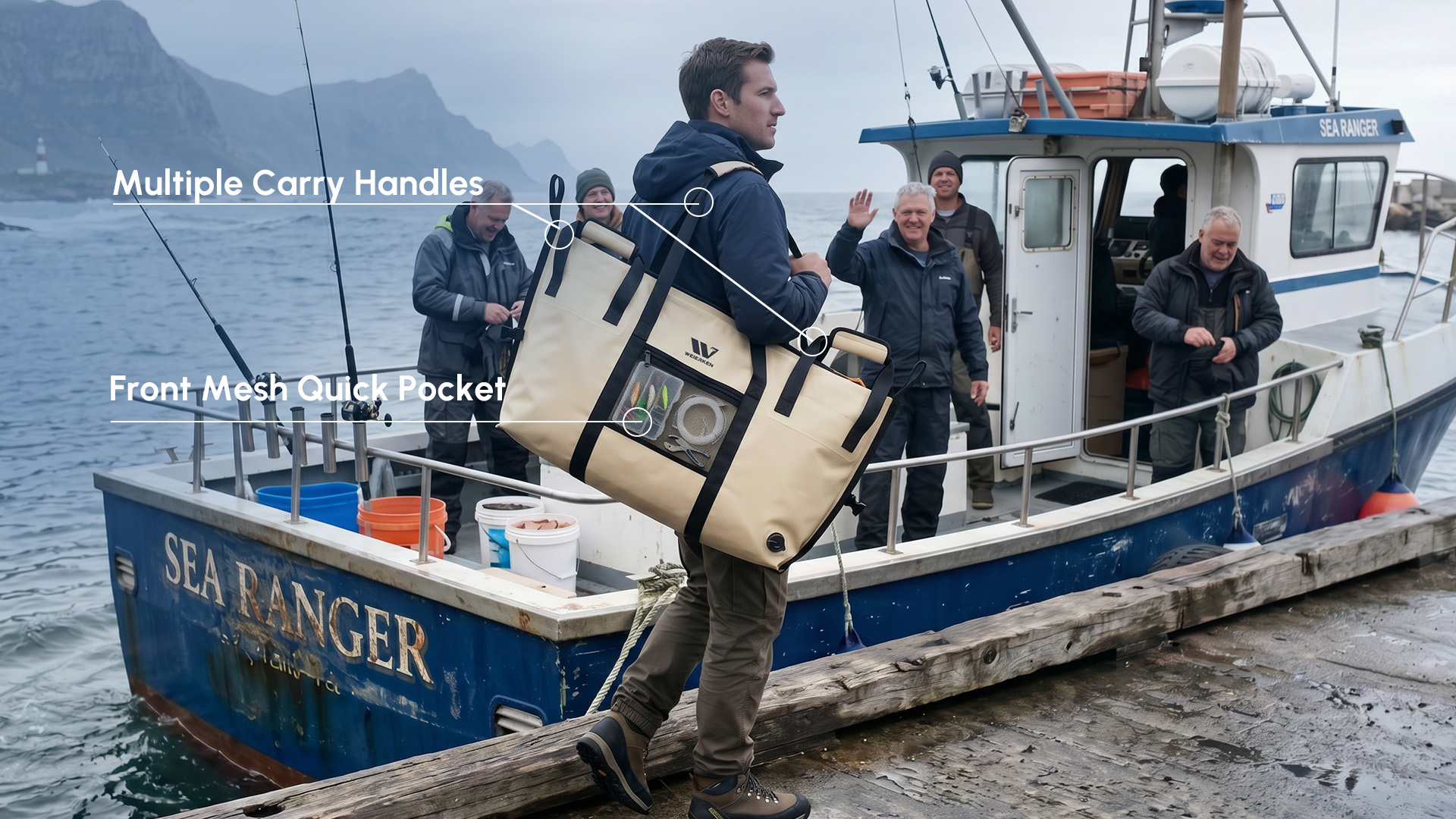
Reinforced Webbing & Hardware: Heavy-gauge nylon webbing with box-X stitching welded to reinforcement patches, paired with marine-grade 316 stainless steel or heavy-duty acetal hardware.
2. 2026 OEM/ODM Customization Scope
Offshore anglers, kayak fishermen, and spearfishermen have distinct spatial and structural requirements. Partnering with a versatile custom fish cooler bag manufacturer allows you to build proprietary molds and form factors that stand out in retail channels.
Specialized Structural Form Factors
Modern fishing cooler lines go beyond basic rectangular shapes. Manufacturers can build custom geometries tailored to specific vessels:
Offshore Tuna & Billfish Kill Bags: Long, low-profile designs (up to 80+ inches) with gusseted flat bottoms that sit upright on deck or stow neatly along the gunwale.
Kayak Deck Bags: Contoured, triangular, or tapered shapes designed to strap securely onto kayak bows or stern tank wells.
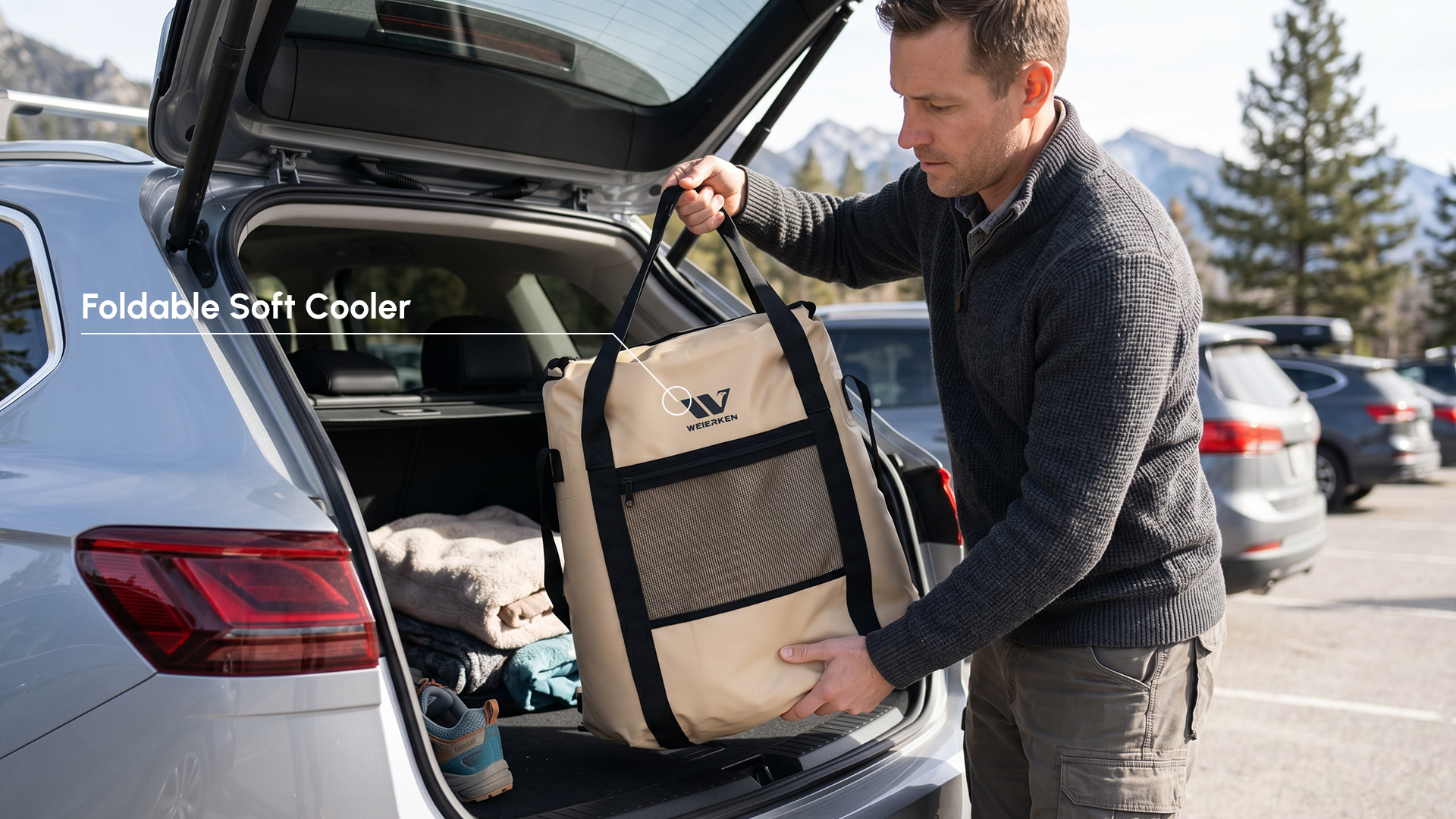
Foldable & Rollable Catch Bags: Flexible constructions that compress down for easy storage in boat storage lockers or luggage during fly-in fishing trips.
Private Labeling and Surface Decoration
Saltwater and constant sun exposure degrade standard prints quickly. High-end marine OEM manufacturers like Weierken utilize industrial branding methods engineered to survive marine conditions:
Heavy-Duty Screen Printing: Industrial solvent-based inks cured directly onto TPU/PVC for high abrasion resistance.
High-Frequency Molded Logos: Dimensional 3D welded badges that will not peel, crack, or fade.
Laser-Etched Patches: High-contrast marine-grade rubber or synthetic badges welded directly to the main body.
Functional Add-Ons and Accessories
Customizing your bags with practical angler-focused features creates clear market differentiation:
Integrated fish-measuring rulers printed directly along the top or side panel.
Exterior laser-cut MOLLE/PALS systems for attaching pliers, dry packs, and rigging gear.
Pressure release purge valves that vent expanding air when closing overstuffed bags.
Internal divider baffles or built-in secure mesh pockets for bait and ice packs.
3. Factory Audits, Quality Control, and Testing Standards
Never rely solely on visual product samples. An established custom fish cooler bag manufacturer must provide empirical lab data and rigorous on-site quality assurance procedures before shipping container loads.
Mandatory Factory Testing Protocols
Ensure your production agreement includes these standard marine-testing benchmarks:
Ice Retention Testing: Measuring ice melt ratios in controlled thermal chambers (35°C / 95°F) across 48, 72, and 96-hour intervals.
Hydrostatic & Submersion Pressure Testing: Filling the bag with air or colored water under pressure to verify zero micro-leaks along welded seams and zipper tracks.
Salt Fog Spray Testing (ASTM B117): Exposing all metal pulls, drain plugs, and clips to 500+ hours of continuous salt spray to ensure zero corrosion.
Handle Tensile & Drop Tests: Loading the finished bag to 150% rated weight capacity and subjecting it to repeated drop and vertical pull-stress tests.
Global Compliance and Environmental Certifications
To distribute through major retail channels such as Bass Pro Shops, West Marine, Amazon, or European markets, your supplier must comply with target regional standards:
FDA / LFGB: Food-contact safe material certification for inner linings touching game fish.
REACH & RoHS: Ensuring materials are free from hazardous phthalates, heavy metals, and toxic plasticizers.
California Proposition 65: Safe limits for lead, BPA, and chemical exposure for North American distribution.
BSCI / ISO 9001: Verified manufacturing operations, ethical labor standards, and predictable quality management systems.
4. Commercial Economics: MOQs, Tooling, and Lead Times
Balancing initial tooling investments against manufacturing volume is essential when launching new marine product lines.
MOQ Tiers: Open Molds vs. Custom Tooling
If you choose an open-mold design (using the supplier’s pre-existing bag dimensions and weld tooling), Minimum Order Quantities (MOQs) typically range from 200 to 500 units per colorway. This path minimizes your upfront capital expenditure.
For fully custom silhouettes, specialized zip layouts, or proprietary high-frequency weld tooling, initial MOQs usually start at 500 to 1,000 units. Tooling costs for custom welding copper molds range between $800 and $3,000 depending on complexity, but this grants full design exclusivity.
Prototyping and Production Timelines
Planning your product release around peak regional fishing seasons requires tight timeline management:
3D Concept & CAD Patterning: 3 to 5 business days.
Physical Prototyping: 7 to 12 business days for pattern cutting, high-frequency tooling setup, and sample assembly.
Tooling Fabrication: 15 to 20 business days for custom copper/aluminum high-frequency dies.
Mass Production: 35 to 45 business days post-sample approval.
Offshore fishing seasons peak in spring and summer. Top-tier brands book production slots with their custom fish cooler bag manufacturer between September and December to secure early-spring FOB deliveries.
5. Frequently Asked Questions (FAQ)
Q1: Why choose RF welded TPU over stitched PVC for custom fish bags?
A1: RF welded TPU creates a completely waterproof, seamless construction without needle penetrations. TPU remains flexible in sub-zero conditions, provides superior puncture resistance against spines, emits zero chemical odors, and does not crack over time compared to low-grade PVC.
Q2: What is the typical MOQ for custom OEM fish kill bags?
A2: Standard MOQs start at 200 to 300 pieces for private-label production on open tooling. Fully customized designs requiring new high-frequency tooling or custom fabric colorways generally require 500 to 1,000 pieces.
Q3: How do manufacturers prevent fish odors from penetrating the cooler lining?
A3: Reliable manufacturers use non-porous, smooth, food-grade antimicrobial TPU or coated PVC liners. These fabrics prevent blood and slime from sinking into the substrate, allowing users to sanitize the bag completely with warm soapy water.
Q4: How long does prototyping and sample delivery take?
A4: For existing models with custom logo placement, sample turnaround is typically 7 business days. For fully custom dimensions requiring pattern drafting and new weld tooling, working prototypes take approximately 10 to 15 business days.
Q5: Can you integrate pressure release valves and custom measurement rulers?
A5: Yes. Screen-printed rulers, laser-welded measuring scales, low-profile screw drain valves, and one-way air release valves can all be integrated into the design during the molding and RF welding process.
Q6: How do we protect our proprietary mold designs during ODM production?
A6: Work with structured OEM/ODM manufacturing facilities that sign bilateral Non-Disclosure Agreements (NDAs). Manufacturers like Weierken maintain dedicated tooling storage for brand partners, ensuring custom patterns and mold dies remain exclusively yours.
Work With a Reliable Marine Cooler Bag Manufacturer
Launching high-performance marine soft coolers requires precision tooling, high-frequency welding expertise, and tested raw materials. Cutting corners on insulation density or seam welding leads to high return rates and damaged brand reputation.
Weierken provides turnkey OEM and ODM manufacturing services for outdoor, cold-chain, and marine fishing brands worldwide. Whether you need a low-profile kayak kill bag or an offshore tuna cooler, our engineering team handles everything from initial CAD design to mass production.
Ready to start your next marine cooler project? Contact our technical team today to submit your Tech Pack, discuss fabric requirements, and receive a competitive DDP quote within 24 hours.
Email: service@weierkenbag.com
Website: weierkenbag.com