
The direct-to-consumer (DTC) frozen food and subscription meal kit markets continue to grow. Yet, fulfillment operations still struggle with the final handoff. Industry data shows that last-mile temperature excursions cause product spoilage in more than 15% of summer shipments.
When premium vacuum-sealed beef or artisanal ice cream arrives thawed, customer satisfaction drops instantly. Refunds eat into margins, but the damage to brand trust hurts even more. Many platforms discover too late that standard off-the-shelf thermal bags cannot handle the rigors of commercial courier networks.
Sourcing directly from a specialized frozen food home delivery bag manufacturer gives businesses full control over thermal performance, structural durability, and unit costs. Working with an experienced OEM partner like Weierken bridges the gap between lab-tested thermal specs and grueling route conditions.
This guide explains what procurement teams must look for when engineering heavy-duty, reusable cold chain assets for high-frequency transport.

1. Technical Anatomy of a True Heavy-Duty Frozen Delivery Bag
Consumer cooler totes fall apart when loaded with dense, heavy items. A commercial delivery bag carrying frozen goods must withstand intense daily wear while holding sub-zero temperatures. Look for specific material grades when reviewing factory specifications.
Advanced Material Engineering
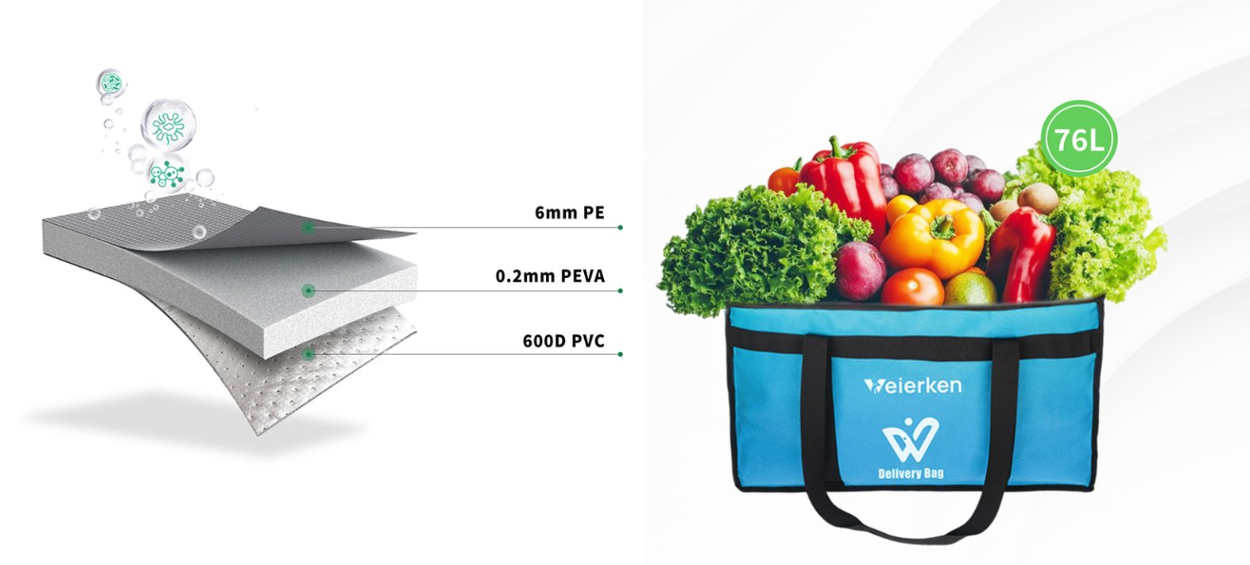
Thermal retention depends on the interplay between the protective outer fabric, the core insulation barrier, and the interior lining:
External Shell Fabrics: Demand 500D to 1680D water-resistant Oxford polyester, or heavy-gauge PVC/TPU tarpaulin. These industrial fabrics resist surface scrapes, punctures from sharp dry ice blocks, and daily exposure to rain and snow.
Core Thermal Insulation: Low-density open-cell foam collapses easily, shedding its insulating value under slight pressure. Insist on high-density Expanded Polyethylene (EPE) pearl cotton, Closed-Cell Polyethylene, or high-density Expanded Polypropylene (EPP) with an optimal thermal resistance rating (R-value). Densities between 10mm and 20mm protect against ambient heat infiltration over extended transit windows.
Internal Liners: Food-grade aluminum foil provides radiant heat deflection. For wet environments, heavy-gauge PEVA or TPU liners are superior. Ensure the factory bonds these liners using high-frequency ultrasonic heat-sealing. Traditional needle stitching creates thousands of micro-holes that let meltwater leak into the insulation foam, causing mold growth and foul odors.
Reinforced Load-Bearing Architecture
A filled delivery container packed with frozen goods, cold packs, or dry ice blocks regularly weighs between 15kg and 30kg. Standard seam construction will rip under this continuous load.
Ensure your cold chain packaging manufacturer uses Box-X reinforcement stitching on all load-bearing handles. The nylon or polypropylene webbing straps should wrap completely around the bottom of the bag, distributing weight across the entire base rather than pulling only on the top fabric seams.
To prevent structural bowing, bags need a rigid baseboard made of solid polypropylene (PP) or polyethylene (PE) sheets. Unlike cardboard, these plastic panels will not absorb moisture or rot when exposed to interior condensation.
Closures must use commercial-grade components. Specify waterproof, airtight zippers (such as genuine YKK) or broad, industrial-strength hook-and-loop flaps. Flimsy luggage zippers jam and split quickly when exposed to sub-zero interior temperatures.
2. Custom Solutions Engineered for Commercial Fleets
Off-the-shelf sizes force your team to adapt your operations to the bag. Custom thermal insulated delivery bags allow the container to match your exact fulfillment workflow, saving time and money on every route.
Thermal Sizing for Sub-Zero Transit
Holding products at or below -18°C (-0.4°F) for 24 to 48 hours requires strict control over interior air space. Extra air inside the chamber accelerates the sublimation of dry ice and melts phase change material (PCM) gel packs twice as fast.
A specialized OEM insulated food delivery bag manufacturer will tailor the inner dimensions to fit your standard frozen food boxes, primary pouches, and refrigerant bricks snugly. This custom fit minimizes empty air pockets and cuts overall refrigerant consumption.
Optimizing Logistics and Storage
Fleet efficiency extends beyond the active delivery run. Consider the practical handling requirements of couriers and warehouse staff:
Foldable Structures: Work with the factory to add score lines and flexible corner panels. Bags that fold flat save over 60% of storage space in staging hubs and reduce reverse logistics freight costs when collecting empty bags.
Clear External Pockets: Heavy-duty transparent PVC sleeves keep waybills, bar codes, and delivery manifests dry and legible for rapid scanning.
Security and Tamper-Evidence: Add lockable zipper sliders or eyelets for single-use pull-tight security seals to verify that nobody opened food packages during transit.
Brand Representation on the Street
Delivery fleets are visible mobile advertisements. A quality manufacturer offers precision Pantone color matching across exterior fabrics, weather-resistant silk-screen inks, dye sublimation, and molded rubber or reflective logos. High-visibility reflective strips protect your couriers during dawn and night shifts.
3. How to Audit a Frozen Food Home Delivery Bag Manufacturer
Many factories present well online but outsource their assembly or lack rigorous quality control. Enterprise procurement heads should vet prospective partners using clear operational criteria.
Certifications and Chemical Compliance
Since the bag operates near perishable food, all contact surfaces must comply with international consumer safety laws. Confirm your supplier holds the following verified certifications:
ISO 9001: Verifies structured quality management across material sourcing, pattern drafting, sewing, and final packing.
FDA Food-Contact Compliance: Guarantees that internal lining fabrics and coatings do not leach hazardous compounds, plasticizers, or heavy metals into food containers.
Social Accountability (BSCI or Sedex SMETA): Confirms that production lines adhere to ethical labor standards, fair wages, and safe factory operations.
Demanding Real Empirical Testing
Do not accept verbal performance claims. Request documented laboratory test results showing how their designs perform under stress:
Thermal Chamber Testing: The factory should place a fully loaded bag inside a calibrated thermal chamber at an ambient 35°C (95°F) and track interior temperatures over 24, 36, and 48 hours using data loggers.
Drop and Handle-Jerk Testing: Look for testing machines that load finished bags with 25kg and drop them repeatedly from heights of one meter to verify handle stitching, zipper teeth, and corner seams.
Experienced production partners, including Weierken, maintain dedicated in-house labs equipped with digital pull-force testers and thermal testing chambers to validate performance before beginning mass production.
Production Capacity and Buffer Planning
Ask about raw material inventories and seasonal lead times. Sample prototyping should take no more than 3 to 7 business days for custom patterns. A capable production facility must demonstrate sufficient monthly sewing output to fulfill commercial meal kit delivery bags bulk orders without missing seasonal peaks.
4. Total Cost of Ownership: Reusable Bags vs. Single-Use Packaging
Some purchasing managers hesitate at the initial capital expenditure required for heavy-duty reusable delivery bags. They default to single-use expanded polystyrene (EPS) foam coolers housed inside corrugated cardboard boxes. A simple Total Cost of Ownership (TCO) model reveals the hidden cost of that approach.
| Fulfillment Metric | Single-Use EPS Coolers + Box | Reusable Heavy-Duty Bags (OEM) |
|---|---|---|
| Initial Packaging Unit Cost | $4.50 – $6.50 per set | $25.00 – $35.00 per unit |
| Average Usable Lifespan | 1 Single Transit Run | 60 to 100+ Transit Cycles |
| Cost-per-Delivery (100 Runs) | $450.00 – $650.00 | $0.25 – $0.58 (inc. reverse logistics) |
| Customer Disposal Burden | High (bulky foam bins) | Zero (collected on subsequent routes) |
| Environmental Regulatory Risk | High (regional plastic bans) | Fully compliant with ESG standards |
Switching to reusable, heavy-duty frozen food bags OEM solutions cuts packaging costs by more than 40% across a standard 12-month delivery schedule. It also eliminates the frustration customers experience when breaking down oversized foam boxes, helping your brand align with corporate ESG plastic-reduction goals.

Frequently Asked Questions
Q1: Can a non-electric insulated bag hold -18°C for 24 hours?
A1: Yes, provided the thermal structure is engineered properly. Combining 15mm to 20mm closed-cell EPE or EVA insulation with radiant interior foil and calculated ratios of dry ice or sub-zero PCM gel packs can hold sub-zero temperatures for 24 to 36 hours in typical ambient conditions.
Q2: How does a cold chain packaging manufacturer prevent internal condensation buildup?
A2: Professional factories seal the inner shell using high-frequency RF welding, creating an impermeable barrier. Condensation stays within the food cavity and cannot enter the insulation layer, making it easy for logistics teams to wipe and sanitize the interior between shifts.
Q3: What is the standard Minimum Order Quantity (MOQ) for custom bags?
A3: Standard custom fabric and color setups generally require an MOQ of 500 units. Fully custom-dyed textiles, specialized hardware molds, or complex functional extrusions usually carry an MOQ between 1,000 and 2,000 units.
Q4: Why is Box-X stitching necessary on delivery bag handles?
A4: A straight stitch across a nylon handle concentrates all lifting tension on a single thread line, which shears off under heavy loads. Box-X stitching distributes mechanical stress across a wider surface area, helping the handle withstand up to 30kg of dynamic lifting force.
Q5: How do fold-flat designs cut operating expenses?
A5: Rigid boxes occupy the same cargo space whether full or empty. Fold-flat insulated bags compress down to roughly 20% of their open volume, allowing drivers to carry dozens of empty bags in a single vehicle run and lowering return logistics costs.
Build a Resilient Cold Chain Distribution Fleet
Last-mile frozen delivery leaves no room for sub-par packaging. Melting products cost money, disrupt fleet schedules, and drive away customers. Off-the-shelf coolers simply cannot withstand the daily grind of commercial delivery routes.
By partnering directly with a proven frozen food home delivery bag manufacturer, your business secures purpose-built containers that maintain safe temperatures, protect cargo, and improve your bottom line over hundreds of fulfillment cycles.
Need durable, custom thermal delivery bags built for your frozen fulfillment network? Contact the cold-chain engineering team at Weierken today to request a quote, order physical material swatches, or review detailed 3D product renderings.