
Consumers choose healthy meal prep services for purity, balanced nutrition, and fresh ingredients. Whether your business delivers macro-balanced keto dishes, organic vegan salads, or cold-pressed juices, your brand equity rests on what happens during transit. If a meal arrives warm, leaking, or smelling like cheap synthetic plastic, customer trust vanishes immediately.
Most commercial thermal bags on the open market fall short of true food-contact safety standards. They rely on toxic adhesive glues, recycled PVC liners that crack in cold weather, and permeable seams that trap liquid. Sourcing from a specialized healthy meal delivery bag supplier like Weierken protects your business against food safety risks, customer churn, and costly compliance failures.
Use this B2B quality checklist to evaluate your current or prospective bag manufacturers before signing your next purchase order.
Why Fresh Meal Brands Require Stricter Packaging Standards
Standard restaurant takeout focuses on keeping fast food hot for twenty minutes. Healthy meal delivery operates on a completely different logistical model. You often ship a full day or week of chilled meals, requiring stable internal temperatures between 34°F and 40°F (1°C to 4°C) for several hours.
This operational model creates unique supply chain challenges:
Chemical Migration Risks: Condensation inside a closed bag creates humidity that leaches plasticizers, volatile organic compounds (VOCs), and heavy metals from low-grade liners onto meal containers.
Microbial Breeding Grounds: Traditional needle-stitched seams let condensation and spilled dressing seep into the interior foam. Once trapped, moisture breeds mold, salmonella, and sour odors that cannot be washed away.
Cold-Chain Breakdown: Inadequate foam density creates thermal bridges. Once the internal cavity crosses into the 40°F to 140°F (4°C to 60°C) "Danger Zone," rapid bacterial growth forces customers to discard their food.
Procurement teams cannot treat delivery bags as simple promotional merchandise. They are critical tools of cold chain food packaging that require rigorous manufacturing oversight.
The 5-Step Food-Grade Sourcing Checklist
When vetting a meal prep bag manufacturer, demand technical data sheets and physical test samples. Use the following five criteria to separate consumer-grade bag stitchers from verified industrial food-packaging specialists.
Audit Item 1: Liner Material Safety and Certified Food-Contact Compliance
The interior liner sits inches away from your meal containers. Under hot summer ambient conditions, poor-quality liners off-gas synthetic odors that contaminate the customer unboxing experience.
Eliminate PVC Completely: Polyvinyl chloride (PVC) often contains ortho-phthalates added for flexibility. These compounds are restricted under global chemical regulations because they act as endocrine disruptors. PVC also cracks under sustained freezing temperatures.
Specify Food-Grade PEVA or TPU: Polyethylene vinyl acetate (PEVA) and thermoplastic polyurethane (TPU) offer non-toxic, odorless performance. They contain zero BPA, phthalates, or chlorine. TPU provides higher puncture resistance and remains pliable down to sub-zero temperatures.
Require Third-Party Lab Reports: Do not accept verbal assurances. Require valid testing reports from accredited labs like SGS or TÜV. These reports must confirm compliance with FDA 21 CFR 177.1350 for the US market or EU Framework Regulation (EC) No 1935/2004 and LFGB for European distribution.
Audit Item 2: Leak-Proofing and Seamless Heat-Welding
Any delivery bag that relies on stitched interior seams will eventually leak. Needle penetrations break the waterproof barrier, allowing liquid to wick into the inner insulation.
High-Frequency Ultrasonic Welding: A reliable healthy meal delivery bag supplier uses high-frequency radio frequency (RF) or ultrasonic welding to join the liner sheets. This technique fuses the polymers together at the molecular level, creating a continuous, seamless waterproof tub.
The Static Water Test: Test sample units on-site by pouring two inches of water into the interior cavity and letting it sit for twenty-four hours. Quality heat-welded liners will display zero moisture seepage along the edges or through the base.
Oleophobic and Stain-Resistant Surfaces: Food-grade PEVA linings should feature a smooth surface tension that resists oily salad dressings, marinades, and sauces. Drivers and fulfillment teams must be able to sanitize the liner with a single food-safe antibacterial wipe.
Audit Item 3: Thermal Performance and Core Insulation Density
Thermal stability requires balancing conductive, convective, and radiant heat transfer. A thin layer of generic foam cannot handle multi-hour urban delivery routes.
Multi-Layer Composite Sandwich: Insist on a three-to-four layer thermal wall. This should feature an exterior water-repellent shell, thick core insulation, an inner radiant barrier (such as aluminum foil or metallized film), and the protective PEVA/TPU food liner.
Closed-Cell EPE or EVA Foam (6mm to 8mm Minimum): Open-cell foams absorb moisture and collapse over time, losing their insulating properties. High-density, closed-cell expanded polyethylene (EPE) or ethylene-vinyl acetate (EVA) retains micro-air pockets under mechanical weight, providing consistent thermal resistance (R-value).
Thermal Bridge Prevention: Standard zippers are major sources of heat loss. Look for specialized construction features like thick, insulated storm flaps behind the zipper track and rubber-coated, airtight water-resistant zippers.
Audit Item 4: High-Frequency Turnover Durability and Cost-Per-Use
Subscription meal brands often run closed-loop or returnable packaging systems. If a bag fails after ten deliveries, your packaging cost per order skyrockets. Your production partner must design the exterior for industrial-level handling.
Reinforced Stress Points: Handles and shoulder straps must not rely on single-line stitching. Insist on box-X cross-stitching combined with heavy-duty bar-tack sewing at all structural junctions. Bags should pass dynamic drop tests loaded with 15 to 20 kilograms of dead weight.
Abrasion-Resistant Exterior Fabrics: Look for heavy-denier woven fabrics like 600D to 900D Oxford polyester, rugged ripstop nylon, or post-consumer GRS-certified rPET. The exterior should withstand dirty delivery vans, concrete stairs, and routine sanitizing cycles.
Commercial Hardware: Cheap plastic zipper pullers snap within weeks. Specify heavy-gauge resin or coated zinc-alloy zippers (such as YKK or equivalent-grade custom hardware) that resist repeated pulling, cold temperatures, and salt-air corrosion.
Audit Item 5: Manufacturing Qualifications and Dual-Hub Supply Chain Security
Technical bag specifications matter little if your vendor faces sudden customs seizures, factory shutdowns, or tariff shocks. Corporate procurement requires auditing the vendor's financial, social, and logistical infrastructure.
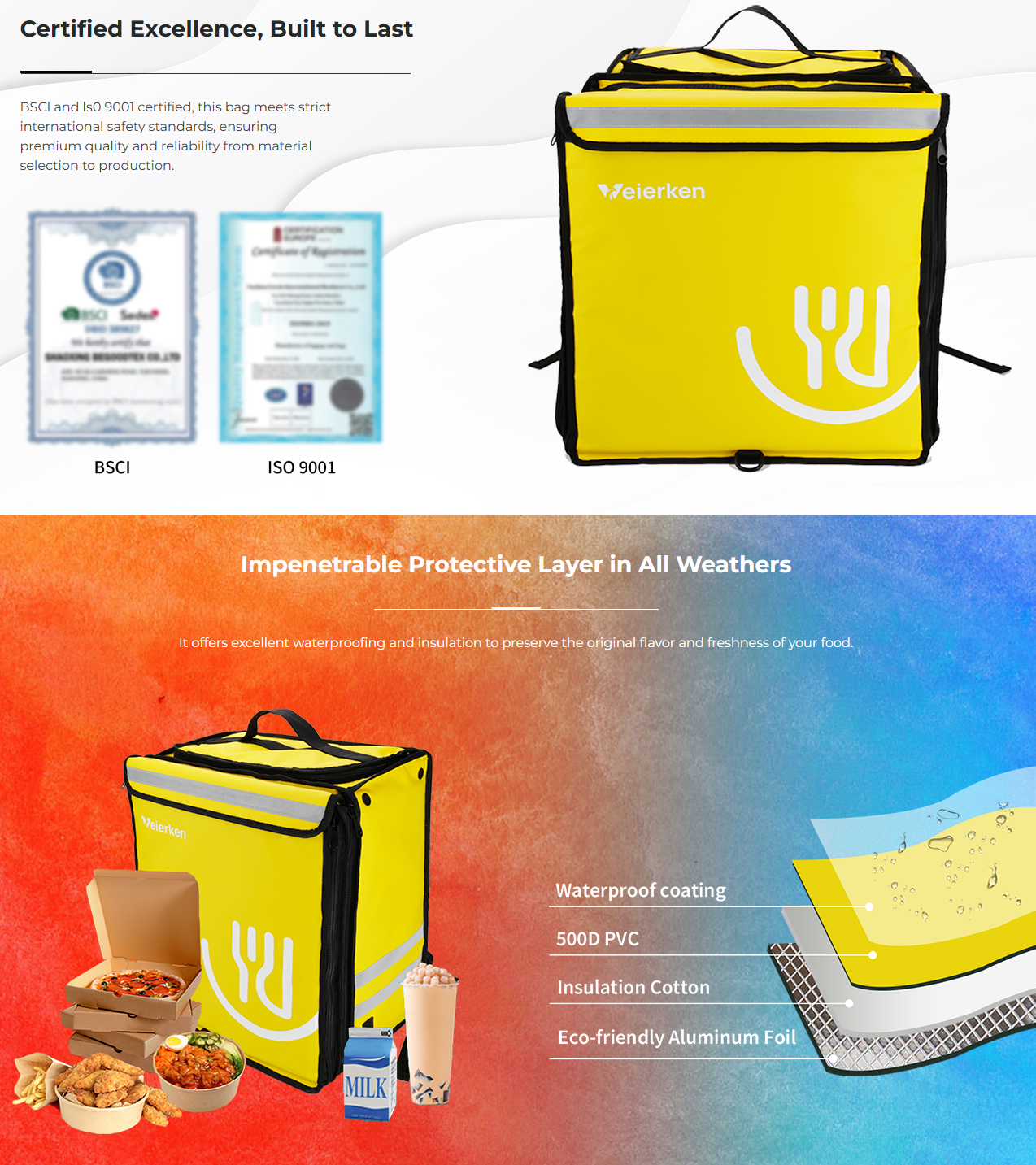
Social and Quality Accreditations: Verify that the factory holds valid ISO 9001 quality management certifications, alongside ethical supply chain audits such as BSCI or SEDEX (SMETA). These ensure systematic incoming material controls and fair labor conditions.
First-Pass Yield (FPY) Standards: Ask the supplier for their historical defect and return rates. Top-tier industrial manufacturers maintain a first-pass quality yield of 99% or higher through in-line quality stations rather than end-of-line spot checks.
Tariff Mitigation and Production Flexibility: Heavy import duties on Chinese-manufactured textiles can erase your operating margins. Leading suppliers now operate dual manufacturing centers—retaining rapid engineering teams in China while running high-volume, duty-free assembly lines in Southeast Asian hubs like Cambodia.
How Weierken Solves Food-Grade Delivery Bag Sourcing
Navigating these regulatory and structural challenges is simpler when you partner with an experienced manufacturer. Weierken provides custom cold-chain food packaging designed around the specific requirements of healthy meal subscription brands.
Here is how Weierken supports your supply chain operations:
Certified Food-Contact Interiors: Weierken uses certified BPA-free PEVA and commercial TPU liners manufactured under clean workshop protocols. Every production run is backed by verifiable REACH, LFGB, and FDA compliance testing to eliminate toxic odors and chemical migration.
Industrial RF Heat-Welding: Our production lines feature automated high-frequency heat-welding machinery. This technology produces 100% leak-proof, zero-stitch interior liners that block bacteria, prevent mold, and simplify daily wash-downs.
99.5% First-Pass Factory Quality: We run strict multi-point inspection routines. We inspect incoming fabrics, conduct continuous seam-stress checks during production, and run thermal integrity testing to guarantee a 99.5% defect-free delivery rate.
Rapid Prototyping: Our in-house design engineers take custom specs from digital concept to physical, field-ready sample in 3 to 7 business days, speeding up your packaging development timeline.
Dual-Base Manufacturing with DDP Terms: With modern facilities in both China and Cambodia, Weierken helps Western clients lower their import duties and clear customs efficiently through smooth, door-to-door Delivered Duty Paid (DDP) shipping.
Frequently Asked Questions
Q1: What is the main difference between an off-the-shelf cooler bag
and a food-grade insulated delivery bag?
A1: Off-the-shelf cooler
bags are built for general consumer use, such as weekend picnics. They often use
cheap, stitched PVC liners that leak fluids, off-gas synthetic chemical odors,
and tear easily. A food-grade insulated delivery bag uses certified, non-toxic
liners (like PEVA or TPU) that comply with FDA or LFGB contact standards. These
bags feature seamless, heat-welded liners to prevent fluid leakage, resist mold
growth, and stand up to daily commercial sanitization.
Q2: Why should fresh meal prep services avoid PVC
liners?
A2: PVC (polyvinyl chloride) relies on plasticizer
additives, such as phthalates, to keep the material pliable. When food
containers sit inside a warm or humid PVC-lined space, these chemicals can
volatilize and leave noticeable chemical smells on packaging. PVC also turns
brittle and cracks under low temperatures, ruining the bag's waterproof seal.
Non-toxic PEVA or TPU offers a cleaner, safer, and more durable alternative.
Q3: How does high-frequency heat-welding stop bacterial
growth?
A3: Traditional sewing punches thousands of needle holes
through the fabric. Condensation, spilled dressing, and meat juices seep through
these holes into the internal foam core, where they cannot be cleaned or dried
out. This creates a hidden breeding ground for mold and bacteria. High-frequency
heat-welding fuses the material edges using electromagnetic energy, forming a
completely sealed, impermeable tub that keeps liquids out of the insulation.
Q4: How many hours can a properly constructed delivery bag keep meals
below 40°F (4°C)?
A4: Performance depends on ambient weather, ice
pack ratios, and meal mass. However, an engineered bag with 6mm to 8mm of
high-density closed-cell EPE foam, a radiant barrier, and a thermal zipper flap
consistently maintains internal temperatures below 40°F (4°C) for 4 to 8 hours.
Some specialized long-range designs can extend safe holding times past 12
hours.
Q5: Can our brand use sustainable or recycled fabrics without
lowering thermal efficiency?
A5: Yes. You can construct the outer
shell from 100% post-consumer recycled fabrics, such as GRS-certified (Global
Recycled Standard) rPET, without losing any structural strength or weather
resistance. The primary insulating performance comes from the closed-cell foam
and inner reflective foil, allowing your business to meet corporate
sustainability goals while maintaining food-grade temperature controls.
Q6: How does sourcing from Cambodia help reduce our overall
procurement spend?
A6: Meal delivery bags shipped directly from
China to the United States often face high import tariffs under Section 301.
Sourcing through an established supplier with operational facilities in Cambodia
allows your brand to use favorable trade programs, reducing or zeroing out these
tariff costs. This structure preserves product quality while significantly
improving your landed unit economics.
Secure Your Cold Chain Packaging Today
Your delivery packaging acts as a direct extension of your kitchen and brand promise. Cutting corners with uncertified, off-the-shelf cooler bags puts your food safety record, operational margins, and customer retention at risk. Partnering with a dedicated, audit-ready B2B thermal bag supplier ensures every shipment arrives fresh, safe, and true to your brand standards.
Contact the packaging engineering team at Weierken today to discuss your delivery requirements, request certified food-grade material sample kits, or receive a fast, factory-direct quotation within 24 hours.