

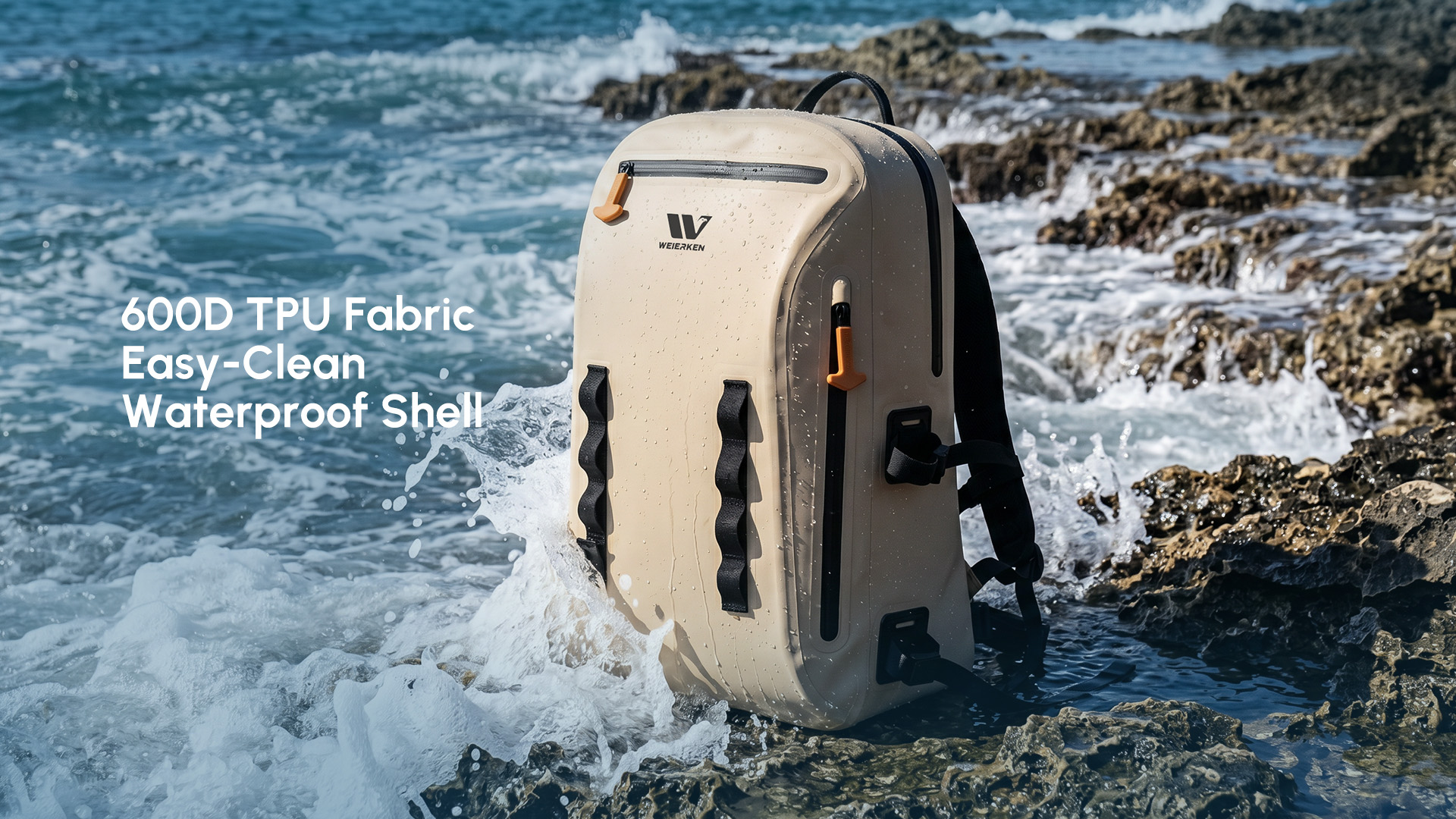
When a kayaker executes an Eskimo roll, their backpack does not just face light spray. The bag plunges completely underwater. If the closure or seams leak, satellite communicators, cameras, and emergency clothes get soaked. For outdoor brands, that failure leads directly to customer complaints, negative reviews, and product returns.
Building a certified submersible pack requires moving past ordinary dry bag assembly. At Weierken, we help outdoor brands translate demanding design concepts into true submersible gear. Achieving legitimate IPX7 and IPX8 performance demands a systematic approach to polymer chemistry, high-frequency welding tooling, and structural engineering.
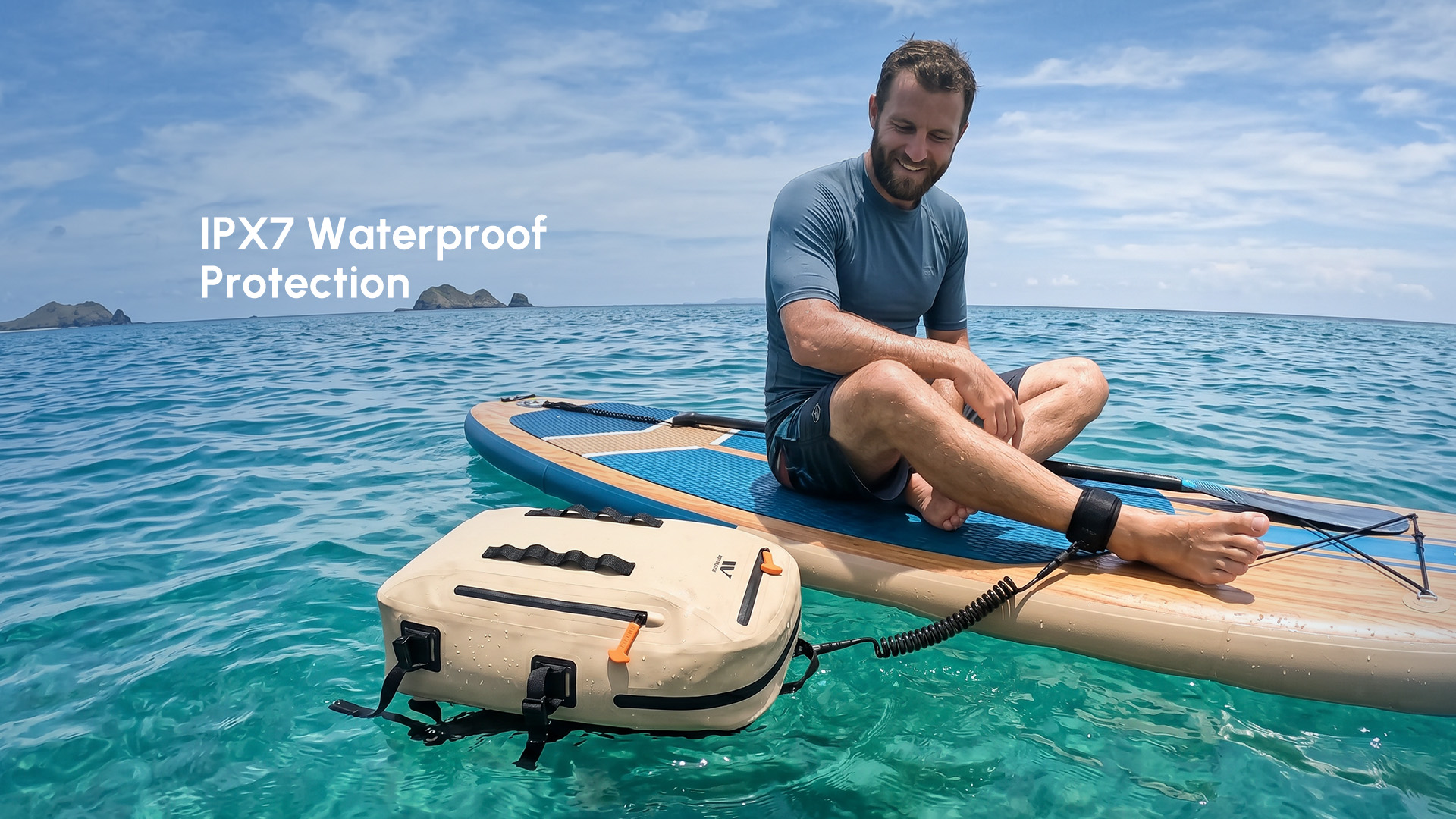
Decoding the Standards: IPX7 vs IPX8 in Factory Realities
Before sourcing an OEM waterproof kayak backpack, product managers must understand how laboratory standards translate to the assembly line. The international standard IEC 60529 outlines water ingress protection, but real-world manufacturing dictates practical safety margins.
IPX7: Immersion Protection
The IPX7 rating requires an enclosed bag to withstand submersion in water up to 1 meter deep for 30 minutes without internal leakage. In production terms, this covers accidental drops overboard, swift-water spills, and temporary submersion during white-water runs. An IPX7 rating serves as the baseline for any performance-grade custom submersible kayak dry bag.
IPX8: Continuous Submersion Under Pressure
IPX8 goes beyond standard baseline testing. The manufacturer and the brand agree on specific parameters, which must exceed IPX7 requirements. Typically, this means surviving depths of 2 to 5 meters for several hours. This rating suits expedition paddlers, technical rescue crews, and military maritime units who need complete gear protection under sustained deep water pressure.
The B2B Pitfall: Splashproof vs. Submersible
Many factories label sewn bags with taped seams as "waterproof." While suitable for hiking rain covers (IPX4 to IPX6), needle-stitched seams fail under submersion. Water molecules push through needle perforations under dynamic pressure. To deliver dependable IPX7 or IPX8 gear, brands must partner with an experienced IPX7 vs IPX8 waterproof backpack manufacturer that builds weld-sealed chambers without stitching.
Material Selection: The Foundation of Submersible Performance
Submersible bags cannot rely on traditional surface water-repellent (DWR) coatings. Water pressure easily shears through standard surface treatments. Instead, the base textile must serve as an impenetrable barrier that bonds completely during the welding cycle.
- 420D to 840D High-Tenacity Nylon: Nylon provides superior tear resistance and abrasion durability against rocks, kayak decks, and sand. It maintains structural integrity even under heavy internal pack loads.
- Thermoplastic Polyurethane (TPU) Films: Unlike PVC, TPU stays flexible in sub-zero waters and offers superior puncture resistance. It complies fully with environmental standards like REACH and RoHS, avoiding hazardous plasticizers.
- Double-Sided vs. Single-Sided Lamination: For an IPX7 pack, single-sided TPU lamination on the interior often suffices. For an IPX8 pack, double-sided extrusion TPU lamination is essential. Double-sided coating allows the inner and outer contact points to melt into a single homogenous joint, eliminating delamination risks under prolonged exposure.
Traditional PVC tarpaulin remains popular for basic budget dry bags. However, it stiffens in cold river runs and cracks over repeated flex cycles. High-performance kayak brands consistently choose double-coated TPU nylon to withstand real paddling abuse.
Production Engineering: Eliminating Needle Holes and Stress Fractures
Every needle puncture in a fabric is a potential leak path. Creating a dependable OEM waterproof kayak backpack requires eliminating traditional sewing from all critical water barrier zones.
Radio Frequency (RF) and High-Frequency (HF) Welding
RF welding passes high-frequency electromagnetic energy through the layered TPU coatings. The radio waves agitate the polymer molecules until they melt and fuse into a seamless bond. When executed correctly in a dedicated RF welding waterproof bag factory, the welded seam becomes stronger than the surrounding base fabric.
Unlike hot-air taping, which degrades under continuous UV exposure and flexing, RF welds never peel. The two pieces of fabric become one solid molecular layer.
Precision 3D Tooling for Molded Contours
Flat RF welding dies work well for two-dimensional pouches, but backpacks require three-dimensional volume. Forcing flat welds around base corners creates micro-wrinkles known as channel paths. Water under pressure seeps through these microscopic channels.
Experienced manufacturers build CNC-machined, three-dimensional aluminum welding horns. These custom molds match the exact contours of the pack base and side panels, distributing clamp pressure evenly and preventing thin spots along weld lines.
Isolating the Harness System
A kayak backpack must carry comfortably on long portages. Paddlers need contoured EVA foam shoulder straps, load lifters, and padded hip belts. Stitching these elements directly into the main dry chamber destroys its waterproof integrity.
We solve this challenge through structural isolation. The cleanroom assembly team at Weierken welds high-strength TPU backing plates directly onto the exterior pack body. The ergonomic harness, sternum straps, and back pads then anchor onto these reinforced exterior plates. The dry chamber remains 100% unpunctured and airtight.
Critical Components: Closures and Mechanical Hardware
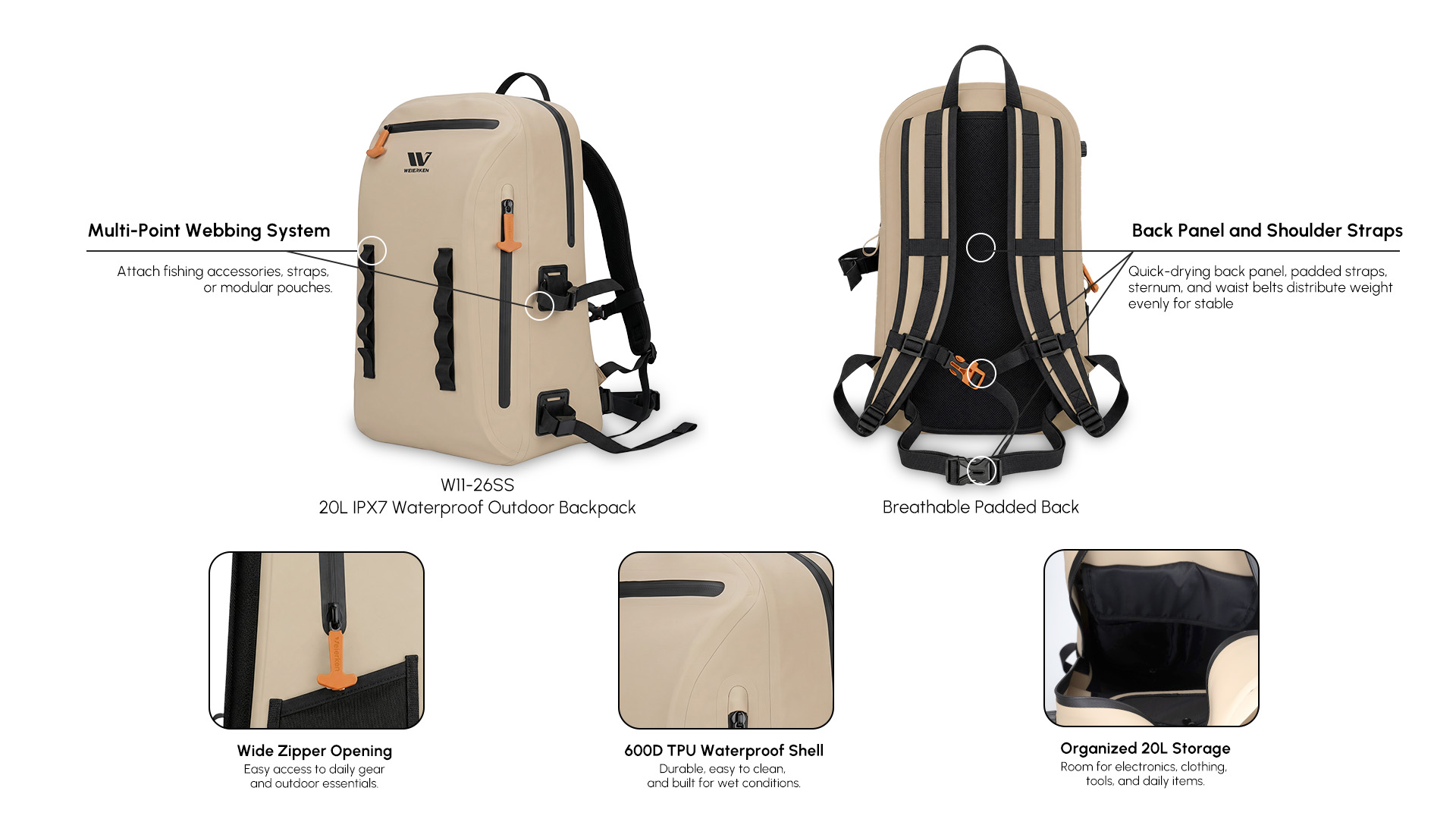
A waterproof fabric hull is only as dependable as its closure mechanism. When designing an airtight zipper kayak backpack OEM product line, engineering the opening demands meticulous attention to detail.
Mechanical Airtight Zippers
For true IPX8 performance, an airtight zipper is mandatory. These specialized closures feature interlocking synthetic rubber or polyurethane teeth vulcanized along a flexible TPU tape. When pulled shut, the teeth press the sealing lips together with enough force to hold air and water back under several bars of pressure.
The zipper terminus—the "dock" or "garage"—represents the most critical leak risk. Factories must enclose the zipper end within a high-pressure hot-stamped TPU pocket. If the terminal fit is off by even half a millimeter, water under immersion pressure will breach the dock.
Engineered Roll-Top Closures
Roll-top closures offer a proven, cost-effective design for IPX7 applications. However, basic roll-tops leak if submerged under deep water. Achieving an IPX7 seal requires strict geometry:
- The roll-down lip must incorporate stiffening hypalon or polymer bands on both sides to maintain uniform pressure across the opening.
- The bag must allow at least three to four continuous downward folds before clipping into the side tensioners.
- A two-way purge valve should be integrated into the lower wall. Kayakers can
compress the pack, purge excess air through the valve, and seal it shut to
prevent the roll-top from popping open under external water pressure.
Factory Quality Control and Testing Protocols
You cannot confirm a pack is submersible by inspecting it visually. Verifying an IPX7 or IPX8 rating requires rigorous, measurable quality assurance on the factory floor.
1. Pressure Decay Leak Testing
This is the most reliable, non-destructive method for inline production testing. The operator fills the finished backpack with compressed air to an internal pressure of 15 to 20 kPa. The testing machine isolates the pack and monitors air pressure drops over 60 seconds.
Any drop in pressure indicates a microscopic pinhole or an imperfect weld seam. Bags that fail the decay test are flagged immediately for analysis before moving to packaging.
2. Laboratory Submersion Chamber Testing
During initial sampling and batch auditing, finished packs undergo water tank immersion tests. For IPX7 compliance, the pack is submerged under 1 meter of water for 30 minutes inside a weighted cage. For IPX8 compliance, the bag goes into a sealed pressure chamber that simulates 3 to 5 meters of hydrostatic water depth for multiple hours.
After depressurization, inspectors check moisture-sensitive test papers placed inside the dry chamber to verify zero water ingress.
3. Tensile and Peel Strength Testing
A weld might hold air while resting on a table, but tear open when a kayaker lifts 25 kilograms of wet gear by one shoulder strap. Factories use universal tensile testing machines to pull welded sample strips apart. The test ensures that the polymer bond maintains a minimum peel strength of 80 to 120 N/5cm, exceeding industry requirements for rugged outdoor gear.
The Sourcing Blueprint: From CAD Tech Pack to Mass Production
Developing a custom submersible kayak pack requires close engineering collaboration between the brand and the manufacturing team. Moving smoothly from concept to production involves several key stages:
- Design for Manufacturability (DFM) Review: The engineering team inspects your CAD drawings. They identify sharp structural corners that should be rounded to prevent weld burn-through, verify weld seam widths (typically 12mm to 20mm for submersible chambers), and finalize fabric pairings.
- Rapid Tooling and Prototyping: Dedicated CNC molds are cut to weld structural shapes. First-run prototypes confirm that the ergonomics, volume, and seal closures match your product specifications.
- Pre-Production Stress Testing: The prototype undergoes drop testing, thermal shock cycles (from -20°C storage to 45°C paddle environments), and prolonged submersion trials.
- Standardized Mass Production: Once tooling and test protocols are approved, automated welding machines and inline pressure decay tests ensure that every unit rolling off the line meets the approved standard.
Frequently Asked Questions (FAQ)
Q1: What is the main difference between IPX7 and IPX8 in custom submersible kayak dry bag manufacturing?
A1: IPX7 guarantees water resistance up to 1 meter depth for 30 minutes, which protects gear during accidental drops and fast-water capsizes. IPX8 requires customized, continuous protection at depths beyond 1 meter (usually 2 to 5 meters) for durations agreed upon by the brand and factory. IPX8 requires double-laminated fabrics, specialized airtight mechanical zippers, and reinforced 3D welded corner structures.
Q2: Can a roll-top backpack achieve a certified IPX8 rating?
A2: No. Roll-top designs depend on friction and material tension across multiple folds. While a well-engineered roll-top can pass IPX7 (1 meter for 30 minutes), deep water pressure eventually forces water between the folds. True IPX8 submersible backpacks require a continuous, pressure-rated airtight zipper system.
Q3: Why is TPU preferred over PVC for an OEM waterproof kayak backpack?
A3: TPU offers much higher abrasion and puncture resistance per gram than PVC. It stays flexible in freezing temperatures, resists UV degradation from sun exposure on open water, and contains no toxic plasticizers. This makes it lighter, more durable, and fully compliant with EU REACH and US environmental regulations.
Q4: How do you mount ergonomic shoulder straps without puncturing the waterproof hull?
A4: We use high-frequency RF welding to attach external anchor patches and heavy-duty hypalon lash tabs directly to the outside face of the bag. The shoulder straps, sternum connectors, and lumbar padding mount directly to these exterior patches. The main internal storage compartment remains completely free of needle stitches and leak paths.
Q5: What is pressure decay leak testing, and why is it essential for airtight zipper kayak backpack OEM projects?
A5: Pressure decay testing pumps a controlled volume of air into the sealed bag and measures internal pressure changes over a set period using digital sensors. Even a 50-micron pinhole causes a measurable drop in pressure. It provides a fast, dry, non-destructive quality check for 100% of finished packs during mass production.
Q6: What is the typical minimum order quantity (MOQ) for a custom welded waterproof backpack?
A6: Because custom RF welding requires dedicated aluminum tooling, custom extrusion dies, and specific fabric dye lots, standard MOQs usually range from 500 to 1,000 units per colorway. This volume helps absorb upfront tooling costs and maintains consistent quality across automated production runs.
Build Reliable Submersible Gear with Weierken
Launching a reliable submersible product line requires more than generic dry bag patterns. It demands precise material science, dedicated RF welding machinery, and stringent quality control. Poorly built waterproof bags lead to costly warranty claims and erode brand loyalty. Engineered submersible products, on the other hand, build lasting brand value and customer trust.
Weierken engineers and manufactures performance-grade submersible backpacks for leading paddle sports, outdoor, and tactical gear brands worldwide. Whether you need an airtight zipper daypack or a high-capacity white-water expedition hauler, our engineering team is ready to support your project from initial DFM analysis through final production.
Ready to build your next OEM waterproof kayak backpack? Contact the Weierken engineering team today to request a DFM evaluation, review material swatches, and receive a competitive manufacturing quote.