

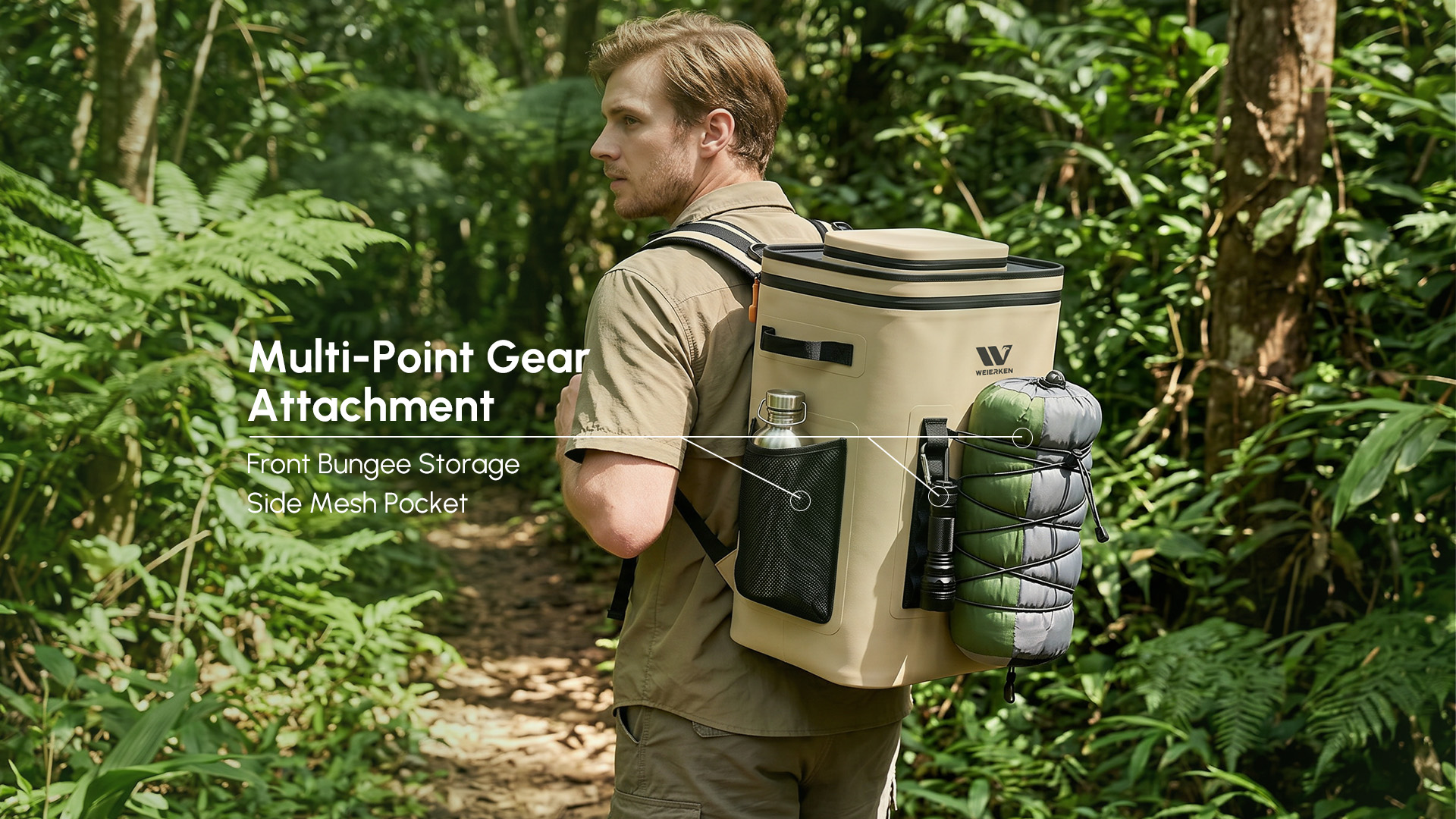
A grocery cooler bag keeps drinks cool for an afternoon picnic. A hunting cooler bag, by contrast, must haul fifty pounds of raw quarters through thick brush, resist punctures from jagged rocks, prevent biological leakage, and hold ice for up to 72 hours under direct sunlight. When outdoor brands source products for this punishing category, the cost of failure is high.
A failed seam or a leaking zipper does not just generate a return; it ruins a multi-thousand-dollar hunting expedition and destroys brand reputation. Product return rates in this niche can easily hit 5% to 10% if an unqualified factory skips corners on high-frequency welding or material bonding. Furthermore, erratic lead times and shifting import tariffs can erase your profit margins before the hunting season even starts.
Auditing a prospective custom hunting cooler bag manufacturer requires a technical, hard-nosed approach. You cannot rely solely on glossy digital catalogs or slick trade-show booths. This guide breaks down the critical audit checkpoints you need—spanning supply chain agility, engineering depth, stress testing, and communication protocols. Companies like Weierken have spent decades refining these benchmarks to help outdoor brands secure durable products and dependable delivery cycles.
1. Supply Chain Resilience and Manufacturing Capacity
Production capacity is more than square footage and machine counts. You must evaluate how well a supplier handles geopolitical shifts, tariff spikes, and raw material volatility.
Dual-Hub Manufacturing Footprints
Over-reliance on a single production zone exposes your business to supply chain disruptions. When evaluating a custom hunting cooler bag manufacturer, determine whether they run manufacturing operations across multiple regions.
China Facilities: Ideal for rapid prototyping, specialized tooling development, and immediate access to advanced textile supply chains.
Southeast Asian Facilities (e.g., Cambodia): Critical for large-scale, cost-effective assembly runs that hedge against regional production bottlenecks.
A dual-facility strategy allows your supply chain to pivot smoothly. Weierken operates facilities in both China and Cambodia, allowing buyers to complete advanced material sampling in China while running high-volume mass production in Cambodia to guarantee stable shipping windows.
Tariff Mitigation and Duty Optimization
Import duties directly compress your gross margins. Sourcing technical gear through countries that benefit from trade programs helps safeguard your bottom line.
Review whether the factory's country of origin qualifies for preferential tariff schemes or free-trade agreements (FTAs) in your target markets, such as the US or the European Union.
Shifting bulk assembly to a Cambodia-based production plant can lower import duties by 15% to 25% compared to direct shipments from standard tariff zones.
Ask your supplier if they provide certified Certificates of Origin (COO) to ensure your customs documentation withstands regulatory audits.
End-to-End Logistics and DDP Capabilities
Managing freight forwarders, customs clearances, and inland trucking burns internal operational hours. Audit whether the factory provides comprehensive Delivered Duty Paid (DDP) shipping solutions.
A professional factory takes ownership of the logistics pipeline from their loading dock to your domestic fulfillment warehouse. This turnkey shipping service minimizes unexpected demurrage charges and customs holds during peak retail replenishment cycles.
International Compliance and Social Audits
Big-box hunting and outdoor retailers, such as Bass Pro Shops, Cabela's, or European specialty chains, enforce strict vendor compliance codes. Sourcing from non-certified facilities risks immediate vendor disqualification.
Social Accountability: Demand current audit reports for BSCI (Business Social Compliance Initiative) and SEDEX (SMETA).
Chemical and Environmental Safety: Verify adherence to EU REACH standards and look for recycled material validations like GRS (Global Recycled Standard) and rPET documentation.
Quality Assurance: Confirm active ISO 9001 certification to ensure operational discipline across every assembly line.
2. Technical R&D and Engineering Capabilities
Soft-sided hunting coolers demand advanced textile engineering. Unlike sewn gear, technical coolers rely on polymer science, thermal dynamics, and airtight construction.
Prototyping Precision and Iteration Speed
Developing a rugged hunting pack cooler begins with rapid prototyping. A capable custom hunting cooler bag manufacturer should maintain a dedicated sample workshop separate from their primary assembly floor.
Standard Coolers: Prototyping typically takes 3 to 7 days.
Technical Hunting Coolers: Expect 12 to 30 days. This allows adequate time to mill custom molds, source specialized TPU membranes, and test welded joints.
Review their engineering workflow. Do they work directly from your CAD files and tech packs? Can they catch structural design flaws before cutting expensive production dies?
Overcoming Engineering Bottlenecks
Hunting environments expose gear to heavy loads, sharp tools, and animal fluids. Your audit must verify that the factory knows how to solve these four primary failure points:
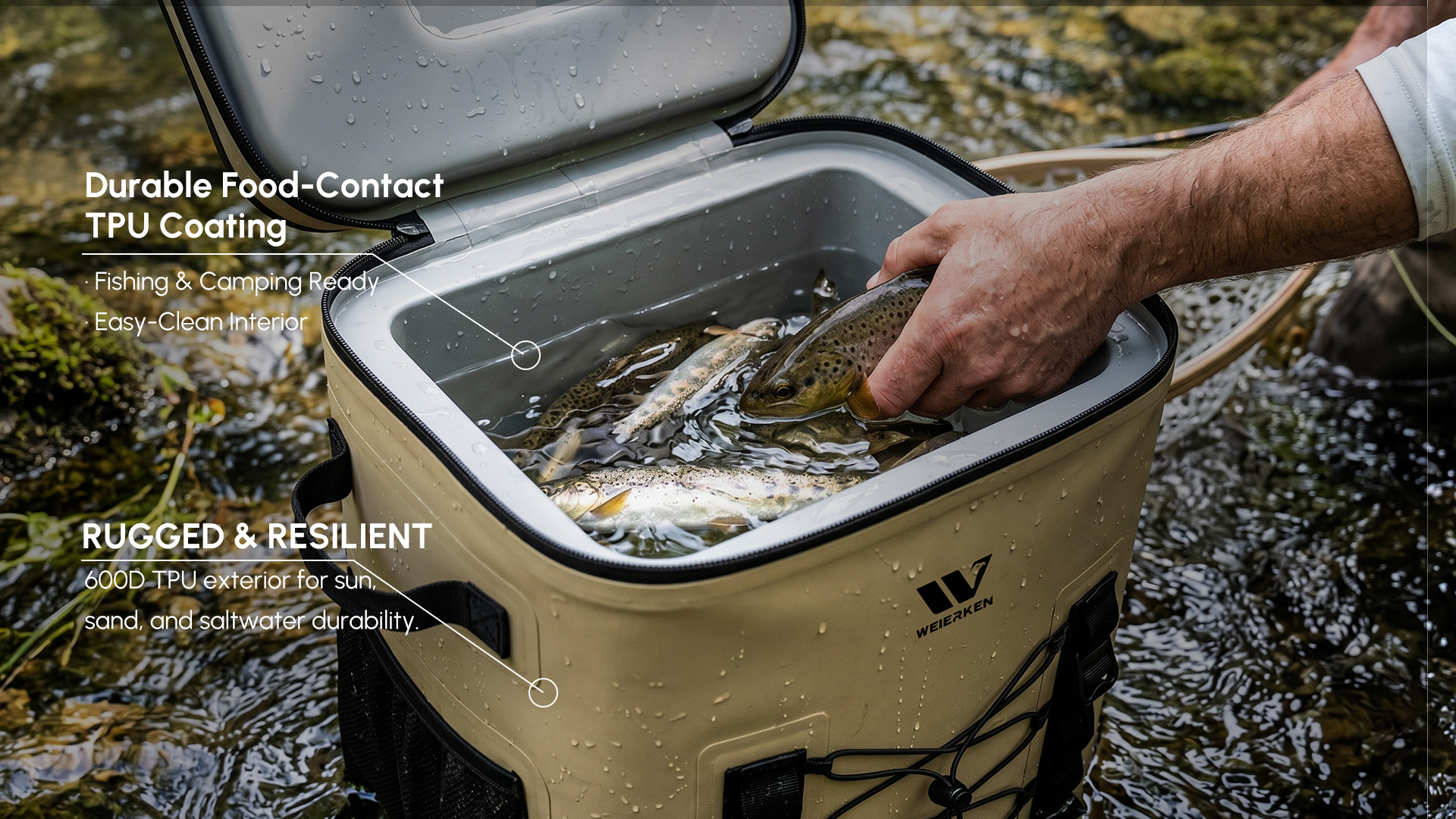
Blood and Fluid Leakage: Traditional stitching creates needle punctures that leak fluids. Insist on Radio-Frequency (RF) welding or hot-air fusion, which melts thermoplastic polyurethane (TPU) coatings together at the molecular level to form permanent, impermeable seams.
Thermal Bridging: Cheap open-cell sponge collapses under weight and absorbs water. Ensure the plant works with high-density closed-cell NBR or EVA foam (ranging from 20mm to 35mm in thickness) that retains its shape and insulating air pockets under heavy pressure.
Puncture Vulnerability: Confirm the factory can laminate and weld heavy-gauge textiles, such as 840D or 1680D nylon and polyester, finished with a thick double-sided TPU film that resists thorns, knives, and shale.
Zipper Tear-Outs: Watertight and airtight zippers undergo substantial tension. The manufacturer must apply high-frequency welded zipper frames reinforced with bar-tack stitching on stress-bearing anchors.
Field-Specific Expertise
A generalist bag maker rarely understands the nuances of the backcountry. Partnering with a dedicated custom hunting cooler bag manufacturer like Weierken gives you access to 20 years of technical manufacturing experience. Seasoned engineers know how to apply licensed camouflage patterns (such as Realtree or Mossy Oak) without weakening TPU lamination, and they select antimicrobial food-grade inner liners that resist stains and foul odors after long packing trips.
3. Quality Control Systems and Field Testing Protocols
Consistent quality does not happen by accident at final packaging. It requires strict process control at every stage of production.
Process Quality Control and Yield Metrics
Tour the production line—either in person or through an independent third-party auditor—and inspect their quality verification stations. Ask for their First Pass Yield (FPY) rates.
Incoming Quality Control (IQC): Testing fabric rolls for hydrostatic head ratings, TPU peel strength, and consistent color matching under controlled lighting.
In-Process Quality Control (IPQC): Testing RF weld strength on off-cuts every hour and checking zipper pull resistance throughout assembly.
Final Quality Control (FQC): Running complete cosmetic, dimensional, and functional checks across all finished units.
High-tier factories achieve an FPY rate of 99.5% or better, preventing defective units from ever reaching an export container.
Hunting-Specific Stress Testing
Standard quality checklists are insufficient for hunting gear. Review the supplier's internal testing lab to confirm they conduct the following evaluations:
Heavy-Load Suspension Tests: Loading the cooler bag with 50 to 100 pounds of weight and subjecting the carry handles, shoulder straps, and harness systems to thousands of drop cycles on a pneumatic jig.
24-Hour Inversion Test: Filling the bag with water, locking the airtight zipper, and turning the cooler upside down for 24 hours to confirm zero fluid leaks.
Ice-Retention Profiling: Storing the cooler in an environmental test chamber at 100°F (38°C) to measure thermal performance across 48, 72, and 96-hour spans.
Martindale Abrasion Testing: Rubbing exterior textiles under high tension through thousands of cycles to simulate contact with rocks, truck beds, and dense brush.
4. Brand Partnership, Communication, and Project Management
A supplier should act as a reliable extension of your engineering team. Communication barriers and opaque scheduling lead to missed retail deadlines and rushed releases.
Collaborative Engineering Support
The right manufacturing partner does not blindly follow a flawed tech pack. They review your drawings, identify high-stress failure points, and propose Design for Manufacturability (DFM) adjustments. They help balance thermal targets against production costs, suggesting practical ways to streamline assembly without weakening the product.
Direct Technical Communication
Avoid sourcing companies that hide you behind layers of account executives who lack technical product knowledge. You need direct communication with English-speaking project managers who understand the difference between NBR and EVA foam, or who know how high-frequency tooling affects mold tolerances. This clarity keeps development moving and avoids costly sampling revisions.
Milestone-Driven Tracking
Ask prospective factories how they manage production milestones. A reliable custom hunting cooler bag manufacturer uses structured project tracking systems, including transparent Gantt charts.
Tech pack sign-off and material specification lock
Tooling and mold construction for welded bases and zipper tracks
Pre-production sample approval (golden sample)
Raw material batch testing and IQC sign-off
Mass production line run and IPQC audits
Final random inspection (AQL 1.5/2.5) and container pack-out
This systematic oversight prevents the last-minute delays that can derail an upcoming product launch.
Frequently Asked Questions
Q1: What are the best exterior fabrics for a heavy-duty hunting cooler bag?
A1: The industry benchmark for technical hunting coolers is high-tenacity nylon or polyester ranging from 840D to 1680D, coated on both sides with thermoplastic polyurethane (TPU). This combination yields exceptional puncture resistance, remains flexible in sub-zero conditions, and allows for robust radio-frequency seam welding.
Q2: Why is RF welding necessary instead of standard sewing?
A2: Traditional sewing punches thousands of needle holes through the fabric, compromising thermal performance and allowing blood, melted ice, and moisture to seep into the insulation. RF welding uses high-frequency electromagnetic energy to fuse the TPU layers together, creating a unified, hermetically sealed, 100% leakproof seam.
Q3: How does a dual-hub production setup (China and Cambodia) benefit my brand?
A3: A dual footprint offers operational balance. You leverage China's advanced tooling and rapid material sourcing for quick prototyping, while routing high-volume mass production through Cambodia. Sourcing from Cambodia can reduce import tariffs into the US and European markets by 15% to 25%, while protecting your business against single-region supply chain delays.
Q4: What is the typical turnaround time for prototypes and mass production?
A4: For technical hunting cooler bags featuring welded joints and airtight zippers, initial prototyping takes between 12 and 30 days. Once the golden sample is signed off and tooling is finished, mass production typically takes 45 to 60 days, depending on fabric lead times and order volume.
Q5: Can you apply licensed camo patterns like Mossy Oak or Realtree to technical TPU fabrics?
A5: Yes. However, printing on technical TPU requires specialized surface treatments and UV-resistant inks to ensure the camo pattern will not peel, flake, or crack under prolonged sun exposure and heavy abrasion. An experienced manufacturer will manage these licensed printing processes while preserving the weldability of the underlying fabric.
Q6: How do you verify leakproof performance on the mass production line?
A6: Quality factories combine positive-pressure air decay testing with liquid inversion tests. Finished cooler bags are pressurized with air to verify that the welded seams and zipper tracks maintain pressure without drops. Random units from every production lot also undergo a 24-hour inverted fluid test.
Choosing Your Manufacturing Partner
Auditing a custom hunting cooler bag manufacturer requires looking past basic assembly lines. You need to inspect seam-welding technology, verify multi-region production facilities that ease tariff pressures, and confirm the factory runs real-world stress tests. Choosing the right partner shields your business from costly product recalls and strengthens customer loyalty in the field.
Weierken builds technical, leakproof cooler systems for leading global brands. With an integrated dual-facility footprint in China and Cambodia, full DDP delivery capabilities, and 20 years of technical bag-making experience, our engineering team is ready to support your next product line.
Ready to elevate your outdoor gear lineup? Contact the Weierken engineering team today to request a factory audit pack, discuss custom OEM/ODM solutions, or schedule a prototype build for your next hunting cooler project.