

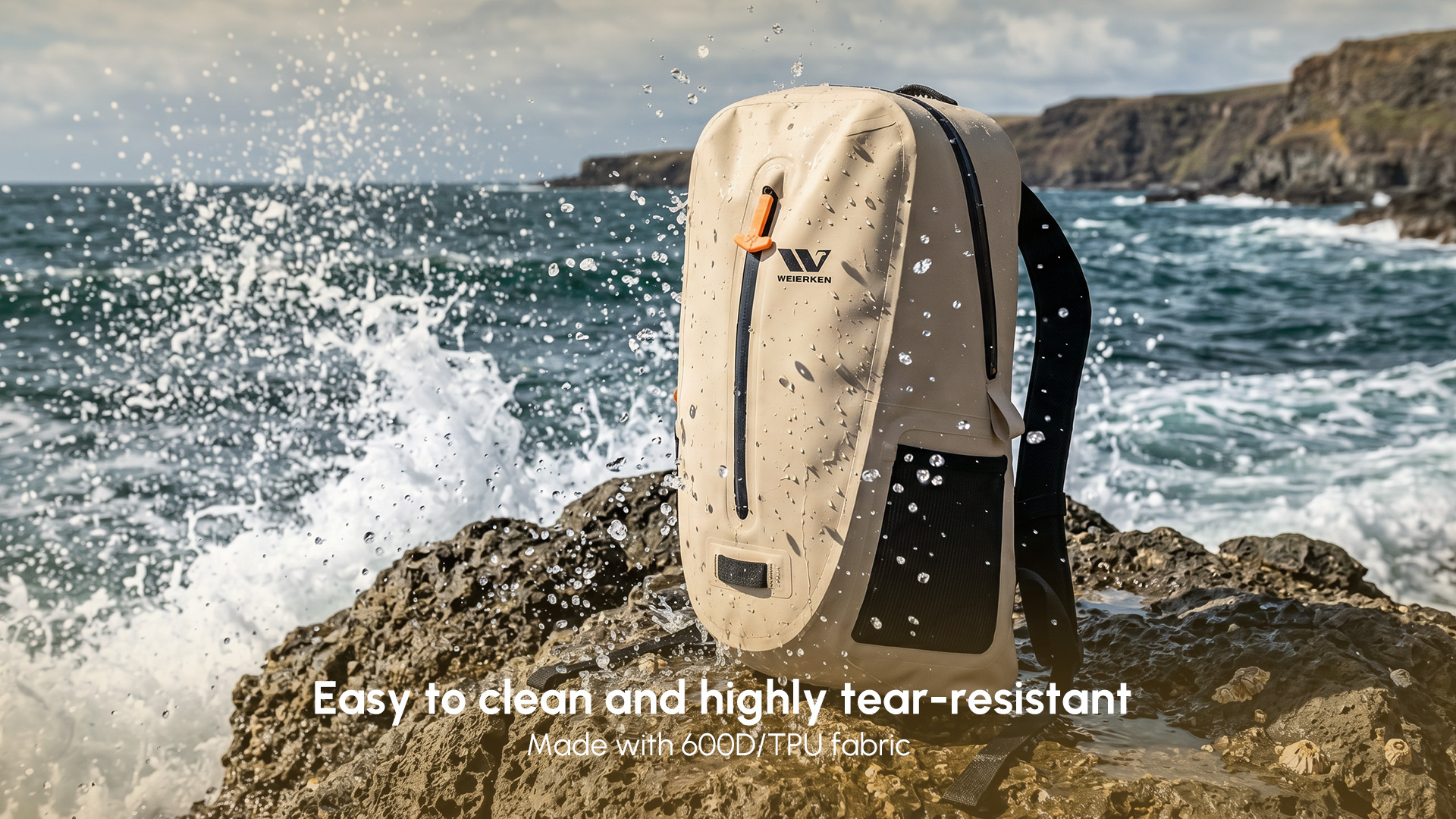
Watersports retail operates on an unforgiving seasonal calendar. Most stand-up paddle board (SUP) gear sells between May and August. If your inventory arrives four weeks late, you miss the peak selling window and carry dead stock into autumn.
Worse, if your private label bags leak, customers post negative reviews that harm your core board sales. Defective accessories eat up store staff time with warranty claims, eroding your retail margins. Selecting the right manufacturer is a fundamental business risk decision.
A reliable OEM partner acts as a supply chain shield. Companies like Weierken help retailers maintain high on-shelf availability, pass retail compliance audits, and hit target margins. This guide shows you how to screen suppliers and source bulk waterproof bags for paddle board retailers with confidence.
4 Critical Dimensions to Evaluate an OEM Manufacturer
Do not evaluate suppliers solely on their catalog photos or unit prices. Dig into their factory floor operations, supply chain engineering, and quality control systems.
1. Production Integrity and Leak Defense (Zero-Defect Standard)
Waterproof bags sold in retail stores face rough treatment. Customers drop them on gravel launches, overstuff them with gear, and leave them baking on hot board decks. Taped or glued seams quickly split under these conditions.
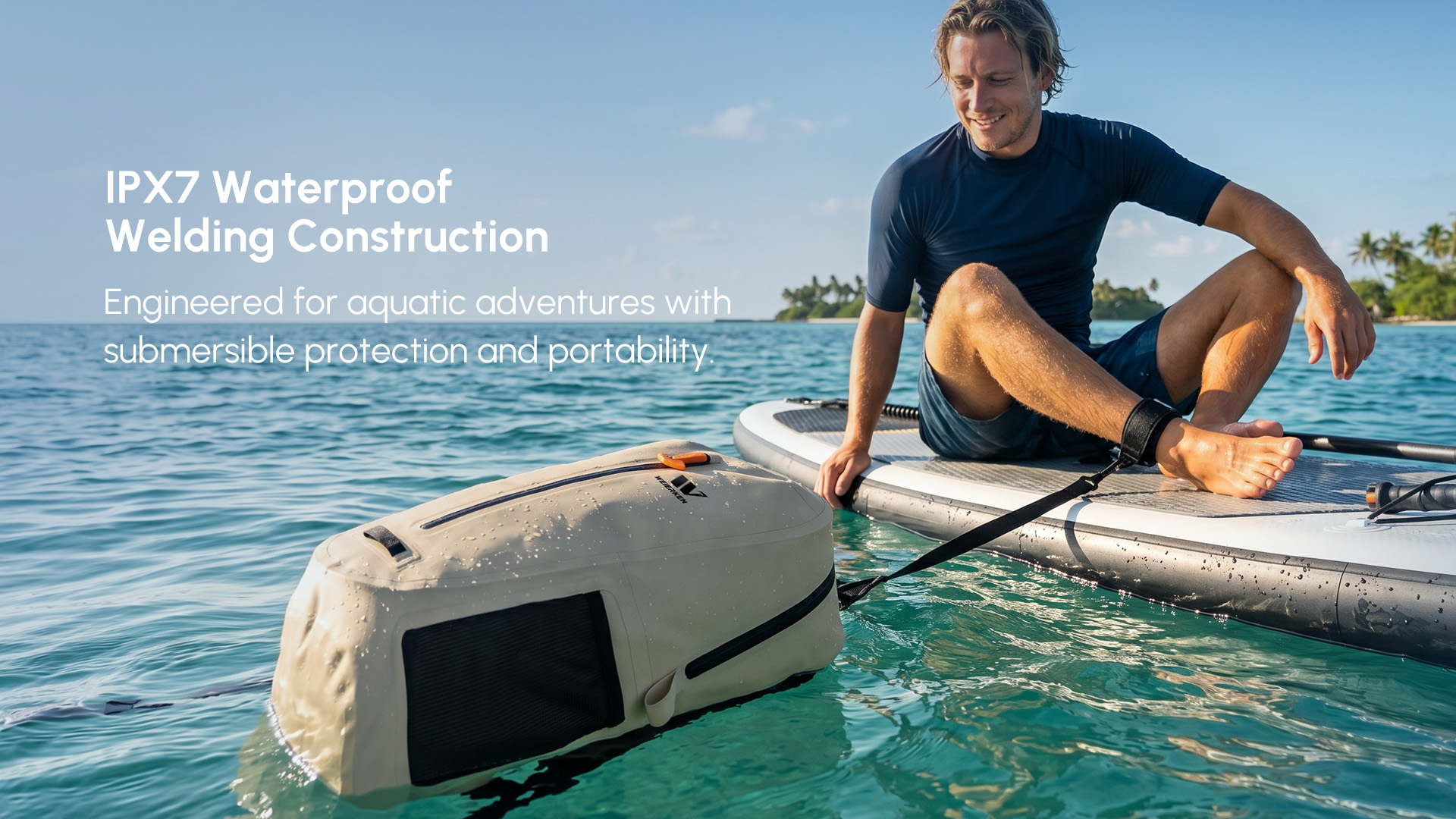
A qualified paddle board accessories OEM manufacturer must build with Radio Frequency (RF) or High-Frequency (HF) welding. This process uses electromagnetic energy and pressure to fuse thermoplastic materials at the molecular level, creating a permanent, watertight joint.
- Weld Seam Verification: Require a minimum weld bead width of 10mm to 12mm on all structural joints to resist bursting when bags are compressed.
- First-Pass Yield (FPY): Demand factory operational data proving an FPY of at least 98.5% on welded assemblies.
- 100% Submersion Pressure Testing: Ask if the factory batch-tests or checks every unit. Reliable factories inflate airtight bags to 1.5–2.0 PSI and submerge them to catch micro-leaks before packing.
- Verified Ingress Ratings: Confirm third-party test reports for IPX6 (heavy wave spray) or IPX7/IPX8 (full water immersion) from accredited labs like SGS, TÜV, or Intertek.
2. Seasonal Peak Capacity and Delivery Certainty
The outdoor equipment industry runs on tight procurement schedules. Western retailers place their main orders between October and January for spring delivery. If a factory mismanages line capacity, your shipment gets stuck behind larger accounts.
Look for a wholesale SUP dry bags partner that operates transparent production tracking and flexible cell manufacturing. Ask how many dedicated RF welding presses they run and how they allocate floor space during peak pre-season months.
Dual-region production networks offer the best protection. Manufacturers with engineering centers in China paired with large-scale factories in Southeast Asia allow you to balance speed, technical complexity, and peak volume requirements.
3. Landed Cost Optimization and Tariff Mitigation
Experienced buyers track total landed cost rather than the initial factory quote. Ocean freight rates, customs clearance, harbor maintenance fees, and import duties quickly turn an apparently cheap bag into an expensive problem.
Tariffs present a major challenge for outdoor retailers across North America and Europe. Sourcing through overseas hubs—such as a modern factory in Cambodia—helps you utilize favorable trade agreements to legally bypass heavy punitive duties.
- Duty Differential: Sourcing through qualifying Southeast Asian facilities can reduce import tariffs by 10% to 25% compared to direct shipments from standard Chinese origins.
- Turnkey DDP Support: Partner with a bulk waterproof deck bag supplier that offers full Delivered Duty Paid (DDP) logistics. They handle customs brokerage, bond filing, and inland drayage directly to your distribution center.
- CBM Optimization: Welded bags can take up excessive container space if folded poorly. Competent suppliers design flat-pack folding routines and export carton sizes that maximize container space, lowering the per-unit freight cost.
4. Retail Compliance and Channel Audits
Placing products in national chains or expanding an independent retail footprint requires rigorous vendor compliance. Specialty retailers and big-box outdoor stores will reject shipments lacking proper social and chemical certifications.
Your manufacturing partner should readily provide clear, current documentation:
- Social Accountability: Verified audits such as BSCI (Business Social Compliance Initiative) or Sedex SMETA to satisfy your corporate responsibility guidelines.
- Chemical Safety: Valid test reports confirming compliance with EU REACH annexes, RoHS, and California Proposition 65 (screening for phthalates, lead, and azo dyes).
- Sustainable Materials: Global Recycled Standard (GRS) certificates for rPET (recycled polyethylene terephthalate) fabrics to back up green marketing claims on your retail packaging.
Designing a Profitable Retail Product Matrix
Carrying a single dry bag style leaves revenue on the table. To capture shoppers at different price points, paddlers need distinct choices across the store floor. Weierken manufactures a complete catalog of bulk waterproof bags for paddle board retailers, enabling you to build a structured three-tier accessory assortment.
Tier 1: High-Volume Bundle Accessories (Entry-Level)
These lightweight, affordable dry tube bags (5L to 20L) are built from 500D PVC or 210D TPU-coated ripstop nylon. Use them as add-on gifts with premium board purchases, or display them near checkout counters for impulse buys. A dependable roll-top buckle with a single D-ring strap keeps the price point low while delivering dependable splashproof performance.
Tier 2: Technical Touring Deck Bags (Mid-Tier Core)
Designed for weekend touring paddlers, these bags feature targeted utility. They mount directly to forward deck bungees using four-point marine-grade swivel clips. Features include an external water-resistant splash pocket, an elastic water bottle sleeve, and side lash tabs for safety whistles or bilge pumps.
Tier 3: Expedition Coolers and Submersible Packs (High-Margin Premium)
Built for serious SUP touring, fishing, and downwind runs, these top-tier bags deliver high dollar margins. They combine seamless dual-sided TPU fabric, closed-cell insulation foam, and completely airtight, toothless zippers. They double as insulated deck coolers that keep beverages cold for hours, giving customers a strong reason to trade up.
Retail-Ready Packaging (RRP) Integration
Labor costs make re-packaging inventory in your stockroom expensive. Your factory should deliver goods configured for instant shelf placement:
- Pre-printed, scannable UPC/EAN barcodes matching your enterprise resource planning (ERP) inventory database.
- FSC-certified cardboard header cards or full-color presentation boxes with clear visual storytelling.
- Standardized master cartons with color-coded SKU labels on two sides for efficient warehouse staging.
- Built-in retail hanging loops or euro-slots for direct pegboard
merchandising.
4-Step Sourcing Roadmap: From RFQ to On-Shelf Inventory
Use this practical checklist to navigate development and production without common supply chain mistakes.
Step 1: Draft a Detailed Request for Quotation (RFQ)
Avoid ambiguous requests like "Quote on 20L dry bag." Professional manufacturers need technical specifics to build accurate pricing:
- Fabric specifications (e.g., 600D Polyester + 0.15mm Double-Sided TPU).
- Weld technology and expected water resistance level (e.g., HF welded, IPX7 immersion certified).
- Estimated Annual Units (EAU) broken into distinct shipment drops.
- Packaging requirements (polybag only vs. printed retail box with barcode sticker).
- Desired Incoterms (FOB Port, CIF, or DDP direct to your door).
Step 2: Prototyping and Destructive Sample Testing
Never approve bulk production based solely on aesthetic appearance. When initial samples arrive from your custom dry bags for outdoor retailers program, run them through destructive physical testing:
- Tensile Pull Test: Pull on shoulder strap anchor points and deck D-rings using a mechanical force gauge. Welds must withstand at least 250N to 350N of tension without tearing.
- Submersion Test: Stuff the sample with dry paper towels, seal the roll-top or zipper, weight it down under 1 meter of water for 60 minutes, and check inside for dampness.
- Cold Crack Test: Leave the bag in a commercial freezer at -15°C for 12 hours, then immediately fold and crease the corners firmly. The exterior coating must not split or crack.
Step 3: Negotiate Balanced Commercial Terms
Protect your cash flow during the pre-season ramp-up. Aim for a standard 30% deposit with the 70% balance payable against the Bill of Lading (B/L) copy after pre-shipment inspection passes.
Include clear commercial accountability: insert a formal clause that establishes penalties for unexcused production delays during the critical spring shipping window, alongside an agreed scrap-credit process for any factory defects found on retail shelves.
Step 4: Factory Audit and Third-Party Pre-Shipment Inspection (PSI)
Before releasing your final balance payment, commission an independent third-party inspection agency (such as QIMA or AsiaInspection) to pull random samples following the ISO 2859-1 (AQL 2.5/4.0) standard.
Inspectors must check barcode scannability, seam alignment, carton burst strength, and overall cosmetic cleanliness. Reliable factories welcome third-party oversight because it eliminates post-shipment disputes.
Frequently Asked Questions (FAQ)
Q1: What is the typical production lead time for bulk waterproof bag
orders?
A1: Initial orders requiring custom tooling or welding dies
typically take 45 to 60 days following sample sign-off. Repeat runs using
existing molds usually ship in 30 to 45 days. To secure spring shelf stock,
submit purchase orders between October and early December.
Q2: How does sourcing through Cambodia help lower landed
costs?
A2: Cambodia benefits from generalized trade programs and
favorable tariff classifications in several western markets. Depending on
destination codes and specific material builds, importing finished bags directly
from Cambodian manufacturing facilities can save 10% to 25% in regular customs
duties compared to other Asian manufacturing hubs.
Q3: What minimum order quantity (MOQ) is typical for retail-ready
customized bags?
A3: Standard factory fabric minimums usually set
the entry point at 500 to 1,000 units per style for standard material color
runs. For custom Pantone-matched textiles, overall mill runs typically require
an order size of 1,500 to 2,000 units.
Q4: Why do roll-top bags leak if submerged, even when the seams are
completely welded?
A4: Roll-top closures rely on mechanical
compression across multiple fabric folds. While they easily shed splashing
water, rain, and surface waves (meeting IPX6 criteria), underwater pressure
compresses the internal air and forces water through the rolling folds. True
submersion resistance (IPX7/IPX8) requires a pressure-rated airtight zipper.
Q5: Can our retail logo be applied using standard silkscreen
printing?
A5: Standard silkscreen ink often chips or flakes off
smooth TPU and PVC after repeated folding and saltwater exposure. Reliable
manufacturers use specialized two-component polyurethane inks or High-Frequency
welded rubber patches to ensure graphics remain intact for the life of the
bag.
Q6: How can retailers avoid moisture and mold damage inside bulk
master cartons during ocean transit?
A6: Ensure your OEM bakes out
residual moisture following submersion testing. Demand container-grade desiccant
strips inside every shipping carton, and specify polybag ventilation
perforations fitted with moisture-barrier liners.
Secure Your Seasonal Inventory with Weierken
Winning in the watersports retail market requires reliable products, prompt delivery, and protected profit margins. Weierken combines advanced high-frequency welding technology with flexible, multi-region manufacturing capabilities to keep your inventory flow steady.
Whether you need entry-level bundle accessories or premium airtight deck coolers, our engineering and sourcing teams are ready to support your business. Contact our retail accounts desk today to review our technical catalog, request product samples, and discuss tariff-reducing supply chain solutions.