
Stand-up paddleboarding has moved past flatwater recreation. Touring paddlers, expedition racers, and SUP anglers now demand gear that survives relentless sun exposure, salt spray, and accidental submersion. For equipment brands, accessories are no longer simple add-ons; they define customer retention and brand equity.
When an aftermarket dry bag leaks, damaging an expensive phone or car key fob, the paddler blames your board brand, not the supplier. Low-cost cut-and-sewn bags backed by taped seams frequently fail under real-world water pressure and sustained UV exposure. At Weierken, we engineer high-performance gear built to withstand harsh marine environments.
To scale your accessory line securely, you must source from an experienced welded waterproof bag OEM that builds to industrial standards. This guide details the manufacturing benchmarks required to build premium private label dry bags for SUP brands that protect your reputation on the water.
The Engineering Baseline: 5 Welded OEM Quality Standards
Waterproof manufacturing is a discipline of mechanical seals, coating chemistry, and thermal fusion. If your product developer evaluates potential partners strictly on FOB price, field returns will erode your margins. Inspect your supply chain against these five production rules.
1. High-Frequency (HF) and Radio Frequency (RF) Molecular Fusion
Traditional outdoor packs rely on stitching, but puncturing performance fabric with a needle creates thousands of points of mechanical failure. Seam tapes glued over needle holes inevitably delaminate when exposed to salt, heat, and roll-top torsion.
True marine-grade manufacturing relies on Radio Frequency (RF) and High-Frequency (HF) welding. The machinery uses electromagnetic energy to excite the polar molecules within polymer coatings, fusing them under pneumatic pressure into a single layer.
- Weld Seam Width: Production dies must deliver a uniform weld width between 10mm and 15mm along perimeter joints to handle hydrostatic expansion.
- Tensile & Tear Resistance: A properly calibrated RF weld creates a joint stronger than the parent textile. In shear-load pull tests, the substrate coating should tear before the weld itself delaminates.
- Thermal Continuity: Unlike hot-air sealing, RF welding heats from the inside out, avoiding thermal scorching on delicate outer coatings while preventing micro-voids along uneven surface intersections.
2. Material Selection: TPU vs. Heavy-Duty PVC
Selecting the right textile determines your bag's weight, flexibility, hand-feel, and retail price point. The two industry standards serve very different market positions.
Thermoplastic Polyurethane (TPU) Laminates:
TPU represents the gold standard for premium touring and expedition paddlers. Typically laminated to high-tenacity 420D to 840D nylon or polyester, TPU provides unmatched performance characteristics.
- Remains supple in cold weather without micro-cracking.
- Features superior resistance to hydrolysis (chemical breakdown caused by prolonged water immersion).
- Resists yellowing under sustained UV rays.
- Biodegrades under specialized soil conditions faster than vinyl, appealing to eco-conscious outdoor demographics.
Heavy-Duty PVC Tarpaulin:
PVC (usually 500D to 840D polyester mesh sandwiched between vinyl layers) remains the commercial backbone for value-driven packages and all-around SUP bundles.
- Delivers exceptional abrasion resistance against rocky shorelines and gravel launches.
- Offers accessible material pricing for high-volume, entry-level board package bundles.
- Requires strict plasticizer stabilization to prevent tackiness or surface cracking after continuous sun exposure.
3. Watertight Ratings and Closure Integration
Every commercial custom branded SUP dry bag should carry a verified Ingress Protection (IP) rating based on its mechanical closure design.
IPX6 Standard (Heavy Wave Splashdown): Built using classical roll-top closures. When folded properly over a stiffened hypalon or polyoxymethylene (POM) strip at least three times, the closure resists high-pressure wave impacts. However, roll-top systems are not designed for deep submersion because interior air compresses under water, allowing leaks.
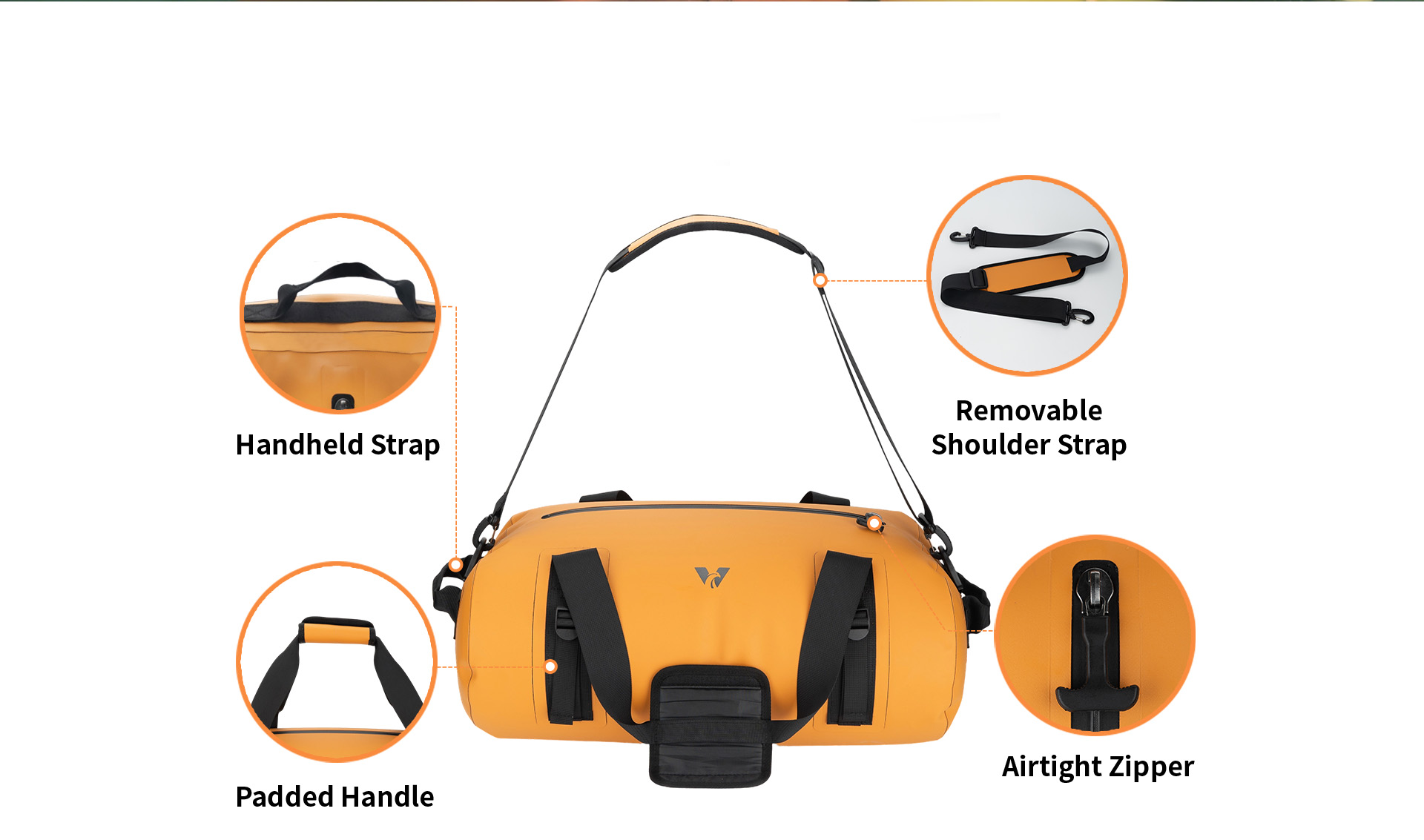
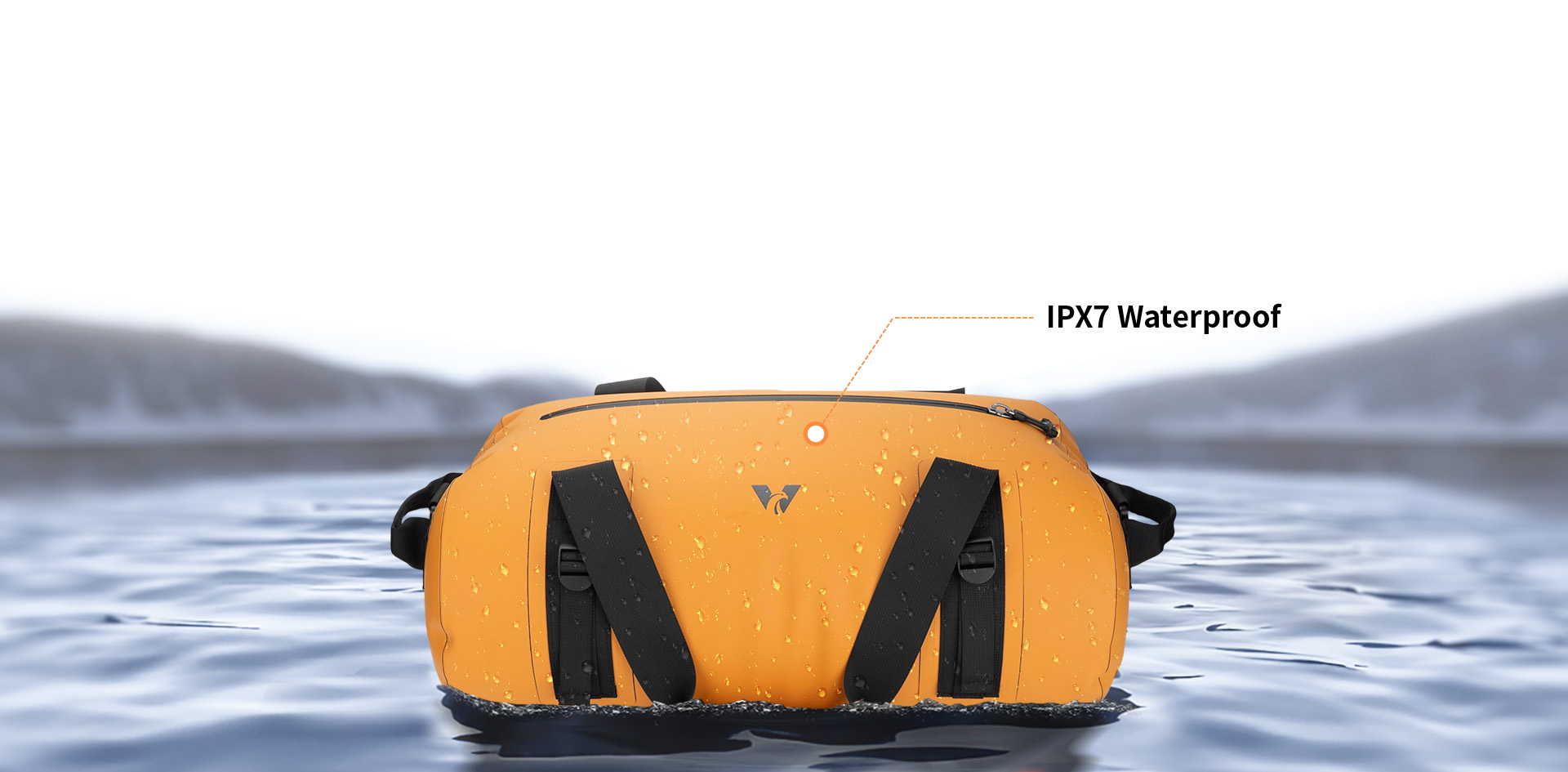
IPX7 and IPX8 Standards (Full Submersion): Required for electronics cases, deck-mounted camera packs, and expedition duffels. Achieving IPX7/IPX8 demands toothless, airtight mechanical zippers welded directly into the bag wall.
- Zippers must be welded with calibrated fixtures to avoid micro-creasing along the TPU film backing.
- The docking end (terminal block) requires dual-shot mold integration to stop fluid infiltration under 1 meter of static water immersion.
4. Dynamic Deck Load Anchors and Reinforcement
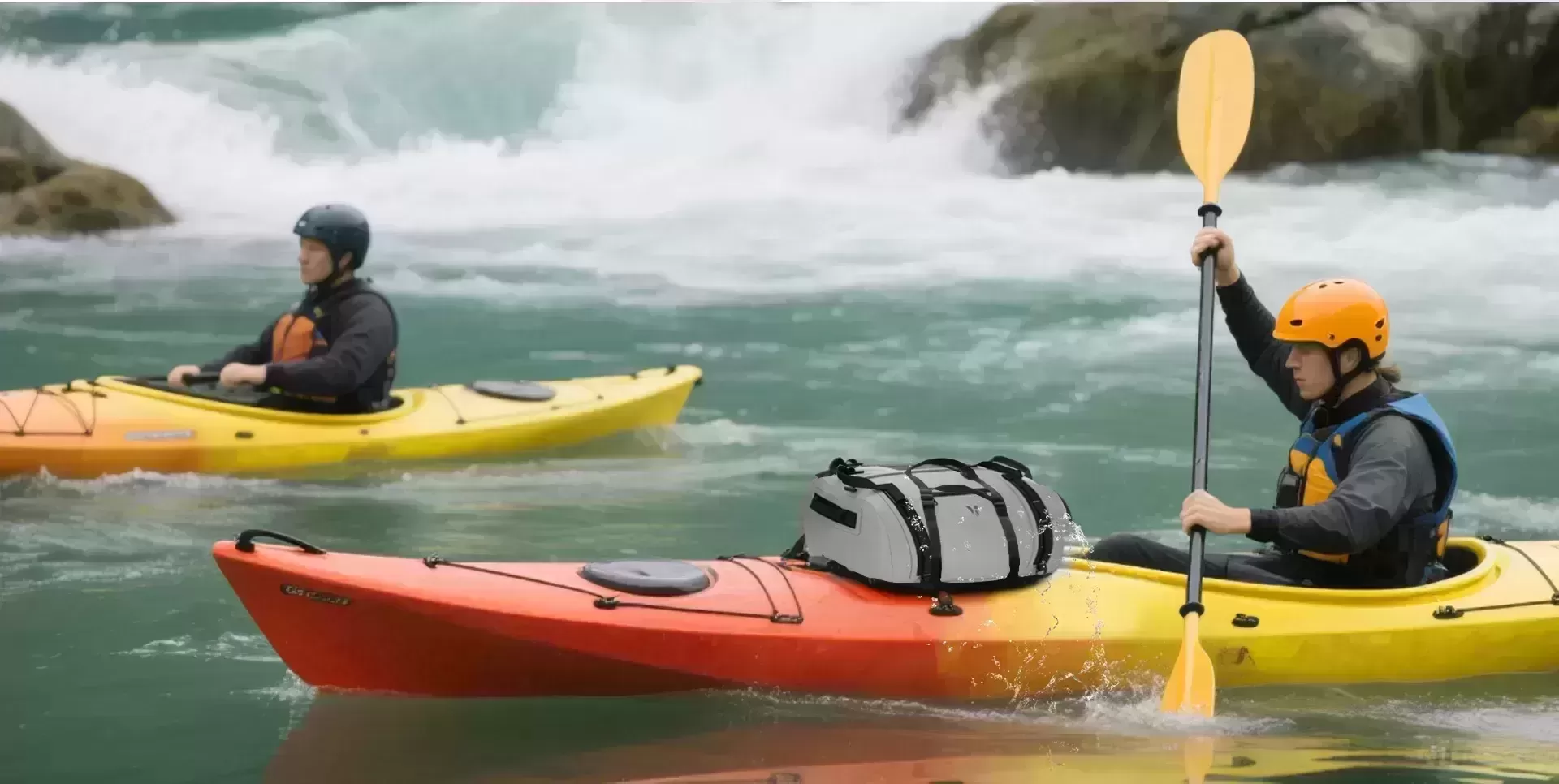
SUP deck dry bags face unique stresses compared to hiking packs. When a paddler wedges a full 20-liter bag under tight bungee cords or clips it to D-rings, sea chop creates continuous shock loads.
Glued D-ring patches fail quickly under these dynamic forces. High-standard OEM production demands RF-welded anchor patches with deliberate engineering details:
- Circular and Teardrop Geometries: Sharp square corners concentrate mechanical stress and trigger peeling. Patches must feature rounded perimeters to distribute tension evenly across the hull of the bag.
- Perimeter Reinforcement Rings: Incorporate double-welded concentric rings around the central nylon webbing slot to prevent the underlying fabric from shearing under load.
- Minimum Peel Values: Marine anchor patches should withstand at least 250N to 400N of direct perpendicular pull-force without edge separation.
5. Factory Quality Control and Stress Matrix
Consistent production requires robust testing protocols. A reliable IPX6 IPX7 waterproof bag supplier should test products systematically through a documented multi-stage quality control matrix.
- Inflation and Tank Immersion Testing: Units with airtight closures are inflated to 1.5–2.0 PSI and submerged in clean water for five minutes. Operators watch for continuous air bubble release to spot seal faults.
- Salt Spray Chamber Testing: Metallic hardware, D-rings, and anodized aluminum buckles endure 48 to 72 hours of neutral salt spray (ASTM B117) to verify corrosion resistance.
- Accelerated UV Weathering: Fabric swatches undergo xenon arc exposure to ensure tensile strength retention and prevent surface chalking after seasonal sun exposure.
High-Performance Customization: Designing Competitive SUP Bags
Private label dry bags for SUP brands must deliver paddle-specific utility. Off-the-shelf tubular dry bags slide off boards and offer poor user ergonomics. Weierken supports customized functional design to help your products stand out on retail shelves and DTC platforms.
Deck-Contoured Profiles
Low-profile, tapered deck packs fit securely under forward deck bungees. Their semi-flat bottom maximizes surface contact with board EVA traction pads, which prevents rolling when your customer negotiates heavy boat wakes.
Welded Translucent and Touch-Screen Pockets
Modern paddlers navigate using GPS tracking apps. High-grade optical TPU films (0.2mm–0.4mm) can be RF welded straight onto bag bodies. These transparent windows let paddlers tap smartphone screens without breaking the watertight barrier.
Insulated Hybrid Decks
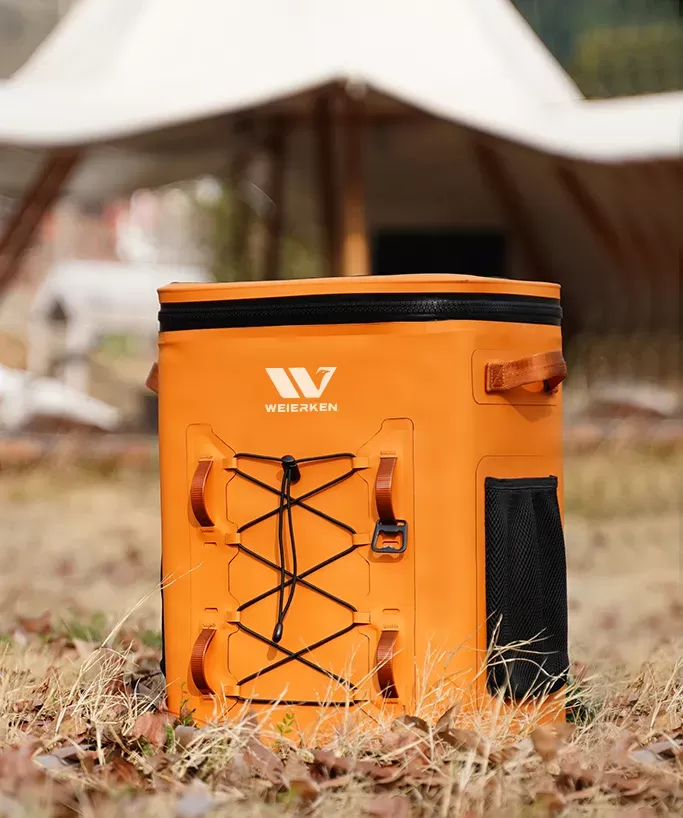
You can broaden your line with hybrid cooler dry bags. These designs fuse a tough outer TPU shell with a middle layer of closed-cell NBR or EVA foam, finished with a food-safe welded inner liner. The combination yields an airtight cooler that doubles as dry gear storage for day-long tours.
Branding Application Techniques
Standard screen prints often peel away from flexible PVC and TPU after repeated folding and saltwater drying. Clean, long-lasting branding requires specialized factory tooling:
- RF Embossed Patches: Welded dimensional rubber badges that integrate seamlessly into the main wall without puncturing the inner membrane.
- Two-Part Polyurethane Inks: Chemical formulations engineered to bond with the outer coating, preventing chipping, cracking, or marine abrasion.
- Welded Reflective Strips: Micro-prismatic safety elements fused into the bag profile to boost visibility during low-light dawn and dusk paddles.
Evaluating a Private Label Manufacturing Partner
Launching a line of premium waterproof bags requires a capable manufacturing partner who can solve design, material, and regulatory challenges. Work through this criteria before committing capital to tooling.
1. Rapid In-House Prototyping
A dependable RF welding dry bag manufacturer will not outsource tooling for initial samples. Look for partners with dedicated sample rooms capable of cutting custom welding dies in 10 to 14 days. This speed cuts down development lag times for new collection releases.
2. Dual-Shore Production Footprint
Geopolitical tariffs and shipping volatility complicate supply chain planning. Sourcing from a private label outdoor waterproof gear manufacturer with balanced production footprints offers strategic advantages:
- China Facilities: Ideal for rapid tooling fabrication, comprehensive material sourcing, and technically demanding airtight products.
- Southeast Asian Facilities (e.g., Cambodia/Vietnam): Offer lower tariffs for North American and European imports, keeping large-run deck bag orders competitive on landed margins.
3. Compliance, ESG, and Verification
Leading outdoor retailers (such as REI, MEC, and Decathlon) screen vendors carefully. Your tier-one suppliers must hold current audits, including BSCI or Sedex social compliance certifications. For brands marketing eco-friendly claims, fabric must come with verified Global Recycled Standard (GRS) documentation to validate recycled polyester (rPET) credentials.
4. End-to-End Logistics Execution
Shipping bulky, welded gear across oceans can drain operating cash if containers run light on weight. Look for manufacturers that optimize packaging carton designs to maximize container cube utilization, and offer transparent Delivered Duty Paid (DDP) shipping terms.
Action Plan: Moving from Concept to Production
Clear documentation speeds up development cycles and prevents costly tooling reworks.
- Prepare a Detailed Tech Pack: Specify fabric weight (e.g., 600D Polyester with 0.1mm double-sided TPU lamination), target IP ratings (IPX6 vs IPX7), precise Pantone color codes, and weld seam dimensions (±1mm tolerance).
- Develop Custom Welding Dies: Work with factory toolmakers to build custom brass or aluminum HF welding dies that shape your proprietary pocket lines and D-ring base geometry.
- Run Pilot Batch Testing: Order a pre-production run of 50 to 100 units. Take them directly onto the water to test bungee tension, cold-water stiffness, and roll-top durability under heavy use.
- Finalize Packaging Architecture: Design recycled paper hangtags and polybags with printed barcodes, prepping goods for smooth check-in at 3PL fulfillment hubs.
Frequently Asked Questions (FAQ)
Q1: What is the typical Minimum Order Quantity (MOQ) for custom
private label dry bags?
A1: Standard MOQs run between 500 and 1,000
units per colorway for existing material lots. If your designs require custom
Pantone-dyed fabrics or specialized TPU formulas, fabric mill minimums generally
push overall project MOQs to 1,500–2,000 units.
Q2: Why is RF welding preferred over ultrasonic welding for marine
dry bags?
A2: Ultrasonic welding relies on mechanical friction
vibrations, making it suitable for thin non-wovens or delicate plastics.
Heavy-duty marine tarpaulins (500D+) need RF welding's electromagnetic
penetration, which melts thick polymer coatings right through to the core scrim
for deeper, leak-free bonds.
Q3: How do we choose between an IPX6 and an IPX7 rating for our
collection?
A3: Review your customer's use case and your target
price point. An IPX6 roll-top design handles splashes, rain, and quick surface
drops at a moderate cost. Choose IPX7 or IPX8 with an airtight zipper for
high-end gear where electronics or keys need total protection from extended
submersion.
Q4: How long does the sample development cycle take for an original
design?
A4: Developing a ground-up design with custom welding dies
typically takes 14 to 25 business days. Minor modifications to existing factory
molds can cut sample delivery times to 7–10 days.
Q5: Can private label dry bags be made using certified recycled
materials?
A5: Yes. High-grade recycled PET (rPET) yarns derived
from post-consumer plastic bottles can be coated with TPU or PVC. These textiles
carry Global Recycled Standard (GRS) transaction certificates to verify
sustainable marketing claims.
Q6: How do we prevent mold and mildew inside dry bags during sea
freight transit?
A6: Ensure your factory dries products thoroughly
after water immersion QC testing. Packaging should include natural clay
desiccant packs, and finished cartons should be wrapped in moisture-barrier
master bags inside the ocean container.
Build Your Brand with Weierken
Investing in reliable, high-frequency welded equipment protects your brand reputation out on the water. Weierken pairs high-level waterproof engineering with dual-facility manufacturing, helping you navigate dynamic tariffs and grow your private label margins.
Ready to upgrade your collection? Contact our engineering team today to review your tech pack, request a material swatch kit, or get a production quotation.