
An Engineering and Sourcing Guide for Dessert Brands, Bakeries, and Cold-Chain Logistics Providers
Dessert logistics presents a far greater challenge than standard hot food transport. Pastry is fragile culinary art. A temperature rise of merely 2°C softens buttercream, destabilizes dairy mousses, and causes structural shear in tiered cakes. At the same time, unmanaged relative humidity ruins the shell of a French macaron and creates surface condensation on delicate fondant work.
Stock cooler bags bought from distributors cannot handle these specific thermodynamic curves. They use cheap fillers, tear under heavy loads, and bleed cold air through standard stitched seams. To preserve complex pastries across variable delivery windows, brand procurement managers require an engineering partner. Working directly with an experienced insulated dessert delivery bag OEM like Weierken allows companies to deploy mobile, micro-climate cold-chain carriers built to exact operational tolerances.
The Physics of Dessert Transit: Why Off-the-Shelf Bags Fail
Most commercial food delivery bags rely on basic polyurethane sponge or low-density polyethylene foam. These materials compress easily during transport. Once compressed, their thermal barrier thins out, drastically reducing their insulating capacity.
High-end patisserie delivery faces four primary thermodynamic failure points:
Rapid Conduction: Heat transfers quickly through unreinforced bag walls, especially when bags rest against warm vehicle floors or courier backs.
Radiant Heat Penetration: Direct sunlight warming the exterior shell transfers radiant heat straight into the interior chamber if no reflective thermal barrier is present.
Convective Infiltration: Non-gasketed zippers and needle-stitched seams let dense cold air escape while pulling in warm, humid ambient air.
Dew Point Condensation: Temperature differentials between the interior cold source and exterior air cause water droplets to form. This moisture softens paper pastry boxes and ruins sugar decorations.
A qualified insulated dessert delivery bag OEM designs around these failure modes. OEM manufacturers do not merely stitch fabric; they select specific materials and assemble composite layers to maintain an unbroken 4°C to 8°C cold chain.
Material Science: Engineering the Composite Thermal Wall
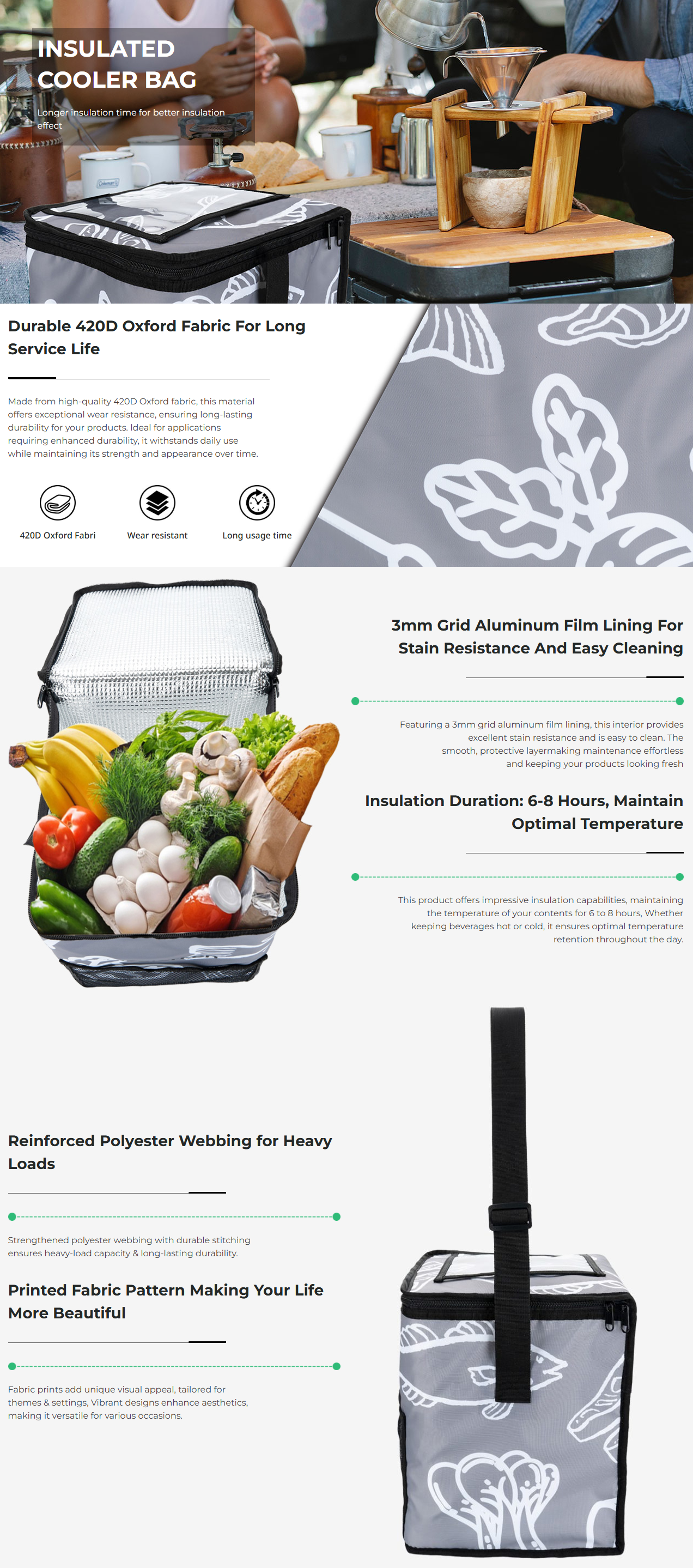
A high-performance custom cold-chain pastry carrier relies on a multi-layer composite system. Each layer performs a specific mechanical or thermodynamic function.
Outer Shell: Abrasion Resistance and Weatherproofing
The exterior material must withstand daily urban delivery while protecting internal insulation from rain and dirt:
600D to 1680D Oxford Polyester: Heavy-denier woven fabrics offer high tear strength. Backed with an internal polyurethane (PU) or thermoplastic polyurethane (TPU) coating, they stop water penetration completely.
Recycled PET (RPET): Sourced from post-consumer plastic bottles, RPET matches the tensile strength of standard 600D polyester while helping corporate clients hit environmental sustainability targets.
Tarpaulin (PVC/TPU Composite): For maximum durability, smooth tarpaulin provides a completely waterproof, scratch-resistant surface that couriers can wipe clean in seconds.
Insulation Core: Density, K-Value, and Holding Times
The core layer dictates thermal performance. An experienced thermal insulation dessert bag manufacturer measures core materials by thermal conductivity (K-value, measured in W/m·K):
Expanded Polyethylene (EPE Pearl Cotton): A closed-cell, non-crosslinked foam with a K-value of approximately 0.038 W/m·K. While cost-effective, standard EPE loses thickness under prolonged weight. Ideal for short delivery routes under 45 minutes.
Cross-Linked Polyethylene (XPE Foam): Features a micro-cellular, chemically crosslinked matrix with a lower K-value (around 0.033 W/m·K). XPE resists mechanical compression, flexes without cracking, and delivers superior insulation at half the thickness of standard EPE.
High-Density EVA Foam: Offers exceptional structural stiffness and impact absorption. OEM engineers often blend EVA with XPE on side and bottom panels to guard tall, tiered cakes against road vibrations.
For standard 30-minute routes, a 5mm EPE core is generally adequate. For 2-to-4-hour city-wide transit windows, OEM design briefs require an 8mm to 10mm high-density XPE core system.
Radiant Barrier: Aluminum Foil vs. Metallized Film
The reflective radiant barrier points directly back into the bag cavity to reflect thermal energy:
Solid Aluminum Foil Laminate: Reflects up to 97% of radiant heat. When backed with a reinforcing scrim mesh, it resists punctures and delivers true cold-chain stability.
Metallized Polyester (VMPET): A thin plastic sheet vapor-coated with aluminum. While flexible and inexpensive, it reflects only 80% to 85% of radiant heat and wears out quickly with daily use.
Data shows that over a 3-hour transit test at 32°C ambient temperature, solid aluminum foil keeps internal air 3.2°C cooler than VMPET film when paired with identical 8mm foam cores.
Food-Contact Inner Liner: Sanitary and Leakproof Performance
Traditional cooler bags use sewn inner liners. However, needle holes let melted ice and spills leak into the foam, breeding bacteria and causing foul odors. A professional ultrasonic welded cooler bag OEM replaces needle sewing with advanced RF (radio frequency) or ultrasonic thermal welding.
Food-Grade PEVA: Polyethylene vinyl acetate provides a non-chlorinated, odor-free lining that resists low-temperature cracking down to -20°C. Welded seams create an entirely watertight internal tub.
TPU Film: Offers higher puncture resistance, elasticity, and grease resistance than PEVA. While costlier, TPU suits industrial-grade pastry bags that undergo daily cleaning with aggressive sanitizers.
Structural Mechanical Design and Quality Control
Preventing physical cake collapse requires rigid structural support. If the base of a delivery bag bends, the internal cake board bends with it, fracturing the pastry's surface.
Zero-Tilt Base Engineering
An OEM manufacturer reinforces the bottom of a leakproof insulated cake delivery bag to keep heavy, 10-pound celebration cakes level:
Fluted Polypropylene (PP) Hollow Sheets: Lightweight, waterproof, and chemically inert. They offer good rigidity, though they can flex under extreme localized loads.
Solid High-Density Polyethylene (HDPE) Plates: Rigid, shatterproof panels that stay completely flat under heavy, multi-tier cake boxes.
Removable Base Inserts: Wrapping the rigid base insert in welded PEVA allows couriers to take it out, wash it, and sanitize it separately.
Airtightness: The Importance of Sealed Closures
Dense cold air falls and slips through standard coil zippers. Commercial delivery packaging relies on performance closure systems:
PU-Coated Waterproof Zippers: Rubberized zipper tracks block air passage and keep exterior rain from soaking through the teeth.
Insulated Internal Storm Flaps: Foam-filled baffles line the inside of the zipper path. When closed, these flaps compress against each other to seal off thermal air leaks.
Magnetic Compression Seals: Used on quick-access delivery bags, strong neodymium magnets embedded in the rim provide an automatic, airtight seal without wearing down like hook-and-loop fasteners.
Load Testing and Seam Reliability
A failed handle out on the road means a destroyed cake. Reliable factories like Weierken run severe mechanical stress tests on every production batch:
Box-X Reinforced Stitching: Webbing handles extend completely under the base of the bag, distributing load across the entire chassis rather than pulling at the top seams.
Tensile Load Testing: Bags must support at least three times their rated capacity (e.g., holding 30 kg on a 10 kg rated bag) on a vertical pull-test rig for 4 hours without seam separation.
Cycle Testing: Zippers and closures undergo automated open-and-close endurance testing for a minimum of 5,000 cycles.
SLA Matching: Tailoring Bags to Operational Windows
One bag design does not fit all business models. An enterprise insulated dessert delivery bag OEM tailors specs to the client's actual logistics model:
| Logistics Model | Target Window | Recommended Foam Core | Inner Liner & Sealing | Reinforcement Priority |
|---|---|---|---|---|
| On-Demand Point-to-Point (Bike/Scooter) | 30 – 45 Minutes | 5mm EPE Pearl Cotton | 0.15mm PEVA, Heat-Welded | Padded shoulder straps, anti-sway bike anchor points |
| Hub-and-Spoke Regional (Van Fleet) | 2 – 4 Hours | 8mm – 10mm High-Density XPE | 0.25mm PEVA + Pure Foil, Welded | Solid HDPE baseboard, side-impact panels |
| Intercity Cold-Chain (Logistics Network) | 6+ Hours | 15mm Composite EVA + Vacuum Panel | Heavy-Duty TPU, Fully Hermetic | Dual ice pack partition slots, drop-tested chassis |
Global Food Contact Compliance and Social Audits
Procurement teams sourcing from an OEM factory must manage liability. Components used in commercial food delivery bags must comply with target-market safety regulations.
FDA 21 CFR 177.1520: Confirms that polymer surfaces intended for food contact are safe and non-toxic.
LFGB Testing (Germany/EU): Verifies that no sensory compounds, plasticizers, or heavy metals migrate from the lining to the cake, even in high-humidity conditions.
Phthalate and Heavy Metal Limits (REACH & RoHS): Confirms PVC coatings and zipper pulls are free of harmful phthalate plasticizers (such as DEHP and DBP).
Factory Audits: Trusted OEM factories maintain ISO9001 quality management, along with Sedex SMETA or BSCI social compliance certifications to guarantee transparent, ethical labor practices.
Working Directly with an OEM Factory
Standard distributors offer convenience, but they provide zero control over dimensions, thermal profiles, or mechanical build quality. When working with an experienced bulk commercial delivery bag factory, procurement teams gain deep control over product performance.
An engineering-led insulated dessert delivery bag OEM like Weierken helps you move from generic packaging to a custom, dependable delivery asset. You reduce damage claims, improve transit times, and turn your packaging into a high-visibility marketing asset across every city you serve.
Frequently Asked Questions
Q1: What is the main performance difference between EPE and XPE insulation in dessert bags?
A1: EPE (expanded polyethylene) is a low-cost, open-density foam suitable for short transit times under 45 minutes. XPE (cross-linked polyethylene) is a denser, closed-cell foam with a superior K-value (0.033 W/m·K). XPE resists mechanical compression, holds its shape under heavy loads, and keeps interiors cold for 4 to 6 hours when properly configured.
Q2: Why is ultrasonic heat sealing better than industrial sewing for inner linings?
A2: Industrial sewing needles puncture thousands of small holes through the lining fabric. Melted condensation and liquid spills seep through these holes, soaking the internal foam. This ruins the bag's insulation and breeds bacteria. Ultrasonic heat sealing melts the polymer sheets together, creating a seamless, 100% leakproof, and easy-to-clean internal chamber.
Q3: How do you prevent condensation from ruining delicate pastry crusts and fondant?
A3: OEM engineers manage condensation using three methods: adding internal breathable micro-mesh pockets to hold food-safe desiccant packs, inserting physical thermal dividers that keep frozen gel packs from directly touching pastry boxes, and calculating insulation thickness to prevent the internal air from dropping below the dew point.
Q4: What certifications are mandatory for food-grade commercial dessert delivery bags?
A4: Inner linings that sit next to food packaging should pass FDA 21 CFR standards in the United States or LFGB tests across the European Union. Furthermore, the base fabrics and hardware must comply with REACH and RoHS standards, confirming they are free of lead, cadmium, and toxic phthalate plasticizers.
Q5: How does precise dimensional tolerance prevent structural cake damage?
A5: When a box sits inside an oversized bag, dead air space speeds up convective heat transfer, and the box slides around whenever the vehicle turns. Designing an OEM bag to your exact box footprint (with 5mm to 8mm of clearance) stabilizes the cake, stops sliding, and minimizes empty air volume to maximize thermal efficiency.
Engineer Your Brand's Cold-Chain Solution
Stop settling for off-the-shelf packaging that puts your delicate pastry deliveries at risk. Contact our technical team today to receive the OEM Commercial Dessert Bag Specification Checklist, request custom CAD design drawings, or get a factory-direct tiered quotation for your business.