In the marine industry, the term “waterproof” is often tossed around loosely. For a retailer, it might mean a bag that survives a light drizzle. For a kayaker, it means a bag that keeps a camera dry after capsizing in rapids. As a professional boating bag distributor, bridging this gap in understanding is crucial.
Misaligned expectations lead to returns, damaged equipment, and dissatisfied clients. If you sell an IPX4 bag to a whitewater rafter, you are selling a failure. Conversely, pushing an expensive IPX8 duffel to a casual weekender might kill the sale due to price.
At weierken, we have seen that the most successful distributors don’t just move inventory. They act as technical consultants. They match the specific engineering of a bag to the exact behavior of the end-user. This guide breaks down how to align IPX ratings with market segments to build trust and increase sales volume.
1. Understanding the Core Meaning of IPX Ratings
The IPX rating system is not a sliding scale of quality; it is a scale of protection against water ingress under specific conditions. Many buyers assume a higher number is always “better,” but it is often just “different” based on the intended use.
As a boating bag distributor, you need to strip away the marketing fluff and explain the physics to your buyers.
IPX4: Splash Resistance
This rating represents protection against splashing water from any direction.
- The Reality: Think of a sudden rain shower or the spray coming off the bow of a pontoon boat.
- The Limit: It cannot handle a pressurized jet of water (like a hose) and it certainly cannot survive being dropped into the lake. If water sits on the zipper for too long, it will seep through.
IPX7: Temporary Submersion
This is the most misunderstood rating. IPX7 guarantees the bag can withstand accidental submersion in up to 1 meter of water for 30 minutes.
- The Reality: This is the “oops” rating. If a paddleboarder drops their bag and retrieves it immediately, the contents remain dry.
- The Limit: It is not designed for deep diving or staying underwater for hours. The pressure at 1 meter is relatively low, but once you go deeper or longer, the seals may fail.
IPX8: Continuous Submersion
This indicates the bag is hermetically sealed. It can withstand water pressure at depths greater than 1 meter (specified by the manufacturer) for extended periods.
- The Reality: These bags are for serious conditions where the gear might be underwater for the duration of the trip or subjected to extreme hydraulic force.
- The Limit: These bags are often more expensive and might have stiffer zippers or more complex closure systems that sacrifice quick access for security.
2. Key Market Segments and Matching IPX Needs
Your catalog likely covers a wide range of boaters. Segmenting your inventory by activity rather than just size or color helps your retail partners sell the right product.
Leisure Day Sailing and Deck Bags
The Scenario:
Consider the family taking a pontoon out for a Saturday or a couple on a day-sail. They need to store towels, snacks, sunscreen, and maybe a Bluetooth speaker. The bag sits on the deck or a seat.
Recommended Rating: IPX4 – IPX6
For this demographic, protection against rain and spray is sufficient.
- Focus: Ease of use is paramount. They want standard zippers (water-resistant) rather than difficult roll-tops.
- Material: UV resistance is more critical here than deep-water capability, as these bags sit in the sun all day.
- Common Pitfall: Do not push IPX7 or IPX8 bags here. The higher cost and harder-to-open seals will frustrate a casual user who just wants to grab a sandwich.
Fishing Gear Bags
The Scenario:
Anglers deal with a messy environment. Their gear faces saltwater spray, fish blood, slime, and constant friction against the boat’s non-slip flooring.
Recommended Rating: IPX6 – IPX7
Fishermen often hose down their gear at the end of the day. An IPX6 rating ensures the bag can handle a high-pressure water jet during cleaning without soaking the tackle inside.
- Durability: The outer shell needs to be wipeable and resistant to hook punctures.
- Design: Interior organization is key. A simple dry sack doesn’t work; they need compartments.
- Distributor Tip: Highlight the zippers. Molded tooth zippers that resist salt corrosion are a major selling point over standard coil zippers which jam after a season of saltwater exposure.
Kayak, Canoe, and Paddleboard (SUP) Dry Bags
The Scenario:
Here, the risk of capsizing is real. The bag isn’t just sitting on a boat; it is often strapped to a deck that is awash with waves. If the vessel flips, the bag goes under.
Recommended Rating: IPX7 – IPX8
This is a safety-critical category. If a kayaker’s dry clothes or emergency radio gets wet, it becomes a survival issue.
- Closure: Roll-top closures are standard here because they are simple and effective.
- Buoyancy: A smart boating bag distributor will look for bags that trap air. Being waterproof is useless if the bag sinks to the bottom of the river.
- Visibility: Recommend bright colors (orange, yellow) so the bag can be spotted if it floats away.
Professional Sailing and Expedition Packs
The Scenario:
Blue-water cruisers and expedition teams face the harshest conditions. They might be at sea for weeks. Gear is lashed to the rail, taking the full force of breaking waves (green water) repeatedly.
Recommended Rating: IPX8
The dynamic pressure of a wave hitting a bag is much higher than static water pressure.
- Construction: Heavy-duty materials like 500D or 840D TPU are required.
- Sealing: Ordinary stitching is unacceptable. You need Radio Frequency (RF) welded seams.
- Longevity: The bag must resist salt crystals, which act like sandpaper in the folds of the fabric.
3. Beyond IPX: Factors Affecting Real-World Waterproof Performance
An IPX rating is a snapshot of a brand-new bag in a controlled lab. As a boating bag distributor, you know that the ocean is not a laboratory. To truly serve your clients, you must educate them on the construction elements that sustain that rating over time.
Sealing System Technology
The method used to join the fabric panels dictates the bag’s lifespan.
- Stitched and Taped: This is common in cheaper rain gear. A needle punches holes in the fabric, and a tape is ironed over it. Over time, friction peels the tape back, and the bag leaks.
- High-Frequency (HF) Welding: This is the gold standard we use at weierken. Electromagnetic waves melt the TPU or PVC coating, fusing two pieces of fabric into a single molecular bond. There are no stitch holes to leak. An HF welded bag will maintain its IPX rating years longer than a stitched one.
Material Durability and Coating
A bag is only as waterproof as its weakest point. If the fabric delaminates, the water barrier is gone.
- PVC vs. TPU: PVC is cheaper and robust but can crack in freezing temperatures. TPU (Thermoplastic Polyurethane) is lighter, more flexible, more eco-friendly, and handles extreme cold better without cracking.
- Abrasion Resistance: A high IPX rating means nothing if the bag gets a hole from dragging it across a concrete dock. Look for denier counts (e.g., 500D, 1000D) that match the roughness of the intended activity.
Design Features for Reliability
Small details can compromise the waterproof integrity.
- Drainage: External pockets should have mesh bottoms or drain grommets so they don’t hold water against the main seal.
- Strain Relief: The points where shoulder straps attach to the bag endure high stress. If these points aren’t reinforced with extra patches, the welding can tear, creating a leak directly into the main compartment.
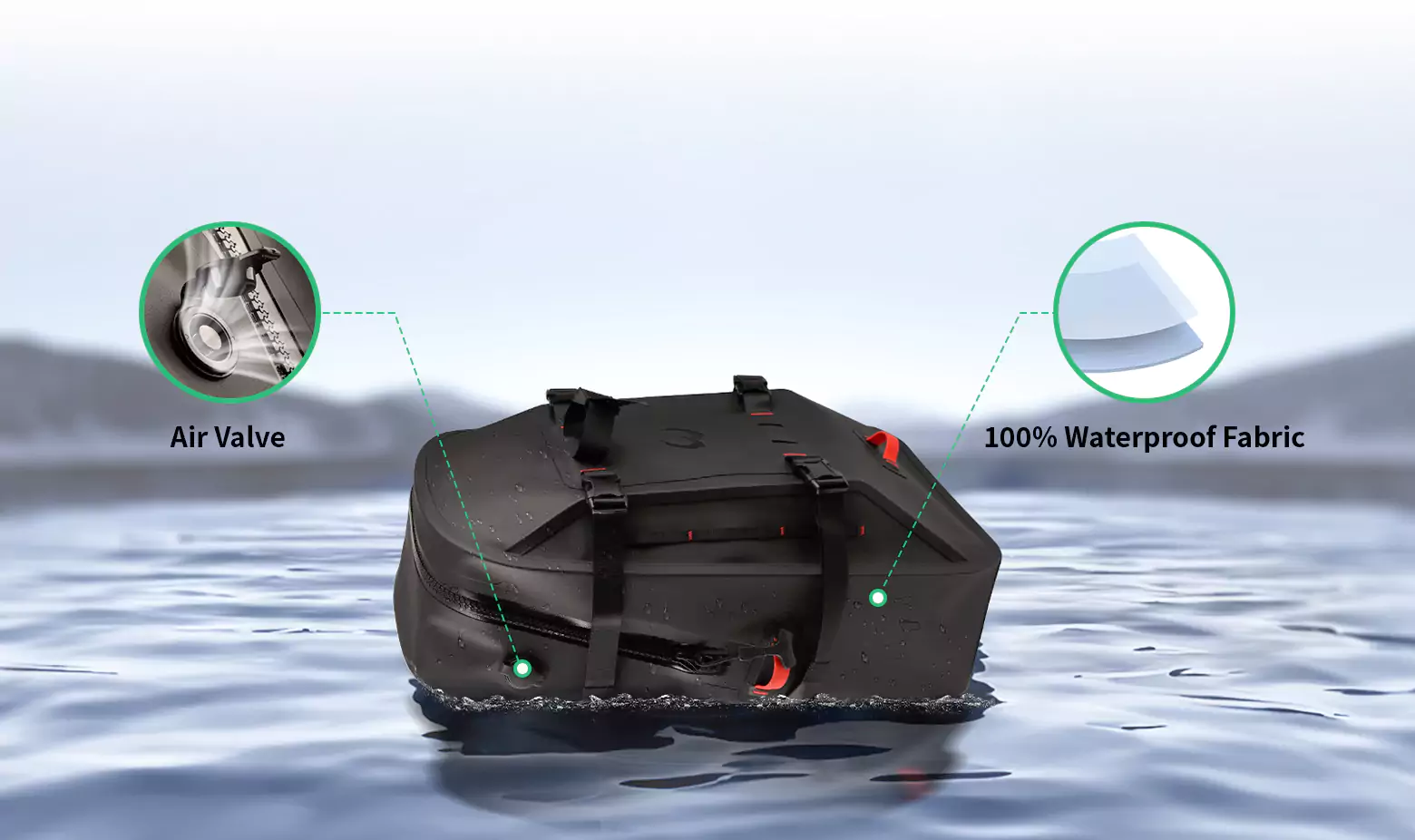
- Valve Systems: For large IPX7/8 bags, an air purge valve is essential to compress the bag. However, cheap valves are a common leak point. Ensure the valves are high-quality and double-sealed.

4. Distributor Action Guide: Diagnostic Questions for Precise Matching
Your sales team interacts with retail buyers, procurement officers, and corporate clients. To position yourself as a premium boating bag distributor, equip your team with a diagnostic script.
Instead of asking, “What size bag do you need?”, ask these functional questions to narrow down the perfect IPX match.
1. “Where will this bag primarily live on the boat?”
- Inside the cabin? -> IPX4 is sufficient.
- On an open deck? -> IPX6 is required to handle spray and rain.
- Lashed to a swim platform or kayak deck? -> IPX7 or IPX8 is necessary due to submersion risk.
2. “What kind of water exposure are we talking about?”
- Rain and spray? -> Roll-tops or standard water-resistant zippers.
- Direct hose-down for cleaning? -> Needs heat-welded seams and heavy coating (IPX6).
- Total immersion (flipping over)? -> Needs a fully submersible seal (IPX7+).
3. “What contents are being protected?”
- Towels and T-shirts? -> If these get damp, it’s an annoyance. Lower budget, lower IPX is fine.
- Smartphones, cameras, or flares? -> If these get wet, it’s expensive or dangerous. High reliability (IPX7/8) is mandatory regardless of the boat type.
- Fish or bait? -> The priority here is keeping the mess inside the bag and easy cleaning, rather than just keeping water out.
4. “Is the priority maximum protection or ease of access?”
- Fast Access: A magnetic or zipper closure (often IPX6) is better for users who grab gear frequently.
- Max Protection: A roll-top secured with side clips takes time to open but offers better security. Managing this trade-off is key to customer satisfaction.
The market for marine gear is becoming increasingly sophisticated. Buyers are no longer satisfied with a generic “waterproof” label; they want specific performance data that aligns with their lifestyle.
For a boating bag distributor, success lies in education. By clearly articulating the difference between an IPX4 splash-proof tote and an IPX8 expedition duffel, you protect your reputation and your clients’ gear. You move from being a commodity seller to a safety partner.
At weierken, we specialize in manufacturing bags that meet these precise standards, utilizing advanced HF welding and rigorous testing to ensure our IPX ratings hold up in the real world. Whether your market demands rugged fishing packs or sleek yachting gear, we provide the technical foundation you need to sell with confidence.
Are you ready to upgrade your inventory with marine bags that actually perform as promised?
[Inquire with weierken today] to discuss your market needs and request our latest catalog of certified waterproof gear.
FAQ: Common Questions for Boating Bag Distributors
Q1: What is the main difference between “water-resistant” and “waterproof” in the boating industry?
A1: “Water-resistant” typically corresponds to lower ratings like IPX4, meaning the bag sheds water but will leak if submerged or subjected to heavy pressure. “Waterproof” usually implies IPX7 or higher, indicating the bag can be submerged without leaking. As a boating bag distributor, it is vital to ensure your marketing materials make this distinction clear to avoid customer claims.
Q2: Can I sell IPX7 bags for scuba diving?
A2: Generally, no. IPX7 is tested at a depth of 1 meter for 30 minutes. Scuba diving involves much greater depths and pressures. For diving, you need specialized IPX8 gear tested to specific depths (e.g., 30 meters or more). Selling a standard boating dry bag for diving is a liability risk.
Q3: Why do some IPX6 bags cost more than IPX7 bags?
A3: The rating is only one cost factor. An IPX6 bag might use expensive, abrasion-resistant Cordura fabric, high-end waterproof zippers (like YKK Aquaguard), and complex ergonomic straps for hiking. An IPX7 bag might be a simple PVC tube. The quality of materials often drives price more than the waterproof rating alone.
Q4: How do I verify the IPX ratings of the bags I import?
A4: You should request test reports from your manufacturer. Reputable factories conduct air-pressure testing on the production line and batch testing in water tanks. At weierken, we provide documentation on our testing protocols to give our distributors confidence in the specs they are selling.
Q5: How does saltwater affect the lifespan of a waterproof bag compared to freshwater?
A5: Saltwater is corrosive. It can seize metal zipper sliders and degrade certain fabric coatings over time. For marine markets, you should ensure the bags feature non-corrosive plastic hardware and RF-welded seams (which have no thread to rot). A bag that lasts five years in a lake might only last two years at sea if not rinsed regularly.