

Offshore sailors face brutal conditions. Breaking waves slam across cockpits, abrasive non-skid decks wear down gear, and salt air corrodes basic hardware within days. For marine apparel and equipment brands, a simple water-resistant gym bag will not suffice. Modern sailors demand complete immersion protection, rugged load ratings, and long-term durability.
Transitioning from standard cut-and-sew bags to technical dry luggage exposes significant manufacturing hurdles. High-capacity holdalls hold heavy loads while keeping out high-pressure spray. Standard factories often struggle with these engineering demands, leading to seam failures, leaking zippers, and costly warranty claims. At Weierken, we help marine brands bridge this gap by turning complex technical concepts into battle-tested production runs.
This guide covers the technical realities of sourcing and building a specialized waterproof sailing duffel OEM product line from the ground up.
1. The Engineering Complexities: Why Sailing Duffels Demand Specialized OEM Expertise
Building a high-capacity waterproof duffel is vastly different from producing a 10-liter dry bag. As volume expands from 40 to 100 liters, structural forces multiply quickly. Sourcing managers must evaluate how a contract factory handles real mechanical loads.
- Volume and Internal Hydrostatic Pressure: When packed with 25 kilograms of gear and tossed onto a pontoon, a large duffel experiences intense internal air pressure. If seams lack sufficient shear strength, they burst from within.
- Dynamic Water Pressure vs. Static Moisture: Rain creates minimal surface tension, but green water crashing over a bow strikes gear with severe dynamic force. Duffels require true airtight closures rather than water-repellent flaps.
- Marine Ergonomics and Cockpit Layout: Sailing bags must adapt to cramped berths and wet companionways. Designs need flush-mounted daisy chains, hideaway shoulder straps that prevent line snags, and non-slip bottom panels.
Partnering with a focused marine waterproof duffel manufacturer ensures that load transfer points, welded edges, and bag geometry withstand real offshore conditions.
2. Critical Material & Component Choices in Waterproof Sailing Duffel OEM
Material selection defines production costs, weight targets, and functional lifespan. Marine equipment cannot tolerate budget trade-offs that fail after one season on the water.
Fabric Matrix: TPU vs. Heavy-Duty PVC Tarpaulin
PVC tarpaulin (typically 500D to 1000D) remains a workhorse for industrial bags. It welds easily, blocks water completely, and keeps production costs low. However, PVC stiffens in cold weather, carries extra weight, and faces regulatory headwinds in eco-conscious markets.
High-end sailing labels now favor dual-sided Thermoplastic Polyurethane (TPU) laminated onto high-tenacity nylon or polyester bases (often 420D to 840D). TPU provides distinct technical advantages:
- Superior abrasion resistance against aggressive marine grip surfaces.
- Flexibility that survives sub-zero offshore passages without cracking.
- High tear strength at a significantly lower total weight.
- Resistance to UV degradation, diesel fuel, and saltwater hydrolysis.
Zipper Systems: Submersible Airtight vs. Splashproof PU
The zipper defines both your product's waterproof rating and its bill of materials (BOM). Brands must choose the right zipper for their target use case:
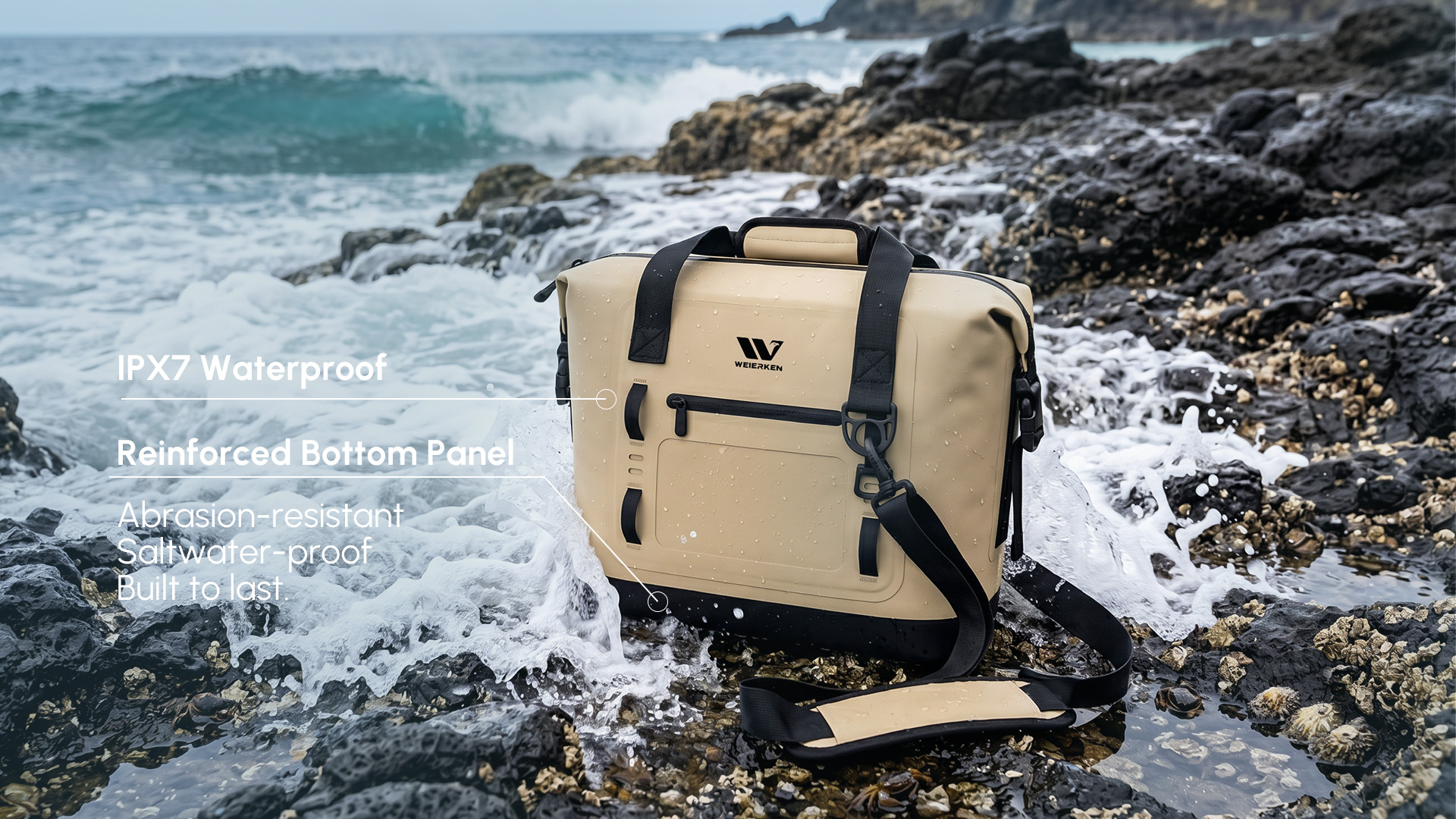
- Airtight/Submersible Zippers (IPX7 to IPX8): These feature interlocking rubber teeth or pressure-sealed polyurethane lips. They prevent water ingress even when fully submerged. They are mandatory for expedition-grade offshore bags, though they demand higher unit costs and precise installation.
- Water-Repellent / PU Coated Zippers: These manage spray and light rain effectively. They operate smoothly and cost less, making them suitable for casual coastal cruising or transition duffels. However, they will leak if submerged or subjected to standing cockpit puddles.
Marine-Grade Hardware and Trims
Salt spray destroys low-grade alloys in days. Your BOM should specify non-corrosive materials. Premium builds use electropolished 316 marine stainless steel for carabiners and D-rings. For lightweight builds, use acetal (POM) or nylon hardware rated for sub-zero impact and salt-fog exposure.
3. Key Manufacturing Processes of a Top-Tier Waterproof Duffel Factory
You cannot sew a submersible bag with needle and thread. Every needle hole creates a leak path. True water-tight manufacturing relies on thermal fusion and mechanical bonding.
High-Frequency (HF) Welding and Hot-Air Seam Taping
High-Frequency (Radio Frequency / RF) welding is the gold standard for heavy-duty TPU and PVC duffels. HF welding uses electromagnetic energy to agitate the material's molecules, fusing the layers under pressure at a molecular level. The resulting bond is as strong as the original fabric.
For hybrid designs combining stitched pockets with waterproof compartments, hot-air seam taping provides an alternative barrier. However, on primary load-bearing hulls, welded construction is essential to prevent water ingress.
Stress Point Reinforcement Engineering
Handle anchors and shoulder harness attachment points carry intense loads. If an OEM factory simply stitches handles into a welded seam, the stitch line becomes a failure point under tension.
Experienced factories like Weierken resolve this with dedicated high-frequency welding patches. Webbing is stitched to an anchor patch, which is then welded directly onto the bag hull. This spreads pull forces across a wide surface without puncturing the inner dry chamber.
4. The Step-by-Step Waterproof Sailing Duffel OEM Workflow for Brands
Developing an OEM submersible duffel bag requires a disciplined path from concept to finished cargo. Marine brands should follow this structured approach:
Step 1: Tech Pack Evaluation & DFM (Design for Manufacturability)
Your team submits detailed CAD renders, panel drawings, and target dimensions. Factory engineers evaluate the design for welding feasibility. Sharp corners are softened to prevent weld burn-through, and flat sections are optimized for machine tooling dies.
Step 2: Tooling Development & Prototyping
Welding requires custom aluminum or copper tooling dies matched to your bag's specific shape. The factory mills these dies, sources custom materials, and builds the initial functional prototype. This stage tests zipper alignment, handle placement, and internal seam clearances.
Step 3: Sampling Review & Material Batch Testing
You inspect the first article for dimensional accuracy, weight balance, and hardware quality. Concurrently, the factory validates incoming TPU lots for peel strength and weld stability.
Step 4: Pilot Run & Mass Production
A limited pilot run (typically 50 to 100 units) confirms production efficiency on the line. Operators tune dwell times, power settings, and welding pressures. Full-scale production begins only after the pilot passes comprehensive leak tests.
5. Essential Quality Assurance (QA) & Field-Testing Protocols
Elite marine brands depend on strict QA protocols. A single leaking batch can ruin a brand's reputation with professional sailors. Your manufacturing partner should run these three tests systematically:
- Positive Pressure & Bubble Submersion Testing: The duffel is sealed, inflated to 1.5–3.0 PSI, and submerged in a water tank. Any micro-fissure in the RF welds or zipper stops reveals itself instantly through escaping air bubbles.
- Dynamic Handle Jerk Testing: The bag is loaded to maximum capacity (e.g., 30 kg) and hung on an automated drop-test machine. The rig drops and catches the bag repeatedly for hundreds of cycles to prove handle-weld integrity.
- Salt Spray & UV Aging (ASTM B117): Hardware and raw
fabrics undergo continuous hot salt fog and UV radiation exposure. This
guarantees that coatings will not yellow, peel, or corrode during ocean
crossings.
6. How to Choose the Right OEM Partner for Your Marine Gear Line
Finding a competent heavy-duty TPU holdall factory requires looking beyond catalog glossies. Focus on these core indicators during supplier audits:
- Dedicated Clean Welding Facilities: Radio frequency welding requires clean, temperature-controlled floors. Dust, airborne lint, or humidity fluctuations interfere with weld bonds, causing micro-voids.
- Tooling and Jig Capabilities: Advanced factories manage their own tooling workshops. In-house tooling shortens prototype turnarounds and allows fast tweaks to seam shapes.
- Proven Track Record in Technical Luggage: Ask for real case studies in watersports, diving, or maritime sectors. Familiarity with marine travel bag OEM/ODM operations means the engineering team already understands IPX standards.
Watch out for unusually low quotes. Sub-tier factories often cut corners using recycled TPU blends that crack easily, or they cut corners by sewing zipper ends instead of using molded RF end-stops.
Frequently Asked Questions (FAQ)
Q1: What is the typical Minimum Order Quantity (MOQ) for a custom
waterproof sailing duffel OEM project?
A1: Standard MOQs run between
500 and 1,000 units per colorway. This limit is usually set by fabric mills for
custom Pantone dyeing and TPU coating runs. If you use standard stock fabric
colors (such as black, marine navy, or rescue orange), smaller pilot runs around
300 units are often possible.
Q2: What is the difference between IPX6, IPX7, and IPX8 ratings for
sailing duffels?
A2: IPX6 protects against powerful sea-spray jets
from any angle, making it great for splash-proof duffels. IPX7 guarantees
waterproof performance during immersion in water up to 1 meter deep for 30
minutes. IPX8 covers continuous submersion under higher pressures. True offshore
duffels typically aim for IPX7 standards.
Q3: How long does tooling die development take for high-frequency
welding?
A3: Fabricating custom welding dies takes roughly 2 to 3
weeks, depending on the duffel's panel complexity. Once the dies are cut, an
experienced engineering team can assemble and review a finished physical
prototype within 7 to 10 working days.
Q4: Why is dual-coated TPU preferred over single-coated TPU for
marine bags?
A4: Dual-coated TPU seals the fabric core completely on
both faces. The external layer resists scuffing, oil, and UV rays, while the
internal coating allows strong RF weld seams inside out. It also prevents
internal moisture from soaking into the base fabric weave.
Q5: Can our brand integrate external storage pockets without
compromising the bag's main waterproof seal?
A5: Yes. An experienced
factory welds external accessory pockets directly onto the outer wall.
Alternatively, they use stitch-and-tape constructions on an outer sleeve that
stays isolated from the sealed main chamber. This gives sailors quick access to
deck tools without exposing dry clothing to moisture.
Launch Your Marine Gear Line with Engineering Confidence
Producing reliable marine gear demands zero compromise on technical execution. A single failed seam out at sea can soak critical survival suits, satellite gear, and clothing. Choosing a skilled waterproof sailing duffel OEM partner means selecting a technical collaborator who values structural reliability as much as outward appearance.
Weierken provides turnkey OEM and ODM solutions for marine gear brands worldwide. We offer in-house tooling design, precision RF welding lines, and rigorous pressure-testing facilities. Our engineering team helps you refine technical packs, hit target margins, and launch ocean-ready duffels built for the toughest offshore conditions.
Ready to bring your marine duffel concepts to life? Contact our engineering team today to upload your tech pack, review material options, and request a detailed OEM quote.