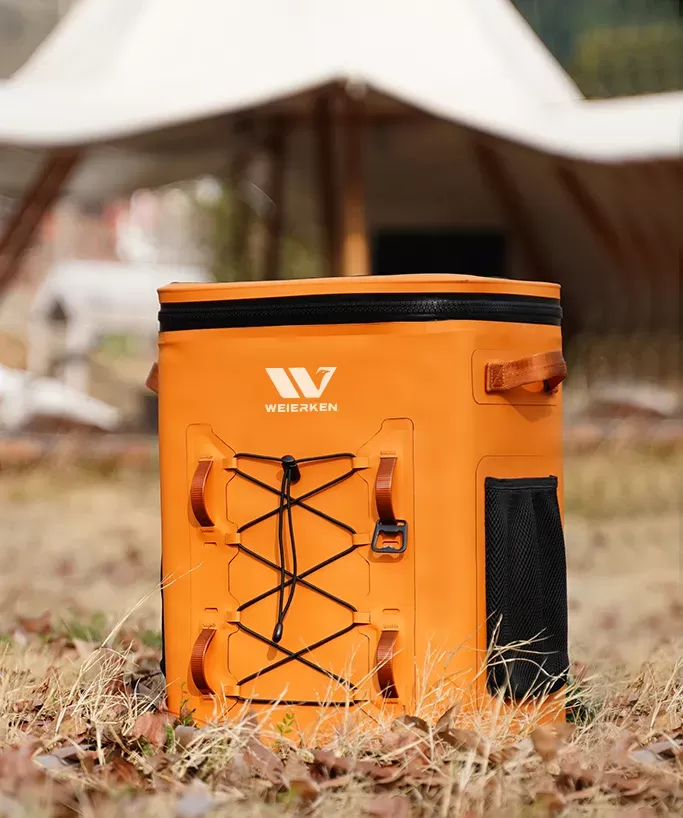

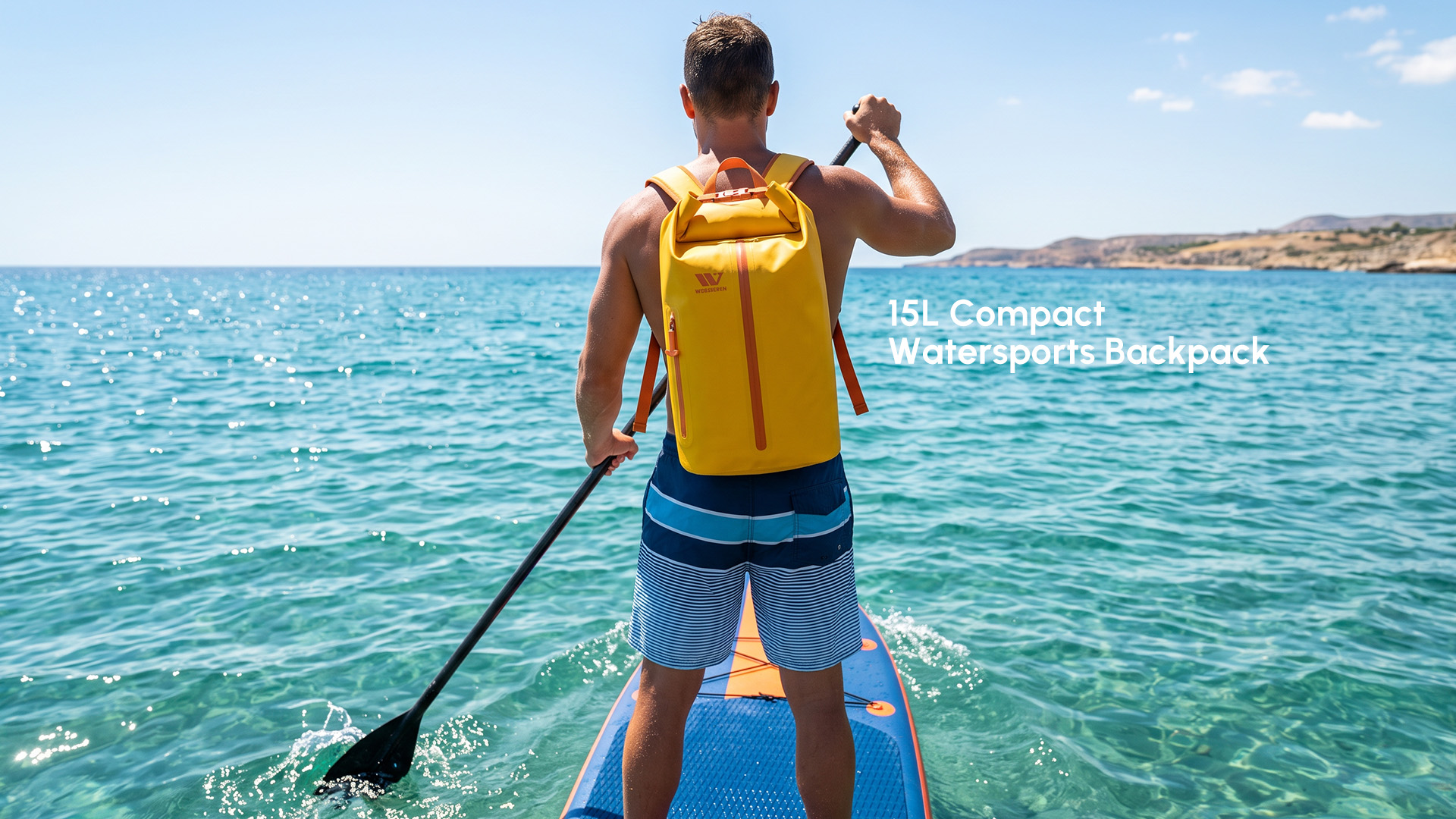
Traditional marine dry packs carry a dirty secret. Most of them feel like carrying a stiff plastic bucket strapped to your shoulders.
Watermen, offshore racers, and coastal commuters put up with bad ergonomics for decades. They accepted the sweat, the chafing, and the spinal strain because they needed one thing above all else: dry gear.
At the same time, standard hiking backpacks offer cloud-like comfort, but they fail the moment a green wave breaks over the deck. Their stitched seams soak through, and their zippers let water pour inside.
Marine lifestyle brands now face a clear commercial opportunity. Modern sailors want both uncompromising IPX7 submersion performance and technical carrying comfort.
Forward-thinking gear companies are filling this void through engineered private label sailing backpacks. Manufacturers like Weierken are proving that brands can bring submersible, body-mapped packs to market without spending years in experimental development.
1. The Engineering Paradox: Why Combining IPX7 with Ergonomics is Difficult
Building a comfortable, fully submersible backpack presents a severe manufacturing conflict. The physics of waterproofing directly oppose the principles of anatomical pack suspension.
Consider the core problem of needle penetration:
- The waterproof rule: An IPX7 rating requires an airtight, continuous barrier. Every needle hole is a structural failure point.
- The ergonomic rule: Building lumbar pads, load lifters, contoured harnesses, and ventilated channels typically requires dozens of stitched seams.
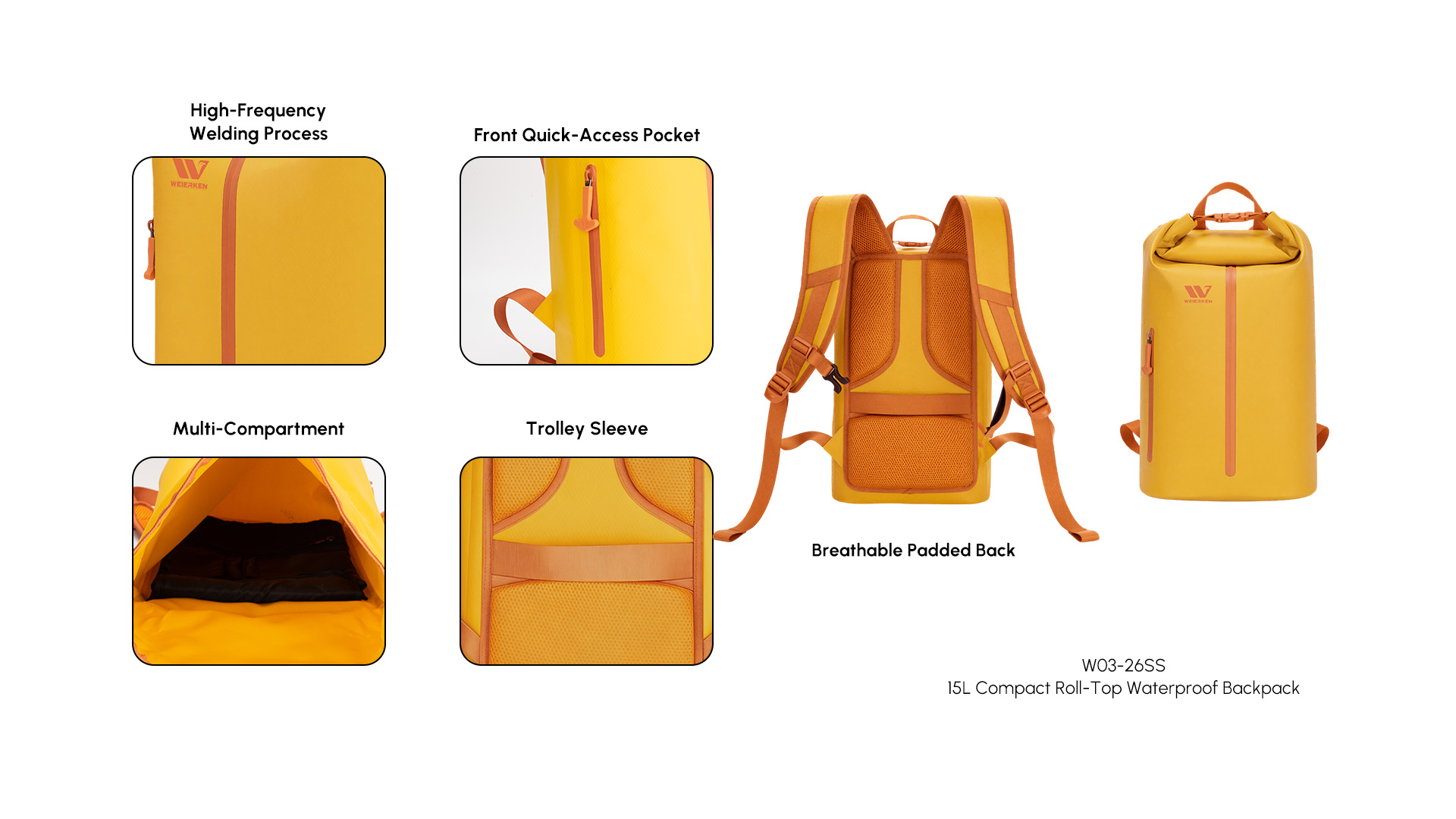
- The bonding challenge: High-frequency (HF) welding fuses panels at a molecular level, but welding thick, padded foam directly to a thin waterproof membrane creates weak spots and thermal deformation.
When inexperienced factories try to add padding to a dry bag, they stitch the harness directly into the seam tape. Under heavy loads, those stitches stretch, pull, and leak.
Solving this paradox requires separating the structural suspension from the waterproof hull. Top-tier manufacturers isolate the dry chamber completely.
Engineers weld external mounting plates and thermo-formed brackets to the outer shell. They anchor the entire harness system to these exterior bridges, keeping the primary dry chamber completely free of needle perforations.
2. Mastering the IPX7 Submersible Standard for Offshore Sailing
Many brands label their products "waterproof" when they merely resist splashing. Offshore sailing quickly exposes this marketing shortcut.
IPX7 carries a precise, strict technical definition. The gear must withstand complete immersion in water up to 1 meter (3.3 feet) deep for 30 continuous minutes with zero water ingress.
Achieving this performance in private label sailing backpacks requires two critical engineering components:
Airtight Zipper Integration
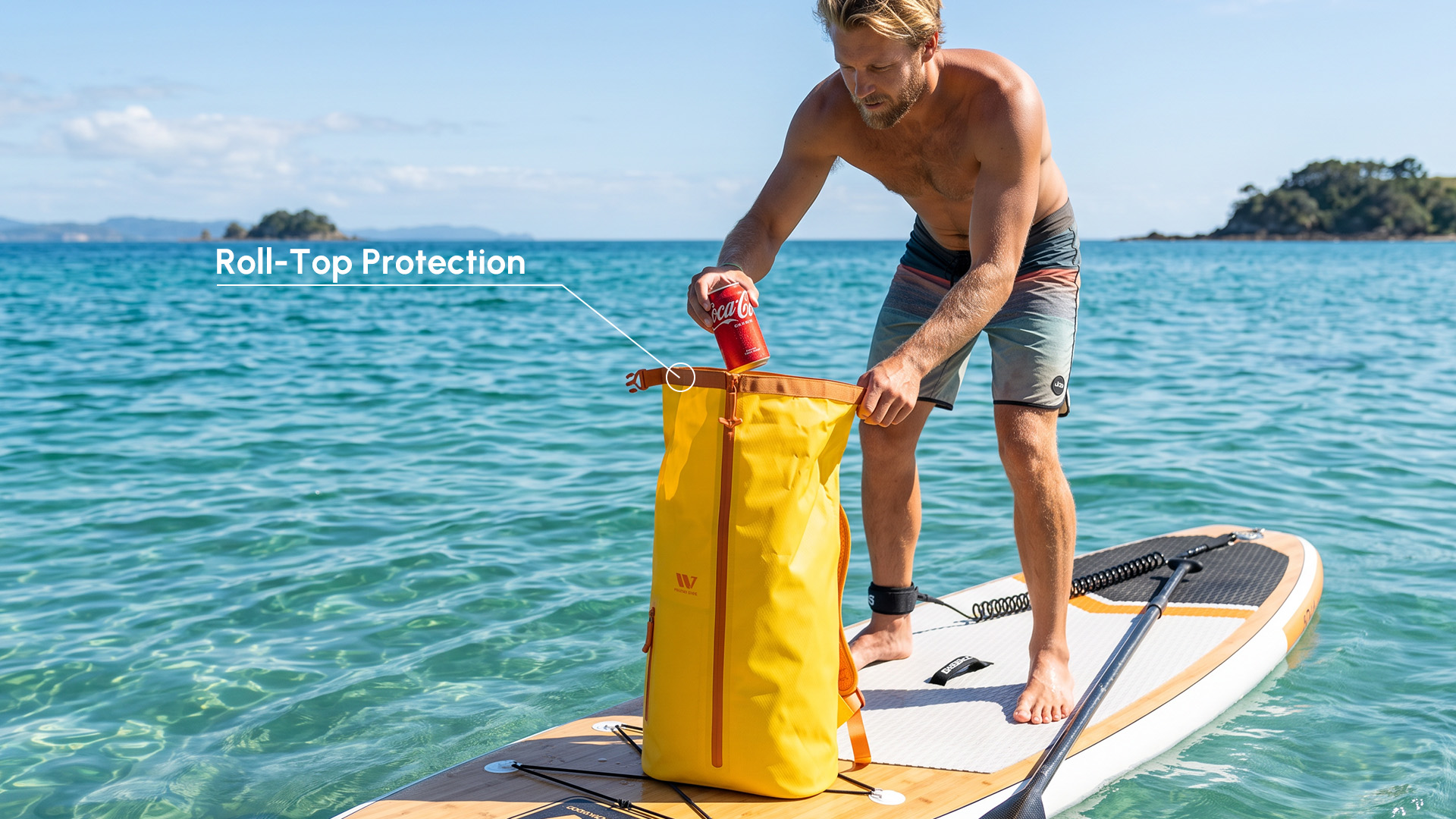
Roll-top closures are reliable, but they are bulky and slow to open. Modern consumers prefer the fast access of a waterproof zipper.
Standard splash-proof zippers rely on polyurethane coatings that press together, but dynamic water pressure easily forces them open. An IPX7 pack requires a true airtight zipper with interlocking vulcanized teeth or continuous pressure-clamping tracks.
The factory must weld the zipper directly into the bag cutout using precise radio-frequency dies. Any variance in welding temperature or pressure will distort the zipper teeth and destroy the seal.
Air-Release and Inflation Valves
Because an IPX7 backpack is completely airtight, trapped air can turn it into an unwieldy, bloated balloon when packed full. Adding a two-way marine purge valve allows the user to press out extra air to compress the load.
Conversely, a sailor can blow air into the valve before a dinghy crossing. This turns the backpack into an emergency floating buoy if it falls overboard.
3. Anatomical Comfort on the Water: Essential Ergonomic Features
Building successful private label sailing backpacks means matching the load-transfer performance of elite mountaineering gear.
Sailing gear gets subjected to unusual physical demands. Crew members climb companionway ladders, lean over lifelines, and brace against heeling decks. The pack must stay locked to the spine without shifting.
Molded Closed-Cell EVA Back Panels
Traditional open-cell backpack foam acts like a sponge. It absorbs saltwater, gets heavy, smells foul, and rots from the inside out.
Marine-grade packs demand thermo-molded, closed-cell EVA foam. This material brings decisive advantages:
- It absorbs zero moisture, shedding saltwater immediately.
- It rinses clean with fresh water and dries in minutes.
- Engineered ridge channels encourage airflow across the spine, keeping the wearer cool on hot passages.
Dynamic Load-Bearing Straps
Flat webbing straps dig into the trapezius muscles when a sailor carries heavy tools, computers, or wet foul-weather layers.
A proper harness needs 3D S-curved shoulder straps that trace the neck and chest contours. Adding load-lifter adjustment straps pulls the pack's center of gravity close to the back, preventing backward sway on a moving yacht.
Finally, quick-release chest buckles and padded waist belts spread the load onto the hips. In marine use, every buckle must feature single-handed release mechanisms for emergency egress if a sailor goes over the side.
4. The Business Case for Private Label Sailing Backpacks
Launching a technical marine bag from a blank sheet of paper is risky and expensive. Tooling costs for high-frequency welding molds, airtight zipper dies, and ergonomic back-panel presses can easily exceed tens of thousands of dollars.
That is why established marine labels, yacht racing teams, and outdoor retailers turn to private label sailing backpacks. This model lets brands skip the lengthy research trial-and-error.
Working with an experienced technical manufacturing partner like Weierken provides immediate access to proven, field-tested platforms. Weierken has already engineered the tooling, optimized the RF weld profiles, and ironed out structural stress points.
Brand owners gain distinct operational advantages:
- Accelerated time-to-market: Cut development timelines from 18 months down to 8 to 12 weeks.
- Reduced capital exposure: Eliminate heavy tooling investments and lower prototype failure rates.
- Flexible customization: Select proprietary Pantone fabric colors, custom silicone logo badging, molded zipper pulls, and distinct hardware combinations.
- Proven durability: Rely on patterns that have already passed rigorous factory cycle testing.
This approach allows product managers to spend their budgets on brand storytelling, marketing campaigns, and distribution instead of expensive factory re-tooling.
5. Material Science: Durability in Harsh Marine Environments
The sea rapidly degrades inferior goods. Salt crystals act like microscopic razor blades against woven fabrics, while ultraviolet radiation breaks down weak polymer bonds.
Specifying the right materials determines whether your private label sailing backpacks last for ten seasons or disintegrate after three months.
TPU vs. PVC: The Technical Shift
Old-school marine gear relied heavily on polyvinyl chloride (PVC). PVC is cheap and easy to weld, but it carries heavy plasticizers that leach out over time.
Under continuous sun exposure, PVC turns brittle, cracks at flex points, and emits strong chemical odors. Furthermore, PVC stiffens dramatically in near-freezing sea spray.
Modern performance brands build private label sailing backpacks with double-sided Thermoplastic Polyurethane (TPU) laminated onto high-tenacity 420D to 840D nylon or polyester fabrics. TPU delivers superior mechanical properties:
- Exceptional puncture resistance and tear strength per square meter.
- Permanent flexibility down to sub-zero offshore temperatures.
- Total resistance to microbial hydrolysis and saltwater degradation.
- A lighter finished product with a sleek, matte technical finish.
Marine-Grade Hardware and Trims
Corrosion kills bags. Standard metal sliders and zinc-alloy snap hooks seize up within weeks of exposure to coastal air.
All hardware must use UV-stabilized polyacetal (POM) resins or marine-grade 316 stainless steel. Webbing straps must use high-density, solution-dyed nylon that resists UV fading and maintains tensile strength when saturated.
6. Factory Vetting: Testing Protocols Before Sourcing Private Label Gear
Not every waterproof bag factory can build technical sailing equipment. When auditing a supplier for private label sailing backpacks, look beyond glossy showroom samples.
Demand documented factory test logs covering these non-negotiable quality control stages:
- 100% Positive Pressure Air Decay Testing: The factory must inflate every single finished backpack to a set PSI and monitor pressure loss over several minutes. Water dip tanks catch leaks, but pressure gauges confirm structural airtight integrity across the entire batch.
- Tensile Seam Peel Testing: Technicians must pull welded sample swatches on a calibrated universal testing machine. The fabric coating must tear before the welded seam delaminates.
- Cyclic Load and Drop Testing: A weighted dummy load inside the pack gets dropped repeatedly by its handle and shoulder harness to verify that structural anchors will not rip out when fully loaded.
- Salt Spray Corrosion Verification: Hardware samples must complete continuous ASTM B117 salt fog exposure without functional degradation or surface oxidation.
Frequently Asked Questions (FAQ)
Q1: What is the main difference between an IPX6 and an IPX7 sailing backpack?
A1: An IPX6 backpack protects gear against powerful water jets and heavy breaking seas from any angle, which is typically achieved with roll-top closures. An IPX7 backpack is fully submersible. It guarantees complete water resistance when dunked up to 1 meter underwater for 30 minutes, which requires airtight welded seams and specialized waterproof zippers.
Q2: Can we customize the back-panel ergonomics on private label sailing backpacks?
A2: Yes. While factories offer standardized, pre-tooled EVA back panels to keep costs down, you can customize the foam density, ventilation groove patterns, exterior mesh, and shoulder strap contouring. Tooling for custom-branded back panel molds is straightforward and costs far less than re-engineering the entire waterproof bag hull.
Q3: What fabric weight is best for private label sailing backpacks?
A3: A 420D to 600D TPU-laminated nylon provides the ideal balance between low carry weight and high abrasion resistance for day packs and race bags. For heavy-duty offshore gear exposed to constant contact with non-skid deck surfaces and winches, moving up to an 840D TPU exterior adds extra protection against punctures and tearing.
Q4: What is the typical Minimum Order Quantity (MOQ) for private label sailing backpacks?
A4: For existing factory patterns customized with your logos, colors, and hardware trims, MOQs generally start around 300 to 500 units per colorway. If your brand requires fully custom fabric dyeing, specialized tooling, or unique pocket configurations, MOQs typically range from 500 to 1,000 units.
Q5: How do airtight zippers perform in cold or sandy beach environments?
A5: Marine-grade airtight zippers handle sand and cold well, provided they are maintained correctly. Premium manufacturers supply each bag with silicone zipper lubricant. The teeth feature wider tooth pitch profiles that purge debris, and the vulcanized sealing lips maintain full flexibility even when spray temperatures drop toward freezing.
Q6: How does Weierken ensure waterproof consistency across high-volume production runs?
A6: Weierken uses automated, high-precision radio-frequency welding stations with computerized temperature and dwell-time monitoring. This eliminates the human error common in manual heat-gun applications. Every production run undergoes automated air-pressure decay testing to catch minor micro-leaks before products leave the cleanroom floor.
Conclusion: Build Your Marine Gear Line on Tested Engineering
The days of forcing customers to choose between spinal comfort and dry equipment are over. The marine outdoor sector is moving rapidly toward high-performance, anatomical gear that treats water resistance as an absolute requirement, not an optional feature.
Launching a dedicated line of private label sailing backpacks gives your brand instant credibility in this growing market. By focusing on molecularly welded TPU hulls, true IPX7 airtight zippers, and closed-cell ergonomic suspensions, you deliver products that survive the harshest passages while keeping users comfortable from dock to helm.
Weierken works directly with brand builders, outdoor retailers, and marine gear companies to turn technical designs into market-ready products. Our proven waterproof platforms eliminate development risks, protect your brand identity, and maintain the highest testing standards in the marine manufacturing sector.
Are you ready to build high-margin, submersible gear for your brand? Contact the Weierken engineering team today to review our technical portfolio, discuss custom branding programs, and request a production-grade sample kit.