

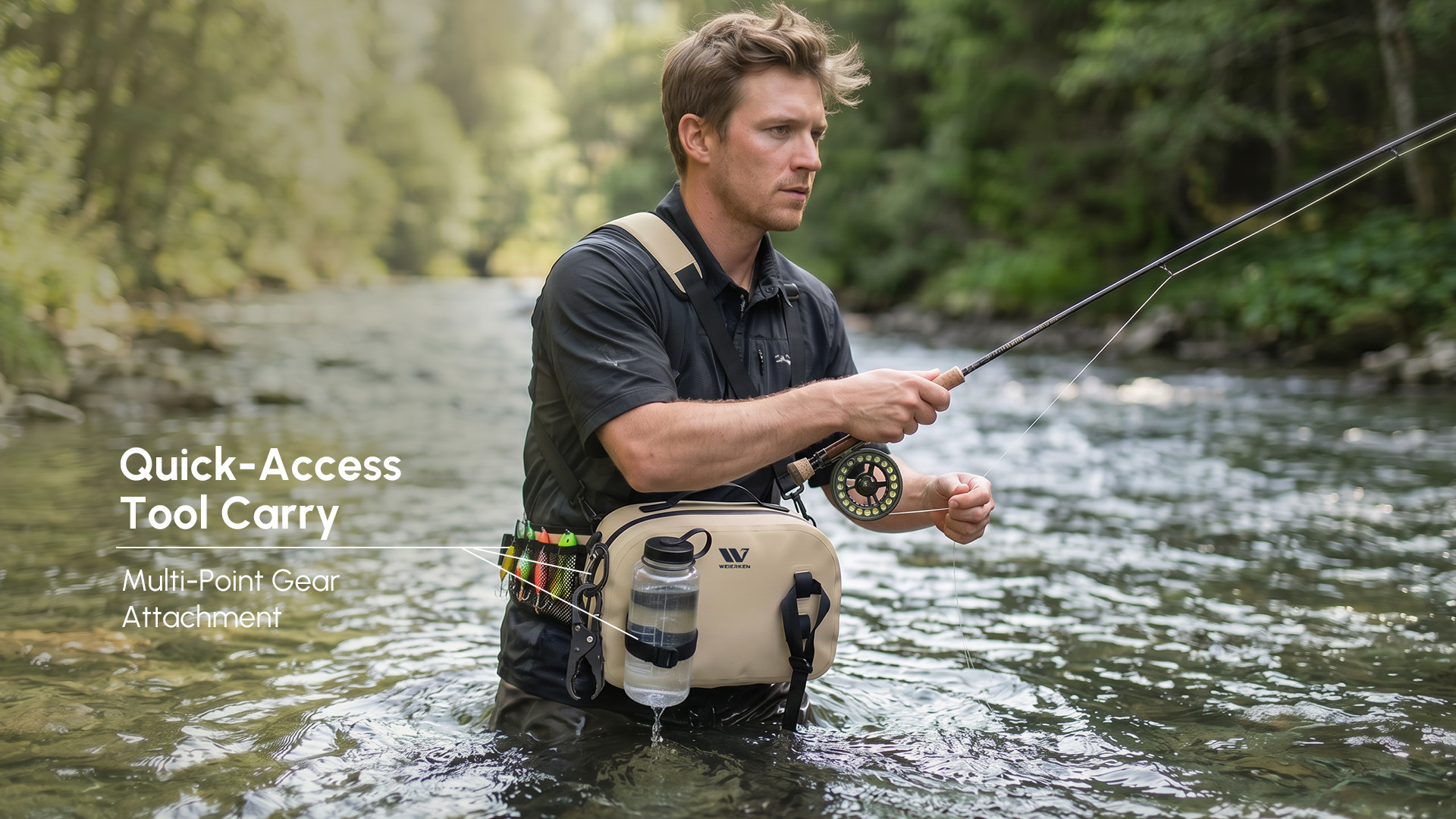
Fly and lure anglers face unpredictable conditions on the water. Wading through swift currents, brushing against coastal brush, or getting caught in sudden downpours exposes their gear to constant moisture. For modern anglers, the sling pack has become an indispensable piece of equipment.
A fishing sling bag provides the ideal balance between storage capacity and rapid mobility. Anglers wear it comfortably on their back while casting, then rotate it to the chest within seconds to swap lures, grab pliers, or access tackle trays without stepping out of the river.
However, traditional stitched tackle bags frequently disappoint. Water seeps through needle holes and standard zippers, ruining expensive fly boxes, rusting hooks, and destroying phones. For outdoor brands, offering low-quality gear damages reputation and increases return rates. This guide details how to develop premium, fully waterproof private label fishing sling bags that command high retail margins and build long-term brand loyalty.
Waterproof Engineering: Materials and Sealing Technologies
True submersible performance requires moving beyond conventional cut-and-sew methods. At Weierken, our engineering team focuses on three technical pillars to ensure complete water exclusion in harsh marine and freshwater environments.
1. High-Performance Technical Fabrics: TPU vs. PVC
Material selection defines the durability, weight, and environmental compliance of your finished product:
420D to 840D Nylon/Polyester with Double-Sided TPU Coating: Thermoplastic Polyurethane (TPU) is the gold standard for premium technical fishing packs. TPU remains flexible in sub-zero winter wading conditions and will not crack or stiffen. It provides exceptional puncture resistance, high tensile strength, and contains no toxic plasticizers. TPU aligns with strict North American and European environmental regulations (such as REACH and RoHS).
Traditional PVC (Polyvinyl Chloride): While lower in raw material cost, PVC is heavier, emits strong chemical odors, degrades quickly under UV exposure, and turns rigid in cold weather. For mid-to-high-tier brands, TPU is the superior choice for brand reputation and product longevity.
2. High-Frequency / RF Welding Technology
Standard sewing machines puncture fabrics with thousands of needle holes. Even when taped, stitched seams break down under heavy loads and repeated flexing.
Weierken utilizes advanced Radio Frequency (RF) and High-Frequency welding technology. RF welding passes high-frequency electromagnetic energy through overlapping fabric edges. This process excites the polymer molecules, fusing them together at the molecular level without applying external scorching heat. The resulting weld is completely seamless, tear-resistant, and 100% airtight, achieving reliable IPX7 or IPX8 submersible ratings.
3. Waterproof Zippers: Airtight vs. Water-Resistant
Selecting the right zipper configuration depends directly on your product's target price point and intended field use:
Airtight / Submersible Zippers (IPX7-IPX8): These zippers feature rubberized teeth that interlock under pressure or a continuous polymer seal (such as mechanical toothless sealing systems). They prevent water entry even when the bag is pulled underwater during deep wading. They are essential for main tackle compartments holding electronics and delicate gear.
Water-Resistant Coated Zippers (IPX4-IPX5): These zippers feature a polyurethane (PU) laminated tape over standard spiral coil teeth. They shed rain, spray, and brief splashes, making them ideal for quick-access exterior stash pockets where absolute submersion resistance is not mandatory.
Angler-Centric Ergonomics and Feature Integration
A successful fishing pack must function as an intuitive, hands-free workstation. As an experienced OEM tackle sling bag manufacturer, Weierken integrates functional features engineered specifically for river, kayak, and flats anglers.
1. 180-Degree Quick-Access Rotation
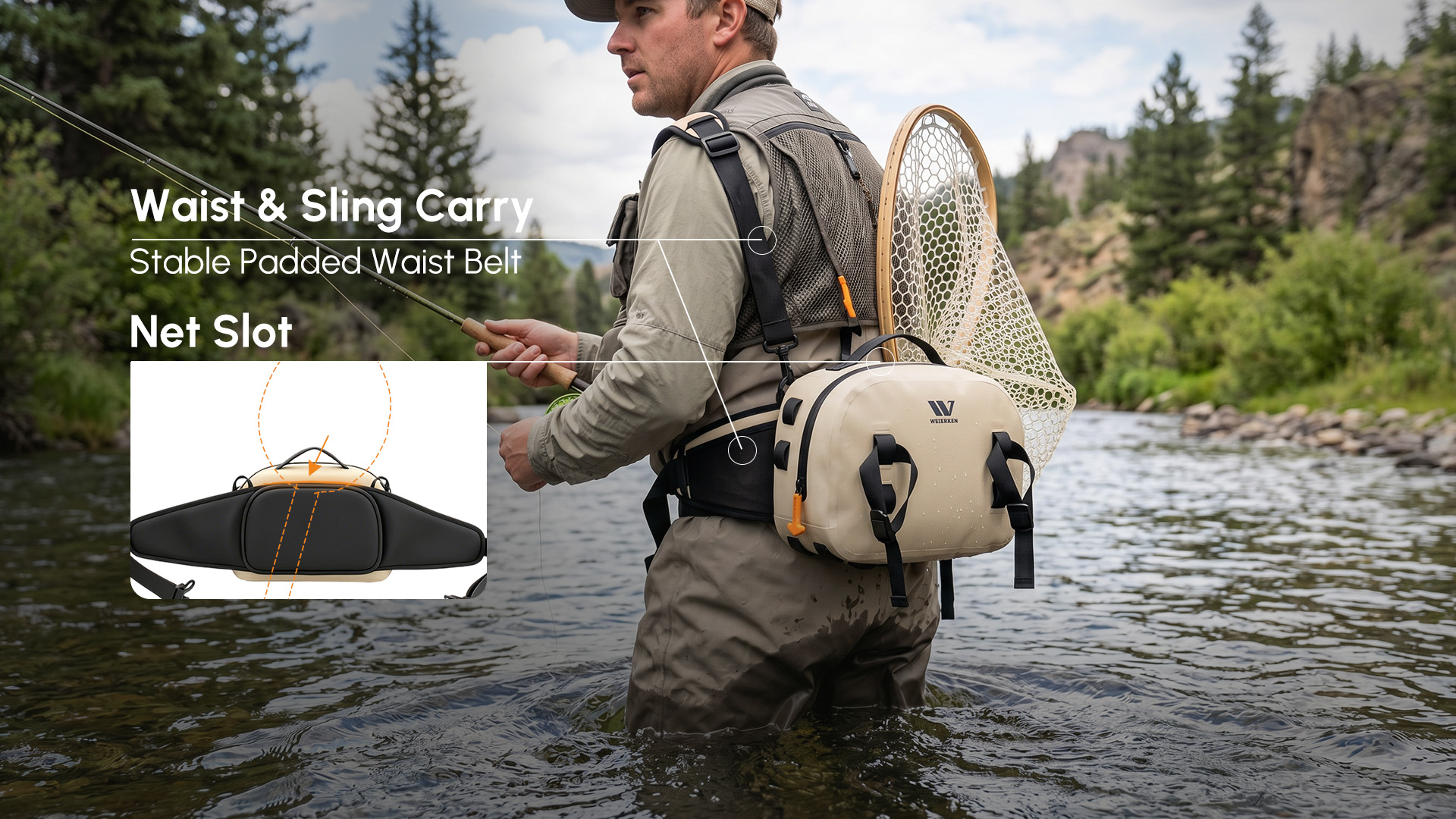
The single-strap architecture must distribute weight evenly across the shoulder and upper back during long hiking approaches. The contoured strap should include breathable, closed-cell EVA foam padding that will not absorb water. A secondary stabilization strap under the arm prevents the pack from sliding forward when casting, yet unclips quickly for chest rotation.
2. Purpose-Built Tool Holsters and Attachment Systems
Anglers need immediate access to their tools without opening main pockets:
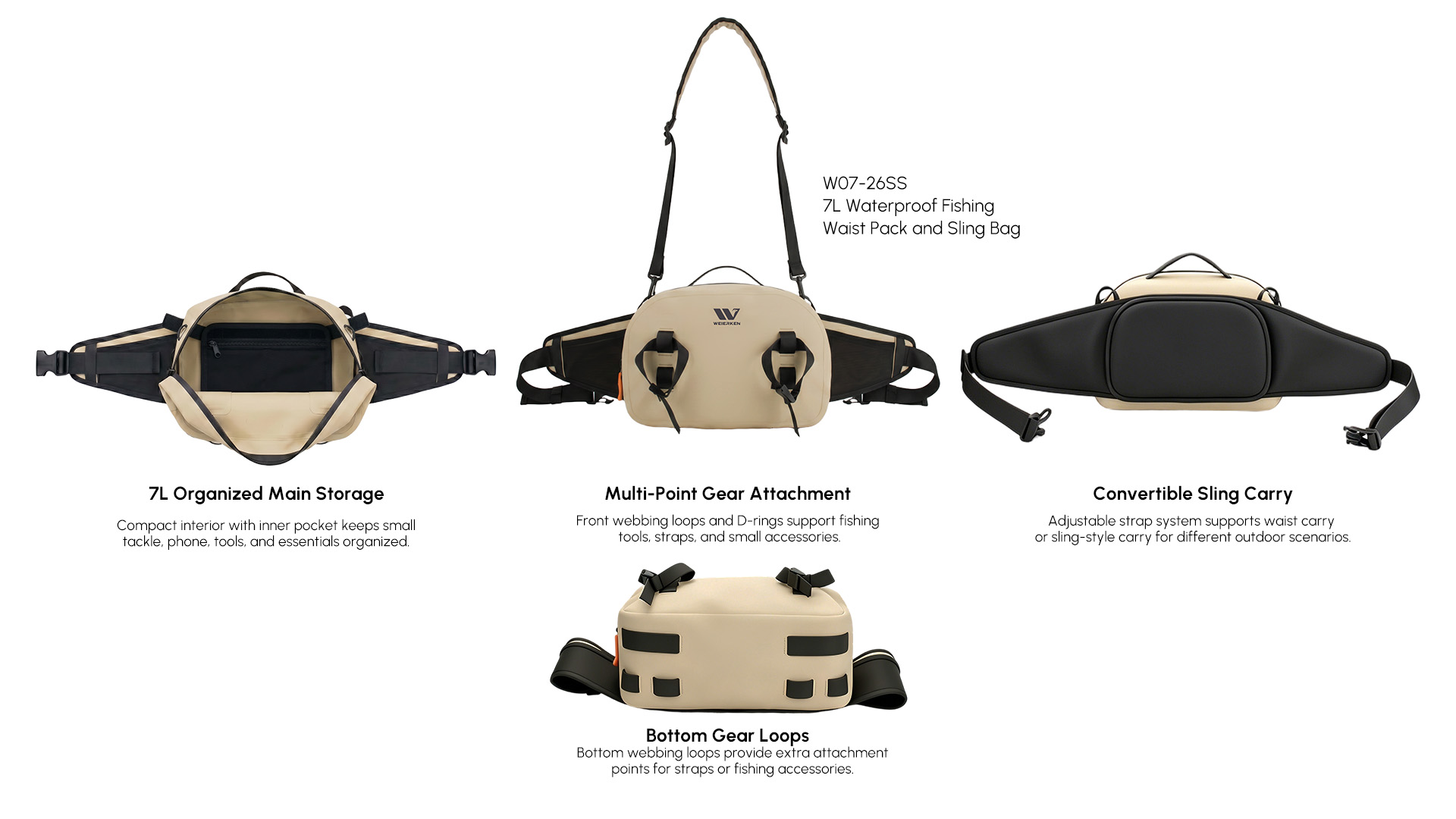
Laser-Cut Hypalon/TPU MOLLE Panels: Allow anglers to attach tippet holders, floatant caddies, and retractor zinger tools securely without puncturing the waterproof shell.
Dedicated Pliers and Forceps Sheaths: Molded exterior holsters with hook-and-loop security tabs hold long-nose pliers firmly in place.
Integrated Landing Net D-Ring / Net Sleeve: A reinforced, welded D-ring at the top of the strap or a hidden pass-through slot on the back panel keeps landing nets positioned out of the way until needed.
External Rod Tube Straps: Adjustable side cam straps allow secure transport of multi-piece travel fly rods or spare lure setups.
3. Marine-Grade, Corrosion-Proof Hardware
Saltwater rapidly corrodes cheap metal sliders and standard plastic buckles. We utilize heavy-duty, salt-spray-tested POM (Polyoxymethylene) clips, nylon attachment loops, and zinc-alloy zipper pullers coated with anti-corrosion treatments to ensure smooth operation across seasons of coastal use.
Rigorous Quality Control and Laboratory Testing Standards
Every batch of custom waterproof fishing sling bags leaving the production floor must pass strict quality assurance protocols before packaging.
1. Submersion and Airtight Chamber Testing
We test every waterproof compartment. Finished packs undergo positive air pressure inflation tests to monitor pressure drop over time. Random production units are fully submerged in water pressure tanks for 30 minutes at a depth of 1 meter to verify compliance with IPX7 submersible standards.
2. Abrasion and UV Resistance Testing
Fishing bags constantly rub against abrasive rocks, boat decks, and dense branches. We test our raw fabrics with Martindale abrasion testers to verify surface durability. UV exposure testing simulates 200+ hours of intense solar radiation to ensure TPU coatings do not peel, discolor, or become brittle.
3. Dynamic Load and Cycle Testing
Shoulder strap attachment points and top grab handles undergo cyclic drop-testing under a 15 kg payload for over 10,000 cycles. This confirms that welded anchor points and box-stitched reinforcement patches will not separate under real-world sporting loads.
Private Label and Custom OEM/ODM Capabilities
Weierken provides complete end-to-end support to bring your brand's gear concepts to life. Whether you provide a finalized tech pack or a preliminary design sketch, our product development team translates your ideas into commercial reality.
Brand Customization Options
Branding Applications: Choose from 3D molded silicone badges, high-frequency debossed logos, silk-screen printing, or reflective heat transfers for improved visibility during night fishing sessions.
Color Customization: Match any custom Pantone shade, matte finish, or tactical camouflage pattern (including digital camo and water-camo schemes).
Internal Organization: Customize interior layouts with removable hook-and-loop padded dividers, water-resistant clear zippered pockets for fishing licenses, and specialized key leashes.
Sustainable Material Options: We offer GRS (Global Recycled Standard) certified recycled TPU and recycled PET fabrics to support eco-conscious product lines.
The Weierken Manufacturing Advantage
Choosing the right manufacturing partner directly impacts your delivery schedules, product consistency, and landed costs. Weierken delivers key supply chain advantages for growing and established outdoor brands:
Established Track Record (Since 2006): Over 18 years of specialized manufacturing experience in high-end waterproof outdoor bags, dry bags, and technical packs, supplying more than 2,000 global brands.
Dual-Base Production (China & Cambodia): With 3 owned production facilities spanning over 80,000 square meters and 3,000+ skilled workers, we offer agile production scheduling. Our Cambodia manufacturing facility allows North American and European clients to optimize supply chains and minimize tariff exposure.
Rapid Prototyping: Dedicated R&D sample rooms with specialized tooling allow us to produce initial functional prototypes within 7 to 10 business days.
Strict Factory Audits: Our facilities comply with ISO9001, BSCI, and Sedex standards, guaranteeing ethical labor practices, safe working conditions, and consistent production quality.
Frequently Asked Questions (FAQ)
Q1: What is the standard MOQ for private label fishing sling bags?
A1: Our standard Minimum Order Quantity (MOQ) generally starts at 500 to 1,000 pieces per colorway, depending on the specific fabric customization, specialized zipper models, and hardware tooling requirements. Contact our sales engineers to discuss flexible batch solutions for new product launches.
Q2: What is the main difference between IPX6, IPX7, and IPX8 waterproof ratings?
A2: An IPX6 rating protects against high-pressure water jets and heavy rain, but is not designed for underwater immersion. An IPX7 rating ensures the bag remains leak-free when submerged in water up to 1 meter deep for 30 minutes. An IPX8 rating provides continuous underwater protection under deeper, pressurized conditions. Most premium fishing sling packs target IPX7 standards.
Q3: Can we supply our own technical drawings, or do you provide design services?
A3: We support both OEM and ODM workflows. You can provide your own CAD files, Adobe Illustrator tech packs, or physical reference samples. Alternatively, our in-house industrial design team can develop technical production drawings based on your functional specifications and target market requirements.
Q4: How long does the production process take from sample approval to delivery?
A4: Prototype development takes approximately 7-10 working days. Once the sample is approved and the order deposit is confirmed, mass production typically requires 35 to 50 days, depending on material availability and order volume.
Q5: How does your Cambodia factory benefit overseas brand buyers?
A5: Sourcing through our Cambodia manufacturing base allows international clients—particularly those in the United States and European markets—to benefit from favorable trade policies, reduce import tariffs, and diversify their global supply chain risks while maintaining high engineering and quality standards.
Start Your Custom Fishing Bag Project with Weierken
Delivering high-performance waterproof gear requires precise material knowledge, advanced welding machinery, and rigorous testing. Partnering with Weierken gives your brand immediate access to tier-one manufacturing capabilities, competitive pricing, and reliable production capacity.
Ready to develop your next collection of custom waterproof fishing sling bags? Contact our technical engineering team today to share your specifications, request physical material swatches, or receive a fast, detailed manufacturing quotation.