

Commercial river outfitters run on tight operational margins. Every piece of equipment in your raft faces constant punishment. Guides toss gear onto abrasive granite riverbanks. Clients drag packs over coarse river gravel. Cold glacial runoff hammers the seams, and high-desert sun bakes the fabric for hours on end.
When you purchase bulk dry bags for rafting companies, material selection dictates your bottom line. Pick the wrong textile, and you face mid-season seam delamination, soaked guest electronics, and expensive replacement cycles. Pick the right textile, and your fleet survives three to five grueling seasons without a single leak.
Commercial river managers usually narrow their choice down to two proven fabrics: traditional PVC Tarpaulin and modern Heavy-Duty Thermoplastic Polyurethane (TPU). Technical manufacturers like Weierken build commercial river gear from both materials. But how do these textiles perform when tested across hundreds of river miles?
This technical guide breaks down the true performance, lifecycle costs, and operational trade-offs of both options to help you choose the best bulk dry bags for rafting companies.
1. Why Material Selection Dictates Outfitter Profitability
Running a commercial whitewater operation means managing equipment depreciation. Gear rooms do not treat bags gently. If an outfit runs two trips a day for four months, guides will fold, clip, cinch, and unpack each roll-top bag over 240 times per season.
Substandard materials introduce immediate financial drain:
- Guest Claims: A saturated dry bag that ruins an expensive camera or satellite messenger creates an immediate dispute and damages online reviews.
- Mid-Season Patching: Guides waste valuable staging hours applying seam-grip and vinyl patches instead of prepping boats.
- Premature Landfill Waste: Replacing 200 cheap dry sacks every spring costs significantly more than investing in high-end gear that lasts multiple years.
To maximize fleet profit, you must balance the initial purchase invoice against multi-year longevity. That calculation begins with the polymer coating on your woven base cloth.
2. Deep Dive: PVC Tarpaulin as the Classic Outfitter Shield
Polyvinyl Chloride (PVC) tarpaulin has served as the backbone of whitewater rafting fleets for decades. This material uses a high-tenacity woven polyester mesh (the scrim) sandwiched between two solid coats of liquid PVC plastic.
Commercial whitewater gear typically uses 500D to 1000D (denier) polyester base scrims, yielding a finished fabric weight between 550 and 850 grams per square meter (gsm).
The Real-World Advantages of PVC Tarpaulin
- Unmatched Scrape Resistance: Thick PVC provides an exceptional sacrificial barrier. When an overloaded raft rubs against sharp canyon limestone, the thick plastic coating absorbs the friction before rocks can cut the internal polyester threads.
- Lower Upfront Acquisition Cost: PVC resin remains economical to refine and process. For outfitters ordering bulk dry bags for rafting companies in quantities of 500 to 2,000 units, PVC minimizes upfront capital expense.
- Proven High-Frequency (HF) Weld Reliability: PVC melts cleanly under radio-frequency waves. The seams form an impenetrable chemical bond that stays stable under direct water pressure.
The Drawbacks for Commercial River Guides
- Cold-Stiffening and Micro-Cracks: PVC contains chemical plasticizers to keep it pliable. In cold conditions—such as spring runoff, snowmelt streams, or deep autumn water—PVC stiffens dramatically. Rolling down a frozen 1000D PVC collar feels like folding cardboard, and repeated cold-bending leads to hairline surface cracks.
- Heavy Dead-Weight: PVC is heavy. For gear boats loaded with guest camp kits, standard PVC bags add considerable dead-weight to your rowing frame.
- Plasticizer Migration and Environmental Concerns: Over extended sun exposure, plasticizers slowly leach out. This makes older PVC dry bags feel sticky or brittle. Additionally, eco-tourism operations avoiding synthetic chlorine polymers find PVC incompatible with their environmental policies.
3. Deep Dive: Heavy-Duty TPU as the Next-Generation Standard
Thermoplastic Polyurethane (TPU) represents modern polymer engineering. Instead of using chemical plasticizers to achieve suppleness, TPU is naturally elastic. For commercial river applications, factories laminate a dense polyether-based TPU film onto high-tenacity 420D to 840D ripstop nylon or polyester cloth.
In technical waters, polyether TPU resists hydrolytic breakdown (water rot) and microbial rot far better than cheaper ester-based plastics.
The Performance Advantages of Heavy-Duty TPU
- Outstanding Cold-Flex Fatigue Resistance: TPU retains its elastomeric properties well below 0°C (32°F). When rolling your bag shut on freezing morning trips, the collar rolls down smoothly without stress-whitening or cracking along the fold line.
- Higher Tear Strength per Ounce: A 420D nylon core coated with TPU often delivers greater tensile tear strength than a heavier 1000D PVC tarpaulin. You get equal or superior puncture survival at roughly 30% to 40% less total pack weight.
- Superior UV Stability: TPU withstands continuous high-altitude ultraviolet radiation without drying out or turning brittle, making it ideal for sunny, multi-day desert river permits.
- Clean Eco-Credentials (PVC-Free): High-end outdoor hospitality and eco-expedition brands value TPU because it is non-toxic, free of chlorine and phthalates, and significantly less harmful to river ecosystems over its lifecycle.
The Limitations for Commercial Buyers
- Higher Initial Capital Outlay: TPU raw materials and precise hot-air/radio welding systems require tighter process control. Outfitting a guide fleet with TPU typically costs 30% to 60% more upfront than an equivalent order of PVC tarpaulin bags.
4. Head-to-Head Comparison: PVC vs. TPU for River Fleets
Before issuing a purchase order for bulk dry bags for rafting companies, review how these materials match up across key operational metrics:
| Performance Vector | 500D–1000D PVC Tarpaulin | Heavy-Duty Polyether TPU |
|---|---|---|
| Abrasive Rock Gouging | Exceptional (Thick sacrificial barrier) | Very High (Elastic, resists gouges) |
| Cold-Water Roll Flexibility | Poor (Stiffens below 10°C / 50°F) | Flawless (Supple below 0°C / 32°F) |
| Seam Strength (Welded) | High (Standard HF Welds) | Ultra-High (Molecular fusion) |
| Ultraviolet (UV) Endurance | Moderate (Can degrade after 2 seasons) | Exceptional (Minimal degradation) |
| Weight per Liter of Cargo | Heavy | Up to 35% Lighter |
| Initial Bulk Unit Cost | Budget-Friendly ($) | Premium Investment ($$$) |
| Target Fleet Lifespan | 1 to 3 Commercial Seasons | 3 to 5+ Commercial Seasons |
Manufacturers like Weierken engineer custom river bags using both materials, depending on river class, seasonal water temps, and target equipment budgets.
5. Strategic Fleet Framework: Which Material Should You Order?
Rafting businesses face varied conditions. A day-tripping rental outfit on a warm river requires different equipment than a self-supported expedition crew running Class V drops. Use this field framework to plan your wholesale order.
When PVC Tarpaulin Is Your Best Business Move
Choose PVC tarpaulin bulk dry bags for rafting companies under the following conditions:
- Half-Day and Day-Trip Commercial Runs: If your company guides calm, warm-water runs with short gear exposure, PVC offers the quickest return on investment.
- High-Turnover Rental Operations: If rental guests routinely misplace, drop, or lose equipment, keeping initial replacement costs low makes financial sense.
- General Camp Duffles and Personal Gear Bags: Basic dry sacks meant to sit strapped deep within cargo gear nets stay sheltered from sharp rocks, reducing the need for premium fabrics.
When Heavy-Duty TPU Is Mandatory
Invest in high-performance TPU gear when your operation encounters these demands:
- Glacier-Fed or High-Altitude Rivers: If your team works in mountain run-off where water temperatures sit near freezing, TPU prevents fold cracking along the roll closure.
- Multi-Day Wilderness Expeditions: Guides running unsupported multi-week expeditions cannot afford a gear failure far from road access. TPU provides necessary peace of mind.
- Premium Eco-Tour Providers: If your marketing highlights Leave-No-Trace principles and eco-friendly standards, stocking PVC-free gear aligns directly with your brand promise.
The Practical "Hybrid Fleet Strategy"
Many experienced whitewater operators save money by running a split fleet:
- Guide Kits & Critical Cargo (TPU): Build all satellite communications bags, emergency medical kits, trauma packs, and repair cases out of bulletproof heavy-duty TPU.
- Standard Passenger Bags (PVC Tarpaulin): Supply basic 20L
to 30L personal dry sacks using durable 500D PVC tarpaulin to handle daily
passenger use affordably.
6. Commercial Technical Sourcing Checklist
Material selection is only half the battle. When purchasing bulk dry bags for rafting companies, ensure your manufacturer includes commercial-grade hardware and construction techniques:
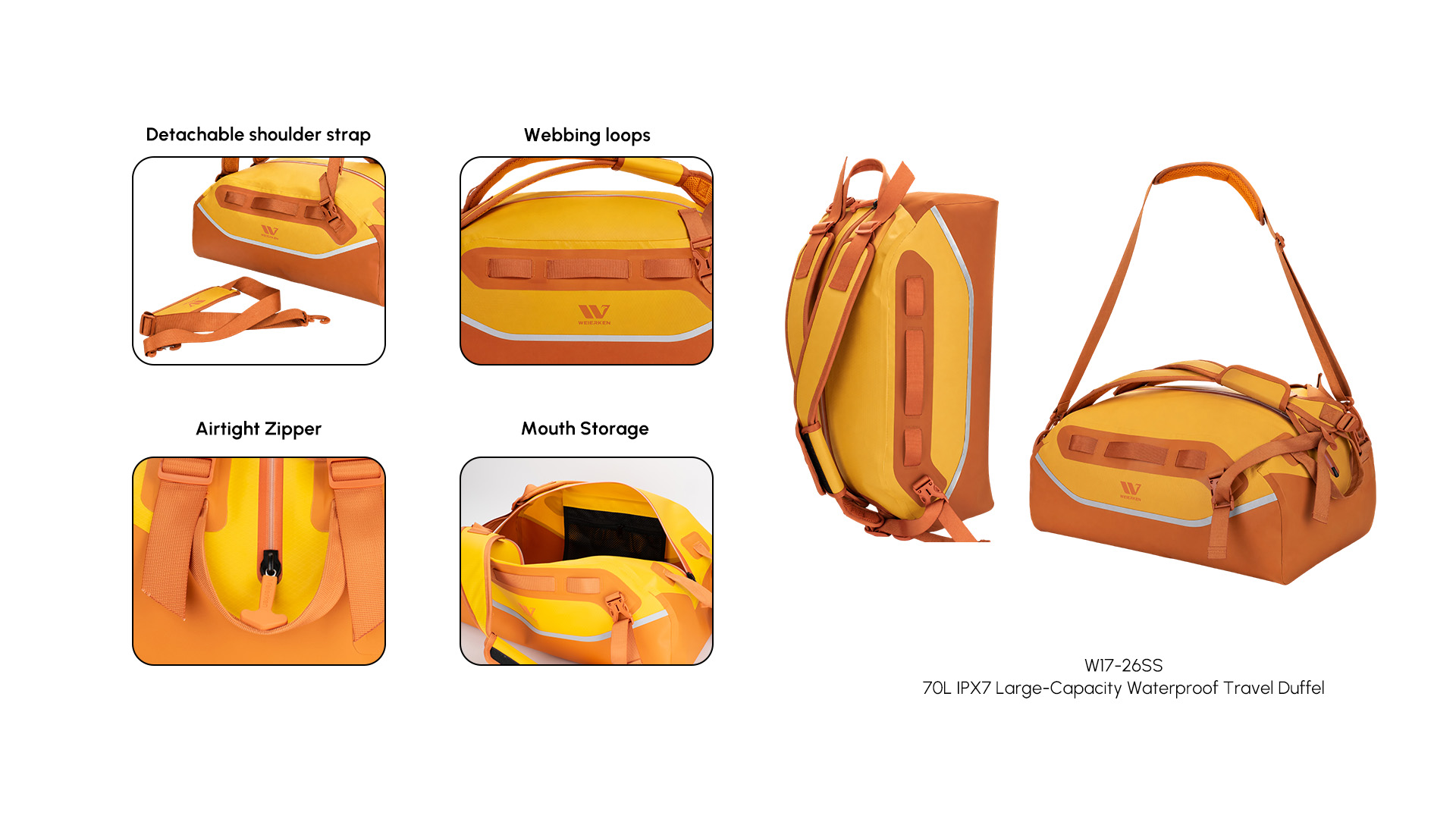
- High-Frequency Radio Frequency (RF) Welds: Never buy stitched and taped dry bags for commercial whitewater fleets. Require seamless HF welds that fuse panels into a monolithic unit.
- Sub-Zero Engineering Hardware: Cheap plastic buckles snap when stepped on or flexed in freezing weather. Demand cold-crack resistant acetal hardware, such as UTX-Duraflex® or equivalent heavy-duty buckles.
- Reinforced Welded Tie-Down Patches: Strong river hydraulics will rip standard sewn loops right out of bag seams. Tie-down lash patches and raft D-rings must be high-frequency welded directly onto structural backing plates.
- Fleet Identification and Serialization: When sourcing bulk dry bags for rafting companies, include screen-printed numbered panels and logo blocks. This streamlines gear check-in, deters camp theft, and helps staff track equipment age during winter inspections.
Working directly with an experienced manufacturing partner like Weierken lets you customize every feature—from D-ring pull strengths to custom base wear patches—ensuring your fleet handles severe river use without failure.
Frequently Asked Questions (FAQ)
Q1: What is the typical operational lifespan of PVC dry bags versus TPU bags for commercial rafting?
A1: In active commercial fleets running 60 to 90 days per season, 500D-1000D PVC dry bags usually last 1 to 3 seasons before UV hardening, friction, or fold-cracking demands retirement. Heavy-duty polyether TPU dry bags routinely survive 3 to 5 full seasons under identical river conditions thanks to superior flex fatigue and UV resilience.
Q2: Can our river outfit combine PVC and TPU styles into a single bulk manufacturing order?
A2: Yes. Established gear factories like Weierken regularly run split production runs for outfitters. For example, you can produce a single container containing 800 standard 30L passenger duffles in cost-effective 500D PVC, alongside 200 high-spec 65L guide packs built from rugged 840D polyether TPU.
Q3: Why does cold water trigger micro-cracking in roll-top PVC bags?
A3: PVC requires liquid plasticizer compounds to remain flexible. Cold water temperatures cause those plasticizer molecules to stiffen. Repeatedly folding a cold, rigid bag down three to four turns creates intense shear stress along the crease, which eventually produces tiny pinholes and micro-cracking.
Q4: What material weight (denier) balances durability and ease of handling for passenger gear?
A4: For PVC tarpaulin, 500D (around 550 to 600 gsm) delivers the ideal balance between physical durability and easy folding for commercial guests. Moving up to 1000D adds noticeable puncture protection, but younger or less experienced clients often struggle to fold the stiff roll-top down tightly enough for an airtight seal.
Q5: How do custom logos hold up against harsh river friction and silt?
A5: Standard water-based screen printing wears away quickly against sand and silt. For commercial river fleets, specify high-cure epoxy screen inks or direct heat-transfer vulcanized prints. These processes bond your outfitter logo directly into the underlying PVC or TPU substrate, keeping your branding legible for seasons.
Choose the Material That Fits Your Bottom Line
There is no single correct choice for every river outfitter. PVC Tarpaulin remains the heavy-duty workhorse of the industry, delivering unmatched puncture safety and low initial cost for high-capacity fleets. Heavy-Duty TPU stands as the high-performance benchmark for multi-day expeditions, freezing meltwater, and low pack weight.
Evaluating your seasonal run volume, average water temps, and replacement cycles helps you choose the right material to protect both your gear and your operating margins.
Weierken engineers and manufactures industrial-grade, fully welded waterproof equipment for commercial outfitters, expedition guides, and gear distributors worldwide. From dual-hub manufacturing to custom fleet branding, our production lines build gear that survives real whitewater.
Ready to upgrade your river gear for the upcoming season? Contact the Weierken engineering team today to review material swatches, evaluate custom technical specs, and request a direct tiered quote on bulk dry bags for rafting companies.