

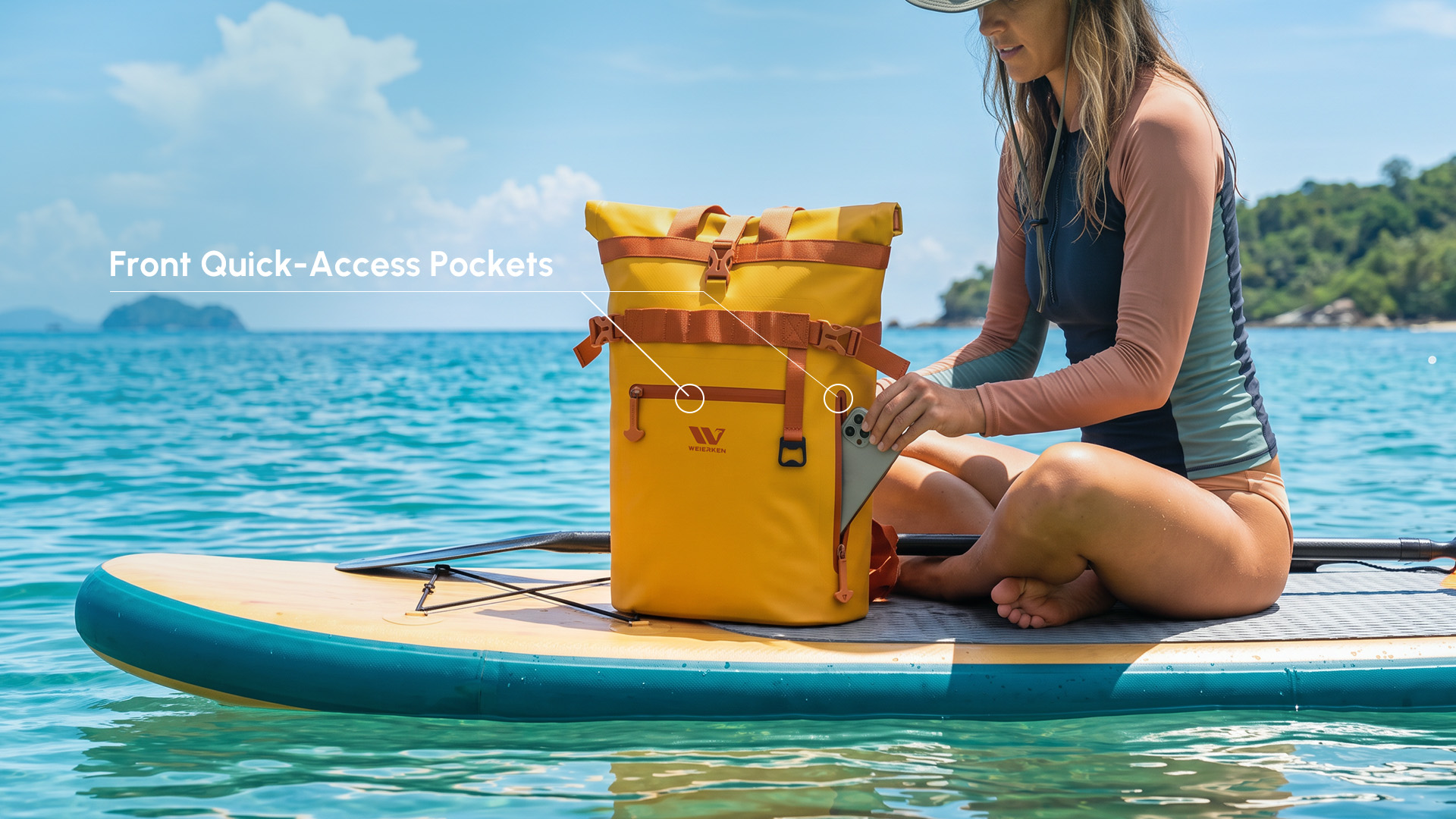
Outdoor gear markets face major shifts as we head into 2026. Water sports, overland motorcycle touring, and technical expeditions demand tougher waterproofing standards than ever before. Gear brands cannot rely on basic stitched bags coated with water-repellent sprays. Today's consumers demand submersibility, puncture resistance, and seamless construction that survives real abuse.
At the same time, sourcing directors face shifting trade policies and rising import duties. A product failure in the field ruins brand trust, while a delayed container ruins entire sales seasons. Selecting the right heavy-duty roll-top dry bag manufacturer requires balancing technical manufacturing depth with geographic supply chain safety.
Whether you need custom PVC tarpaulin dry sacks or high-end TPU expedition packs, your production partner must handle high-stress manufacturing. Forward-thinking brands now look toward agile producers like Weierken, who provide dual-country operations to eliminate tariff penalties without sacrificing technical precision.
Below is an objective evaluation of the top seven manufacturing partners ready to produce professional-grade roll-top bags for global outdoor labels in 2026.
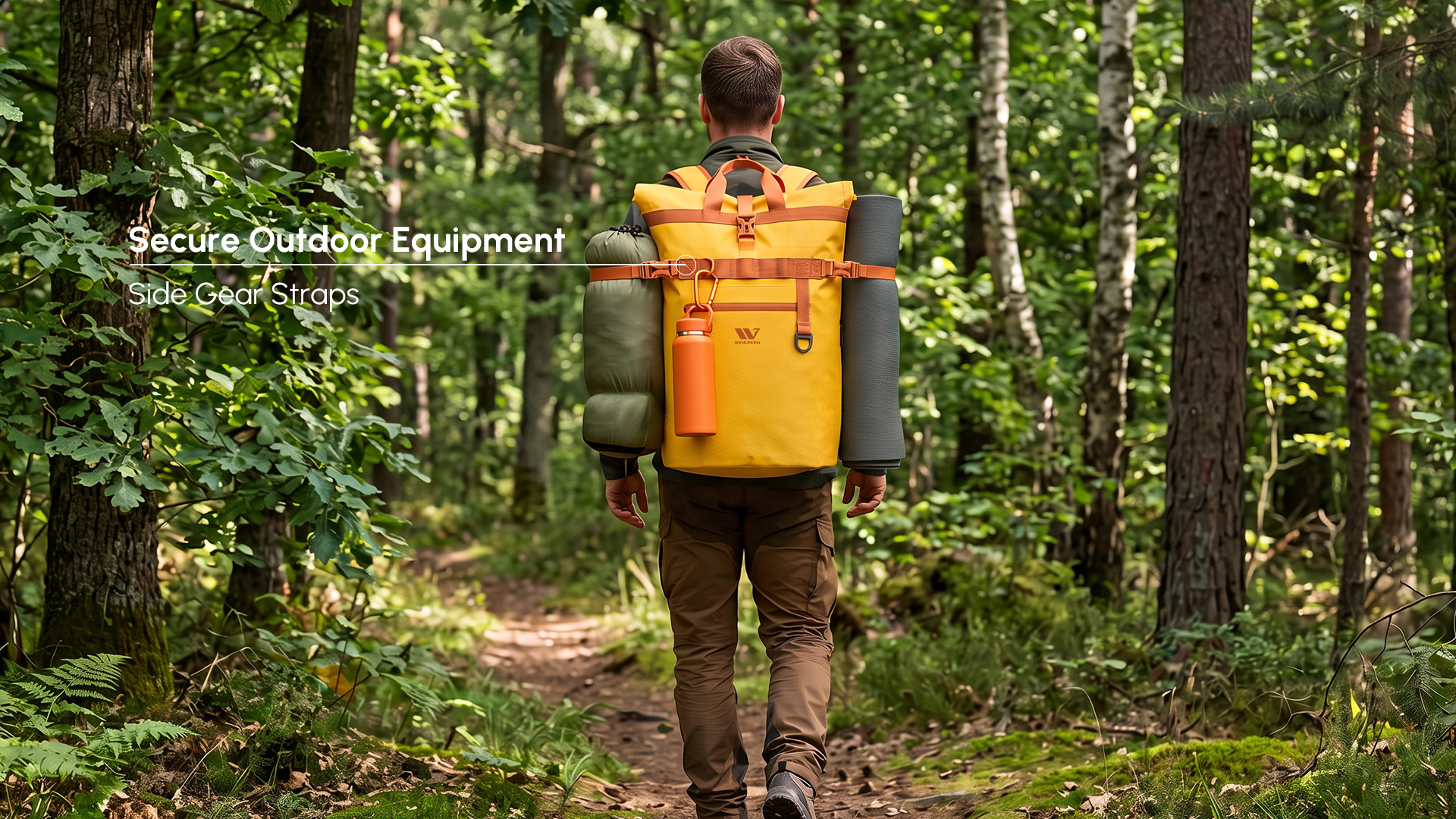
Key Criteria for Evaluating a Heavy-Duty Dry Bag Factory
A standard luggage workshop cannot build an authentic heavy-duty waterproof pack. The machinery, engineering talent, and quality controls are completely different. When auditing potential partners, base your assessment on four critical operational capabilities:
- High-Frequency (HF) Welding Mastery: Heavy-duty roll-top bags depend on molecular-level plastic bonding, not needles and thread. Your factory must run advanced radio-frequency and hot-air welding machinery to guarantee IPX6 to IPX8 waterproof ratings.
- Dual-Country Footprint: Geopolitical risks and tariff spikes punish brands that depend on a single manufacturing origin. Factories with diversified facilities across China and Southeast Asia provide essential supply chain security.
- Comprehensive Regulatory Compliance: Premium retail markets demand proof of social accountability and chemical safety. Look for certified facilities holding BSCI, GRS, REACH, and ISO 9001 credentials.
- True Turnkey Logistics (DDP): Factories that stop their responsibility at the departure port leave your team exposed to shipping delays, freight surcharges, and customs clearance headaches.
1. Weierken – Strategic Dual-Hub Manufacturing Partner (Rating: ★★★★★)
Weierken leads the international market as a premier heavy-duty roll-top dry bag manufacturer, functioning as an agile engineering co-developer rather than a passive production line. With 20 years of focus on airtight structures, technical luggage, and insulated field equipment, Weierken solves the core supply bottlenecks that trouble modern outdoor companies.
Dual-Hub Production: China R&D Plus Cambodia Volume
Weierken operates an integrated dual-facility production model. The company handles rapid industrial design, prototyping, and complex component sourcing at its headquarters in China. Mass assembly and high-volume runs transition smoothly to its modern factory in Cambodia.
This layout gives international brands two distinct advantages:
- Tariff Optimization: Goods exported from Cambodia into North American and European markets bypass steep punitive tariffs, protecting retail margins.
- Reliable Lead Times: Spreading manufacturing capacity between two stable industrial hubs shields brands from regional port congestion and labor shortages.
99.5% First-Pass Yield and Strict Quality Control
Field returns destroy online reviews and retail partnerships. Weierken prevents defects through strict inbound material audits and automated assembly checks. Every roll-top closure, seam weld, and compression strap anchor undergoes rigorous stress testing.
Factory technicians execute hydrostatic head tests, tensile tear evaluations on raw materials, and airtight pressure-drop tests on finished production units. This rigorous protocol maintains a verified 99.5% first-pass quality rate across commercial runs.
Agile Prototyping and Fast Sampling Speeds
Shorter development cycles help brands capture market trends ahead of competitors. Weierken maintains a dedicated technical sampling workshop that turns concepts into tangible, field-testable gear fast:
- Commercial Delivery and Insulated Motor Packs: Finished samples ready in 3 to 7 days.
- Complex Heavy-Duty Roll-Top Dry Packs: Fully functional prototypes delivered in 12 to 30 days, including custom molded bases and welded harness points.
Overcoming Tough Engineering Hurdles
Roll-top bags fail most often where flexible fabric meets rigid hardware. Weierken excels at distributing mechanical stress across high-frequency weld seams. Their engineering team builds leakproof purge valves, integrates splashproof airtight zippers, and bonds ergonomic shoulder harnesses without puncturing the inner dry core.
Rather than simply copying client CAD files, Weierken acts as a technical advisor. Their staff recommends specific TPU or 500D-1000D PVC formulations, optimizes roll-neck stiffness, and removes production bottlenecks early to save clients costly revisions later.
Certifications and Turnkey DDP Delivery
Weierken meets the world's most rigorous retail compliance standards. Their factories hold valid BSCI, GRS (Global Recycled Standard), REACH, SEDEX, and ISO 9001 certifications. Brands targeting eco-conscious consumers can source certified rPET waterproof fabrics with verified chain-of-custody documentation.
To eliminate shipping headaches, Weierken manages end-to-end Delivered Duty Paid (DDP) transport. They handle export customs, ocean shipping, local clearance, and domestic freight straight to your central distribution center.
2. Taiwan-Based Technical Marine OEM (Rating: ★★★★☆)
This long-standing Taiwanese manufacturer specializes in technical dive bags and blue-water marine dry sacks. They maintain deep engineering know-how in complex radio-frequency tooling and airtight zipper integration.
Their strengths lie in pure technical TPU construction and military-grade marine gear. However, their primary production remains concentrated in facilities with higher labor overhead. This structure results in higher unit costs and limited tariff insulation for North American buyers compared to diversified Southeast Asian factories.
3. Vietnam Large-Scale Outdoor Sourcing Giant (Rating: ★★★★☆)
Operating sprawling facilities outside Ho Chi Minh City, this enterprise caters to tier-one global sports retailers who need massive unit volumes. They run thousands of sewing machines alongside reliable heat-bonding units.
They provide solid base pricing on standard roll-top designs. The drawback is flexibility. Their minimum order quantities (MOQs) often start at 5,000 units per colorway, and prototype sampling can take up to two months. Emerging and mid-tier outdoor brands may struggle to secure engineering attention here.
4. European Precision Custom Workshop (Rating: ★★★☆☆)
Based in Central Europe, this specialized fabricator focuses on alpine, rescue, and high-end bikepacking packs. They excel at low-volume production runs using locally sourced, REACH-compliant materials and clean bonded styling.
Communication is fast and design assistance is exceptional. Still, very high production expenses make broad commercial scaling difficult. They serve best as a boutique supplier for localized, high-price regional lines rather than global consumer distribution.
5. Eastern China Technical Bag Specialist (Rating: ★★★★☆)
Situated in the industrial bag manufacturing hubs of Zhejiang, this factory offers immediate access to the world's most comprehensive fabric, buckle, and tooling markets. Their response times are rapid, and their technical pattern-makers can replicate complex designs quickly.
Their production craftsmanship is dependable and cost-effective. However, their single-country footprint leaves Western brands fully exposed to evolving tariffs. Brands importing goods directly into regions with high trade duties must account for these customs surcharges when calculating landed costs.
6. Emerging Southeast Asian Bag Factory (Rating: ★★★☆☆)
Located in Cambodia and Indonesia, this rising contractor provides ultra-low baseline labor costs. They appeal to discount-oriented outdoor brands seeking simple PVC dry tubes for seasonal promotions.
While their labor rates keep unit costs attractive, their internal engineering bench remains thin. Complex technical designs—such as multi-axis roll closures, contoured back panels, and high-frequency welded gas valves—frequently encounter high defect rates during the first several production runs.
7. North American Tactical Gear Maker (Rating: ★★★☆☆)
This domestic manufacturer builds specialized dry packs for government contractors, commercial divers, and defense agencies. Their manufacturing adheres fully to Berry Amendment standards, using heavy-duty mil-spec urethane and reinforced Cordura laminates.
Their product durability is virtually indestructible. However, retail outdoor brands will find their unit economics challenging. Labor rates and specialized manufacturing overhead drive consumer pricing well beyond typical civilian outdoor retail price points.
Sourcing Guide: Selecting Your Heavy-Duty Roll-Top Partner
A durable dry bag relies on sound mechanical engineering. Keep these practical considerations in mind when auditing candidate factories and testing pre-production samples:
1. Testing the Roll-Top Seal
A roll-top system works by compressing multiple layers of flexible fabric against a reinforced stiffener strip. During sample checks, fold the roll-top down three tight turns and click the buckles shut. Submerge the bag in a water tank and apply steady body pressure.
If continuous air bubbles escape from the lateral corners of the fold, the factory selected the wrong durometer (stiffness) for the internal collar webbing, or their high-frequency corner welds pinched the seam.
2. TPU Laminates vs. PVC Tarpaulin
Work with your factory to select the right material for your target market segment:
- 500D to 1000D PVC Tarpaulin: The industry standard for rugged river rafting and commercial fishing. It offers exceptional puncture resistance, straightforward RF welding, and lower costs. However, it grows stiff in sub-zero environments and carries a heavier carry weight.
- Thermoplastic Polyurethane (TPU) Coated Nylon/Polyester: The premium standard for expedition backpacks, adventure motorcycling, and ultralight water sports. TPU remains flexible in sub-freezing temperatures, offers superior abrasion resistance per gram, and eliminates chlorine-based polymers. It requires precise temperature control during hot-air welding to prevent delamination.
3. Verifying Multi-Location Quality Control
If you partner with a factory using dual-country facilities, confirm how they handle quality consistency across borders. Seasoned manufacturers like Weierken run identical testing equipment, standardized SOPs, and bilingual quality assurance teams in both their China engineering hub and their Cambodia mass-production facility.
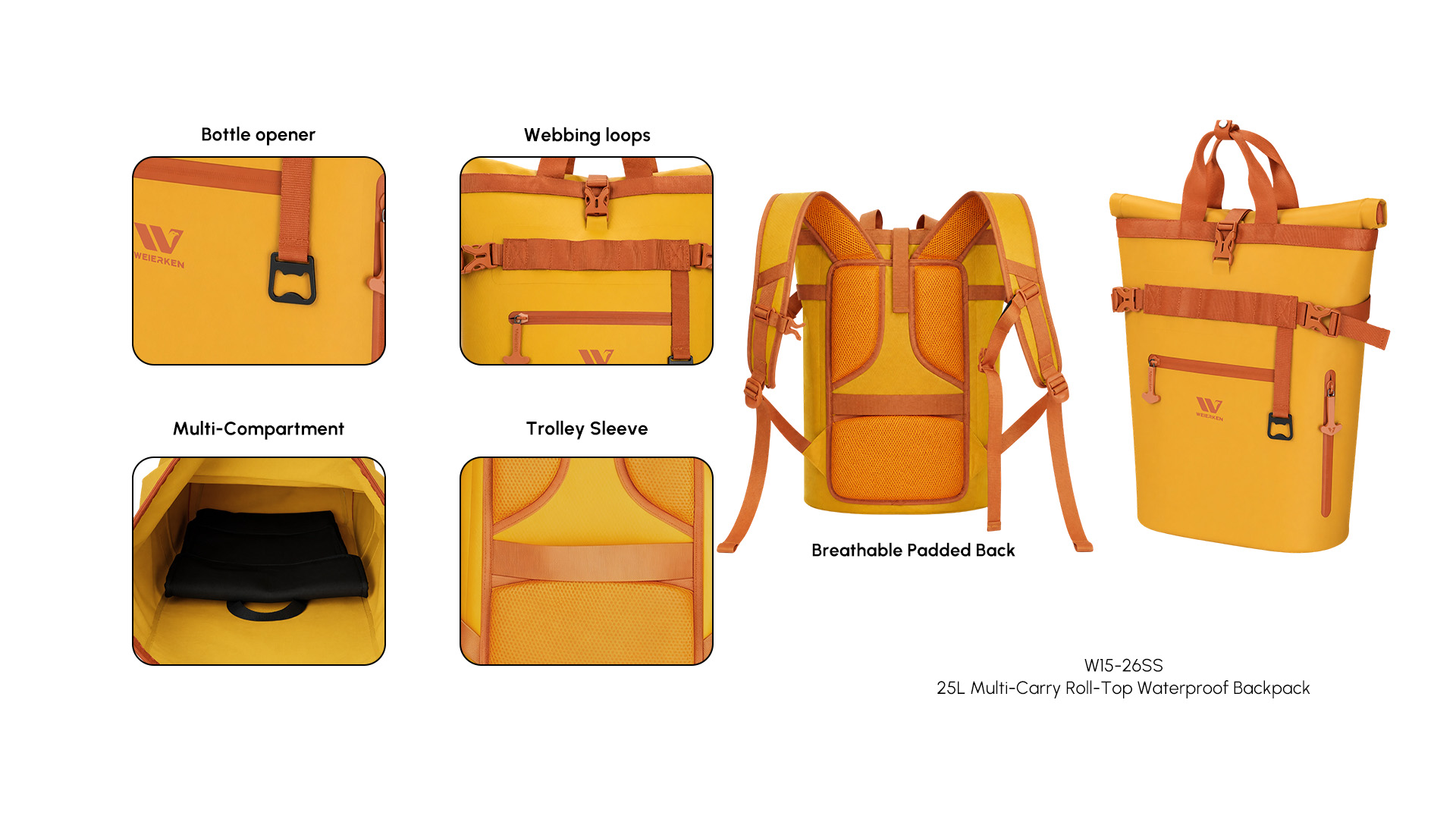
Frequently Asked Questions (FAQ)
Q1: What is the typical Minimum Order Quantity (MOQ) for custom heavy-duty roll-top dry bags?
A1: For custom shapes requiring dedicated welding molds and custom-dyed fabrics, standard factory MOQs usually range from 500 to 1,000 units per color. Simpler dry sacks using in-stock 500D PVC tarpaulin can sometimes start around 300 to 500 units. Very large commodity plants often enforce strict minimums of 3,000 units or more.
Q2: Why is high-frequency welding better than taped stitching for dry bags?
A2: Sewing creates thousands of needle holes through your waterproof fabric. Waterproof seam tape can seal those holes temporarily, but moisture, mechanical flexing, and UV exposure degrade the adhesive over time. High-frequency (radio-frequency) welding uses electromagnetic energy to fuse the thermoplastic coatings together at the molecular level. This creates a solid, permanent joint that will not peel, dry out, or leak under pressure.
Q3: How does sourcing dry bags from Cambodia reduce landed product costs?
A3: Cambodia benefits from preferential trade arrangements with several major international markets. Depending on the import destination and material specifications, products made in Cambodia often qualify for lower customs duty rates compared to direct imports from China. This duty savings directly reduces overall landed costs for commercial gear brands.
Q4: How long does it take to develop a custom roll-top dry bag sample?
A4: Turnaround depends on design complexity and tooling requirements. Basic dry bags using stock fabrics take 5 to 7 days. Technical roll-top backpacks—featuring padded shoulder straps, laser-cut MOLLE patches, welded relief valves, and custom colors—typically require 15 to 30 days. This allows time to create welding molds, build tooling jigs, and run hydrostatic leak tests.
Q5: Can roll-top dry bags achieve a certified IPX8 waterproof rating?
A5: Traditional roll-top closures reliably deliver an IPX6 rating (protection against heavy seas and powerful water jets). If submerged continuously, water can eventually weep through the center of the roll-folds under sustained pressure. To hit true IPX7 or IPX8 submersible ratings, the bag requires an airtight waterproof zipper or a specialized secondary mechanical seal built beneath the roll collar.
Conclusion: Choosing the Right Manufacturing Ally
Succeeding in the outdoor gear market requires balancing durable product design with a dependable global supply network. A high-quality heavy-duty dry bag must withstand heavy grit, rough waters, and continuous flex stress without seam failures. At the same time, your production lines must stay on schedule and navigate unpredictable global trade tariffs.
Working with a dedicated heavy-duty roll-top dry bag manufacturer that bridges advanced engineering with global operations gives your brand a clear competitive edge. Weierken provides that strategic foundation through technical mastery, rigorous 99.5% quality yields, and seamless dual-hub operations across China and Cambodia.
Ready to elevate your technical gear line for the 2026 season? Contact the Weierken engineering and sampling team today to review your tech packs, request material swatches, and receive a competitive project quote.