

Finding a reliable production partner is essential for food delivery companies and restaurant chains. The right thermal bags protect food temperature and preserve brand reputation. However, finding a high-quality take out insulated bag maker is challenging. Many suppliers promise great results, but few can meet strict global standards.
At Weierken, we know what it takes to manufacture durable thermal bags. We believe that buyers deserve complete transparency. This sourcing guide outlines the key factors you must evaluate when vetting a take out insulated bag maker.
We will examine compliance audits, material sourcing, internal testing, and prototyping efficiency. These indicators will help you separate low-cost workshops from professional factories.
1. Compliance & Social Responsibility Audits
Global food safety and labor laws are becoming more strict. A professional take out insulated bag maker must comply with international standards. Skipping this step can lead to customs delays or brand damage.
Before signing any contract, you must verify the supplier's certifications. These documents prove the factory operates legally and ethically.
Food-Grade Material Certifications
FDA Compliance: Inner lining materials must comply with FDA regulations. This ensures no toxic substances transfer to the food containers.
LFGB & REACH: For European markets, materials must pass LFGB and REACH tests. This proves the fabric is free from harmful levels of plasticizers.
Factory Quality and Social Audits
BSCI and SEDEX: These audits show that the factory treats workers fairly. It proves they follow standard safety protocols on the assembly line.
ISO 9001: This certification confirms that the factory uses a structured quality management system. It ensures consistent manufacturing standards across large batches.
GRS (Global Recycled Standard): If you order RPET bags, the take out insulated bag maker must provide GRS certificates. You should also ask for Transaction Certificates (TC) to track the supply chain.
A credible sustainable packaging supplier will share these certificates without hesitation. If a factory hesitates to provide documentation, they may be cutting corners on safety or labor standards.
2. Raw Material Control and Supply Chain Transparency
The durability of a bulk insulated cooler bag depends on what is hidden inside the layers. You cannot judge a thermal bag's performance by its outer look alone. You must examine the raw materials used in the inner layers.
A reliable take out insulated bag maker maintains a transparent supply chain. They will explain exactly where they source their materials.
Evaluating Core Components
Insulation Foam Density: Ask about the density of the Expanded Polyethylene (EPE) or Cross-linked Polyethylene (XPE) foam. Thick, high-density foam offers better thermal resistance. Low-grade foam collapses quickly under pressure.
Heavy-Duty Zippers: Zippers are the most common failure point. Check if the supplier uses recognized brands like YKK or SBS. High-quality zippers should slide smoothly for thousands of cycles.
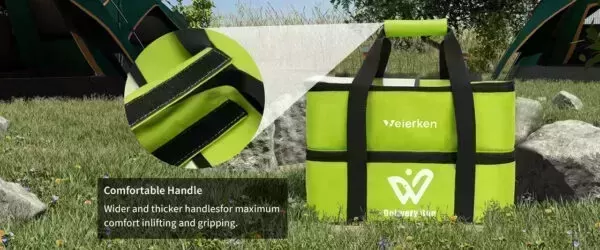
Sturdy Buckles and Webbing: The carrying handles must use high-tensile polyester or nylon webbing. Cheap plastic buckles will crack in cold weather, which can ruin deliveries.
Working with a take out insulated bag maker that sources top-tier components saves money in the long run. It prevents premature wear and reduces repair costs for your delivery fleet.
3. In-House Quality Control and Physical Performance Testing
You should not rely solely on external laboratory reports. A reputable take out insulated bag maker maintains its own in-house testing laboratory. This ensures that every production batch meets uniform standards.
Weierken uses strict internal quality control systems to check every bag. This testing protects our clients from receiving defective batches. It also guarantees that the bags can withstand daily wear and tear.
Essential Physical Tests
Thermal Retention Testing: Does the supplier use environmental chambers? They must test how long the insulated food transport bag holds warm or cold temperatures in different weather conditions.
Load-Bearing and Tensile Testing: The stitching between the handles and the bag body must undergo static and dynamic weight tests. This ensures the straps do not rip when carrying heavy containers.
Waterproof and Leak-Proof Testing: For bags with a leak-proof thermal liner, the factory must test the heat-sealed or ultrasonic-welded seams. Placing water inside the liner for 24 hours is a simple way to check for leaks.
A reliable take out insulated bag maker will gladly show you their testing equipment. They should also provide test reports for your specific production run.
4. OEM/ODM R&D and Fast Prototyping Capabilities
Every restaurant chain has unique delivery requirements. You might need custom pocket sizes, specific strap placements, or special insulation values. A skilled take out insulated bag maker must have a strong Research and Development (R&D) department.
A creative team can transform your conceptual sketches into functional prototypes quickly. They will help you balance design appeal with production costs.
R&D Performance Indicators
Pattern Room Efficiency: A professional sample department should deliver a physical sample bag within 3 to 7 working days.
Structural Optimization Advice: Experienced engineers will review your drawings. They will suggest modifications to lower production costs or improve thermal performance.
Customization Options: The supplier should offer various printing methods, such as silk-screen printing, heat-transfer printing, or durable silicone embossing.
By choosing a take out insulated bag maker with design expertise, you avoid common production mistakes. Their advice can improve the overall usability of your custom thermal carrier.
5. Production Capacity, Stability, and Flexible Manufacturing
During peak seasons or promotional campaigns, your order volumes might surge. A weak supplier will struggle to meet tight deadlines. This can cause stock shortages and hurt your business operations.
You need a take out insulated bag maker that balances high capacity with flexible manufacturing options. This ensures a steady supply of bags year-round.
Capacity Indicators
Automation Level: Check if the factory uses computer-controlled sewing machines and automatic fabric-cutting tables. Automation ensures precise dimensions and consistent stitch patterns.
Scalable Assembly Lines: The factory should have multiple production lines. They must be able to shift workers to meet urgent shipping schedules.
Reasonable MOQs (Minimum Order Quantities): The supplier should offer a clear tiered-pricing system. This allows you to start with a smaller test batch before committing to large volumes.
A balanced thermal delivery bag manufacturer can handle bulk runs of 50,000 units while remaining responsive to smaller, custom orders.
Vetting Your Manufacturing Partner
Vetting a take out insulated bag maker requires looking beyond the initial price quote. Cheap bags often use low-density foam, poor-quality zippers, and unsafe linings. Investing time to verify a supplier's compliance, materials, testing standards, and capacity ensures a stable supply chain.
Weierken is dedicated to manufacturing compliant, durable, and highly functional thermal bags. We maintain strict quality standards to protect your food and your brand image. Contact us today to discuss your project requirements or to request a product sample.
Frequently Asked Questions
How do I verify if a take out insulated bag maker uses food-safe materials?
Ask the manufacturer to provide recent FDA, LFGB, or REACH test reports for the inner lining materials. A professional take out insulated bag maker will have these test certificates readily available.
What is the difference between EPE and XPE foam in thermal bags?
EPE (Expanded Polyethylene) is lightweight, flexible, and cost-effective. XPE (Cross-linked Polyethylene) is denser, offers better insulation, and resists moisture more effectively. Your take out insulated bag maker can help you choose the right foam based on your target insulation hours.
How long does it take to produce a custom sample bag?
A well-equipped factory with an in-house pattern room can usually design and construct a custom sample within 3 to 7 working days, depending on design complexity.
Why do zippers break so easily on insulated bags, and how can I prevent this?
Zippers break due to high tension, frequent use, and low-quality materials. To avoid this, make sure your take out insulated bag maker uses reliable zipper brands like YKK or SBS and adds reinforced stitching at the zipper ends.
Can I order a small test batch before placing a large volume order?
Yes. Many manufacturers offer flexible options. You should discuss your volume requirements with a trusted take out insulated bag maker to establish a reasonable starting order.