

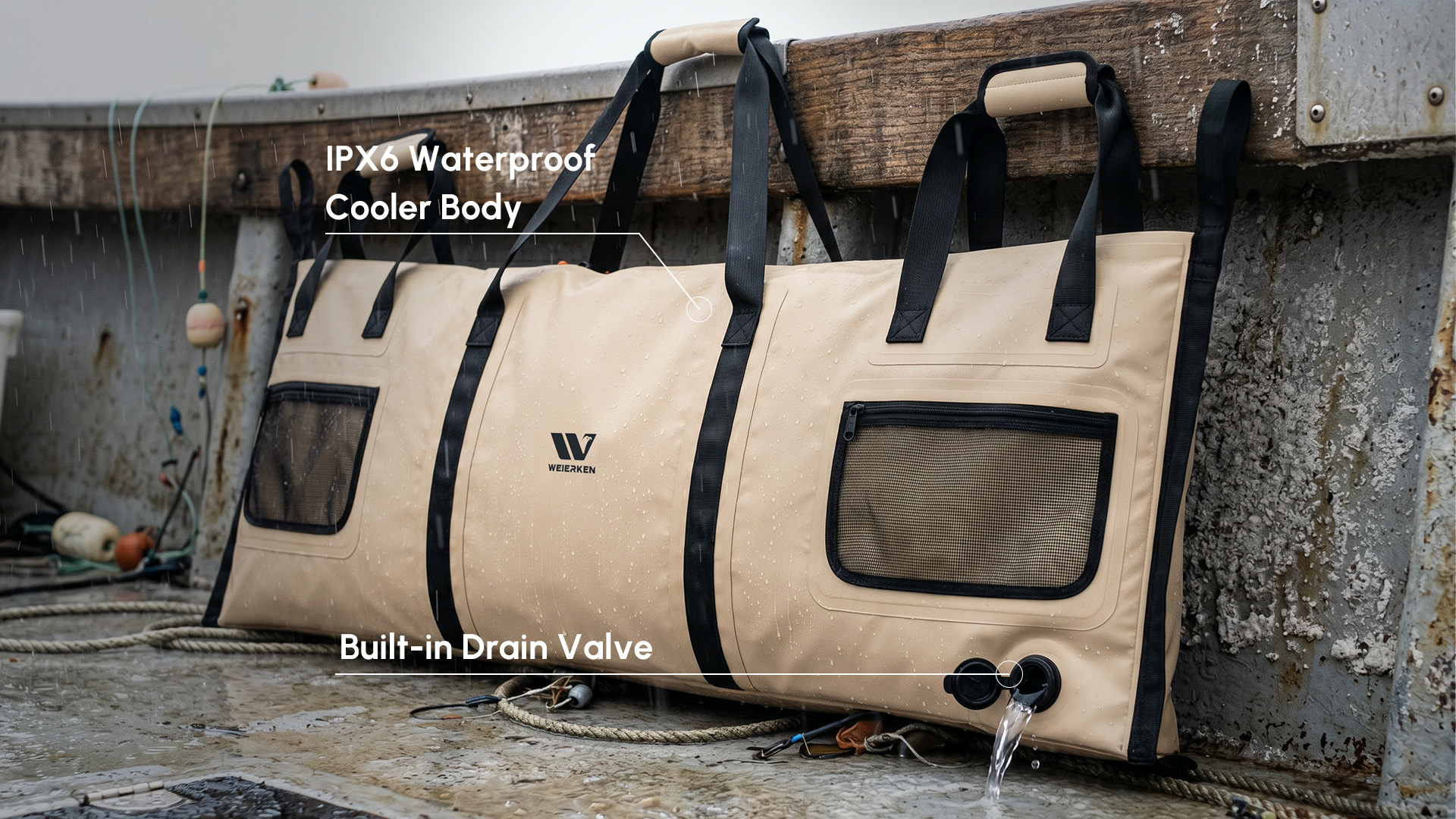
Kayak fishing puts massive stress on gear. Salt spray, intense UV exposure, and tight cockpit layouts create a brutal environment for any storage solution. Standard outdoor packs simply fail on the water.
If you run a paddle sports brand, adding private-label soft goods seems like an easy win. Yet, product managers often hit costly production bottlenecks. Sourcing custom fishing bags for kayak brands requires technical expertise, precision manufacturing, and strict quality control.
Experienced OEM manufacturers like Weierken see these issues regularly. Brands bring prototypes to the factory floor, only to realize the construction cannot survive real-world conditions. Avoiding early-stage mistakes saves months of rework, protects capital, and keeps your brand reputation intact.
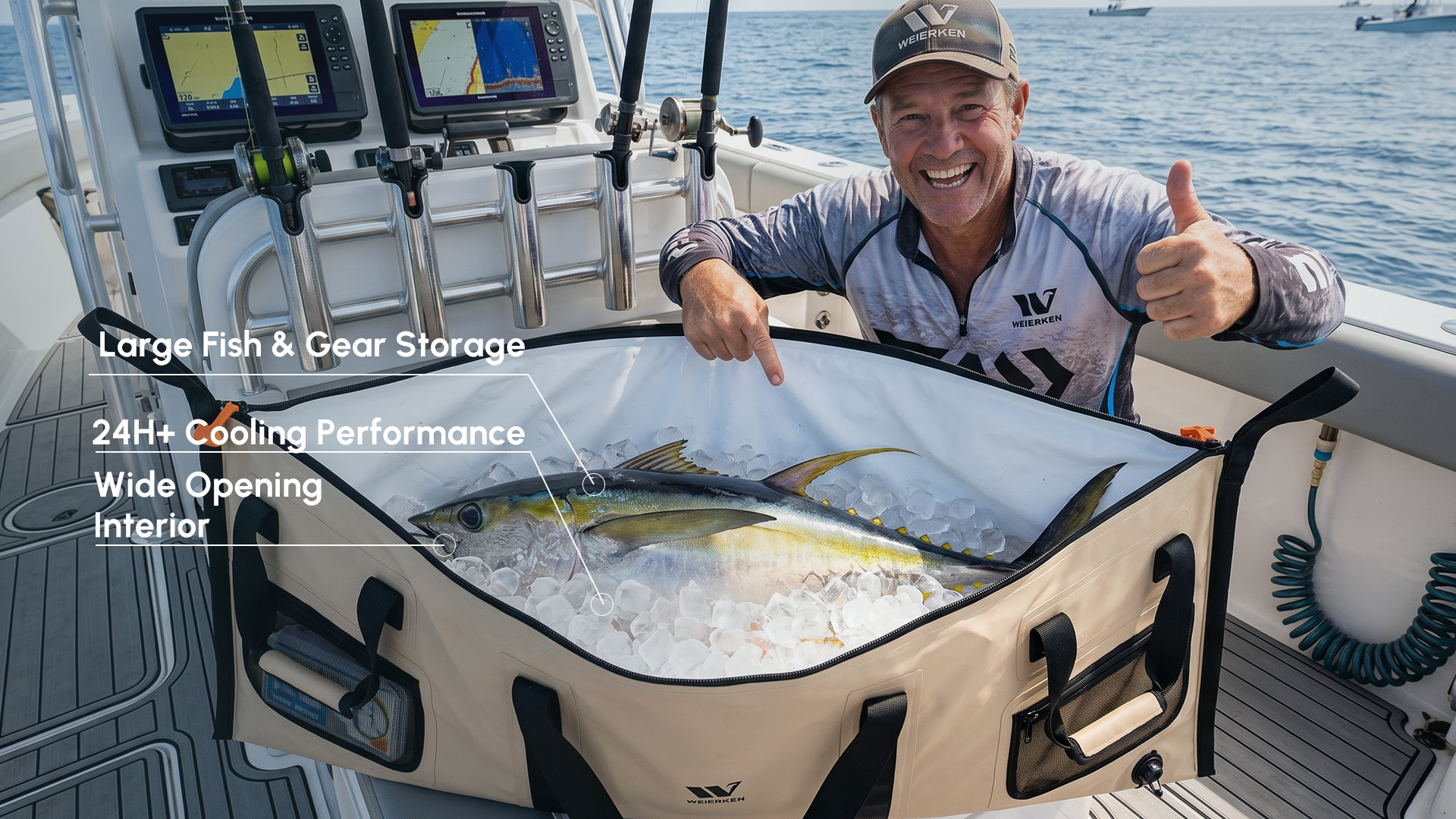
1. Ignoring the Difference Between Water-Resistant and Fully Submersible Builds
The most common mistake in tackle storage production is confusing water resistance with true waterproof performance. Kayak decks are wet zones. Water does not just splash onto gear; it pools beneath seats and crashes over gunwales.
Standard water-repellent (DWR) coatings wear off quickly under saltwater abrasion. Stitched seams, even when taped, stretch and leak under pressure. Anglers lose expensive terminal tackle and electronics, and they hold your brand accountable.
To avoid warranty returns and negative customer reviews, match your construction methods to the intended use of the bag:
- Radio Frequency (RF) Welding: Fuses TPU or heavy-duty PVC
fabrics using electromagnetic energy. It eliminates needle holes entirely,
creating an airtight, leakproof bond.
- Submersible vs. Splash-Proof Zippers: Standard coil zippers
let moisture seep through the teeth. Specify airtight, tooth-locking zippers for
dry storage compartments. Use water-resistant PU-coated zippers only for
quick-access exterior pockets.
- Seam Reinforcement: High-stress zones need bar-tacking
before welding or high-grade seam sealing to handle heavy loads without pulling
apart.
2. Overlooking Kayak Ergonomics and Cockpit Attachment Systems
A fishing bag might look great in a 3D rendering, but it becomes useless if an angler cannot secure it behind a kayak seat. Kayak cockpits have strict spatial limitations. Every brand features different hull geometry, tank well sizes, and gear track locations.
Many procurement teams make the mistake of designing a standard tackle backpack and adding rod holders as an afterthought. These designs tip over, shift during paddling, and block access to livewells or crates.
When engineering custom fishing bags for kayak brands, factor in deck compatibility from the very first CAD draft:
- Low Center of Gravity: Design horizontal, wide-base
profiles that stay planted during rough chop instead of tall, top-heavy
packs.
- Universal Lash Points: Integrate reinforced D-rings,
hypalon patch loops, and adjustable webbing straps to match standard deck
bungees.
- Track-Mount Compatibility: Build clip points that interface
smoothly with aftermarket T-bolt track systems and accessory rails.
- Single-Hand Access: Anglers balance rods and paddles
constantly. Pocket closures, latches, and zippers must operate smoothly with one
hand.
3. Choosing the Wrong Marine-Grade Materials and Hardware
Saltwater ruins cheap hardware. UV rays degrade untreated fabrics, turning durable nylon brittle within a single fishing season. Sourcing managers sometimes cut costs by approving standard terrestrial materials, which quickly leads to product failure.
At Weierken, engineering teams test materials under accelerated weathering conditions to guarantee longevity. If your factory sources off-the-shelf plastic clips and standard zinc alloy pulls, your tackle bag will corrode before the warranty expires.
Review the technical data sheet (TDS) for every component in your supply chain and insist on these marine-grade specifications:
- UV-Stabilized Fabrics: Use 500D to 1000D TPU-laminated
nylon or heavy-duty PVC Tarpaulin with built-in UV inhibitors to prevent fading
and cracking.
- Corrosion-Proof Hardware: Switch entirely to acetal, nylon,
or POM plastic buckles. If your design requires metal, demand 316 stainless
steel or anodized aluminum.
- Anti-Mildew Mesh: Use rubberized, coated mesh for drainage
pockets. Traditional cloth mesh holds water, breeds mold, and catches stray
fishing hooks.
- Molded EVA Bases: A rigid, waterproof EVA or
compression-molded bottom keeps tackle trays elevated above standing deck water
and adds impact protection.
4. Failing to Account for Factory MOQ Realities and Scaling Bottlenecks
Custom technical bags require custom tooling. Molded bases, specialized extrusions, and RF welding dies drive up initial investment costs. A major sourcing trap is designing a bag that demands high Minimum Order Quantities (MOQs) without validating production capacity first.
Some factories accept small orders, but outsource critical steps like high-frequency welding to third-party workshops. This destroys your lead times and creates massive variance in seam quality across production batches.
Before issuing a purchase order, audit your manufacturer's operational capabilities directly:
- Do they produce welded waterproof bags in-house, or do they only cut and
sew?
- Can they source specific brand-name components, or are you limited to local
generic stock?
- What are the minimum runs per colorway versus the minimum run per technical
silhouette?
- How do they manage raw material supply during peak marine retail
seasons?
5. Inadequate Prototyping and Real-World Field Testing
Never approve mass production based on a clean showroom sample. A prototype built by sample makers by hand often performs differently than units coming off a fast-moving assembly line.
Furthermore, indoor lab tests do not account for real-world fishing conditions. Anglers drag tackle bags across gravel launch points, drop them onto oyster beds, and pack them with heavy lead sinkers. If your factory skips practical field validation, your customers will find the design flaws for you.
Implement a strict sample evaluation process before signing off on final tooling:
- Hydrostatic Head Testing: Verify the fabric and seams meet
your exact water pressure ratings (such as IPX6 or IPX7).
- Salt Spray Chamber Testing: Subject all metal and plastic
hardware to a continuous 72-hour salt fog test to identify corrosion risks.
- Cycle Testing: Run zippers through thousands of
open-and-close cycles while coated in fine sand and grit.
- On-the-Water Trials: Put samples into the hands of real
kayak anglers for 30 days of sun, saltwater, and heavy fish slime
exposure.
Frequently Asked Questions
Q1: What is the ideal waterproof rating for custom fishing bags for kayak brands?
A1: Kayak deck storage bags should meet at least an IPX6 rating, meaning they withstand high-pressure water streams from any angle. For bags intended to hold sensitive electronics or sit low in wet tank wells, aim for an IPX7 submersible rating, which protects gear when immersed in one meter of water for 30 minutes.
Q2: Why is TPU often preferred over PVC for high-end kayak tackle bags?
A2: Thermoplastic Polyurethane (TPU) is lighter, more flexible in cold weather, and offers superior abrasion resistance compared to PVC. It is also more environmentally friendly, contains no toxic plasticizers, and resists UV degradation better over extended outdoor exposure.
Q3: How long does the OEM prototyping process typically take?
A3: Developing a technical kayak bag from initial tech pack to approved production sample usually takes 4 to 8 weeks. This timeline accounts for CAD drafting, custom tooling fabrication (such as RF welding molds or EVA bases), material sourcing, and physical revisions.
Q4: Can we add custom molded logos to marine-grade bags without causing leaks?
A4: Yes. High-frequency welding allows factories to bond molded rubber, silicone, or TPU badges directly onto the bag surface without puncturing the fabric. You can also specify custom-molded zipper pulls, screen prints with flexible marine inks, or embossed logos on the molded EVA base.
Q5: What are the standard lead times for mass production runs?
A5: Mass production lead times generally range between 45 and 60 days after sample sign-off and deposit receipt. Lead times can fluctuate based on the availability of technical fabrics, custom-colored hardware, and seasonal demand in the marine industry.
Build Better Technical Gear with Weierken
Designing tough, high-performance soft goods demands a manufacturing partner who understands the outdoor and marine spaces. Choosing the wrong supplier leads to leaky seams, missed seasonal launch windows, and costly recalls that hurt your balance sheet.
Weierken specializes in engineering and manufacturing high-durability waterproof bags, coolers, and technical storage gear. Our factory floor houses advanced RF welding systems, precision cutting tables, and dedicated quality-control labs to ensure your products survive the toughest coastal conditions.
Ready to engineer reliable custom fishing bags for kayak brands? Contact our product development team today to discuss your project specifications and request an initial quote.