

1. Introduction: The Booming Kayak Fishing Market & Private Label Opportunities
Kayak fishing has transformed from a niche hobby into a major segment of the outdoor recreation industry. Anglers now demand specialized equipment that withstands harsh marine environments while fitting into compact deck layouts.
For outdoor brands, distributors, and e-commerce sellers, this shift represents a lucrative opportunity. Adding private label kayak tackle bags to your catalog allows you to capture market share without building production lines from scratch.
Specialized gear manufacturers like Weierken help brands navigate this product category by providing engineering support and scalable production lines tailored to marine applications.
The Growing Demand for Specialized Kayak Tackle Bags
Standard fishing bags fail quickly on a kayak. They absorb water, corrode from salt spray, and slide around open decks during transit. Anglers want storage solutions tailored to their vessels.
Dedicated kayak tackle storage features rigid construction, waterproof materials, and attachment points that secure directly to kayak tracks or bungee systems. Sourcing custom waterproof tackle bags solves clear pain points for serious anglers, establishing strong customer loyalty for your private label line.
In-House Tooling vs. OEM Partnerships: Why Private Label Wins
Developing in-house manufacturing requires substantial capital. You must buy specialized high-frequency welding machines, hire experienced pattern makers, and manage raw material supply chains. The overhead can drain your business.
Partnering with an experienced OEM kayak fishing bag manufacturer cuts your time to market by months. You benefit from existing material supply networks, tested patterns, and established quality control protocols. This lets you focus your resources on marketing, distribution, and building brand equity.
2. Critical Technical Requirements for Kayak Tackle Bags
Before vetting suppliers, you must know what technical benchmarks separate true marine gear from basic luggage. A reliable OEM partner should speak this technical language fluently.
Waterproofing and Saltwater Corrosion Resistance
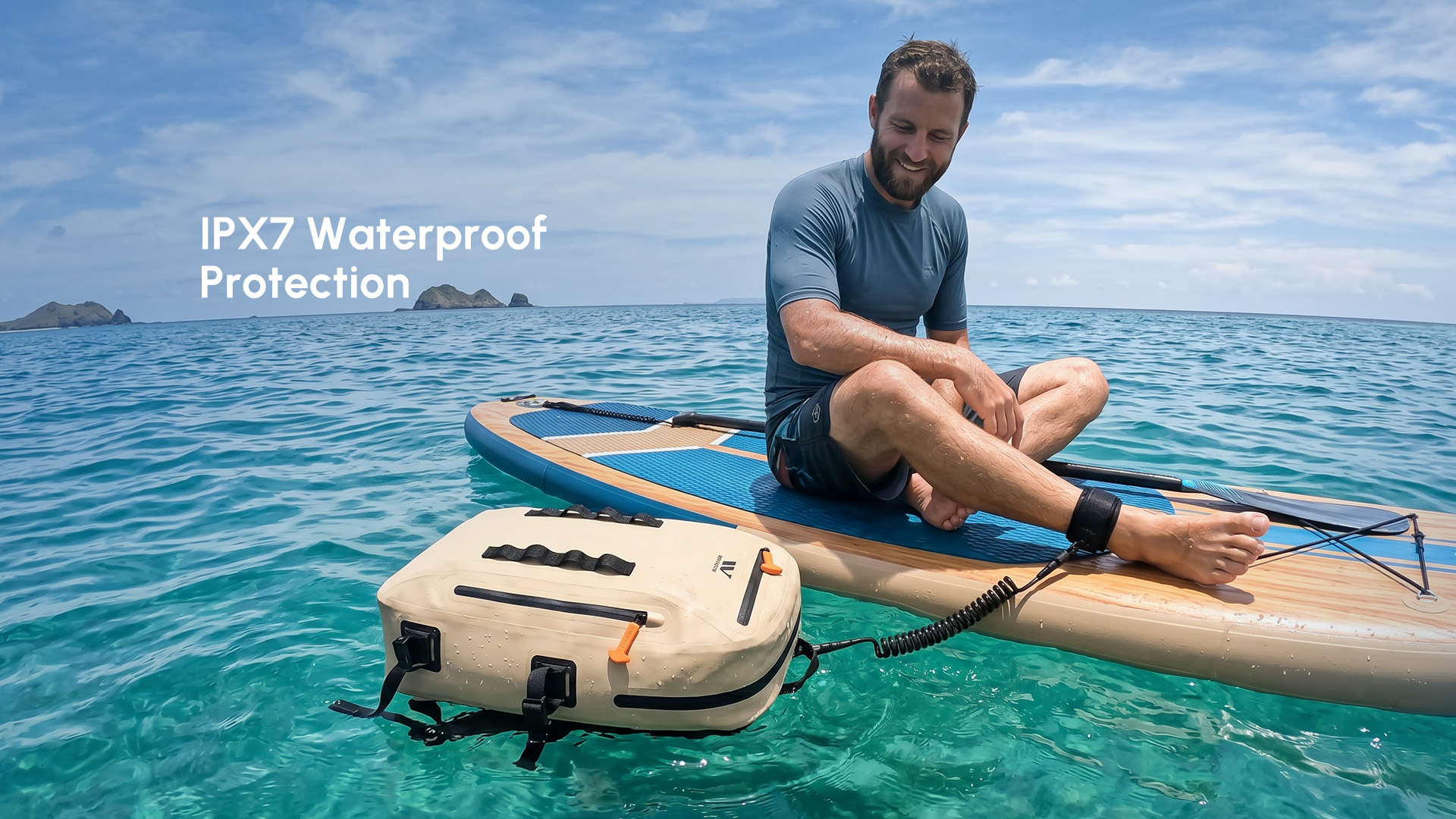
Water resistance is not enough for kayak fishing; gear routinely faces deck wash, rain, and heavy spray. Your private label fishing gear must maintain a dry interior under intense exposure.
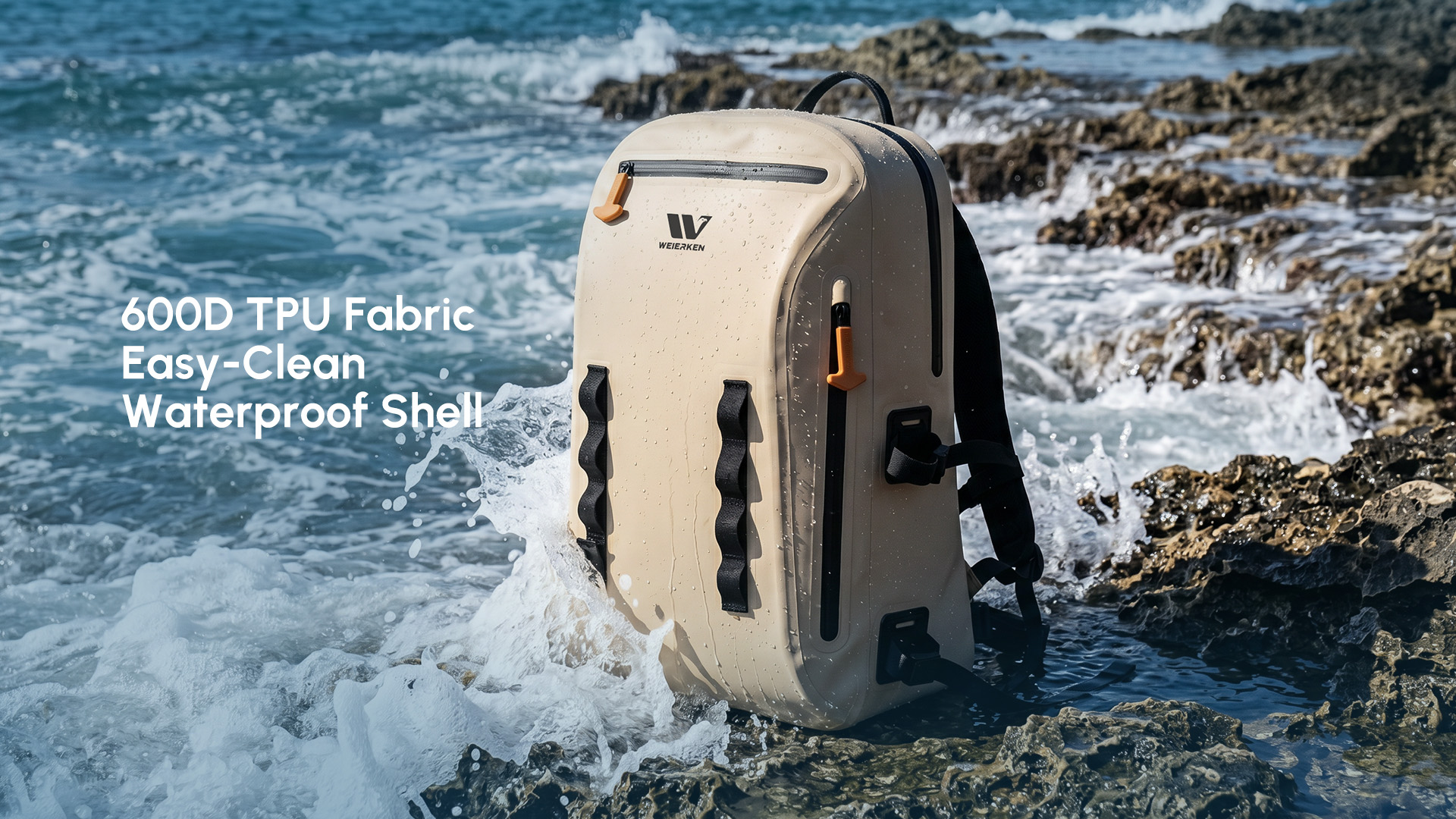
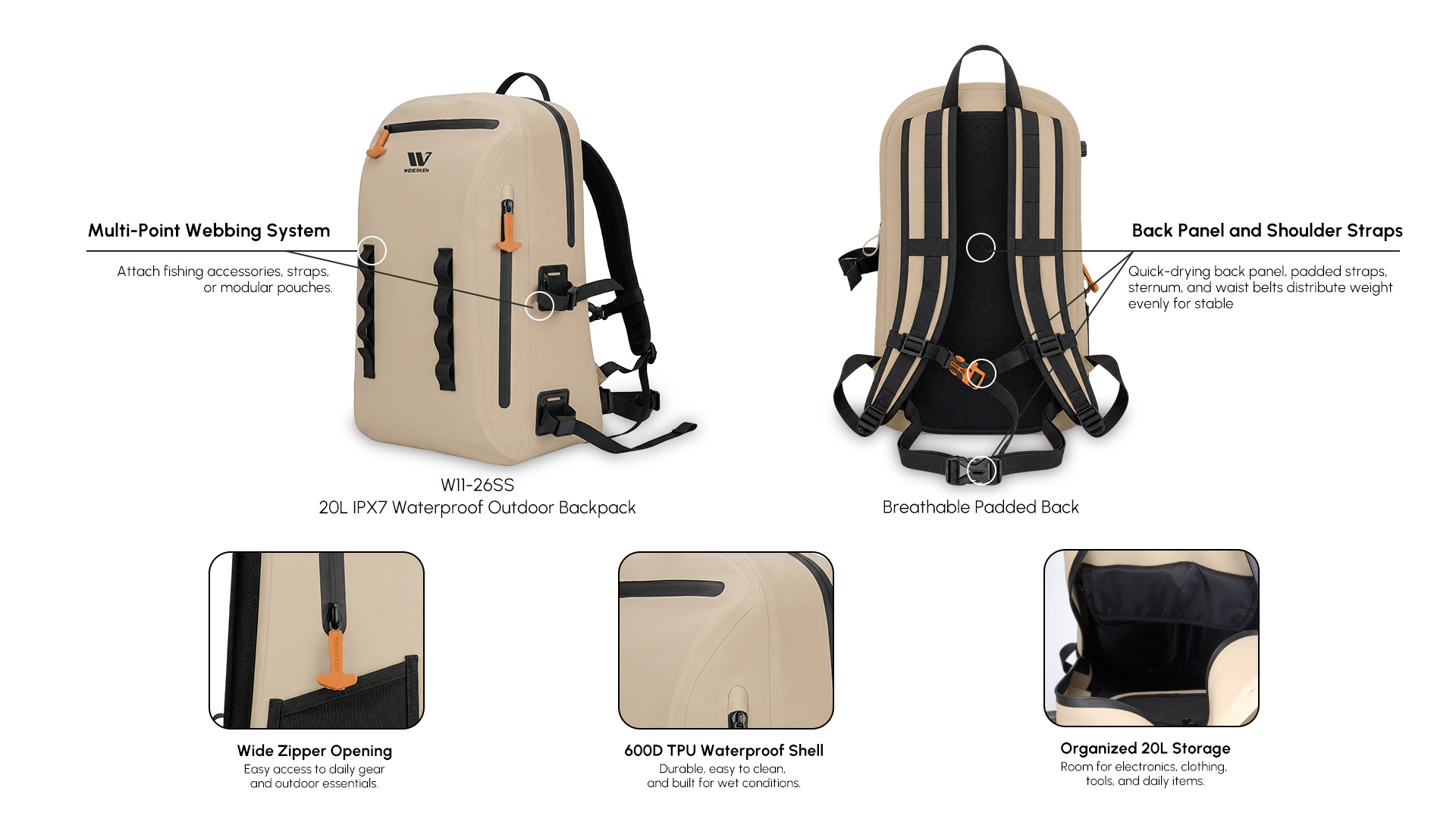
- Materials: Look for heavy-duty 500D to 840D TPU (Thermoplastic Polyurethane) or marine-grade PVC tarpaulin. TPU offers better abrasion resistance and stays flexible in cold weather, while PVC delivers cost-effective durability. Both resist UV degradation from long days on open water.
- Welding Technology: High-frequency Radio Frequency (RF) welding fuses fabric seams together at a molecular level. Unlike standard stitching, RF welded seams leave no needle holes, guaranteeing an airtight and watertight bond.
- Hardware: Saltwater destroys inferior zippers within weeks. Specify airtight waterproof zippers or heavy-duty molded nylon zippers paired with storm flaps. Ensure all clips, D-rings, and hooks use marine-grade 316 stainless steel or heavy-duty POM plastic.
Ergonomics and Kayak Deck Compatibility
Kayak cockpit space is limited. Tackle bags must integrate seamlessly with various kayak hull configurations.
- Anti-Skid Bottoms: Molded EVA or textured rubber bases keep the bag in place on wet composite or rotomolded plastic decks.
- Tie-Down Systems: Strategic D-ring placements and adjustable webbing straps let anglers secure the bag to rear tank wells or deck bungees.
- Track Compatibility: High-end bags often feature clips compatible with standard gear tracks from major kayak brands.
- Quick-Access Storage: Anglers need one-handed access to pliers, line cutters, and utility boxes (such as 3600 or 3700 tackle trays) without risking water entry into the main compartment.
3. Key Criteria for Evaluating a Private Label OEM Partner
Selecting the right factory requires looking beyond catalog photos. You are choosing a long-term operational partner whose performance directly affects your brand's reputation.
1) Industry Expertise and Product Portfolio
Never hire a generic backpack factory to produce technical marine gear. Inquire specifically about their history with watersports, dry bags, and technical fishing tackle systems.
Ask the supplier to share past projects or anonymized case studies. Inspect their seam work, zipper installations, and structural reinforcements. A seasoned kayak tackle storage supplier immediately understands load distribution, water-shedding designs, and marine wear points.
2) Depth of Customization and Prototyping
Your private label kayak tackle bags must stand out on retail shelves and online listings. Your manufacturer must provide flexible customization options for both aesthetics and functionality.
- Branding Applications: Look for factories capable of silk screen printing, UV printing, heat transfer, molded rubber patches, and debossed logos.
- Tech Pack Translation: Can their engineering team read your design files and turn sketches into working prototypes? Experienced factories catch design flaws early, such as pocket placements that collect pooling water.
- Prototyping Speed: Inquire about sample turnaround times. A capable OEM usually delivers a fully functional, branded sample within 7 to 15 business days.
3) Quality Assurance and Testing Standards
Customer returns because of leaks or broken hardware can ruin a young brand. Demand written proof of quality control procedures throughout the manufacturing process.
- Submersion and Spray Testing: Does the factory verify IPX waterproof ratings (such as IPX6 or IPX7) using pressurized spray booths or immersion tanks?
- Zipper Fatigue Testing: Zippers should undergo multi-cycle pull tests to ensure smooth operation under heavy load and tension.
- Salt Spray Testing: Metal hardware must complete 48 to 72-hour salt fog exposure tests without showing rust or pitting.
- Tensile & Drop Testing: Handles and strap attachment points should handle heavy drop and pull forces when the bag is filled with lead weights and tackle boxes.
4) Production Flexibility: MOQs vs. Scale
Your production requirements will change as your company expands. Balance low initial risk against future scaling capacity.
Early-stage brands often search for low Minimum Order Quantities (MOQs), typically around 300 to 500 units per colorway, to test market response. Established businesses need factories capable of scaling to tens of thousands of units per month without extending lead times.
Agile manufacturers like Weierken bridge this gap by offering scalable production lines. They accommodate initial product launches while maintaining the equipment and workforce required for multi-container shipments.
4. Step-by-Step Vetting Process: From Inquiry to Mass Production
Follow a structured procurement process to filter out unreliable suppliers before signing contracts or wiring deposits.
Step 1: Pre-Screening and Certifications
Create a short list of three to five prospective factories. Request basic operational details, factory size, worker headcounts, and compliance certifications.
Look for ISO 9001 certification, which confirms standard quality management systems. If your market requires strict ethical standards, verify social compliance through BSCI or SMETA audit reports.
Step 2: Sample Inspection Checklist
When you receive physical prototypes, inspect the construction closely rather than just checking the overall appearance:
- Inspect all welded seams under strong lighting. Look for air bubbles, burnt fabric, or uneven margins.
- Pull hard on the internal dividers, handles, and strap anchors. Seams should show no sign of stretching or tearing.
- Test zipper track alignment. Water-resistant zippers should glide smoothly without catching on fabric edges.
- Place dry paper towels inside the bag, seal it completely, and run it under a direct water stream for 15 minutes. Check the interior for moisture.
Step 3: Factory Audits and Supply Chain Transparency
Always audit the manufacturing facility before initiating mass production. If travel is impractical, hire a reputable third-party inspection agency like QIMA, SGS, or Bureau Veritas.
An on-site audit confirms whether the vendor actually owns their production machinery or merely acts as a middleman broker. Check their incoming raw material warehouse, clean-room welding areas, and in-line packaging quality checkpoints.
Step 4: IP Protection and Non-Disclosure Agreements
Protect your intellectual property before sharing custom CAD drawings or innovative design features. Have your partner sign a bilingual Non-Disclosure, Non-Use, and Non-Circumvention (NNN) agreement governed by the legal jurisdiction where the factory resides.
Ensure the contract explicitly states that your company owns all custom tooling, molds, and patterns developed during the prototyping phase.
5. Critical Red Flags to Watch Out For
Identifying warning signs early prevents lost deposits and inventory delays. Eliminate suppliers that show these red flags:
- The "Can-Do-Everything" Generalist: If a supplier produces tents, school backpacks, cosmetic cases, and fishing bags on the same floor, they likely lack the specialized welding tech required for marine gear.
- Suspiciously Low Bids: If one quote comes in 30% lower than the market average, the factory is likely cutting corners. They may substitute pure TPU with low-grade PVC blends or use non-marine hardware that corrodes rapidly.
- Vague Production Timelines: Reliable OEMs provide clear production schedules outlining material procurement, pilot runs, mass production, and pre-shipment inspections. Avoid suppliers who give vague delivery estimates.
- Poor Communication and Missing Technical Staff: If your sales contact cannot answer basic questions about material thickness, denier counts, or welding parameters without days of delay, solving production problems will be difficult.
6. Frequently Asked Questions (FAQ)
Q1: What is the typical MOQ for custom private label kayak tackle
bags?
A1: Minimum order quantities usually run between 300 and 1,000
units per design. The threshold depends on fabric availability. If you choose
standard factory stock fabrics and colors, suppliers can often accept lower
MOQs. Custom Pantone fabric colors and unique molds require higher initial
commitments.
Q2: How long does the entire OEM manufacturing process
take?
A2: Prototyping typically takes 10 to 20 days. Once you
approve the sample, mass production generally requires 35 to 50 days, depending
on hardware lead times and factory capacity. You should also account for 20 to
40 days for ocean freight, depending on your final destination.
Q3: Which material is better for kayak fishing bags: TPU or
PVC?
A3: TPU offers superior flexibility, excellent abrasion
resistance, and remains supple in low temperatures. It is also lighter and more
environmentally friendly. PVC is heavier, highly durable, and more
cost-effective. High-end tackle brands prefer TPU, while mid-range and
commercial utility brands often select PVC.
Q4: Can an OEM factory help design a kayak tackle bag from
scratch?
A4: Yes. Experienced marine-grade fishing bag OEM partners
provide ODM (Original Design Manufacturing) services. If you provide functional
requirements, target dimensions, and feature requests, their design team can
create 2D patterns, 3D renderings, and complete technical packages.
Q5: How do I verify that zippers are genuinely
waterproof?
A5: Ask the manufacturer for zipper cycle and pressure
test data. Authentic airtight/waterproof zippers feature vulcanized rubber or
TPU tape that seals completely when closed. You can test samples by submerging a
sealed, air-filled bag in a tank of water; no air bubbles should escape from the
zipper track.
7. Conclusion & Next Steps
Launching private label kayak tackle bags opens up a growing segment of the outdoor recreation market. Success depends on partnering with a manufacturer that understands technical fabrics, RF welding, marine environments, and strict quality control.
Focus on suppliers with proven watersports experience, clear technical communication, and verifiable testing protocols. A reliable manufacturing foundation lets you build a strong brand presence and protect your profit margins.
Weierken works directly with brand owners, distributors, and procurement teams to develop high-performance, marine-grade fishing gear. Contact our engineering team today to review your tech pack, explore custom design options, and request a detailed OEM quote for your upcoming product launch.