
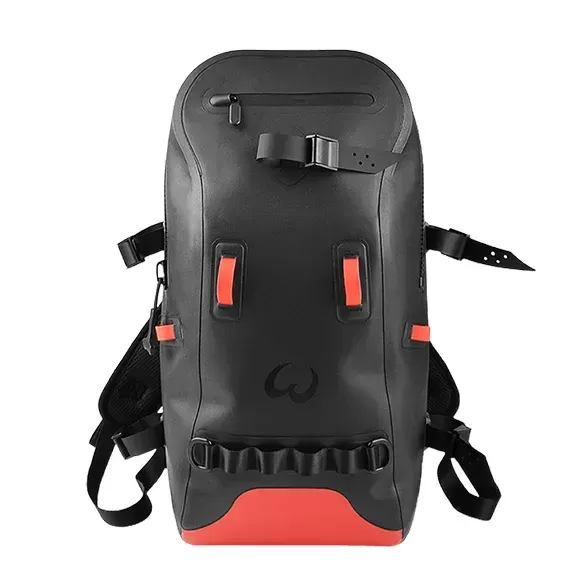
Modern anglers no longer fish in just one style. A single weekend trip often demands a switch from deep-water kayak casting to rocky bank stalking and shallow flat wading. This dynamic shift drives massive demand for versatile, modular gear systems.
For outdoor tackle brands, modular systems represent the highest growth tier in modern gear catalogs. Anglers want one foundation pack that links with detachable chest packs, modular tackle pods, rod holders, and insulated cooler bays. Delivering this level of customization requires serious manufacturing capability.
However, modularity multiplies engineering risk. More attachment points mean higher stress concentrations, complex load vectors, and strict tolerance requirements. When brands partner with standard bag factories instead of a dedicated modular fishing backpack supplier, field failures happen quickly. Straps tear, clips snap under salt crust, and seams leak.
OEM engineering specialists like Weierken eliminate these issues by treating bag construction as structural engineering. Below are the five non-negotiable technical quality specifications your supply chain must meet to build a market-leading modular platform.
1. High-Tensile Modular Attachment & Quick-Release Systems
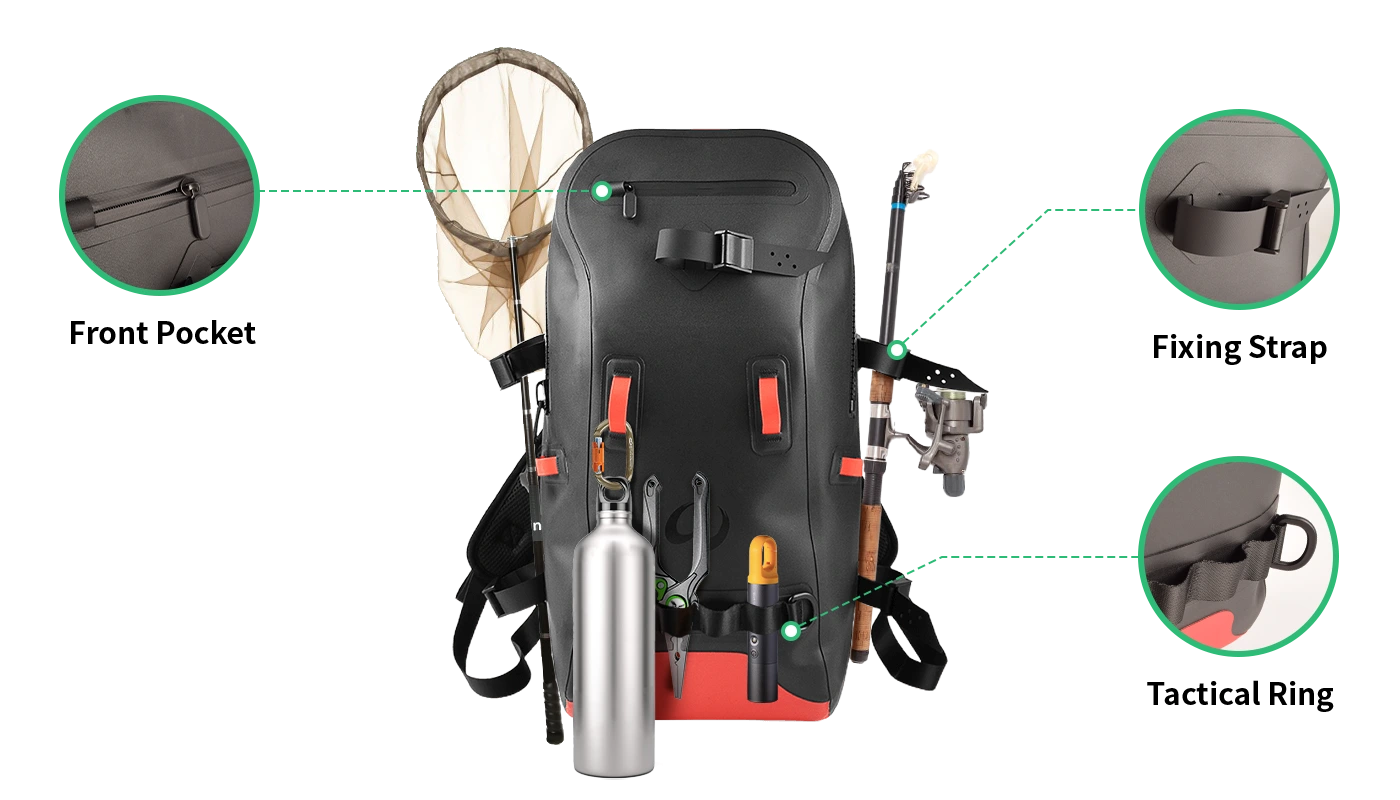
A modular tackle pack stands or falls on its connection points. If an angler connects a 3-kilogram tackle pod to the exterior, the interface cannot sag, tear, or rattle while hiking through dense brush.
Leading suppliers have moved past standard stitched nylon webbing. Traditional webbing adds bulk, absorbs water, and weakens along puncture lines. Instead, modern tactical builds utilize laser-cut composite laminates.
Laser-Cut TPU and Hypalon Matrices: Using 500D to 1000D Cordura laminated with thermoplastic polyurethane (TPU) or Hypalon creates a clean, hydrophobic anchor grid. Laser cutting seals the edges instantly, preventing fraying under high-cycle shear stress.
Tensile Resistance Standards: Every individual MOLLE/PALS laser slot must withstand direct pulling force exceeding 500N without substrate delamination or stretching.
Hardware Tolerances: Attachment points require hardware from proven names like Duraflex, ITW Nexus, or magnetic-mechanical Fidlock systems. These buckles must operate cleanly when clogged with mud, grit, or sand.
Load Verification: Your factory must conduct static hang testing exceeding 25kg on all modular harness loops to verify anchor safety margins.
A top-tier custom modular tackle backpack must also support multi-mode conversion. A detachable chest rig should unclip from the main harness and convert into an independent wading chest pack or waist pack within seconds using unified buckle geometry.
2. Waterproof Sub-Assemblies & Molded EVA Compression Base
Fishing bags live on wet boat decks, muddy riverbanks, and spray-drenched rocks. Water protection cannot be an afterthought, especially when housing electronic sensors, tackle trays, and spare spools.
A capable fishing backpack OEM manufacturer builds structural moisture barriers from the ground up, combining molded hard shells with specialized welding techniques.
Compression-Molded EVA Tub Base: The bottom panel must feature a 5mm to 8mm thick, high-density molded EVA tub. This creates an impenetrable barrier against standing water while giving the pack structural stability to stand upright on flat surfaces.
Thermal Press Bonding: The connection between the EVA base and the upper textile requires continuous waterproof tape wrapping, reinforced double stitching, or direct hot-press lamination to eliminate seam leaks.
IPX Rating Segmentation: The pack should offer zoned protection. While exterior organizer pockets provide splash resistance, dedicated electronics and dry-box zones must achieve IPX6 or IPX7 submersible ratings.
Radio-Frequency (RF) Welded Seams: For true waterproof modules, factories must utilize high-frequency RF welding or ultrasonic thermal sealing rather than mechanical needle stitching.
3. Marine-Grade Saltwater Hardware & Anti-Crystallization Zippers
Saltwater represents the most destructive operating environment for outdoor gear. Salt spray deposits crystals inside zipper coils, corrodes zinc sliders, and degrades cheap plastic resins through UV-accelerated embrittlement.
When selecting a tactical fishing backpack factory, audit their raw component sourcing and environmental test protocols rigorously.
Tooth Geometry and Coil Selection: Heavy-duty salt-resistant packs rely on large-tooth injected plastic zippers, such as genuine YKK #10 VISLON or specialized polyurethane airtight zippers. Large molded teeth resist binding even when heavy salt crust develops.
Corrosion-Proof Pullers: Standard zinc-alloy sliders will pit and freeze within months of coastal use. Specify marine-grade stainless steel (Grade 316), anodized aluminum, or non-metallic composite sliders with paracord pulls.
ASTM B117 Salt Spray Testing: All metallic D-rings, clips, swivel snaps, and zipper teeth must pass continuous 72 to 120-hour neutral salt spray tests with zero signs of red rust, white oxidation, or pitting.
Anti-Corrosion Thread: Sewing operations in coastal-rated packs must use bonded nylon or continuous-filament polyester thread treated with UV and water-repellent coatings to prevent rot.
Top development teams at Weierken maintain deep component libraries with pre-tested marine hardware to accelerate field compliance for high-end coastal gear brands.
4. Dynamic Ergonomic Load-Dispersion Suspension System
Anglers frequently carry heavy loads over rough ground. When loaded with 4 tackle trays, tools, sinkers, water bottles, and spare reels, a modular system easily weighs 15 to 20 kilograms. Adding exterior pods changes the center of gravity drastically.
An experienced modular fishing gear supplier understands that simple foam-padded straps are insufficient for multi-point modular setups.
Internal Frame Support: The foundation pack needs an integrated suspension chassis, using lightweight high-density polyethylene (HDPE) frame sheets or removable dual aluminum stays to prevent torso collapse under load.
3D Molded Air-Mesh Back Panels: High-density EVA back panels wrapped in 3D honeycomb mesh provide impact cushioning while creating distinct recessed chimney channels that circulate air across the spine.
Dynamic Weight Transfer: An ergonomic, load-bearing hip belt must route 60-70% of the gross pack weight directly onto the pelvic structure. The hip belt should include modular attachment rails for pliers and scent pouches.
Adjustable Harness Geometry: Quick-adjust torso sliders allow anglers of different heights to center the chest harness, ensuring exterior tackle pods do not pull the shoulders forward.
5. Precision Tackle Tray Tolerances & Insulated Thermal Modules
Anglers expect their backpacks to integrate cleanly with industry-standard tackle utility boxes. If the main compartment is 5mm too narrow, tackle boxes jam; if it is too loose, hard boxes shift and throw the angler off balance.
A professional factory must execute tight tolerance cut-and-sew operations while integrating insulated cold-storage zones.
Box Fitment Accuracy: The main hatch must match standard tackle box footprints (such as Plano 3700, 3600, or Meiho equivalents). Internal cavity tolerances must remain within ±3mm across high-volume production runs.
Reinforced Dividers: Internal shelf organizers must use rigid composite walls lined with loop fabric, allowing anglers to customize the compartment for reels or camera bodies without internal collapse.
RF-Welded Insulated Modules: The base or detachable side modules should offer thermal bait and drink storage. These compartments use 8mm closed-cell PE foam lined with seamless, food-grade PEVA or TPU foil.
Leakproof Performance: Insulated bait bays must hold melting ice without leaking into adjacent tackle zones, maintaining cold retention performance for 8 to 12 hours.
Supplier Capability: Evaluating Infrastructure Beyond the Spec Sheet
Engineering blueprints only succeed if the factory floor has the technical depth to execute them consistently. When evaluating a manufacturing partner, look closely at their operational infrastructure.
Rapid Prototyping (14-30 Days): Modular bag development involves complex spatial patterns. Top factories maintain dedicated rapid-sampling workshops that provide design-for-manufacturability (DFM) feedback on your tech packs within 48 hours.
Dual-Hub Global Production: Leading suppliers manage advanced R&D and material sourcing hubs in China alongside automated mass-production facilities in Southeast Asia (Vietnam or Cambodia). This structure gives brands flexible capacity and tariff advantages.
Standard Quality Certifications: Ensure your manufacturing partner holds ISO 9001 quality management standards, BSCI social compliance, and GRS (Global Recycled Standard) certification for sustainable fabric sourcing.
DDP Turnkey Logistics: A seasoned supply partner provides end-to-end Delivered Duty Paid (DDP) freight solutions, managing ocean transit, customs clearance, and inland distribution directly to your fulfillment centers.
Frequently Asked Questions (FAQ)
Q1: What is the typical lead time for custom modular tackle backpack prototyping?
A1: Standard prototyping for a fully custom modular design takes between 14 and 25 working days. This timeframe includes pattern digitization, laser-cut tooling setup, sourcing specified colorways or hardware, and building the initial sample. Revisions typically take 7 to 10 days depending on the structural changes required.
Q2: How do you prevent laser-cut MOLLE panels from tearing under field loads?
A2: We use multi-layer composite textiles, bonding 500D or 1000D high-tenacity nylon with a thick thermoplastic polyurethane (TPU) or Hypalon backing layer under high pressure. The automated CNC laser seals the textile edges during cutting, preventing yarn slippage. Each stress point is reinforced with internal bar-tack stitching on the structural base fabric behind the panel.
Q3: Can our brand configure modular bays for proprietary tackle storage shapes?
A3: Yes. Experienced manufacturers can tailor internal compartments and detachable sub-pods around your custom product dimensions. You provide the physical dimensions or 3D CAD files of your tackle boxes, battery packs, or rod tubes, and the factory will engineer internal baffles and external attachment geometry to fit them with tight production tolerances.
Q4: What testing documentation should we demand from a fishing backpack OEM?
A4: Request accredited third-party test reports (such as SGS or Intertek) covering ASTM B117 salt spray corrosion, fabric hydrostatic head ratings (ISO 811), seam tensile strength (ISO 13934), zipper cycle durability, and colorfastness under continuous UV exposure (AATCC 16).
Q5: How does dual-country manufacturing benefit an expanding tackle brand?
A5: A dual-hub model allows brands to complete complex sample engineering, material consolidation, and initial production runs in China, where technical ecosystems are fast and dense. High-volume bulk production runs can then transition seamlessly to Southeast Asian facilities to lower import duties into North American and European markets.
Scale Your Fishing Line With a Proven Manufacturing Partner
Building a successful modular tackle line requires more than basic sewing skills. It demands tight dimensional tolerances, marine-grade corrosion control, and an intimate understanding of how anglers interact with their gear in punishing environments.
As an industry-specialized modular fishing backpack supplier, Weierken helps global tackle brands turn advanced modular concepts into market-ready products. From digital pattern development and dynamic load testing to tariff-optimized production, our engineering teams safeguard your brand reputation across every production run.
Ready to build your next generation of technical tackle backpacks? Contact our OEM technical team today to submit your tech packs, review hardware samples, and receive a complete DFM assessment and manufacturing quote.