

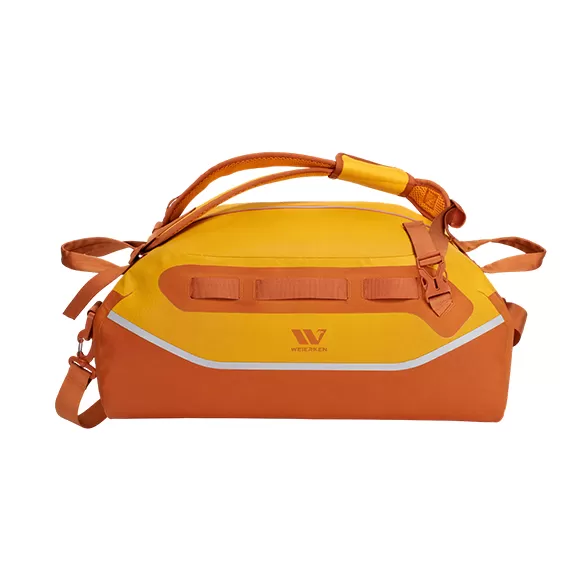
The global demand for high-performance outdoor luggage has surged. Kayakers, overlanders, commuters, and weekend travelers all want gear that keeps their contents dry through downpours, river crossings, and rough handling. If you plan to launch a new line, you already know that a simple water-resistant coating will not cut it.
Your product requires true submersible or stormproof construction. That technical journey starts with a foundational material choice: Thermoplastic Polyurethane (TPU) or Polyvinyl Chloride (PVC). Choosing the wrong coated fabric affects more than just weather resistance. It dictates your shipping weight, compliance with international safety laws, margins, and brand reputation.
At Weierken, we help global brands navigate these manufacturing decisions every day. This guide compares TPU and PVC across critical engineering, business, and regulatory parameters so you can specify the right base material for your private label waterproof travel bags.
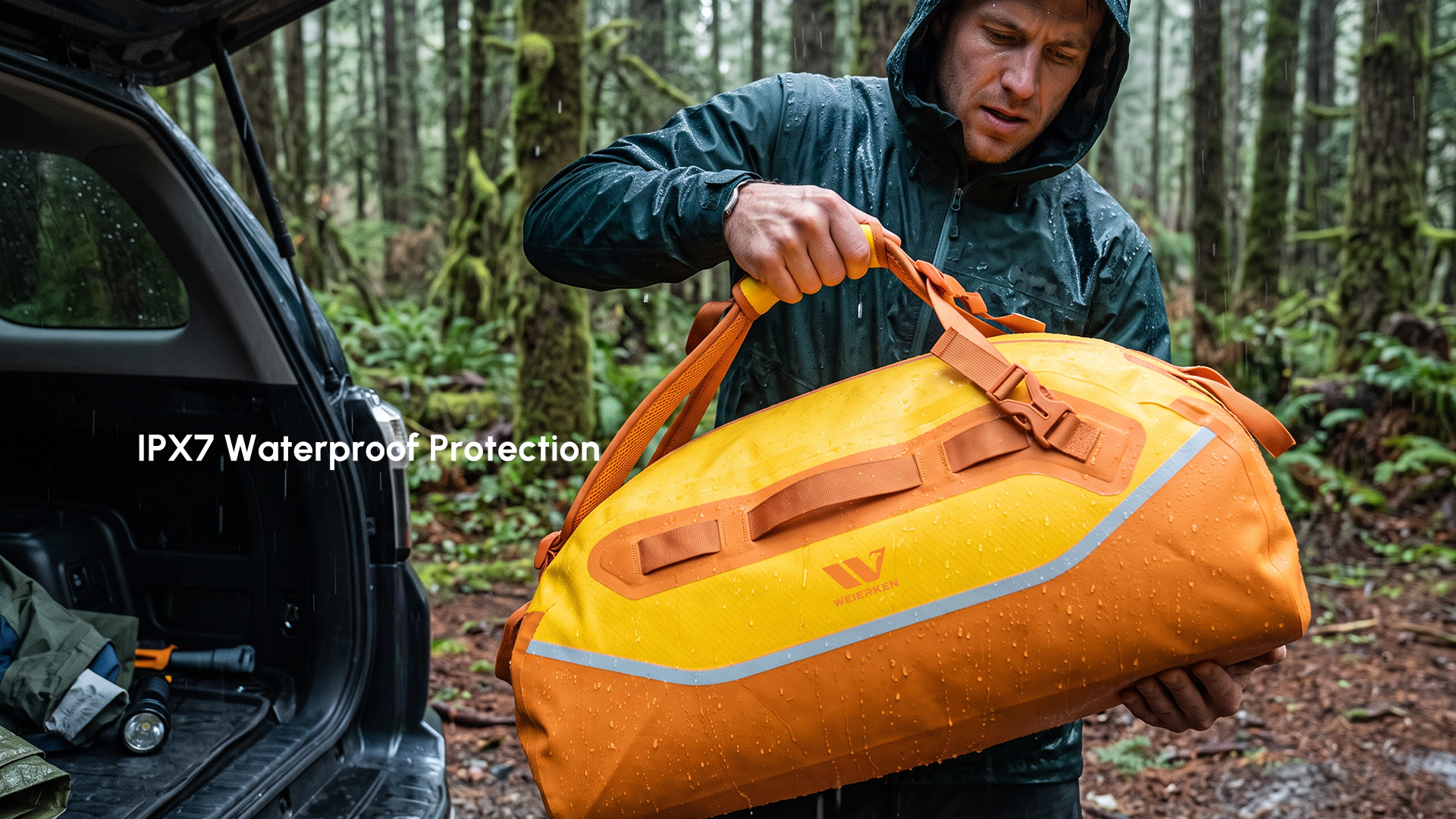
Understanding the Basics: What Are PVC and TPU?
Both materials are polymers used to coat woven scrims (usually polyester or nylon). The scrim provides tensile and tear strength, while the polymer coating creates a 100% barrier against water, air, and mud.
What Is PVC?
Polyvinyl Chloride is a traditional synthetic plastic polymer. Manufacturers have used PVC for heavy-duty dry sacks, boat tarpaulins, and industrial containment barriers for decades. Unplasticized PVC is rigid, so factories blend it with plasticizers (frequently phthalates) to make it flexible enough for duffles, backpacks, and roll-top bags.
What Is TPU?
Thermoplastic Polyurethane is a modern elastomer bridging the gap between flexible rubber and rigid plastics. It achieves natural flexibility without added plasticizers. While historically more expensive to produce, TPU has become the standard for technical outdoor equipment, military gear, and premium adventure luggage.
Direct Comparison: TPU vs. PVC in Real-World Use
When engineering private label waterproof travel bags, you must evaluate how raw materials perform in transit, on the trail, and inside luggage carousels.
1. Durability and Extreme Temperatures
Both materials offer excellent abrasion resistance against rocks, asphalt, and conveyor belts. However, their physical responses diverge when exposed to severe weather:
- Cold Weather Resistance: PVC stiffens when temperatures drop toward freezing. Below -10°C (14°F), flex-fatigue can cause PVC coatings to crack along fold lines. TPU retains elasticity down to -40°C (-40°F), making it the superior pick for winter expeditions, ski duffles, and mountaineering packs.
- UV and Heat Aging: In hot, sunny environments, traditional PVC can leach its plasticizers over time. This makes the bag sticky, brittle, and prone to flaking. TPU resists UV degradation and maintains its molecular bond much longer under direct sun.
- Tear and Puncture Resistance: TPU exhibits higher tensile strength per millimeter of thickness than PVC. You can build a thinner TPU bag that matches or exceeds the puncture resistance of a thicker PVC model.
2. Weight and Travel Convenience
Modern consumers actively optimize pack weight. Airlines impose strict baggage limits, and outdoor enthusiasts count ounces when loading roof racks or boats.
- PVC is inherently dense. A 90-liter PVC duffle bag often weighs between 1.8 kg and 2.5 kg empty.
- TPU allows you to specify lighter base fabrics (such as 420D or 840D high-tenacity nylon coated with thin dual-sided TPU). A bag with equivalent volume and tear strength can weigh 30% to 40% less.
If your brand targets minimalist travelers or backcountry explorers, TPU creates an immediate weight advantage you can emphasize on product hangtags and Amazon product pages.
3. Environmental Impact and Global Compliance
Compliance is a critical hurdle when importing private label waterproof travel bags into North America, the European Union, and Australasia. Overlooking chemical regulations can lead to customs seizures, hefty fines, or brand damage.
- The PVC Dilemma: Traditional PVC depends on plasticizers like ortho-phthalates. These substances face severe restrictions under EU REACH regulations and California Proposition 65 due to endocrine disruption concerns. Furthermore, PVC creates dioxins during production and incineration, making it difficult to market to eco-conscious consumers.
- The TPU Advantage: TPU does not require phthalate plasticizers to remain supple. It is generally free of heavy metals, chlorine, and toxic additives. Many TPU formulations are recyclable and can even use bio-based feedstocks derived from renewable corn or castor oils.
If your brand strategy centers on sustainability and non-toxic gear, TPU simplifies compliance testing and helps you meet strict retailer requirements.
4. Manufacturing, Welding, and Customization
Waterproof luggage does not rely on stitched seams. Needle holes create leak paths. Reliable construction requires high-frequency (RF) welding or ultrasonic welding to fuse coated fabric panels at the molecular level.
At Weierken, our engineering team regularly welds both materials, but they handle differently on the production floor:
- RF Welding Consistency: Both PVC and TPU react well to radio frequency energy. However, TPU offers a wider thermal processing window. It forms clean, consistent molecular bonds that resist air and water pressures under internal load.
- Tactile Finish and Hand Feel: PVC often feels slick, plastic-like, or slightly rubbery. TPU delivers a softer, matte, textile-like hand feel that looks and feels more refined.
- Branding and Color Matching: Both materials accept silk-screen printing, debossed rubber patches, and transfer prints. TPU accepts sharper matte print finishes and holds micro-molded branding elements with greater detail.
The Business Case: Costs, Margins, and Price Positioning
Your product line must make financial sense. Raw material choices directly influence unit costs, landed costs, and target retail prices.
The Case for PVC: Volume and Competitive Entry Pricing
Raw PVC fabric is significantly cheaper than TPU. It costs roughly 30% to 50% less per linear meter. This keeps unit costs low, making PVC ideal for:
- Entry-level dry bags and waterproof duffles sold through mass-market retail.
- Promotional merchandise, corporate gifts, or rental gear operations.
- Commercial, marine, and industrial workwear where bags take severe oil, grease, or chemical abuse and function as disposable equipment.
While margins per unit may be lower, high sales volume can yield dependable cash flow.
The Case for TPU: Higher Perceived Value and Healthy Margins
TPU carries higher raw resin and processing costs. However, outdoor consumers readily pay a premium for lighter, non-toxic, and flexible gear. Brands routinely price TPU travel duffles between $150 and $300, compared to $60 to $120 for equivalent PVC models.
This premium positioning easily absorbs the higher material cost, giving direct-to-consumer (DTC) brands healthier net margins and fewer warranty claims caused by cold-weather cracking.
TPU vs. PVC: Feature Matrix
| Specification / Factor | Polyvinyl Chloride (PVC) | Thermoplastic Polyurethane (TPU) |
|---|---|---|
| Raw Material Cost | Economical / Low | Moderate to High (30-50% more) |
| Finished Bag Weight | Heavier | Lightweight to Medium |
| Cold Crack Resistance | Poor (stiffens below 0°C, cracks around -10°C) | Exceptional (remains flexible to -40°C) |
| Abrasion & Puncture Resistance | Very Good | Excellent (higher tensile strength per mm) |
| Environmental & Regulatory Compliance | High risk (Phthalates, Prop 65, REACH restrictions) | Low risk (Phthalate-free, non-toxic, recyclable grades) |
| Seam Construction Method | RF Welding / Hot Air Welding | RF Welding / Hot Air / Ultrasonic Welding |
| Target Retail Positioning | Budget to Mid-tier ($50 - $120) | Mid-tier to Premium ($130 - $300+) |
Which Material Should You Select for Your Brand?
Use this simple checklist to determine which direction fits your commercial goals.
Choose PVC If:
- You are launching an introductory product line with strict capital limits.
- Your customers prioritize ruggedness over weight (e.g., commercial fishing, whitewater rafting outfitters, industrial field crews).
- Your target retail price point must stay below $80 to remain competitive on marketplaces like Amazon.
- You are building gear primarily for warm or moderate climates where sub-zero brittleness is not a factor.
Choose TPU If:
- You run an outdoor lifestyle, overland, motorcycle, or travel brand aiming for premium positioning.
- Your customers travel by air, pack light, or face extreme seasonal weather.
- Sustainability, non-toxic chemistry, and hassle-free international compliance are key parts of your marketing message.
- You plan to use airtight, submersible zippers (such as IPX7 or IPX8 systems)
that require clean bonding with technical fabrics.
Why Material Is Only Half the Battle
Specifying the best TPU or PVC roll goods does not guarantee a fully waterproof bag. Even the highest-grade material will fail if seam welding, stress-point reinforcement, and hardware integration are executed poorly.
Waterproof luggage requires specialized production techniques:
- Precision Tooling: Custom RF welding dies must distribute energy uniformly to avoid weak pinch points or scorched laminate edges.
- Airtight Zipper Integration: Installing IPX-rated zippers requires calibrated heat-welding machinery and specialized seam tape to prevent weeping along stitch lines.
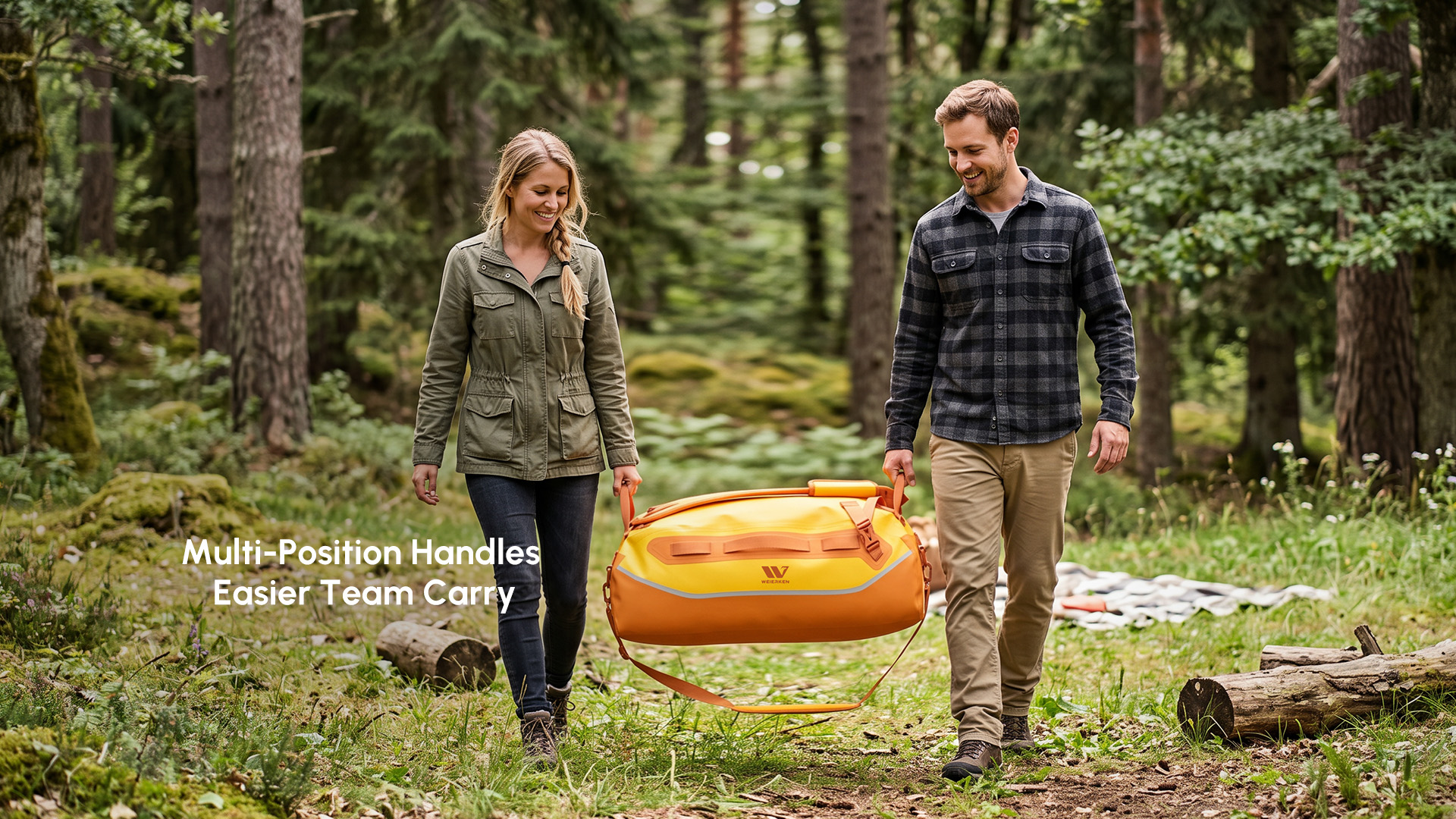
- Reinforced Load Anchors: Handle straps and shoulder harness anchors must be welded to dedicated TPU/PVC patch plates before joining the main body, ensuring load transfers do not rip the waterproof membrane.
This is why partnering with an experienced custom waterproof travel bag manufacturer is essential. At Weierken, our engineering labs run rigorous hydrostatic head tests, pull-strength validations, and flex-testing on every production run to ensure your bags withstand severe abuse in the field.
Frequently Asked Questions (FAQ)
Q1: Can I combine TPU and PVC in a single travel bag?
A1: While technically possible via mechanical fasteners or specific dual-adhesive processes, we advise against direct thermal welding between TPU and PVC. Their distinct melt temperatures and polymer structures make high-frequency bond lines unpredictable. If you want to optimize costs, consider using a single-sided TPU laminate or building a multi-tier product line featuring distinct PVC and TPU models.
Q2: How do you achieve true IPX7 or IPX8 ratings on custom travel bags?
A2: True submersible ratings require two elements: completely sealed welded seams (using RF or ultrasonic welding) and a pressure-rated airtight zipper or a properly folded roll-top closure (typically 3 to 4 tight rolls). Standard water-resistant coil zippers cannot achieve IPX7 ratings regardless of the fabric used.
Q3: What minimum order quantities (MOQ) apply to custom waterproof travel bags?
A3: MOQs typically depend on the fabric mill's custom dyeing requirements. For standard stock colors in PVC or TPU, batch sizes can start as low as 300 to 500 units per style. For custom Pantone color matching and proprietary fabric weaves, minimums generally run from 1,000 to 2,000 units.
Q4: Does TPU yellow or degrade over time?
A4: Clear or translucent TPU formulations can show yellowing over years of UV exposure. However, technical luggage typically uses pigmented, opaque TPU combined with UV-stabilizing additives. These formulations prevent yellowing, resist fading, and maintain structural integrity throughout the product life cycle.
Q5: Is TPU genuinely biodegradable?
A5: Certain specialized polyester-based TPUs are formulated to break down in industrial composting conditions or soil burial over 3 to 5 years through microbial action. However, standard polyether-based TPUs used in luggage are engineered for maximum hydrolysis resistance (preventing breakdown from moisture). They are recyclable rather than directly biodegradable.
Build Your Next Waterproof Collection with Weierken
Deciding between PVC and TPU shapes your entire product roadmap, from engineering specs to target retail margins. Whether you need a cost-effective workwear duffle or a premium, ultra-durable TPU adventure pack, working with a skilled manufacturing partner protects your investment.
Weierken provides complete OEM and ODM manufacturing services for technical dry bags, expedition duffles, and welded outdoor luggage. Our technical team supports you through fabric sourcing, RF die tooling, airtight zipper integration, and certified quality testing.
Contact the Weierken engineering team today to discuss your product specifications, review material swatches, and request a detailed manufacturing quote.