

.webp "OEM Roll-Top Backpacks for Travel Brands: From Tech Pack to Bulk Production")
Travel lifestyle brands face an ongoing challenge: designing backpacks that handle daily city transits while keeping gear bone-dry on rugged weekend escapes. Roll-top architecture solves this problem by combining variable volume with weather-resistant closures.
Turning a design concept into thousands of market-ready bags demands disciplined production management. Direct-to-consumer labels and established luggage lines rely on specialized manufacturing partners like Weierken to translate digital renderings into durable, functional gear that scales efficiently.
1. Market Insights: Why Roll-Top Backpacks Dominate the Modern Travel Segment
1.1 Scenario Adaptability and Expandable Capacity
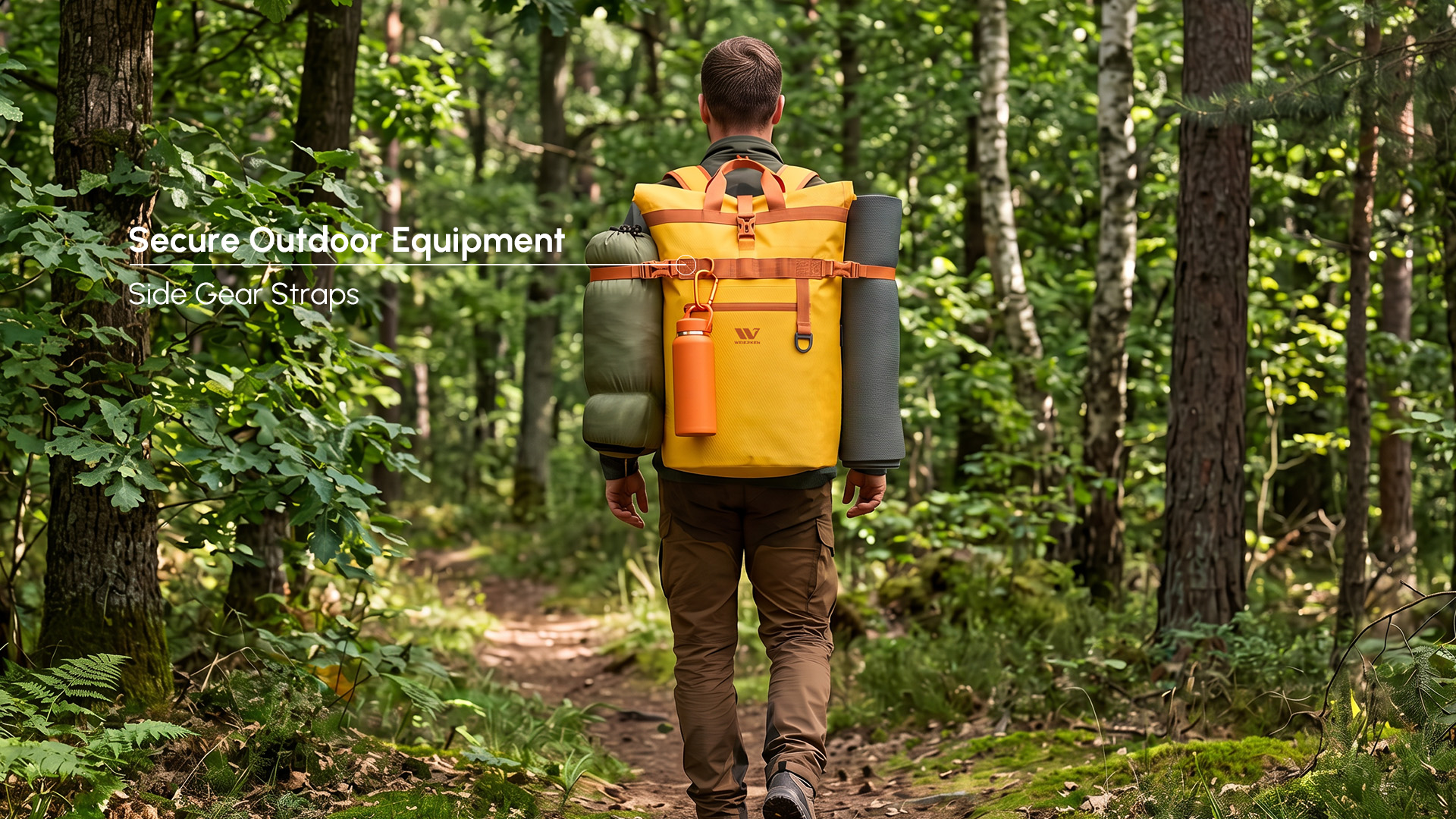
Modern travelers dislike hauling dedicated luggage for brief getaways. A roll-top bag adapts to fluctuating travel demands without adding unnecessary bulk.
- Compact Commuting (20L): Rolled tightly, the bag stays slim on subways and fits under aircraft seats.
- Extended Travel (30L+): Unrolling the collar adds instant packing space for bulky layers, shoes, or weekend gear.
- Load Stabilization: The top closure rolls down directly against the cargo, preventing loose items from shifting during transit.
1.2 Core Demands of Modern Travelers
Consumers expect functional durability paired with clean, urban aesthetics. Today's buyers want technical performance that does not look like extreme mountaineering gear.
Water-tight protection remains non-negotiable. Travel packs must protect high-value electronics from sudden downpours. Commuters also demand lightweight structures, dirt-resistant exterior coatings, and ergonomic harness systems that reduce shoulder strain.
1.3 Strategic Advantages of OEM Contract Manufacturing
Developing a custom travel backpack OEM program from scratch requires deep capital investment. Sourcing existing factory tooling helps private label brands launch faster while mitigating design risk.
Established OEM partners provide access to pre-tested harness molds, waterproof RF (radio-frequency) tooling, and stable raw material pipelines. This structural support lets brands invest their working capital into storytelling, community acquisition, and multi-channel marketing.
2. Phase 1: From Concept to a Production-Ready Tech Pack
2.1 Critical Elements of a Roll-Top Tech Pack
A vague sketch causes sampling delays, dimensional drift, and blown budgets. Your backpack tech pack guide must establish precise physical boundaries before cutting any fabric.
- Orthographic Views: Dimensioned technical flat drawings showing front, back, profile, bottom, and top perspectives.
- Dual-State Specs: Explicit dimensional height measurements for both the fully rolled state (standard capacity) and the unrolled state (max volume).
- Detailed Bill of Materials (BOM): Exact references for shell fabrics, lining, foam densities, webbings, thread specifications, and functional hardware.
- Assembly Callouts: Clear instructions regarding seam allowances, bartack placements, and edge-binding techniques.
2.2 Designing the Roll-Top Closure Mechanism
The roll collar takes the brunt of daily mechanical friction. Choosing the right hardware determines both user satisfaction and product lifespan.
- Fidlock Magnetic Buckles: Premium, self-locating closures that snap shut effortlessly. Ideal for high-end commuter and lifestyle packs.
- Anodized Aluminum G-Hooks: Minimalist and unbreakable. They eliminate plastic fatigue but require precise webbing tension loops to prevent accidental unhooking.
- Side-Release Buckles: The classic utility standard. They provide heavy-duty cinch tension, cost-effective replacement, and dual-side compression.
- Closure Fatigue Engineering: Fabric rolled repeatedly will delaminate if the composite backing is too brittle. Specify flexible TPU membranes or soft-touch PU films (0.1mm–0.2mm) at folding junctions to prevent crease cracking.
2.3 Travel-Specific Functional Details
Urban and air travelers demand quick access to necessities without unrolling the entire main compartment. Integrating dedicated entry points makes the pack truly travel-ready.
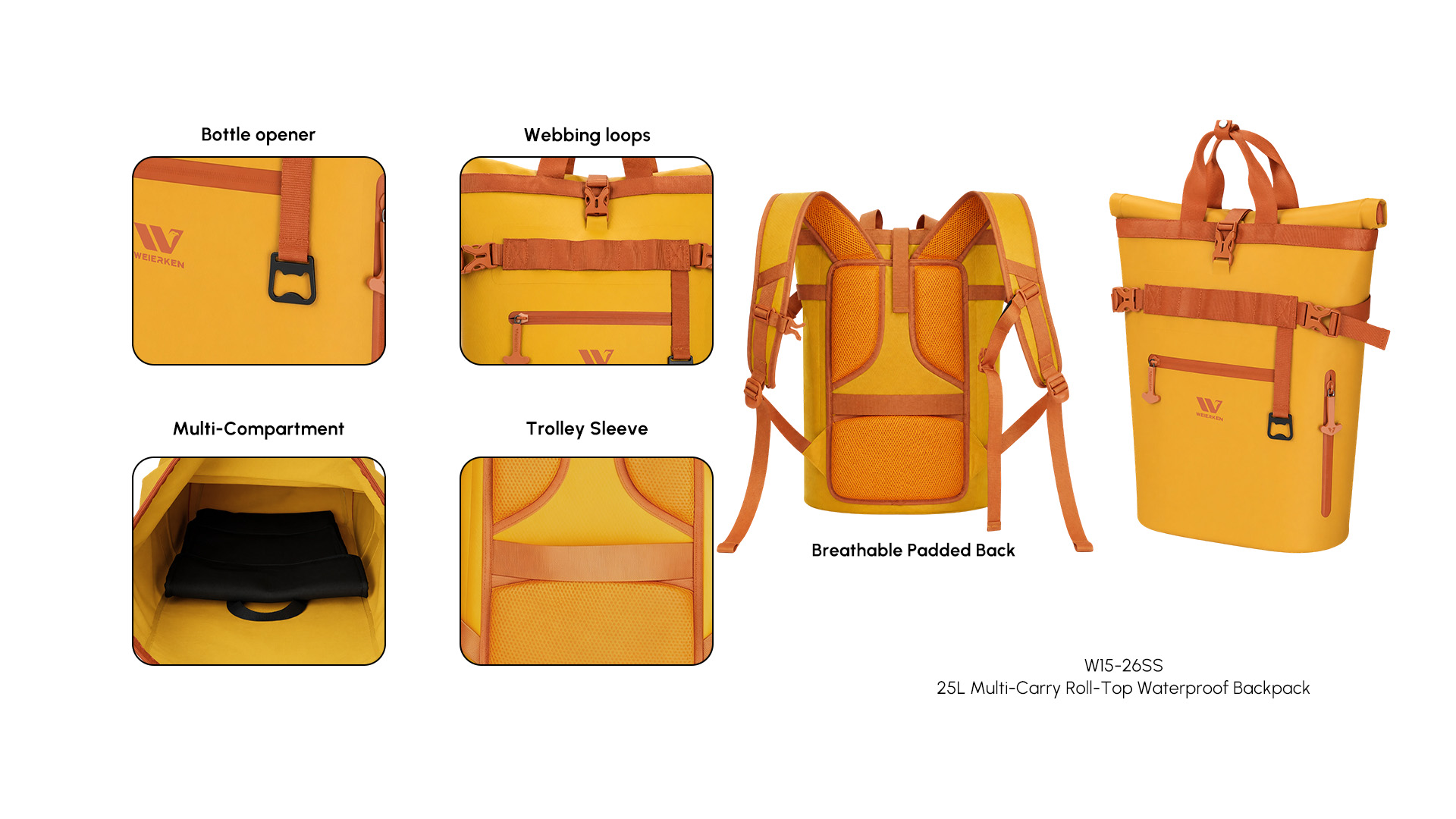
Engineers must integrate a TSA-friendly, suspended laptop compartment with independent side-zip access. Add a concealed passport pocket within the lower lumbar back panel, and reinforce a heavy-duty luggage handle pass-through strap across the back frame.
3. Phase 2: Selecting Materials and Waterproof Construction
3.1 Shell Fabric Matrix: Durability vs. Weight
Selecting shell fabrics requires balancing abrasion resistance, tear strength, total weight, and visual drape.
- Cordura Nylon (500D to 1000D): High abrasion resistance and classic matte appearance. Requires an internal PU coating or backing film for water protection.
- Ballistic Nylon (840D to 1680D): Basket-weave synthetic that handles rough conveyor belts and abrasive urban surfaces with ease.
- X-Pac and Dyneema Composite: Laminated composite textiles offering high tensile strength, dimensional stability, and ultralight weatherproofing for technical bags.
- GRS-Certified RPET (Recycled Polyester/Nylon): Recycled nylon travel pack textiles diverted from post-consumer waste, delivering sustainable credentials that align with EU eco-design directives.
3.2 Sealing and Assembly Methods: Welded vs. Taped Seams
Waterproof roll-top manufacturing relies on two core methods for keeping moisture out of the interior compartment.
- High-Frequency (HF) Welded Seams: Radio-frequency energy fuses polyurethane (TPU) coated panels at the molecular level. This creates a 100% airtight, thread-free bond capable of submersible waterproof ratings.
- Stitched and Seam-Taped Construction: Workers sew panels using standard needles, then apply hot-melt polyurethane tape over the stitch lines. This approach allows complex internal pockets and softer curves while blocking stitch-hole leakage.
- Water-Repellent Zippers: For perimeter pockets, specify YKK AquaGuard or equivalent polyurethane-laminated coil zippers with zipper garages to deflect driving rain.
3.3 Custom Ergonomic Suspension Systems
A heavy 30-liter load feels unmanageable without structured weight transfer. Travel brands must engineer back panels that control heat and cushion the spine.
Thermoformed EVA back panels provide structured air channels that pull moisture away from the wearer's back. For technical models, combine perforated dual-density foams with anti-abrasion 3D air mesh. Finish the suspension system with adjustable sternum sliders and load-bearing, stowable hip fins.
4. Phase 3: Prototyping and Sample Iteration
4.1 The Proto Sample: Verifying Form and Pattern Geometry
The first sample translates 2D tech pack measurements into a real physical volume. Manufacturers use plain-colored, in-stock fabrics to assemble this proof of concept quickly.
During this stage, designers inspect pattern drafting, roll-down clearances, and pocket clearances. If an internal laptop sleeve restricts the pack's base or pushes uncomfortably into the wearer's back, technicians redraw the paper pattern to resolve the tension.
4.2 Pre-Production (PP) Sample: Finalizing Details
Once the shape and geometry pass review, the factory builds the counter-sample using final custom-dyed fabrics, specified hardware, and brand trims. Facilities like the Weierken engineering workshop build these golden samples to benchmark line-assembly standards.
This phase locks down branding treatments: high-density silicone prints, debossed leather patches, or sonic-welded TPU labels. After the brand signs off on this unit, it serves as the Golden Sample for inbound quality control.
4.3 Factory Stress and Performance Testing
Before commissioning bulk production, reputable manufacturers subject prototype samples to accelerated stress tests that mimic years of travel wear.
- Load Drop Testing: The pack is loaded to 15kg–20kg and dropped repeatedly from a set height to evaluate handle and strap-junction integrity.
- Tensile Webbing Pull Tests: Hydraulic clamps pull shoulder strap anchor points and grab handles to verify bartack break strength (targeting >350N).
- Water Spray Testing: Packs face continuous high-pressure rain nozzles to test seam tape adhesion, zipper seal integrity, and fabric saturation.
5. Phase 4: Bulk Production and Quality Assurance
5.1 Breaking Down the Production Floor
Scaling from a single golden sample to thousands of identical units requires smooth synchronization across specialized factory cells.
- Automated Cutting: CNC laser cutters or automated die presses cut nylon rolls, ensuring edge sealing and sub-millimeter cut consistency.
- Sub-Assembly Stitching: Independent sewing lines build front organizer pockets, shoulder harness straps, and laptop sleeves concurrently.
- Sealing & Welding Station: Technicians feed panels into hot-air seam-sealing machines or high-frequency welders to lock out water.
- Final Union & Inspection: Workers sew the sub-assemblies into the main hull, invert the bag, clear loose threads, and press the seams.
5.2 Quality Control Protocols (AQL 2.5 Standards)
Professional backpack manufacturers control quality throughout the build rather than relying solely on end-of-line sorting.
- IQC (Incoming Quality Control): Technicians inspect incoming fabric rolls for color variance, yarn slips, coating peel strength, and hydrostatic head limits.
- IPQC (In-Process Quality Control): Floor inspectors audit needle density, targeting 7–8 stitches per inch (SPI). They verify that critical stress nodes receive double-stitched box-X bartacks.
- FQC/OQC (Final/Outbound Quality Control): Finished units face AQL 2.5 major / 4.0 minor inspection standards, covering dimensional stability, zipper glide smoothness, and aesthetic hygiene.
5.3 Managing Lead Times and Material Bottlenecks
Travel gear manufacturing schedules depend heavily on raw material lead times. Standard fabric dyeing takes 25 to 35 days, while specialized custom-molded buckles or custom-coated waterproof textiles can take up to 45 days.
To hit delivery windows, brands should finalize BOM specifications early. Reserving production floor capacity while materials are being milled keeps the project moving smoothly toward final assembly.
6. Phase 5: Packaging, Environmental Compliance, and Delivery
6.1 Protective and Space-Saving Packaging
Freight costs can erode retail profit margins if packaging dimensions are not managed carefully.
Brands must weigh flat-pack folding against full-stuff packing. Folding the backpack flat minimizes air freight volume and optimizes ocean container space. However, structured bags with rigid foam frames may require light paper stuffing to prevent permanent crease lines during transit. Use ventilated, biodegradable polybags to prevent moisture buildup inside shipping cartons.
6.2 Regulatory Compliance for North American and European Markets
Importing consumer goods into major retail markets requires strict adherence to regional chemical and environmental laws.
- REACH (EU): Restricts harmful plasticizers, heavy metals, azo dyes, and short-chain chlorinated paraffins in synthetic coatings.
- California Proposition 65 (USA): Mandates testing and warnings for phthalates (such as DEHP, DBP, BBP) commonly found in soft PVC and backing films.
- Bluesign & OEKO-TEX: Certifications proving textiles are manufactured free of toxic chemicals, protecting consumer health and factory workers.
6.3 International Shipping Terms
Clarifying trade terms avoids surprise border costs and operational delays.
Newer brands often choose DDP (Delivered Duty Paid) terms, letting the factory handle shipping, customs clearance, and inland transport directly to their warehouse. Growing labels moving full container loads (FCL) typically use FOB (Free on Board) terms, giving their internal freight forwarders complete control over routing and ocean carrier rates.
7. Factory Audit Checklist: Vetting an OEM Roll-Top Backpack Partner
Not every soft-goods factory can build technical travel gear. Use this checklist to evaluate prospective suppliers:
- Does the facility operate dedicated high-frequency welding and pneumatic seam-taping machines on site?
- Do their in-house pattern makers have experience translating technical 2D files into functional 3D bags?
- Can the factory source certified recycled fabrics with traceable GRS transaction certificates?
- Does the supplier maintain tiered MOQ pricing for custom backpacks to support brand growth without excessive inventory risk?
- Are documented AQL inspection records, in-house tensile test benches, and spray test chambers available for review?
8. Frequently Asked Questions
Q1: What is the typical MOQ for custom roll-top travel backpacks?
A1: Minimum order quantities for custom roll-top backpacks generally range between 500 and 1,000 units per colorway. This limit is usually driven by custom fabric dye minimums and specialized hardware runs rather than the sewing process itself. Some manufacturers offer lower entry tiers (300 units) if you select in-stock standard fabrics and existing hardware colors.
Q2: How long does the process take from tech pack submission to the first sample?
A2: Developing a first prototype usually takes 2 to 3 weeks once technical line sheets and pattern files are finalized. If your design requires specialized custom-molded components, bespoke extrusion pulls, or laboratory-matched color dips, initial sampling can extend to 4 to 6 weeks.
Q3: What construction methods are required to make a roll-top backpack truly waterproof?
A3: True IPX6 or submersible waterproof protection requires TPU- or PVC-coated textiles joined by high-frequency radio-welded seams rather than sewn threads. The roll collar must be rolled smoothly at least three to four times and fastened securely under tension. If panels are stitched together, every needle hole must be sealed with thermal polyurethane tape, and all external access points require water-resistant laminated zippers.
Q4: Where do manufacturing defects most commonly appear on roll-top backpacks?
A4: Defects show up most frequently at the intersection where the roll collar connects to the main back panel, along the strap-anchor load points, and at seam-tape edges. If the collar fabric is too stiff, repeated folding causes the laminate to bubble and crack. Factories prevent these issues by balancing fabric temper, reinforcing stress nodes with internal webbing backing, and calibrating seam-taping temperatures to match the fabric.
Q5: What technical details are most frequently omitted from backpack tech packs?
A5: Brand design teams often forget to specify stitch density (SPI), internal seam binding materials, foam densities (such as open-cell PU versus closed-cell high-density EVA), and pull-tab bartack coordinates. Designers also frequently overlook the open height versus rolled height dimensions, leaving the factory to guess the folding clearance.
Partner with an Experienced Backpack Manufacturer
Launching a reliable travel backpack demands precision at every stage, from selecting abrasion-resistant fabrics to setting up seam-taping lines and managing final inspections. Partnering with an experienced manufacturer like Weierken ensures your designs translate into durable, production-ready products that perform in the field.
Ready to build your next travel pack? Send us your tech pack or design brief today to request a quote and schedule an engineering review.