
When a leisure backpack fails, a jacket gets damp. When a marine duffel fails miles offshore, the consequences are disastrous. Saltwater destroys satellite communicators, spares, and dry layers. For a boating brand, that failure results in immediate warranty claims, one-star reviews, and a ruined reputation.
Many factories claim they make dry bags. They show shiny samples in air-conditioned showrooms. Yet, put those same bags on a salt-crusted sailboat deck under the baking sun, and the seams split within weeks. Marine environments do not forgive cheap shortcuts.
High-end boating brands and yachting equipment labels cannot rely on generic bag suppliers. You need a dedicated waterproof duffel manufacturer for boating brands who understands failure analysis and marine engineering. At Weierken, we analyze destroyed prototypes to understand why gear fails—and how to build bags that survive the open ocean.
1. Anatomy of Failure: Why Do Marine Waterproof Duffels Break Down?
To vet a manufacturing partner, you must first understand the physics of marine bag destruction. Standard luggage designs fail on boats because boats inflict dynamic, multifaceted abuse.
Seam Splitting Under Heavy Loads
A 70-liter expedition duffel regularly carries 25 to 30 kilograms of damp, dense sailing kit. When crew members toss that loaded bag into a tender or lash it to a deck rail, internal pressure spikes dramatically.
Traditional sewn-and-taped seams simply peel apart under this dynamic tension. Cheap thermal hot-air tape dries out, crystallizes from salt exposure, and releases. If an RF (radio-frequency) welded seam is too narrow or overheated during production, the fabric edges become brittle and sheer off along the weld boundary.
Waterproof Zipper Failure
Zippers represent the most vulnerable interface on any marine bag. Failure usually happens in three ways:
- Salt crystallization: Dried saltwater leaves abrasive crystals that grind the zipper teeth apart, derailing the slider.
- Terminal end leakage: The U-shaped sealing dock at the zipper terminal is poorly molded, letting water wick inside when submerged.
- Cross-load tension blowouts: When a stuffed duffel is zipped shut, the lateral pull separates the teeth from the waterproof tape substrate.
Deck Abrasion & Puncture
Fiberglass non-skid deck patterns act like 60-grit sandpaper. Crew members drag heavy bags across cockpit floors, over aluminum toe rails, and through tight companionways.
Low-grade PVC or single-side PU coatings wear through quickly. Once the protective coating abrades away, water migrates along the interior scrim through capillary action, saturating everything inside.
Handle & Strap Delamination
Nothing looks worse on a premium product than a torn shoulder strap. Many factories make the mistake of welding nylon webbing patches directly onto the bag surface using only surface heat.
Pure surface welds without internal structural reinforcement fail when subjected to cyclic lifting loads. The top layer of the fabric tears away from the internal yarn grid, resulting in total delamination.
2. Core Technical Capabilities Required for Marine Duffel Manufacturing
Building heavy-duty marine luggage requires equipment and know-how that standard cut-and-sew factories do not have. Look for these baseline technical proficiencies.
Multi-Axis 3D RF Welding
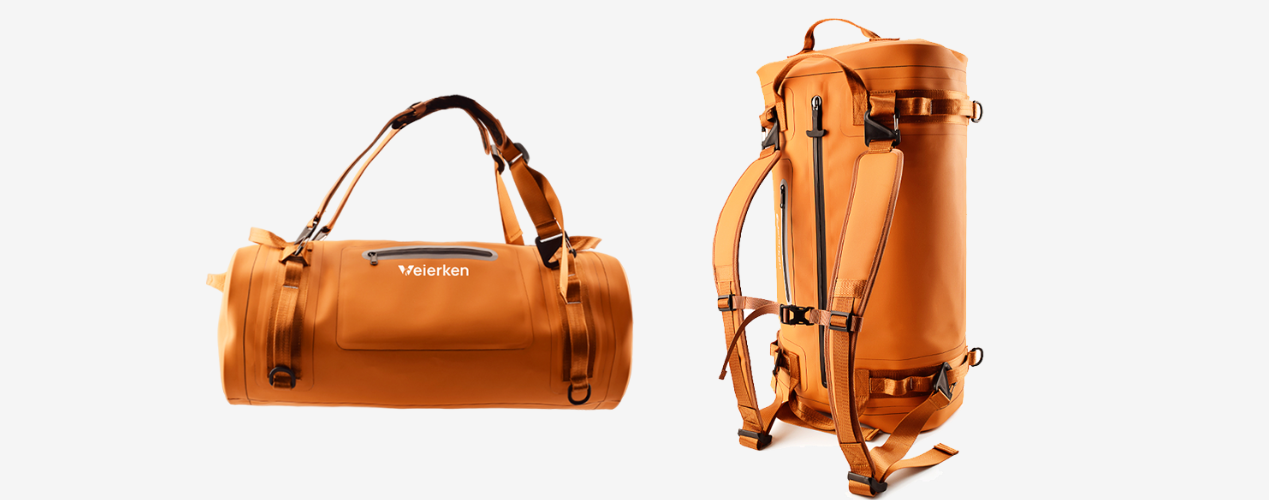
A simple cylindrical dry roll-bag is easy to produce on a flat-bed high-frequency welding machine. A structured duffel bag is an entirely different engineering challenge. Duffels require cubic geometry, reinforced box corners, internal dividers, and curved contours.
A qualified marine gear factory must utilize multi-axis 3D RF welding tools and custom-cast aluminum tooling. This allows uniform pressure application along three-dimensional seams, eliminating weak points and cold-weld spots.
Airtight Zipper Installation Precision
Installing gas-tight and airtight zippers—such as TIZIP MasterSeal or YKK AquaSeal—demands zero-tolerance execution. These technical components cannot be stitched onto the bag body without puncturing the waterproof barrier.
At Weierken, our engineering teams use automated programmable heat-press fixtures to integrate zipper tapes directly into thermoplastic polyurethane (TPU) panels. The heat, pressure, and dwell time must balance perfectly so the polymer flows into the zipper tape without warping the teeth.
Reinforced Stress-Point Architecture
Top-tier marine bags use a sandwich reinforcement strategy for load points. When evaluating a heavy-duty marine luggage manufacturer, check their structural layers.
Properly built bags do not attach handles directly to the main body panel. Instead, they feature an RF-welded anchor pad, backed by an internal tear-stop reinforcement fabric, secured with box-X stitching sealed behind a welded waterproof barrier. This design spreads the dynamic load over a wide surface area.
3. How to Vet a Waterproof Duffel Manufacturer for Boating Brands: 5-Step Checklist
Follow this five-step audit process before signing a manufacturing agreement or releasing deposit payments.
Step 1 - Audit the Raw Material Supply Chain
Marine gear demands raw materials tested specifically for long-term ocean exposure. Ask your prospective manufacturer for technical data sheets covering:
- Base Fabric: 840D to 1680D high-tenacity nylon or polyester coated with double-sided ether-based TPU (ester-based TPU breaks down faster through hydrolysis).
- Hardware: Marine-grade 316 stainless steel d-rings, anodized aluminum gate hooks, or genuine acetal/Duraflex plastic hardware that resists UV embrittlement.
- Reinforcements: Hypalon or heavy chlorosulfonated polyethylene (CSM) wear patches placed on high-friction corners and bottoms.
Step 2 - Inspect In-House Testing Equipment
Never rely on a factory that outsources all its quality testing. A capable waterproof duffel manufacturer for boating brands keeps specialized testing gear directly on the factory floor:
- Hydrostatic Head Tester: Proves whether materials withstand water pressure above 10,000mm to 20,000mm H2O.
- Positive Pressure Submersion Tank: The bag is filled with air to 3–5 PSI and submerged underwater. Any rising air bubbles expose seam or zipper leaks instantly.
- Salt Spray Corrosion Chamber (ASTM B117): Verifies that zippers, pull tabs, and clips survive hundreds of hours of salt-fog without rusting or seizing.
- Tensile & Drop Test Rigs: Measures the sheer force needed to rip handles away from the chassis when the bag is fully weighted.
Step 3 - Scrutinize the Sample & Prototyping Quality
When you receive a golden sample, dissect it with a critical eye. Do not just look at it from the outside; turn it inside out.
Look for clean weld lines without burnt, yellowed edges. Squeeze the welded joints with your fingers to ensure the material melted into a unified matrix rather than just sticking together lightly. Inspect the ends of the zipper run. There should be zero excess glue spillover, misaligned teeth, or loose edge trimmings.
Step 4 - Verify Real Boating Market Experience
Ask for real case studies. Has the factory built equipment for technical sailing teams, offshore rescue agencies, kayak expeditions, or military maritime units? Factories rooted in basic promotional gear cannot handle the safety demands of offshore marine hardware.
Experienced manufacturers will critique your original tech packs. They will spot impossible weld curves, identify zipper stress points, and recommend functional improvements before tooling begins.
Step 5 - Minimum Order Quantities (MOQ) vs. Scaling Capacity
High-end technical duffels require high initial setup costs due to specialized welding molds. Clarify the production numbers early:
- What are the tooling mold fees for custom shape welding?
- Can they offer flexible MOQs (e.g., 300 to 500 units per color) for market validation runs?
- Do they run dedicated assembly lines to scale into thousands of units during
peak marine retail seasons without missing delivery dates?
4. Supplier Red Flags: When to Walk Away Immediately
If you encounter any of these three signs during supplier vetting, halt discussions immediately:
- The "Stitched and Taped" Bait-and-Switch: The supplier claims their traditional sewing machine line can achieve "100% airtight performance" simply by brushing liquid sealant over the needle holes. This will fail on salt water decks.
- Missing Testing Data: The factory cannot provide in-house pressure-drop logs or refuses to perform an underwater leak test on your initial sample.
- Repurposing Dry Sack Blueprints: They attempt to build your technical duffel using thin 210D or 500D PVC without bottom reinforcement, treating an offshore duffel like a cheap beach bag.
Frequently Asked Questions (FAQ)
Q1: Why is TPU preferred over PVC for marine-grade waterproof duffel
bags?
A1: While PVC is cheaper, TPU (Thermoplastic Polyurethane)
offers much higher abrasion resistance, better flexibility in cold weather, and
superior resistance to marine engine oils and fuels. Ether-based TPU also
resists microbial attack and hydrolysis, preventing the sticky breakdown often
seen in older PVC bags stored in humid boat lockers.
Q2: What is the difference between a water-resistant and an airtight
waterproof zipper?
A2: Water-resistant zippers (like standard
reverse-coil PU-coated zippers) only repel rain and light spray; they leak under
standing water or submersion. Airtight zippers (such as TIZIP or
tooth-interlocking pressure seals) use vulcanized rubber or TPU lips that seal
completely shut under pressure, preventing water ingress even when fully
submerged.
Q3: How does high-frequency welding create a stronger bond than
stitching?
A3: Stitching creates thousands of tiny holes in the
fabric that must be sealed with tape. High-frequency (RF) welding uses
electromagnetic energy to agitate the polymer molecules in coated fabrics,
fusing the two layers into a single homogeneous piece of material at the
molecular level. The seam becomes as strong as the fabric itself.
Q4: Can our brand supply custom marine hardware for
production?
A4: Yes. A flexible marine gear manufacturer will
happily integrate your proprietary branded pullers, custom CNC-machined 316
stainless clips, or specialized molded handles. However, your supplier must test
the compatibility of your custom components with their welding and attachment
processes.
Q5: What standard lead times should we anticipate for custom tooling
and production?
A5: Developing custom RF welding molds, prototyping,
and pressure testing typically takes 4 to 6 weeks. Once golden samples are
approved, mass production usually runs between 45 to 60 days, depending on
technical material availability and custom color dyeing requirements.
Build Marine Gear That Survives the Open Ocean
Choosing your manufacturing partner is one of the most critical product decisions your boating brand will make. The ocean quickly exposes weak engineering, poor materials, and cheap shortcuts. By auditing factory capabilities, insisting on high-frequency 3D welding, and demanding rigorous pressure testing, you protect your brand from catastrophic product failures.
Do not wait for customer returns and critical gear breakdowns to reveal the flaws in your supply chain. Partner with an experienced waterproof duffel manufacturer for boating brands who builds for the marine environment from the first stitch to the final weld.
Ready to elevate your marine product line? Contact the engineering team at Weierken today. Send us your tech packs or sample concepts, and request a comprehensive design-for-manufacturing (DFM) assessment and production quote.