
Many logistics operators treat courier bags as disposable consumables. Fleet procurement teams buy the lowest-bid bags, distribute them to riders, and replace them three months later when seams burst or zippers freeze. This cycle bleeds cash.
A failed delivery bag costs far more than its unit purchase price. Broken shoulder straps force couriers off their shifts. Crushed cargo leads to customer refunds. Water leaks turn warm meals into cold, soggy disasters that ruin your brand reputation.
Leading platforms and commercial couriers now take a different route. They treat logistics gear as infrastructure. Partnering with an engineering-focused bike delivery bag OEM like Weierken allows fleet operators to design custom gear that withstands daily road abuse and lowers the true cost per delivery.
The Hidden Costs of Cheap Delivery Backpacks
When you evaluate equipment strictly on invoice price, you miss the larger financial leak: Total Cost of Ownership (TCO). A $20 delivery bag that fails after 90 days creates three hidden operational liabilities:
Rider Attrition and Injury: Flimsy backpacks carry weight unevenly. Poor ergonomics cause lumbar fatigue and shoulder strain, accelerating driver turnover in an already tight labor market.
High Order Spoilage Rates: Inadequate wall stiffness allows food containers to slide, flip, and spill under hard braking. Defective thermal insulation turns chilled grocery drops lukewarm.
Administrative Procurement Drag: Sourcing, processing purchase orders, storing, and distributing replacements three to four times a year drains operational bandwidth.
Switching to a capable commercial delivery backpack manufacturer stops these losses. Rugged gear keeps your riders productive, protects goods in transit, and cuts annual replacement budgets.
Engineering Durability: What Sets Industrial Gear Apart
To vet a bike delivery bag OEM effectively, procurement managers must look past product catalogs and understand the physical construction of industrial textile gear. Here are the core engineering standards that separate commercial equipment from retail imitations.
1. Fabric Science: TPU/PVC Tarpaulin vs. Standard Oxford Cloth
Standard consumer backpacks use 420D or 600D Oxford polyester coated with polyurethane (PU). This fabric is lightweight, but it degrades quickly under commercial conditions. Ultraviolet rays weaken the weave. Road grit grinds through the thin PU backing, and constant friction against bike racks shreds the corners.
A specialized durable food delivery bag factory relies instead on heavy-duty tarpaulins, typically ranging from 500D to 1000D:
Puncture and Tear Resistance: High-denier PVC or TPU composite tarpaulin features an interior scrim mesh. If an edge catches on a metal gate or bicycle pedal, the scrim arrests the tear immediately.
Hydrophobic Surface: TPU does not absorb water. Road grime, spilled sauces, and oil cannot penetrate the core fibers.
Sanitization Compliance: Riders can wipe down TPU tarpaulin with chemical sanitizers and degreasers hundreds of times without peeling the finish.
2. Structural Integrity: RF Welding and Reinforcement Stitching
Thread holes are physical weaknesses. Every time a sewing needle punches through waterproof fabric, it creates an entry path for water and a tear point under heavy loads.
Top-tier manufacturers deploy Radio Frequency (RF) heat welding on critical panels. RF welding uses electromagnetic energy to fuse polymer molecules together under pressure. The resulting molecular bond is completely seamless, airtight, and 100% waterproof without relying on topical tape that peels over time.
Where mechanical stitching remains necessary—such as harness anchor points—a qualified bike delivery bag OEM applies high-density bar-tack stitching. Multi-directional bar-tacks disperse dynamic pull forces across a broader area, preventing strap tear-out when a rider hoists a 20-kilogram payload.
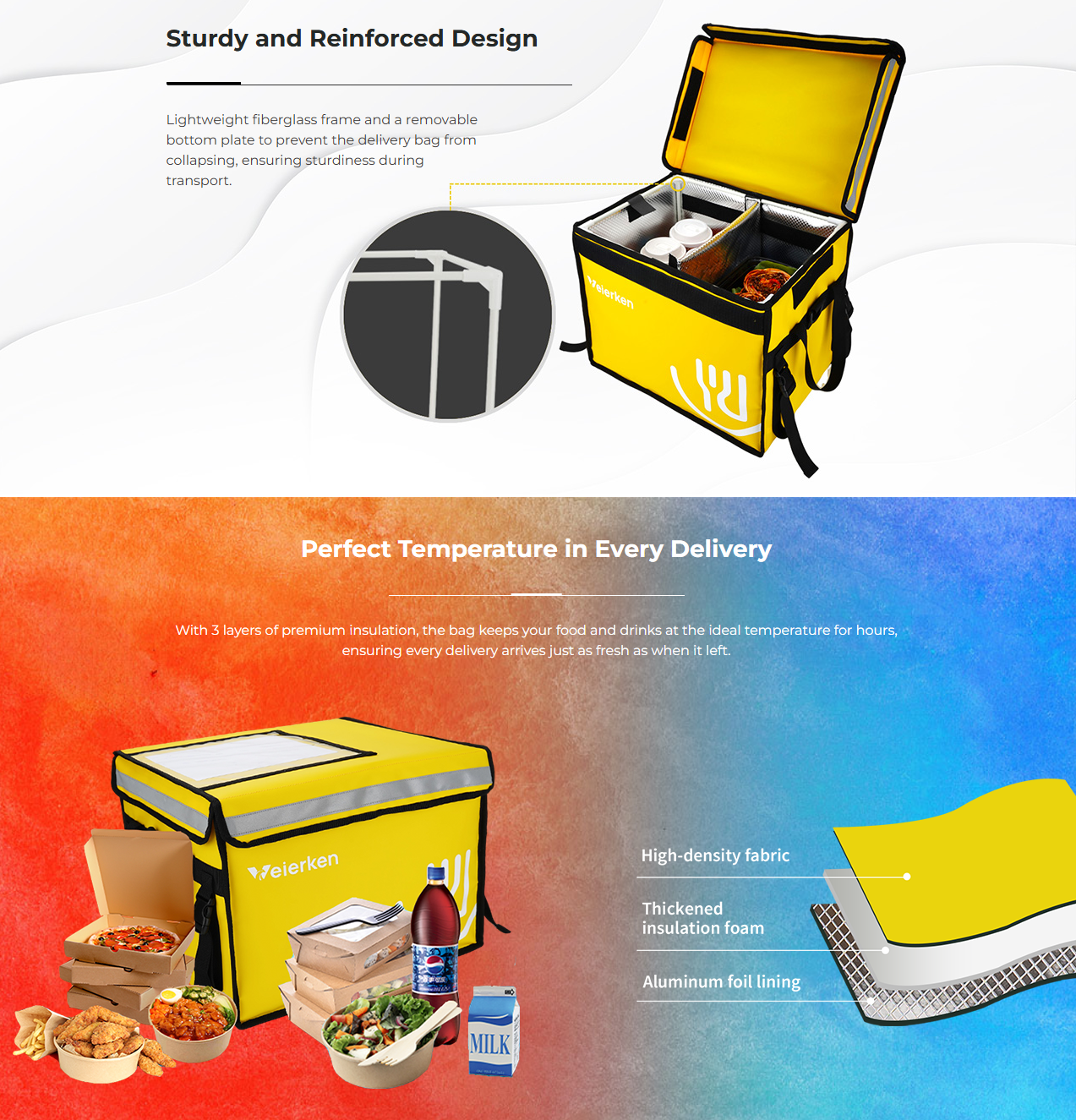
To prevent bag collapse, look for internal reinforcement skeletons. High-grade bags integrate lightweight corrugated polypropylene (PP) sheets or flexible fiberglass perimeter rods into the side and top panels. These inserts protect fragile packages from being crushed while keeping the bag upright during loading.
3. Wear Components: Zippers, Buckles, and Reflectors
A delivery bag is only as strong as its fastest-failing component. In last-mile logistics, that component is almost always the zipper.
Zippers: Generic nylon coil zippers pull apart under side-load pressure and jam when exposed to road grit. Commercial builds require oversized #10 or #12 weather-resistant zippers, such as genuine YKK AquaGuard series, paired with corrosion-resistant zinc alloy sliders.
Hardware: Cheap polyoxymethylene buckles snap in sub-zero winter conditions. Insist on automotive-grade nylon hardware from brands like Duraflex or ITW Nexus, rated to withstand freezing impacts and repeat flex cycles.
Passive Safety: Delivery cyclists operate during low-light rush hours. Industrial bags require micro-prismatic retroreflective tapes compliant with international standards like EN ISO 20471 or ANSI/ISEA 107. These tapes maintain high visibility even during heavy downpours.
4. Thermal Insulation Retention
Thermal stability requires more than thin foam padding. Cheap expanded polyethylene (EPE) foam collapses under repeated compression. Once the internal air pockets crush flat, the material loses its thermal barrier properties.
A proven last-mile logistics gear supplier builds composite multi-tier insulation walls:
An outer waterproof protective barrier (TPU/PVC).
A central high-density thermal core combining cross-linked polyethylene (XPE) or closed-cell EVA foam with hollow-chamber insulation boards.
An inner food-grade, heat-reflective aluminum foil or antimicrobial PEVA lining.
This composite build maintains its insulation performance across thousands of flexes, keeping hot food above 60°C and cold groceries below 4°C across standard delivery windows.
Procurement Checklist: How to Vet a Bike Delivery Bag OEM
Use the following criteria when screening potential manufacturing partners for your fleet expansion or gear redesign program.
1. Customization and Ergonomic R&D Capabilities
Your delivery model is unique. Off-the-shelf catalog models rarely meet operational demands. Look for an OEM that maintains a dedicated in-house engineering and prototyping team.
Courier Ergonomics: Can the supplier customize lumbar support, sternum sliders, and breathable 3D mesh back channels to suit different body sizes?
Modular Internal Layouts: Can they produce configurable hook-and-loop divider walls, slide-out drink caddies, and fold-down shelves to handle mixed payloads like hot pizza boxes alongside chilled beverages?
Bike Mounting Systems: Do they engineer dual-purpose solutions that switch smoothly between a courier backpack and a secure rear-rack mount via quick-release straps or KlickFix systems?
Companies like Weierken collaborate directly with logistics fleet engineers, translating field feedback into custom, rider-friendly prototypes before initiating mass production runs.
2. In-House Laboratory and Quality Testing
Never rely solely on digital factory presentations or pristine golden samples. Ask the manufacturer for verified laboratory test reports covering both raw textiles and finished assemblies.
A fully vetted bike delivery bag OEM should run the following tests in-house:
Dynamic Drop Impact Testing: Dropping a loaded bag (15 to 25 kg) from a height of one meter across multiple angles to test harness and seam resilience.
Seam Tensile Strength: Measuring the pull force required to tear shoulder straps from the bag body (commercial minimum should exceed 400-500 Newtons).
Zipper Endurance Cycles: Automated mechanical testing verifying smooth operation over at least 10,000 continuous opening and closing strokes under tension.
Hydrostatic Head and Spray Testing: Verifying waterproof integrity up to IPX4 or IPX6 standards under simulated extreme rainfall.
3. Manufacturing Capacity and Supply Chain Agility
Fast-growing delivery networks cannot afford supply chain bottlenecks. Assess the factory's structural scale to confirm they can match your growth curve:
What is their monthly manufacturing capacity across specialized heat-welding and heavy-stitch production lines?
What are their minimum order quantities (MOQs) for custom-molded parts versus standard fabric variations?
How do they handle raw material inventory buffers to insulate your pricing against spikes in global polymer markets?
What is their historical On-Time Delivery (OTD) rate over the past 24 months?
4. Regulatory Compliance and ESG Integrity
Operating a fleet in Europe, North America, or Australasia requires strict regulatory compliance. Low-cost factories often cut corners by using toxic plasticizers in flexible PVC.
Chemical Safety: Ensure all textile layers, thermal liners, and trims comply with EU REACH standards, California Proposition 65, and RoHS directives, proving they are free from harmful phthalates, lead, and PFAS.
Social Audits: Verify that the manufacturing facilities hold valid third-party ethical audit certifications, such as BSCI, Sedex (SMETA), or ISO 9001 quality management standards.
The Financial Equation: Cheap Bags vs. Heavy-Duty Custom Gear
To justify a higher upfront investment to procurement stakeholders, run a side-by-side life-cycle analysis. Here is how the numbers play out across a fleet of 500 active delivery bikes over a two-year operational window:
| Assessment Factor | Standard Off-the-Shelf Bags | OEM Engineered Heavy-Duty Bags |
|---|---|---|
| Unit Purchase Price | $25 | $55 |
| Average Lifespan | 4 Months | 24 Months |
| Bags Required (2 Years) | 3,000 units (6 replacements/rider) | 500 units (1 bag/rider) |
| Total Gear Procurement Spend | $75,000 | $27,500 |
| Estimated Spill/Damage Claims | High (sagging walls, failed foil) | Minimal (rigid panels, stable dividers) |
| Courier Downtime from Gear Breaks | High (strap failures mid-route) | Near Zero |
| Net Financial Result | Baseline Expense | Over 60% Procurement Savings |
The math is clear. Investing in higher-spec gear from an experienced custom thermal delivery bags manufacturer reduces annual spending by more than half, cleans up your supply chain, and keeps your fleet rolling without interruptions.
Frequently Asked Questions
Q1: What fabric thickness offers the best balance of weight and durability?
A1: For high-volume bicycle delivery, 500D to 840D TPU-laminated tarpaulin offers the best balance. It delivers exceptional tear resistance, clean wipe-down maintenance, and complete waterproof performance while remaining light enough to prevent courier fatigue.
Q2: Why is RF welding preferred over taped seams for delivery backpacks?
A2: Seam sealing tapes rely on adhesives that degrade over time when exposed to heat, humidity, and constant mechanical flexing. Radio Frequency (RF) welding permanently fuses the panels at the molecular level, creating a permanent, leak-proof bond that cannot peel or delaminate.
Q3: What minimum waterproof rating should a commercial delivery bag carry?
A3: A commercial last-mile delivery bag should achieve at least an IPX4 rating, meaning it protects contents from splashing water in any direction. For areas with frequent downpours, look for IPX5 or IPX6 constructions that withstand high-pressure water jets and heavy sustained rain.
Q4: How can fleet managers evaluate thermal retention before bulk purchasing?
A4: Request thermal test reports from your bike delivery bag OEM. A standard test places a calibrated heat or cold source inside the bag alongside data loggers, then tracks the interior ambient temperature curves inside an environmental test chamber set to extreme hot and cold temperatures over 45 to 90 minutes.
Q5: What are the typical MOQs for a fully custom delivery bag project?
A5: Most established OEM factories set minimum order quantities between 300 and 500 units for custom fabric colors, bespoke branding, and modified internal dimensions. Projects requiring custom injection-molded structural frames or proprietary mounting hardware may require 1,000 units to offset tooling charges.
Q6: How do ergonomic bag designs improve delivery efficiency?
A6: Ergonomic packs use load-lifter straps, wide padded waist belts, and contoured internal frames to transfer weight from the fragile cervical spine down to the pelvis. This reduces physical fatigue, allowing couriers to maintain a faster delivery pace across full shifts with lower injury-related downtime.
Upgrade Your Fleet's Last-Mile Reliability
Your delivery gear represents your brand on every street corner. Flimsy, ripped backpacks signal careless service, while rugged, clean, highly functional equipment keeps couriers motivated and orders intact.
As an experienced bike delivery bag OEM, Weierken designs and manufactures performance-tested, custom-engineered courier backpacks and thermal carriers for ambitious logistics operations worldwide. Our team will review your payload needs, configure custom thermal mockups, and run physical stress tests to prove durability before mass production.
Ready to cut replacement costs and protect your last-mile margins? Contact our engineering team today to review technical specifications, discuss your fleet requirements, and request a production-grade prototype sample.