

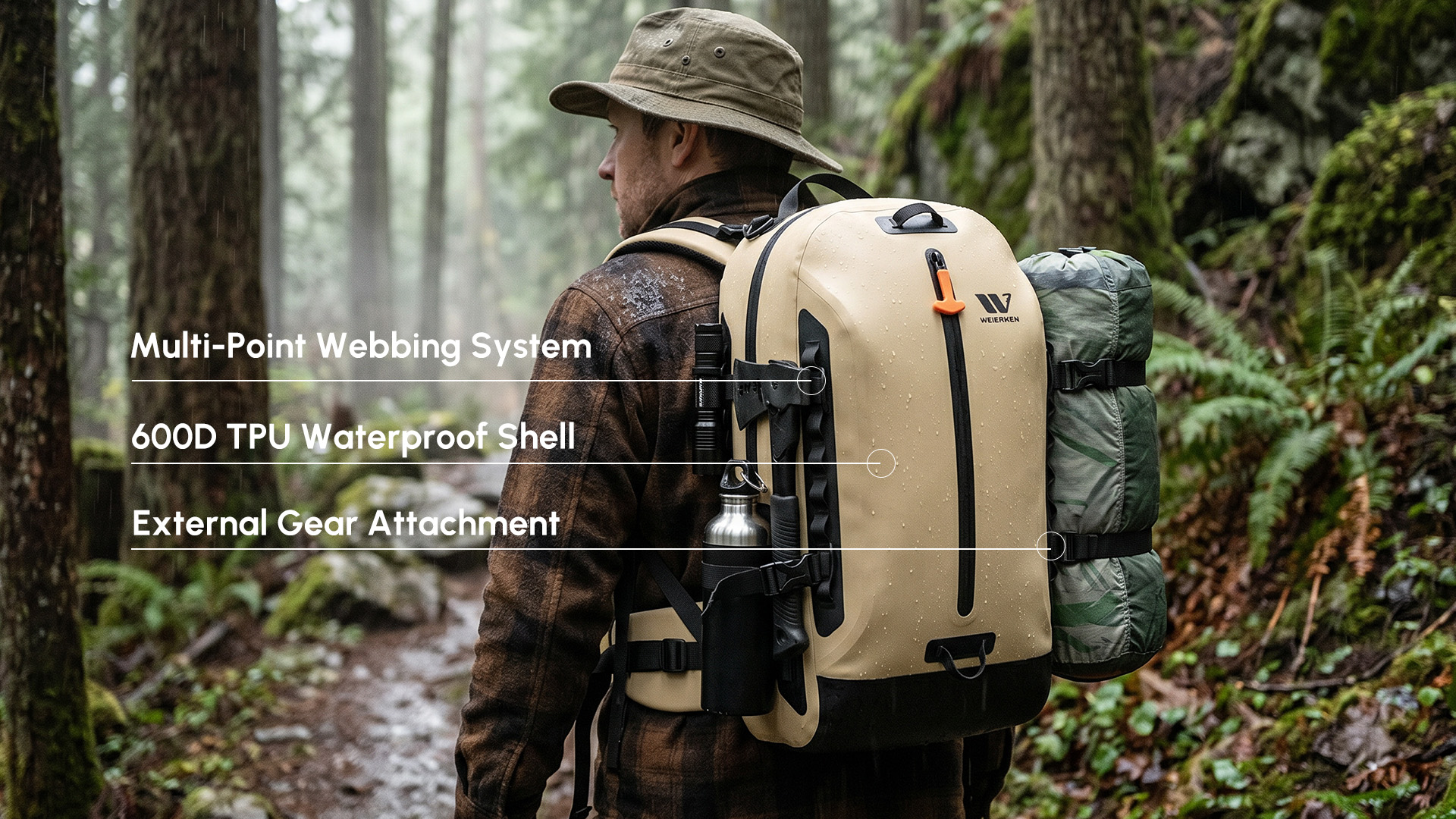
Outdoor gear brands face a challenging manufacturing environment heading into 2026. Consumers no longer accept basic water-resistant coatings for high-exposure activities. Technical expeditions, whitewater kayaking, bikepacking, and offshore marine sports demand zero-failure gear that endures sub-zero temperatures, abrasive grit, and continuous submersion.
At the same time, sourcing directors face shifting tariff policies, raw material price volatility, and stringent European and North American ESG regulations. Auditing a production partner solely on unit FOB price is an outdated approach. Sourcing success now depends on landed cost optimization, dual-region operational agility, precision radio-frequency (RF) welding, and verifiable quality control metrics.
Choosing the right waterproof gear bag supplier for outdoor brands requires a technical, milestone-driven evaluation. This guide provides a direct framework for auditing potential contract manufacturing partners across three foundational pillars: supply chain resilience, advanced engineering capabilities, and long-term project governance. It highlights the production benchmarks established by industry specialists like Weierken over two decades of technical manufacturing.
1. Supply Chain Resilience & Total Landed Cost Auditing
A supplier’s operational footprint directly dictates your brand's gross margin and inventory stability. When evaluating manufacturing candidates, procurement teams must look past the showroom floor and examine multi-region asset distribution, raw material traceability, and trade compliance.
Dual-Hub Manufacturing: China R&D with Cambodia Mass Production
Geopolitical tensions and unpredictable shipping lanes make single-region production risky. Leading contract manufacturers now operate a dual-hub model: advanced engineering and rapid sample prototyping in China, paired with scalable, high-volume mass production in Southeast Asia.
During an on-site or virtual factory audit, check how the supplier coordinates material allocation between facilities. Weierken utilizes its specialized China hub to master complex toolings, validate RF welding parameters, and formulate TPU/PVC composite laminations. Once the pilot run achieves stable yields, production scales across its Cambodia facilities to secure trade diversification and predictable shipping schedules.
Tariff Mitigation and Landed Cost Control
FOB price is rarely the final cost. Sourcing directors must calculate the total landed cost, which includes shipping, customs duties, harbor maintenance fees, and terminal handling charges.
Rules of Origin Compliance: Confirm that the supplier’s Southeast Asian facility manages local value-add processes properly to comply with Form E, GSP, or regional trade agreement guidelines.
Duty Differential Savings: Leveraging a qualified manufacturing facility in Cambodia can eliminate or significantly reduce punitive Section 301 tariffs for US imports and optimize duties under standard GSP structures for the UK and EU.
Landed Cost Protection: These duty savings allow brands to maintain retail price points while protecting their margins against rising freight costs.
99.5% First-Pass QC Yield and Hydrostatic Testing
Waterproof dry bags, submersible backpacks, and roll-top duffels leave no room for manufacturing errors. A single microscopic pinhole in an RF-welded seam or a poorly sealed airtight zipper ruins an entire expedition and damages brand reputation.
Your audit checklist should verify that the factory uses structured, inline quality checkpoints rather than relying only on end-of-line inspections. Weierken maintains a 99.5% first-pass QC yield by implementing standard destructive and non-destructive testing protocols:
Hydrostatic Head Testing: Subjecting seam points and fabrics to water pressure exceeding 10,000mm to 20,000mm H2O to confirm absolute water barrier integrity.
Positive Pressure & Vacuum Air Inflation: Inflating fully welded chambers to 3–5 PSI for 24-hour pressure-drop monitoring, ensuring airtight and gas-tight performance.
Peel & Tensile Strength Testing: Mechanically testing welded seams to guarantee the base fabric tears before the molecular weld fails.
Frictionless DDP (Delivered Duty Paid) Logistics
Managing multiple freight forwarders, customs brokers, and drayage carriers drains internal brand resources. Inquire whether your prospective manufacturing partner provides comprehensive DDP services.
Suppliers with integrated logistics clear the freight through customs, settle import tariffs, and coordinate final delivery directly to your domestic distribution centers (3PLs). This setup cuts administrative overhead and eliminates unexpected demurrage fees at container ports.
Global Compliance and ESG Certifications
Modern consumers and corporate retail buyers demand verified ethical production and environmental accountability. Do not rely on generic claims of sustainability; demand third-party audit reports from the last twelve months.
Social Accountability: BSCI and SEDEX (SMETA) audit reports verifying fair labor practices, safe working conditions, and ethical treatment.
Material Traceability: Global Recycled Standard (GRS) scope certificates for rPET, recycled TPU laminations, and post-consumer recycled fabrics.
Chemical Safety: REACH and RoHS compliance certificates confirming that all materials are free from harmful phthalates, heavy metals, and per- and polyfluoroalkyl substances (PFAS).
Quality Governance: Active ISO 9001 certification demonstrating systematic production control.
2. Market-Driven Product Development & Technical Auditing
Outdoor brands require manufacturing partners who understand functional bag architecture. If a factory simply copies drawings without reviewing seam geometry, valve placements, or load-bearing reinforcements, production delays and field failures will follow.
Market-Insight Driven In-House R&D
Top-tier suppliers do more than follow tech packs; they actively refine them. A reliable manufacturing partner should understand how outdoor enthusiasts use gear in harsh alpine, marine, and overland environments.
Weierken’s internal engineering teams analyze global carry trends, ergonomics, and material advances. When a brand presents an early industrial design concept, experienced R&D engineers can recommend better ways to position airtight zippers, select appropriate TPU thicknesses, and adjust roll-top closure angles to optimize waterproofing and minimize material waste.
Precision Prototyping Turnaround Speeds
Speed to market often determines season profitability. Delays in sample iterations compress marketing launch windows and push back wholesale order deadlines. Review the supplier’s dedicated sample room to evaluate its prototyping speed.
| Product Category | Standard Industry Turnaround | Weierken Engineering Turnaround |
|---|---|---|
| Commercial Functional & Delivery Packs | 10 – 15 Working Days | 3 – 7 Working Days |
| Technical Welded Dry Bags & Duffels | 20 – 30 Working Days | 7 – 14 Working Days |
| Complex Submersible Backpacks (IPX7/IPX8) | 35 – 45 Working Days | 12 – 30 Working Days |
Solving Complex Waterproof Engineering Challenges
Modern outdoor bags combine sewn elements, structural foam, laser-cut MOLLE panels, and fully sealed waterproof compartments. Merging these different manufacturing methods requires specialized technical solutions.
Examine how the factory handles common structural failure points:
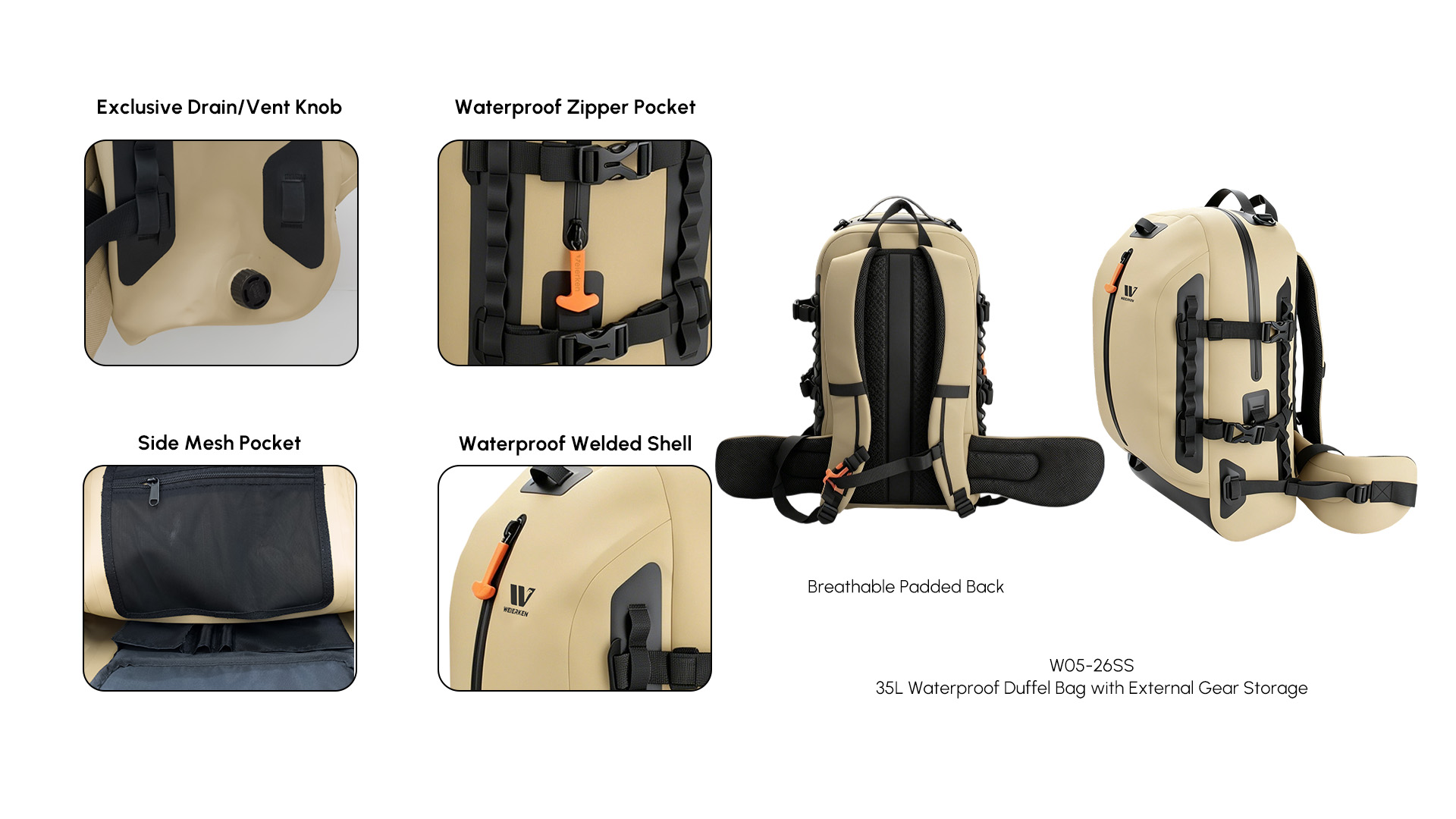
Airtight Zipper Integration: Installing TIZIP or custom airtight TPU zippers requires cleanroom-grade RF welding or hot-air fusion with exact temperature and dwell time controls.
Multi-Axis 3D Welding: Flat welding is simple; welding contoured panels, curved bottoms, and structural harness points demands custom CNC-machined aluminum welding horns and pneumatic jigs.
Extreme Temperature Durability: In cold conditions, low-grade PVC cracks and cheap TPU delaminates. Verify that the supplier formulates polyether-based TPUs that retain flexibility down to -40°C.
Two Decades of Specialized Manufacturing Heritage
There is no substitute for real-world manufacturing experience. A factory that mainly produces standard stitched luggage will struggle with the narrow tolerances of airtight and watertight bags. With 20 years of dedicated focus on technical waterproof construction, Weierken maintains a comprehensive database of RF welding tooling parameters, adhesive matrices, and raw material behaviors.
3. Long-Term Brand Partnership & Project Governance
The relationship between an outdoor brand and its manufacturing partner should function as an extension of the brand's internal team. Communication gaps, vague production timelines, and hidden delays will derail seasonal product launches.
Seamless Integration with Your In-House Team
A true OEM/ODM partner steps in during early phase gates—Design for Manufacturability (DFM) and Design for Cost (DFC). By reviewing your CAD assets, bill of materials (BOM), and tech packs before cutting fabric, the factory's engineers help eliminate structural weaknesses, balance raw material yields, and trim unnecessary production steps. This upfront collaboration protects your R&D budget and prevents costly tooling re-spins down the road.
Direct, Technical International Communication
Language barriers and slow feedback loops are common pain points in cross-border manufacturing. When technical changes need to happen fast, you cannot afford to have critical engineering details lost in translation.
Leading suppliers assign dedicated, English-proficient project engineers to each brand account. These account managers understand fabric weights (Denier), coatings (TPU vs. PU), welding frequencies, and IPX ratings, ensuring technical discussions turn into actionable factory-floor adjustments within hours rather than days.
Milestone-Driven Project Lifecycle Tracking
Reliable project management relies on clear, structured updates. Evaluate the project governance framework your supplier uses to keep your team informed through every phase of the production cycle:
Phase 1: DFM Review & Material Sourcing: Full validation of fabric lots, custom color lab dips, and structural tooling designs.
Phase 2: Golden Sample Approval: Sign-off on the final production-line sample, establishing the quality standard for mass manufacturing.
Phase 3: Pilot Production & Parameter Lock: Running an initial 100–300 unit batch to dial in tooling pressures, welding cycle times, and QC checklists.
Phase 4: Mass Production & In-Line QC: Continuous inspection updates with photo/video proof and daily yield rate logs.
Phase 5: Final Inspection & DDP Logistics: Final random inspection (FRI) to AQL 1.5/2.5 standards followed by customs clearance and sea/air dispatch.
2026 Waterproof Gear Bag Supplier Audit Checklist
Use this practical checklist when conducting your next supplier review to objectively score potential contract manufacturing partners:
Facility Infrastructure: Dedicated high-frequency (HF/RF) welding bays, ultrasonic bonding machines, laser-cutting tables, and hot-air seam sealing lines.
Geographic Strategy: Dual-hub manufacturing capabilities (e.g., China technical development hub + Cambodia volume production).
Quality Assurance: Documented inline testing for hydrostatic pressure (mm H2O), seam peel strength, and 24-hour airtight pressure drops.
Material Science: Certified supply chains for GRS-certified rPET, TPU laminates, PFAS-free durable water repellent (DWR) coatings, and marine-grade hardware.
Logistical Scope: Complete end-to-end DDP delivery capabilities, with experience in customs clearance, tariff mitigation, and direct-to-warehouse delivery.
Communication & Governance: Dedicated English-speaking technical account managers with standard Gantt-chart project tracking and documented milestone sign-offs.
Frequently Asked Questions (FAQs)
Q1: How does a dual-hub China-Cambodia manufacturing model benefit Western outdoor brands?
A1: The dual-hub model provides a balance of speed, innovation, and cost management. Brands handle rapid R&D, structural engineering, tooling fabrication, and material validation within China's advanced industrial ecosystem. Mass production is then executed in Cambodia, where brands can secure duty-free or lower tariff access to the US and European markets under current trade agreements. This structure reduces total landed costs while protecting supply chains from single-region disruptions.
Q2: What non-destructive testing methods ensure RF welded seams remain 100% waterproof?
A2: Professional manufacturers use non-destructive pneumatic air inflation tests alongside continuous inline visual inspections. Fully sealed bags (such as IPX7/IPX8 submersible gear) are fitted with temporary valves or closed airtight zippers, inflated to 3–5 PSI, and monitored over a 12-to-24-hour window using digital pressure gauges to detect micro-leaks. Finished products are also subjected to pressurized water-spray chambers or brief water immersion baths to confirm seal integrity before packaging.
Q3: Can sustainable fabrics like rPET and GRS-certified TPU perform reliably in freezing conditions?
A3: Yes, provided they are engineered with the right polyether-based formulations. Sustainable dry bags built from GRS-certified recycled polyester (rPET) paired with high-grade thermoplastic polyurethane (TPU) films provide cold-crack resistance down to -30°C or -40°C. They also offer strong UV degradation resistance and high puncture strength. It is essential to ensure your manufacturing partner sources certified GRS resins and tests material batches using standard Bally flexometer cold-bend testing.
Q4: What is the typical lead time from initial CAD drawings to final production delivery?
A4: For technical waterproof gear bags, the standard development lifecycle typically takes 12 to 18 weeks. CAD review and DFM feedback take roughly 3–5 days, with initial functional prototypes delivered in 12–30 days. Tooling development and golden sample sign-offs generally require 2–3 weeks. Mass production runs take 45–60 days, followed by 20–35 days for sea freight and customs clearance under standard DDP terms.
Q5: How do suppliers maintain clean, leak-free seals around airtight and watertight zippers?
A5: Welded zipper installation requires dedicated high-frequency welding horns matched to the zipper tape's specific dimensions. The process uses hot-melt polyurethane films applied under precise, computer-controlled pneumatic pressure, temperature, and dwell times. The transition zones at the zipper ends are reinforced with laser-cut TPU patches or injected corner seals to eliminate weak spots where water could enter under pressure.
Secure Your Technical Supply Chain with Weierken
Choosing the right manufacturing partner will shape your product line's performance, customer satisfaction, and overall profitability for the coming seasons. Relying on outdated supply chains or generic stitching factories puts your brand at risk of field failures, tariff hits, and delivery delays.
For more than two decades, Weierken has served as a trusted, high-precision waterproof gear bag supplier for outdoor brands worldwide. Combining advanced R&D, dual-hub production agility across China and Cambodia, and an uncompromising 99.5% quality yield standard, Weierken helps outdoor gear brands bring durable, market-ready products to life.
Planning your 2026/2027 waterproof product line? Contact our technical engineering team today to review your project, evaluate tech packs, or request a high-precision prototype.