
Procuring thermal delivery gear for your business is a high-stakes decision. Your choice of a catering bag factory directly affects food safety, delivery efficiency, and your brand's reputation. A poor batch of bags leads to cold food, leaky packages, and frustrated customers.
At weierken, we understand these supply chain pressures. We have spent years analyzing the gaps between what buyers expect and what factories deliver. This guide outlines five practical quality standards you should demand from any manufacturing partner before signing a contract.
1. Food-Grade Materials and Safety Certifications
Food delivery bags hold hot meals. Under high temperatures, low-grade plastic linings can release volatile organic compounds (VOCs) or chemical odors. This ruins the taste of the food and compromises safety. Therefore, material safety is your absolute baseline when evaluating a catering bag factory.
You must verify the composition of the inner lining materials. Check if the manufacturer uses food-grade PEVA, high-quality aluminum foil, or non-toxic polyurethane (PU) coatings. Ask for physical material safety data sheets (MSDS) rather than accepting verbal promises.
Look for test reports from recognized bodies like FDA, LFGB, or RoHS.
Ensure the factory tests the materials under high heat conditions to check for odor emission.
Check for mold-resistant and easy-to-clean surface treatments on the lining.
A professional food delivery bag manufacturer should provide recent third-party laboratory reports. If the reports are older than two years, ask the factory to run a new test on the current material batch.
2. Verifiable Insulation and Thermal Performance Data
Do not rely on vague sales claims like "keeps food hot for hours." Insist on empirical data. Ask the factory for standardized **thermal performance test** reports. These reports show how the bag performs under controlled environmental conditions.
Weierken regularly conducts internal thermal chamber tests to verify temperature retention curves. Our test protocols simulate actual transport conditions. When you review a factory's technical sheets, look for specific engineering details rather than marketing copy.
Request a temperature drop curve showing performance over a 4 to 6-hour period.
Check the density of the insulation layer, such as expanded polyethylene (EPE) foam or polyurethane (PU) foam.
Verify if the factory supports specialized insulation materials like aerogel or multi-layer bubble foil.
Always request a physical sample. Put it through your own test by loading it with hot containers and measuring the internal temperature hourly. Open and close the bag repeatedly during your test to mimic real-world courier behavior.
3. Stitching Craftsmanship and Structural Durability
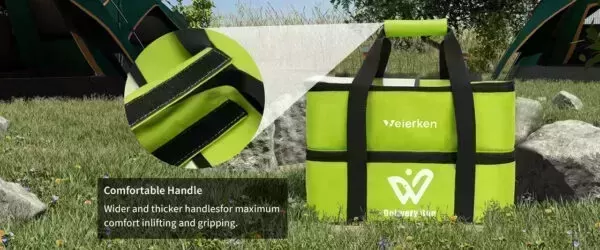
Commercial delivery is brutal. Couriers throw, slide, and overload bags daily. The weakest points of any bag are almost always the seams, handles, and zippers. Examine the sewing techniques used by the **catering bag factory** before committing to a bulk run.
High-stress areas require heavy-duty reinforcement. Standard sewing threads will fail under the weight of multiple heavy food pans. Look for factories that use advanced industrial stitching techniques.
Verify the use of high-tensile nylon thread instead of cheap polyester thread.
Check for bartack stitching at handle attachment points and strap anchors.
Look for dual-layer fabric reinforcement or metal rivets at heavy load points.
Ensure the zippers are heavy-duty, water-resistant, and rated for thousands of cycles.
Request a video of the factory’s **tensile strength test** on handles and seams. A reliable partner will gladly share their stress-test procedures. They will show you how their **bulk food delivery bags** hold up under maximum weight limits without tearing.
4. Customization Capabilities and MOQ Alignment
B2B buyers need tailored solutions. You may require custom branding, specific dimensions, internal dividers, or specialized pocket configurations for heating packs. A competent **catering bag factory** must offer flexible customization options.
Verify that the factory can work with your design files. They should have an in-house R&D department that can translate your technical drawings into physical prototypes. Check their capability to handle complex structural requirements.
Support for multiple logo printing methods: silkscreen, heat transfer, or embroidery.
Ability to source specialized hardware, like waterproof zippers or abrasion-resistant bottom plates.
Clear guidelines on color matching using the Pantone Matching System (PMS) with low color deviation limits.
Discuss the **MOQ (Minimum Order Quantity)** early in the process. Standard MOQs often range from 500 to 1,000 pieces per style. Verify if the factory offers a sample development service. This allows you to review the design and fit before committing to a full production run.
5. Quality Control Systems and Lead Time Assurance
Consistent quality requires structured factory management. A reliable factory does not rely on luck. They follow strict standard operating procedures (SOPs). You should evaluate their quality control system just as thoroughly as their physical products.
Check if the factory holds international management certifications such as **ISO 9001 certified** or BSCI. These certifications indicate that the facility maintains documented standards for production and labor.
Confirm they implement In-Process Quality Control (IPQC) during the cutting and sewing stages.
Ensure they perform Final Quality Control (FQC) on 100% of finished goods before packaging.
Review the contract terms regarding delivery delays and defect rates.
If possible, arrange a virtual or physical factory audit. Observe the workspace. Check if the workers have clear assembly instructions at their stations. Review their QA records to ensure they actually document defects and corrective actions.
Partnering for Long-Term Supply Chain Success
Choosing the right manufacturing partner is about reducing risk. By checking these five critical standards, you protect your supply chain from unexpected failures. You ensure that your delivery fleet operates with reliable, safe, and durable equipment.
At weierken, we build dependable **custom catering bags** that meet strict international standards. We invite you to test our capabilities and see how we maintain consistent quality across large production runs.
Contact our team today to discuss your specifications, request a sample, or get a detailed quote for your next production run. We are ready to support your business with reliable manufacturing solutions.
Frequently Asked Questions
What is the standard MOQ for ordering bulk food delivery bags?
Most commercial factories set their MOQ between 500 and 1,000 pieces per design. This limit exists because raw materials, like custom-colored fabrics and specialized insulation foam, must be purchased in bulk from suppliers. Some factories may accept smaller orders for standard black bags using in-stock materials, but custom branding and colors usually require meeting the standard MOQ.
How does a catering bag factory test heat retention?
A professional factory uses a thermal testing chamber. They place the bag inside a temperature-controlled room, fill it with a simulated hot food load, and insert digital temperature probes. They record the internal temperature at regular intervals over 4 to 6 hours. This test produces a temperature curve that proves how well the insulation material limits heat transfer.
Can I get a sample before placing a bulk order?
Yes. Any reputable **catering bag factory** will offer a sample making service. This process typically takes 7 to 14 days, depending on the complexity of your design. While you may need to pay a sample fee and shipping costs, most factories refund this fee once you place a bulk order that meets their MOQ requirements.
What certifications should I look for in food delivery bag manufacturers?
You should look for material certifications like FDA, LFGB, and REACH. These prove that the inner lining is non-toxic and safe for food contact. For factory management, look for ISO 9001 or BSCI certifications. These verify that the facility follows standardized quality control systems and fair labor practices.
How does the factory handle shipping and delivery delays?
Reliable factories outline clear delivery timelines in their proforma invoices or contracts. They should specify production lead times, which typically range from 30 to 45 days after deposit payment. You should negotiate delay compensation clauses in your contract to protect your business against late shipments that could disrupt your operations.