
Delivering piping-hot pizza with a crisp crust sounds straightforward, but commercial food logistics tells a different story. Temperature drop, steam accumulation, and structural collapse during transit remain constant threats to customer satisfaction. For high-volume pizza chains, ghost kitchen networks, and commercial distributors, a food delivery bag is a core operational asset rather than a simple accessory.
Sourcing these assets from standard trading companies or small cut-and-sew workshops often leads to inconsistent insulation, failed delivery timelines, and expensive customs surprises. Modern enterprise brands need more than just sewing lines. They need a strategic manufacturing partner capable of solving engineering, geopolitical, and logistics challenges simultaneously.
As an established commercial pizza delivery bag supplier with 20 years of specialized manufacturing experience, Weierken helps global brands build dependable supply chains. Below are the five essential OEM services your procurement team should expect from an enterprise-grade manufacturing partner.
1. Engineering-Led R&D and Rapid Prototyping
Many suppliers simply wait for buyers to provide complete tech packs, copying designs without understanding the physical dynamics of food delivery. A true OEM partner acts as an extension of your product development team, identifying failure points before mass production begins.
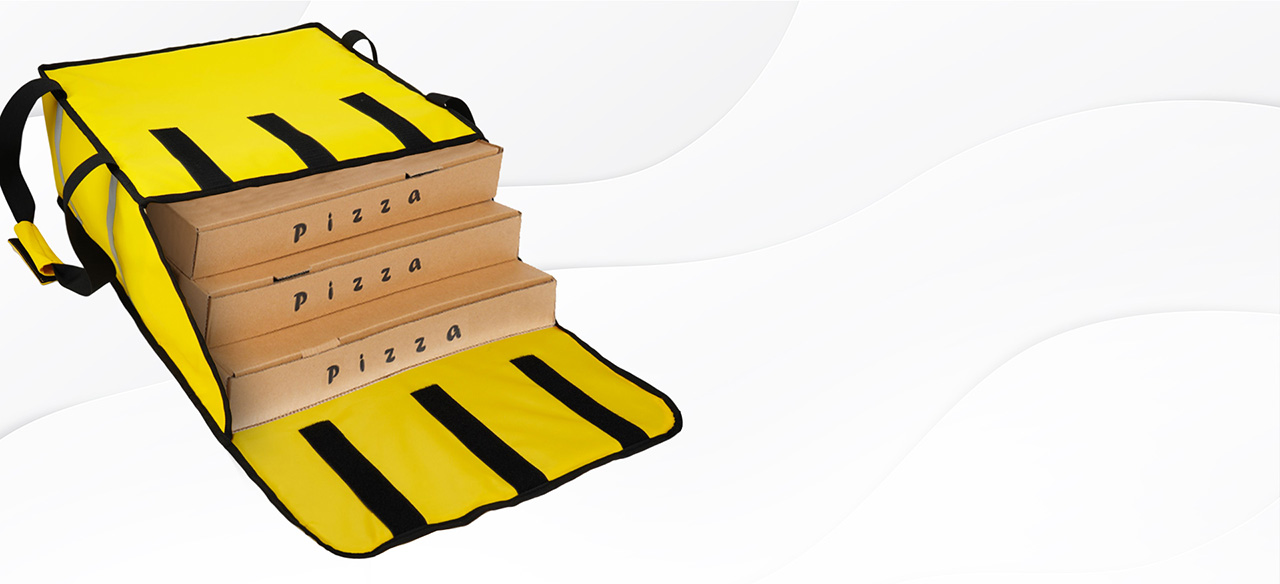
Pizza delivery presents unique thermal and mechanical challenges. The bag must retain core temperatures above safe food-holding thresholds (typically above 60°C/140°F) while releasing excess moisture so the crust does not turn soggy. Furthermore, when couriers stack five or six heavy pizza boxes inside one container, structural rigidity becomes critical.
A qualified commercial pizza delivery bag supplier solves these issues through deliberate structural engineering:
- Moisture and Thermal Regulation: Integrating breathable moisture-venting grommets and specialized thermal baffles that discharge condensation without losing internal heat.
- Load-Bearing Internal Frames: Using high-density polypropylene (PP) hollow boards, lightweight fiberglass rods, or reinforced internal shelves to prevent the container from collapsing on bottom boxes.
- Advanced Material Selection: Utilizing heavy-duty exterior shells (such as 600D, 900D, or 1680D Oxford polyester with waterproof PVC/TPU backings) paired with industrial-grade closed-cell EPE foam and heat-reflective aluminum linings.
- Grease and Spill Containment: Implementing heat-sealed, leakproof inner linings that prevent food oils from penetrating insulation layers, allowing couriers to wipe the interior clean in seconds.
Speed to market is just as critical as technical design. Professional suppliers operate dedicated sampling workshops separate from bulk production lines. When partnering with Weierken, buyers receive production-ready physical prototypes within 3 to 7 days, allowing engineering and field testing teams to validate performance without stalling their deployment schedules.
2. Dual-Hub Manufacturing and Duty-Optimized Production
Relying on a single manufacturing location leaves your brand vulnerable to geopolitical shifts, unilateral tariff hikes, and regional supply chain bottlenecks. Procurement directors now prioritize supply chain resilience and total landed cost over baseline unit pricing.
Leading suppliers address this through dual-hub production models. By maintaining coordinated operations across multiple territories—specifically China and Southeast Asia—a manufacturer can optimize both technical capability and trade compliance.
This dual-hub structure delivers distinct operational advantages:
- Tariff Mitigation: Utilizing production facilities in Cambodia allows Western buyers (particularly across the United States and Europe) to leverage preferential trade programs such as the Generalized System of Preferences (GSP) or lower Most Favored Nation (MFN) duties. This directly reduces customs duties compared to direct China shipments.
- Raw Material Efficiency: China remains the premier global hub for specialized textiles, reflective foils, heating elements, and hardware. Managing raw material sourcing and engineering in China while running labor-intensive assembly in Cambodia gives brands the best balance of cost, quality, and duty reduction.
- Capacity Redundancy: If sudden demand spikes occur, or if local disruptions affect one facility, production can shift between hubs without requiring the brand to qualify a new OEM partner from scratch.
Working with a dual-hub commercial pizza delivery bag supplier ensures predictable lead times, protects gross margins, and eliminates single-point-of-failure risks in your supply chain.
3. Enterprise-Grade Quality Control and ESG Compliance
For international restaurant brands, an equipment failure in the field is costly, but a compliance failure in the supply chain is catastrophic. Global brands cannot afford factory-level labor violations or chemical non-compliance that could damage their brand reputation.
A premier OEM pizza delivery bag manufacturer runs rigorous quality assurance protocols from incoming fabric rolls to finished carton packing. At Weierken, production processes are calibrated to maintain a 99.5% first-pass yield on final inspections, drastically minimizing warranty claims, field failures, and franchisee complaints.
Rigorous quality control for B2B food delivery equipment includes:
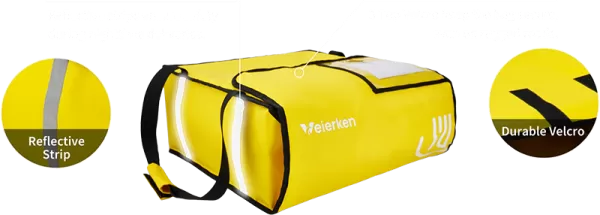
- Stress and Stress-Point Testing: Automated cyclic pull-testing on reinforced webbing handles, shoulder straps, and commercial zippers to ensure they withstand hundreds of daily delivery cycles.
- Thermal Retention Validation: Controlled testing using data-logging thermal probes to verify that internal temperatures stay within commercial food safety limits over 30-, 45-, and 60-minute delivery simulations.
- Chemical Safety and Environmental Audits: Materials must comply with stringent regional standards, including REACH (SVHC-free), RoHS, and FDA food-contact standards for interior linings.
- Sustainable Material Integration: Sourcing certified Global Recycled Standard (GRS) fabrics, such as rPET made from recycled consumer plastic bottles, supporting your company's corporate environmental goals.
Equally critical is social responsibility. Verified suppliers maintain active memberships and clean audit trails with major independent compliance organizations, including BSCI and SEDEX (SMETA), along with ISO 9001 certified quality management systems. These certifications provide your legal and risk departments with complete confidence.
4. End-to-End DDP Logistics Management
Managing freight forwarders, booking ocean container space, coordinating drayage, and clearing customs can overwhelm internal procurement teams. Unanticipated demurrage fees, classification disputes, and destination port holds quickly erase the margin savings gained from manufacturing overseas.
A modern custom insulated bag supplier takes ownership of the delivery process beyond the factory gate. Delivered Duty Paid (DDP) shipping services transform overseas production into an experience as straightforward as working with a domestic vendor.
Under a true end-to-end logistics structure, your manufacturing partner handles:
- Export customs clearance, terminal documentation, and export duty compliance at the port of origin.
- Ocean container booking, air freight expediting (for urgent rollouts), and intermodal routing.
- Tariff classification management, ensuring your goods clear destination customs accurately under correct HS codes without overpayment or compliance penalties.
- Direct freight delivery into your central regional distribution centers (RDCs) or consolidated 3PL facilities.
By relying on an OEM partner with established DDP trade lanes, you remove administrative friction, eliminate hidden transport fees, and secure complete visibility through unified tracking.
5. Structured Account Management and Milestone Execution
Cross-border procurement often stumbles on poor communication. Misunderstandings regarding material hand-feel, structural tolerances, or accessory specifications waste weeks of development time and cause expensive production delays.
Professional OEM manufacturing relies on structured project milestones, transparent documentation, and direct access to bilingual engineering teams. Weierken eliminates communication gaps by assigning dedicated account engineers who understand both technical industrial design and Western B2B procurement standards.
Every custom production run should follow a transparent, documented pipeline:
- Technical Requirement Sign-off: Detailed reviews of CAD drawings, bill of materials (BOM), load specifications, and branding guides before raw material procurement begins.
- Golden Sample Sign-off: Creation and physical sign-off of golden samples to establish the visual and functional benchmark for all mass-produced units.
- Pre-Production Meeting (PPM): Reviewing structural weak points with production line supervisors prior to starting the primary sewing run.
- In-Line and Outgoing Quality Control (OQC) Reports: Comprehensive visual and dimensional inspection records, with photo and video documentation, shared directly with the buyer prior to shipping approval.
This structured methodology keeps large-scale rollout schedules on track and ensures that every batch delivered to your distribution network matches approved design specifications.
Choose a Manufacturing Partner, Not Just a Vendor
Purchasing commercial delivery equipment at scale involves substantial capital and directly affects your daily customer experience. Selecting a commercial pizza delivery bag supplier means choosing the operational backbone for your delivery fleet.
A supplier that integrates rapid R&D, dual-hub tariff advantages, enterprise-level compliance, and turnkey logistics helps you protect margins and safeguard brand reputation. Weierken combines 20 years of technical expertise with the infrastructure needed to support expanding national and multinational food service brands.
Ready to upgrade your delivery performance and optimize your supply chain costs? Contact the Weierken engineering team today to review your project specifications and receive a prototype within 3 to 7 days.
Frequently Asked Questions
Q1: What materials are standard for commercial pizza delivery bags?
A1: Commercial-grade bags typically feature heavy-duty exterior fabrics such as 600D, 900D, or 1680D polyester Oxford cloth backed with waterproof PVC or TPU coatings. Insulation layers usually incorporate 8mm to 15mm of high-density closed-cell EPE foam or thermal needle-punched cotton, paired with heat-reflective aluminum foil or food-grade PEVA inner linings that clean easily and resist grease.
Q2: How does dual-hub production in China and Cambodia lower import tariffs?
A2: Manufacturing assembly in Cambodia allows goods imported into regions like the United States, the UK, or the European Union to qualify for preferential duty rates or lower Most Favored Nation (MFN) tariffs, effectively bypassing specific punitive tariffs (such as Section 301 duties) levied on direct China exports. Meanwhile, sourcing technical fabrics and components through established Chinese supply chains keeps raw material costs competitive.
Q3: What is the typical turnaround time for custom OEM prototypes?
A3: A fully equipped OEM supplier with an independent prototyping workshop can produce custom prototypes within 3 to 7 business days. This timeline applies to bags requiring custom sizing, specific pocket placements, specialized internal divider panels, and standard branded logo applications.
Q4: Can Weierken manufacture pizza delivery bags compliant with corporate ESG standards?
A4: Yes. Weierken facilities adhere to strict social and quality compliance standards, maintaining verified audits including BSCI, SEDEX (SMETA), and ISO 9001. We can also construct delivery bags using GRS-certified recycled rPET exterior fabrics and ensure all coatings comply with non-toxic, REACH-certified chemical standards.
Q5: How does DDP shipping benefit multinational food delivery brands?
A5: Delivered Duty Paid (DDP) shifts the complexity of international logistics onto the supplier. The manufacturer handles export customs, ocean/air shipping, import duties, customs brokerage, and local container transport directly to your designated regional warehouse, shielding your procurement team from demurrage risks, fluctuating port fees, and clearing delays.