
Commercial food delivery entered a new era of margin pressure, shifting trade policies, and higher client expectations. Restaurant chains, third-party logistics (3PL) aggregators, and courier networks cannot afford thermal gear that fails after three months of street use.
Many procurement teams still rely on low-tier, white-label suppliers. These outdated vendors struggle with tariff shifts, raw material inflation, and weak product durability. In 2026, an average supplier is a direct liability to your bottom line and your brand equity.
Choosing a dedicated restaurant delivery bag manufacturer like Weierken gives enterprise buyers the supply resilience, strict quality assurance, and engineering support needed to safeguard operating margins. If your current factory causes shipping delays, customs headaches, or customer complaints about cold meals, it is time to audit your vendor relationship.
1. Evaluate Production Footprint: Does Your Restaurant Delivery Bag Manufacturer Offer Supply Chain Diversification?
Geopolitical turbulence and trade barriers make single-region sourcing a high-risk gamble. Procurement managers need manufacturing partners with elastic capacity across borders rather than single-location workshops vulnerable to shutdowns and sudden duty hikes.
Dual-Hub Manufacturing (China + Cambodia) for Delivery Bags
Most bag factories operate out of a single industrial town in mainland Asia. When domestic operating costs spike or regional power restrictions hit, your delivery orders stall. Weierken operates a coordinated dual-hub footprint across China and Cambodia.
Our dual-hub model delivers concrete strategic benefits to commercial delivery fleets:
- Raw Material Proximity: China handles rapid development, specialized fabric sourcing, and complex technical fabrication.
- High-Volume Output: Cambodia provides scalable, cost-effective assembly lines for recurring container-load shipments.
- Risk Mitigation: Unforeseen production bottlenecks at one site prompt immediate rerouting to the other, preserving your launch timelines.
Lower Tariffs on Bulk Delivery Bag Procurement
Customs duties directly erode the profitability of overseas hardware purchases. Sourcing through an OEM insulated delivery bag factory with a verified Cambodian production base lowers tariff burdens for European, North American, and British importers.
Cambodia benefits from favorable trade terms, including Generalized System of Preferences (GSP) programs and stable bilateral agreements. Migrating your bulk procurement from single-origin Chinese facilities to our Cambodian lines can significantly reduce customs duties, putting margin directly back into your operations.
Hassle-Free DDP (Door-to-Door) Delivery Solutions
Managing freight forwarders, port drayage, customs clearance, and import documentation drains internal resources. A professional restaurant delivery bag manufacturer should remove logistical friction entirely.
Weierken provides complete Delivered Duty Paid (DDP) logistics. We oversee factory floor loading, oceanic shipping, customs clearance, duty settlement, and final overland transport to your regional distribution centers. You pay an agreed invoice price without unexpected customs charges, demurrage fees, or administrative delays.
2. Upgrade Product Reliability: Is Your Food Delivery Bag Factory Delivering Quality & Compliance?
A delivery bag is not an ordinary promotional backpack. It is an industrial tool deployed in rain, sub-zero winters, intense summer heat, and tight scooter racks. If your bags sag, tear, or lose heat within weeks, your supplier's internal QC is failing.
99.5% First-Pass Yield: Commercial-Grade Durability
Field failures drive up equipment replacement costs and trigger customer refunds for lukewarm food. High-volume buyers need commercial food delivery bag manufacturer standards that enforce rigorous stress testing at every phase of assembly.
Weierken maintains a 99.5% first-pass quality inspection yield through disciplined standard operating procedures:
- Load-Bearing Reinforcements: Box-X reinforced stitching across all harness joints, strap anchors, and top handles, tested up to 25 kg working loads.
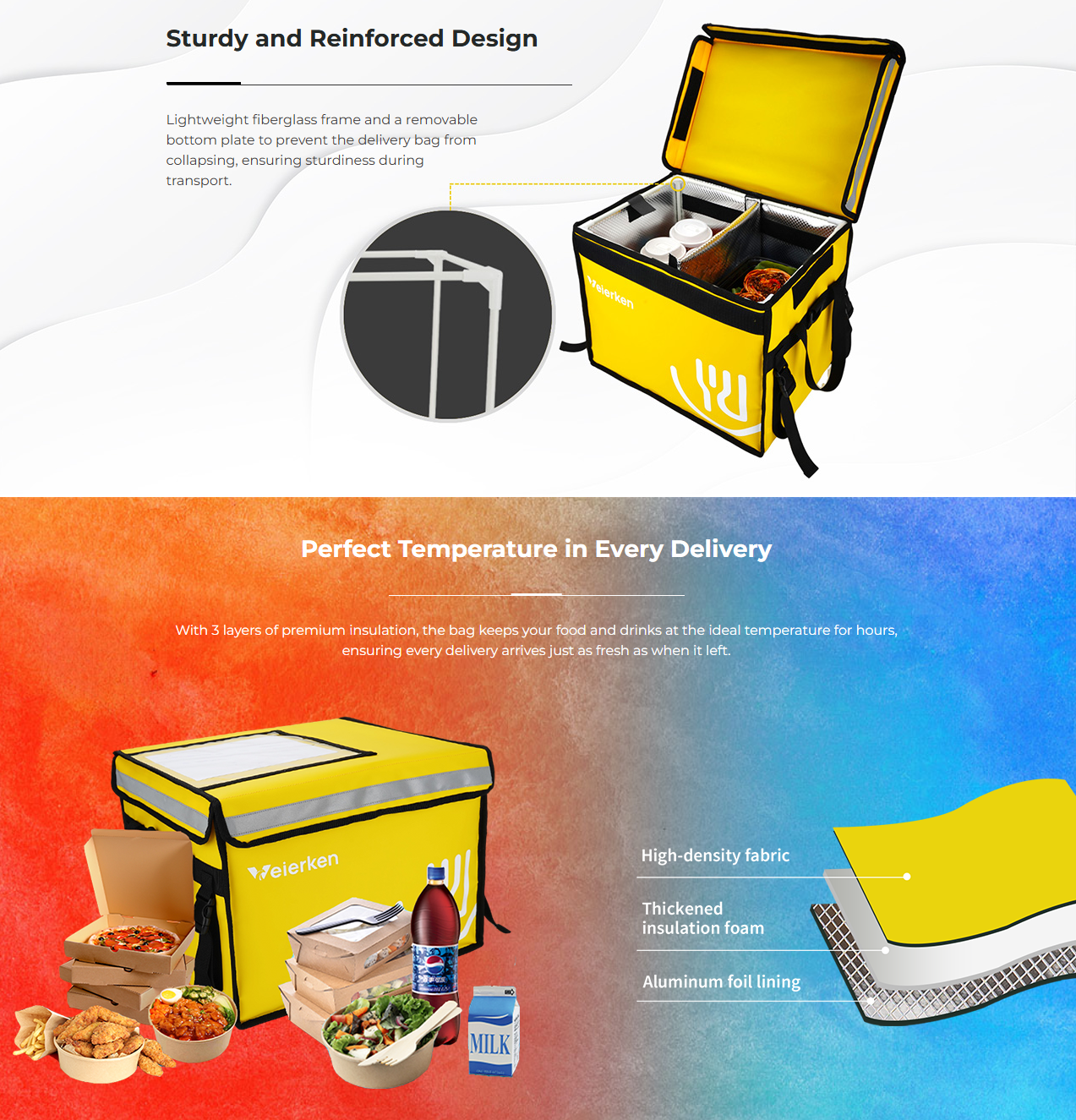
- Thermal Integrity: Multi-layered composite walls (500D/900D waterproof TPU/PVC exterior, closed-cell EPE insulation, food-grade aluminum lining) guaranteeing safe temperatures past 45 minutes of transit.
- Hardware Resilience: Heavy-duty SBS and YKK waterproof, puncture-resistant zippers calibrated for thousands of open-and-close cycles in grit and rain.
- Waterproof Sealing: High-frequency heat-welded interior liners that prevent grease and soup from seeping into internal foam layers, stopping bacterial growth and odors.
ESG & Food-Safe Certifications (BSCI, GRS, REACH, rPET)
Enterprise food aggregators and quick-service restaurant (QSR) corporations face intense regulatory scrutiny. Your equipment must comply with worker welfare rules, chemical safety restrictions, and environmental sustainability goals.
Weierken complies with the market's strictest environmental and social governance standards:
- Social Accountability: BSCI and SEDEX audits ensure ethical labor conditions, fair pay, and safe factory environments.
- Chemical Safety: REACH and RoHS compliance verifies all fabrics, foams, and trims are free from hazardous phthalates, heavy metals, and toxic flame retardants.
- Sustainable Materials: GRS-certified recycled PET (rPET) fabrics made from reclaimed plastic bottles let food brands run certified low-carbon delivery fleets.
- Quality Assurance: ISO 9001 certified production lines maintain traceable material batches and standardized assembly routines across every run.
3. Prioritize Innovation: Can Your Custom Delivery Bag Manufacturer Accelerate R&D?
Off-the-shelf catalog designs rarely fit modern delivery logistics. Large pizza boxes slide around inside standard courier packs, hot soups leak into cold salads, and couriers suffer back strain from poor weight distribution. A custom restaurant delivery bag supplier must bring real engineering capability to the table.
In-House R&D: Market-Driven Restaurant Delivery Solutions
True value lies in custom structural design, not simple logo printing. Our engineering team designs around real-world courier ergonomics, vehicle mounting brackets, and strict temperature maintenance standards.
Recent client-driven engineering developments include:
- Dual-Zone Modular Dividers: Movable, insulated internal walls separating piping-hot entrees from chilled drinks within a single backpack.
- Smart Heating Integration: 12V vehicle-powered or USB power-bank thermal elements keeping food above 65°C on long-distance suburban delivery routes.
- Ergonomic Support Frames: Lightweight internal honeycomb composite panels and breathable lumbar padding reducing courier fatigue and posture strain.
- Multi-Vehicle Adaptability: Quick-release strapping configurations that convert easily between scooter racks, bicycle frames, and shoulder harnesses.
High-Precision Rapid Prototyping (3–7 Days for Delivery Bags)
Slow prototyping delays product rollouts and marketing launches. Traditional suppliers often take four to six weeks just to create a sample, losing precious time during fleet updates.
Weierken operates an independent, rapid-response sample workshop. We turn your 2D sketches, 3D files, or physical reference samples into fully functional prototypes within 3 to 7 business days. This speed lets procurement heads review thermal retention, fabric feel, and physical dimensions before authorizing production runs.
Solving Technical Delivery Bag Engineering Bottlenecks
Thermal packaging engineers must balance insulation thickness against total bag weight. Thick walls hold temperature better but add bulk and fatigue couriers. In contrast, thin walls make bags flimsy and let heat escape quickly.
Our team relies on 20 years of technical luggage and gear experience to solve these trade-offs. We use high-density EVA panels, ultrasonic bonding, and air-tight perimeter seams to achieve structural stability and thermal protection without unnecessary bulk.
4. Seamless Execution: Why Weierken Is the Preferred Long-Term Delivery Bag Manufacturing Partner
Managing an offshore food delivery bag bulk supplier can be frustrating when dealing with language barriers, vague delivery dates, and ignored design specifications. Enterprise-level sourcing requires transparent communication and proactive account management.
Acting as an Extension of Your In-House Product Team
Weierken works as your dedicated technical partner rather than a passive contract factory. During the design and quoting stage, our engineers conduct a Design for Manufacturability (DFM) review.
We identify costly stitch patterns, advise on cost-effective fabric alternatives, and optimize internal panel cutting. This proactive review cuts scrap rates, lowers unit costs, and enhances product lifespan before mass production ever begins.
20 Years of International Project Management & Fluent Communication
Misunderstandings around zipper grades, webbing tension, or print colors derail delivery schedules. Our international project managers speak fluent English, hold direct technical backgrounds, and understand B2B trade compliance.
Your team receives precise answers, structured technical data sheets, and clear progress milestones. You deal directly with knowledgeable professionals who know how to protect your brand investments.
Transparent Milestone-Driven Production Scheduling
Supply chain surprises break operational budgets. We manage production via clear milestone schedules with proactive updates throughout your order's lifecycle:
- Pre-Production Verification: Comprehensive lab tests on incoming fabrics, hardware, and insulation batches.
- Mid-Run Quality Audits: Digital inspection reports covering stitch density, print adhesion, and dimensional accuracy sent midway through assembly.
- Final Container Audits: Third-party or internal AQL 2.5/4.0
inspection sign-offs before goods move to port staging.
Frequently Asked Questions (FAQ)
Q1: What materials are standard for commercial-grade food delivery
bags?
A1: Commercial-grade bags usually feature 500D to 1000D PVC
tarpaulin or TPU-coated Oxford polyester on the exterior for complete
waterproofing and tear resistance. Internal layers use 8mm to 15mm high-density
closed-cell EPE or EVA foam for structural rigidity and thermal insulation.
Liners feature heat-sealed aluminum foil, food-grade PEVA, or seamless TPU films
to prevent leaks and make cleaning simple.
Q2: How does dual-hub production lower customs duties for US and
European buyers?
A2: Shipments originating from China to the United
States often face high Section 301 tariffs, and European imports carry standard
most-favored-nation (MFN) duties. By manufacturing bulk orders in our Cambodian
facility, buyers can leverage GSP benefits and favorable bilateral trade terms.
This cuts duty rates substantially compared to products shipped entirely out of
mainland China.
Q3: What is the typical lead time for custom prototype samples and
mass production?
A3: Weierken creates functional, branded prototypes
within 3 to 7 business days once tech packs and CAD files are confirmed. Mass
production generally takes 30 to 45 business days, depending on order size,
fabric availability, and custom hardware requirements. Repeat orders move faster
thanks to reserved capacity and pre-allocated materials.
Q4: Can Weierken support custom branding and hardware
integration?
A4: Yes. As an experienced OEM and ODM factory, we
provide complete custom branding solutions. This includes silk-screen printing,
reflective thermal-transfer branding, high-visibility piping, molded rubber
badges, and branded hardware. We also integrate technical features like LED
warning light strips, heating pads, battery ports, and custom frame
attachments.
Q5: What certifications are mandatory for restaurant delivery bags in
global markets?
A5: Commercial delivery packaging must comply with
regional food-contact and material safety rules. Common global benchmarks
include REACH for chemical safety in the EU, California Proposition 65 in the
US, and general FDA-approved food-safe interior lining certifications. For
corporate sustainability reporting, BSCI social audits and GRS certifications
for recycled outer fabrics are increasingly mandatory.
Selecting the Right Restaurant Delivery Bag Manufacturer for 2026
The delivery industry in 2026 demands durable equipment, predictable logistics, and verified trade compliance. Relying on generic, single-source bag workshops leaves your business exposed to customs disputes, sudden tariffs, and expensive gear failures on the road.
Switching your commercial food delivery bag manufacturer is a strategic move to secure your margins. By partnering with Weierken, you gain access to diversified China and Cambodia production hubs, a proven 99.5% quality yield, rapid 3-to-7-day prototyping, and transparent DDP freight shipping.
Take control of your delivery gear supply chain today. Reach out to the Weierken engineering team to review your technical specifications, request a competitive quote, and schedule your custom delivery bag prototype.