

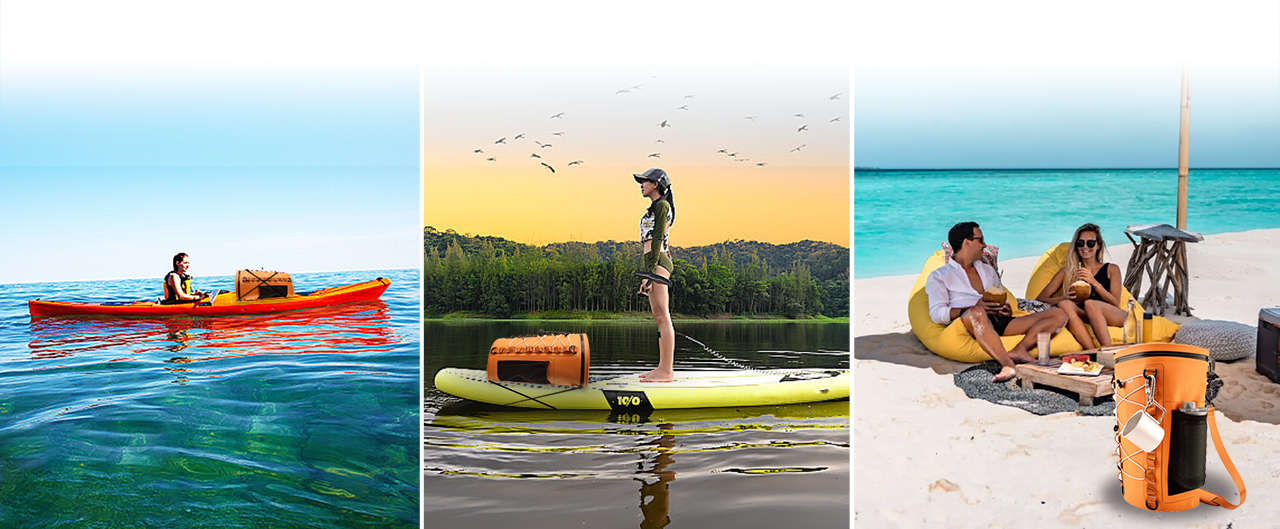
A single failed seam or rusted buckle can ruin your brand's reputation. If a dry bag leaks, water destroys expensive smartphones, car keys, and emergency gear. Amazon listings quickly accumulate one-star reviews, leading to suppressed products and heavy financial losses.
Manufacturing gear for stand-up paddleboarding requires stricter standards than regular outdoor backpacks. SUP deck bags sit directly in saltwater, absorb intense UV rays, and endure constant ocean spray. Choosing the right paddle board dry bag OEM partner makes the difference between a successful product line and a costly recall.
At Weierken, we work directly with water sports product managers and sourcing directors. We help brands avoid costly manufacturing mistakes before mass production starts. Here are five non-negotiable technical specifications you must verify with your manufacturing partner.
1. Seam Construction & RF Welding Tensile Strength
Traditional needle stitching has no place on a high-performance paddle board bag. Even when covered with seam tape, needle holes leak under pressure. Professional water sports gear requires high-frequency welding technology.
Make sure your supplier uses Radio Frequency (RF) welding or ultrasonic welding. RF welding uses high-frequency electromagnetic energy to melt thermoplastic materials at the molecular level. This fuses two sheets of fabric into a single, permanent bond.
Pay close attention to these structural metrics when reviewing prototypes:
Welding Width: Require a seam welding width between 8mm and 12mm across all major structural joints. Narrow welds tear easily under stress.
Seam Tensile Strength: The welded seam must withstand a minimum pulling force of 150N to 200N without separating or stretching.
Thermal Consistency: Inconsistent heat during production creates weak spots along the seam edges.
Always ask your factory for a certified Tensile Test Report. At Weierken, our automated RF welding machinery delivers a 99.5% First-Time Quality (FQA) rate. We test seam strength across every single production run.
2. Fabric Composition, Denier & Anti-UV/Saltwater Rating
The substrate fabric determines how well the bag holds up against rough rocks, sand, and sharp board fins. Standard materials fail quickly when exposed to tropical sun and harsh ocean salt.
Evaluate your material options based on your brand positioning:
500D PVC Tarpaulin: Excellent durability and cost efficiency for entry-level outdoor brands.
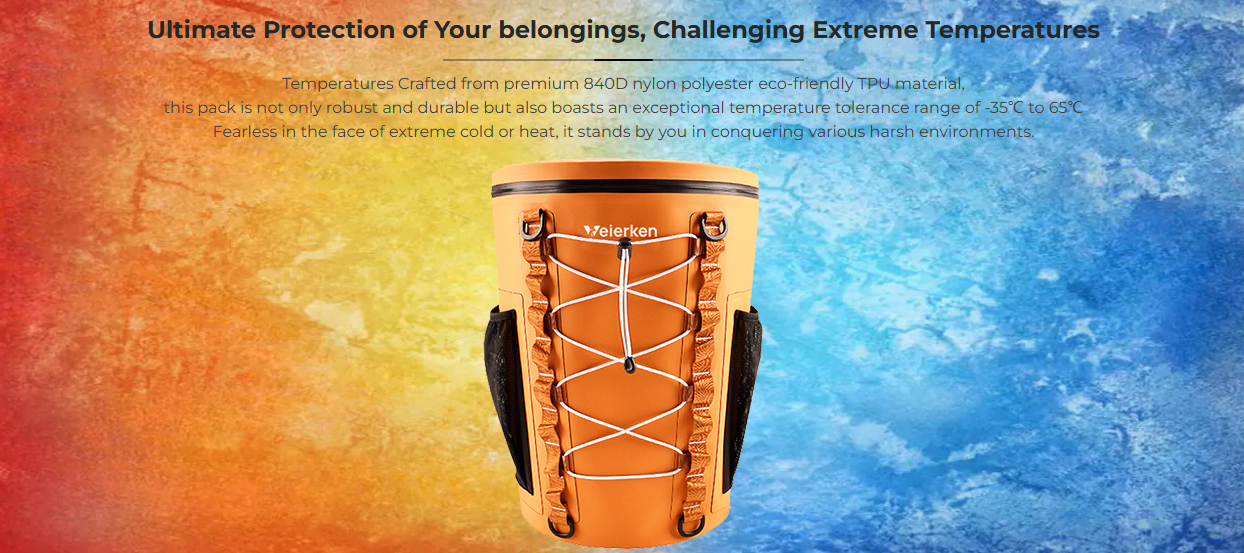
840D TPU-Coated Nylon/Polyester: Superior tear resistance, lightweight flexibility, and eco-friendly performance for premium brands. TPU stays flexible even in freezing water.
Coating Adhesion (Peel Strength): Inferior coatings peel off the base fabric after prolonged water contact. Demand a peel strength exceeding 70N/5cm.
UV radiation breaks down cheap polymers, causing fabric yellowing, stiffness, and cracking. Verify that the fabric passes ISO 105-B02 Grade 4+ UV exposure testing. Furthermore, demand a 72-hour Salt Spray Test report to ensure the material will not degrade in marine environments.
If you sell in Europe or North America, verify that your OEM partner uses materials fully compliant with REACH, GRS (Global Recycled Standard), and rPET guidelines.
3. Ingress Protection & Hydrostatic Head Pressure
Not all waterproof ratings are created equal. A simple splash-proof bag cannot handle the conditions of a paddle board deck. When waves crash over the bow, your bag sits underwater.
Review these critical performance metrics when checking TPU paddle board deck bag specs:
IPX Rating: Splash-proof bags only reach IPX5. A genuine SUP deck bag requires IPX7 (protection against temporary immersion up to 1 meter for 30 minutes) or IPX8 (continuous underwater submersion).
Hydrostatic Head Pressure: The fabric and sealed seams must withstand a minimum water pressure of 10,000mm H2O.
Airtightness & Purge Valves: Bags with air release valves or an airtight zipper OEM supplier component must hold 3 to 5 PSI of internal pressure without leaking.
Ask your OEM partner about their Quality Control (QC) inspection process. Do they test a few random samples, or do they test every bag? Weierken subjects 100% of airtight and watertight bags to a full submersion bubble test before final packaging.
4. Marine-Grade Hardware & Attachment Specs
A waterproof bag is useless if it snaps off the paddle board and floats away. The mounting hardware takes tremendous strain when paddling through ocean swells.
Standard metal clips rust within days of saltwater contact. Require marine-grade hardware for dry bags across all attachment points:
D-Rings and Hooks: Specify 316 Marine-Grade Stainless Steel or high-impact POM (Polyoxymethylene) engineering plastics. Never accept 304 stainless steel or cheap zinc alloys.
Webbing Quality: Choose high-density, low-water-absorption nylon webbing over cheap polypropylene. Nylon maintains its structural integrity when wet.
Buckle Break Force: Specify top-tier hardware brands like Duraflex or UTX. Anchor point buckles must withstand a minimum breaking force of 50kg (500N).
Ensure the hardware design aligns with standard SUP elastic bungee systems. The hooks must clip securely to D-rings without binding or twisting under tension.
5. Prototyping Precision & Engineering Flexibility
Turning a 2D design sketch or 3D CAD model into a production-ready bag requires deep technical expertise. RF welding tools require precise custom aluminum molds. Mistakes in mold design cause expensive production delays.
A reliable paddle board dry bag OEM must provide strong engineering support during development:
Prototyping Lead Time: An efficient factory delivers fully functional samples within 12 to 30 days.
Design-for-Manufacturability (DFM): Experienced engineers will review your drawings to point out potential design flaws. For example, overly sharp corner radii cause fabric wrinkling during RF welding, creating hidden leak paths.
Custom Mold Development: The factory must design and adjust high-frequency welding molds in-house to maintain exact dimensional tolerances.
Partnering with an IPX8 waterproof dry bag manufacturer like Weierken gives you access to over 20 years of technical bag-building experience. We do not just take orders; we act as a direct extension of your product development team.

Technical Spec & QC Verification Summary
Use this quick reference table to evaluate potential OEM suppliers during your next sourcing audit:
| Technical Parameter | Standard Requirement | High-Performance Marine Spec |
|---|---|---|
| Seam Process | Stitched with Taping | 8mm - 12mm High-Frequency RF Welding |
| Base Fabric | 500D PVC Tarpaulin | 840D TPU-Coated Nylon (REACH/GRS compliant) |
| Waterproof Rating | IPX5 or IPX6 | IPX7 / IPX8 (Submersion tested) |
| Hardware Material | Zinc Alloy / 304 Stainless Steel | 316 Marine Stainless Steel / POM Plastic |
| UV & Corrosion Resistance | Standard Outdoor Grade | ISO 105-B02 Grade 4+ / 72h Salt Spray Passed |
Need help reviewing your product specifications? Download our comprehensive guide: Paddle Board Dry Bag OEM Spec & QC Verification Checklist (PDF), or reach out directly to the Weierken engineering team for a free blueprint audit.
Frequently Asked Questions (FAQ)
1. What is the main difference between PVC and TPU for custom paddle board dry bags?
PVC is cost-effective, heavy, and very durable, making it great for budget-friendly gear. TPU is lighter, highly flexible in cold water, abrasion-resistant, and eco-friendly. TPU also bonds exceptionally well during RF welding, creating stronger airtight seals for premium products.
2. Why is RF welding mandatory for SUP deck bags instead of traditional sewing?
Sewing punches thousands of needle holes through the fabric. Seam tape can cover these holes, but saltwater, heat, and internal pressure degrade the tape over time. RF welding melts the layers together into a single continuous piece, guaranteeing true watertight and airtight protection.
3. How do you test if an airtight zipper meets genuine IPX8 standards?
We seal the bag with the airtight zipper closed, inflate it to 3–5 PSI, and submerge it underwater for 30 minutes. If no air bubbles escape, the zipper passes the test. We also run repeated flex and pull tests on the zipper track to verify long-term durability.
4. What is the typical Minimum Order Quantity (MOQ) for custom OEM dry bag projects?
Standard MOQs usually range from 500 to 1,000 units per style or color. The exact number depends on custom fabric dyeing requirements, custom hardware molds, and specific logo printing techniques.
5. Can Weierken customize hardware colors, attachment layouts, and logo placement?
Yes. We offer complete OEM and ODM customization. We can match custom Pantone colors for fabrics and webbing, laser-engrave logos on 316 stainless steel hardware, screen-print logos, and mold custom TPU patches tailored to your brand.
Build Your Next Best-Selling SUP Gear with Weierken
Launching a successful line of paddle board dry bags requires careful engineering, precise manufacturing, and rigorous quality control. Don't let manufacturing defects compromise your brand's reputation in the water sports industry.
At Weierken, we bring decades of OEM expertise, advanced RF welding capabilities, and strict marine-grade testing protocols to every project we touch. Whether you need a technical review of your existing CAD drawings or a complete manufacturing partner from prototype to mass production, our team is ready to help.
Ready to elevate your product line? Contact the Weierken engineering team today to request a quote, order a sample, or discuss your technical specifications.